Antimicrobial Silicone Keypads for Patient Monitors: The Hidden Impact of Silver-Ion Additives on Hardness and Rebound
- Share
- publisher
- FromRubber
- Issue Time
- Oct 5,2026
Summary
Antimicrobial additives go into the same matrix that has to act as the key's spring. Hardness may stay inside tolerance while elastic recovery moves enough for users to notice. This article explains why, and sets out a comparison method that measures hardness, rebound and actuation force against a control part before tooling.
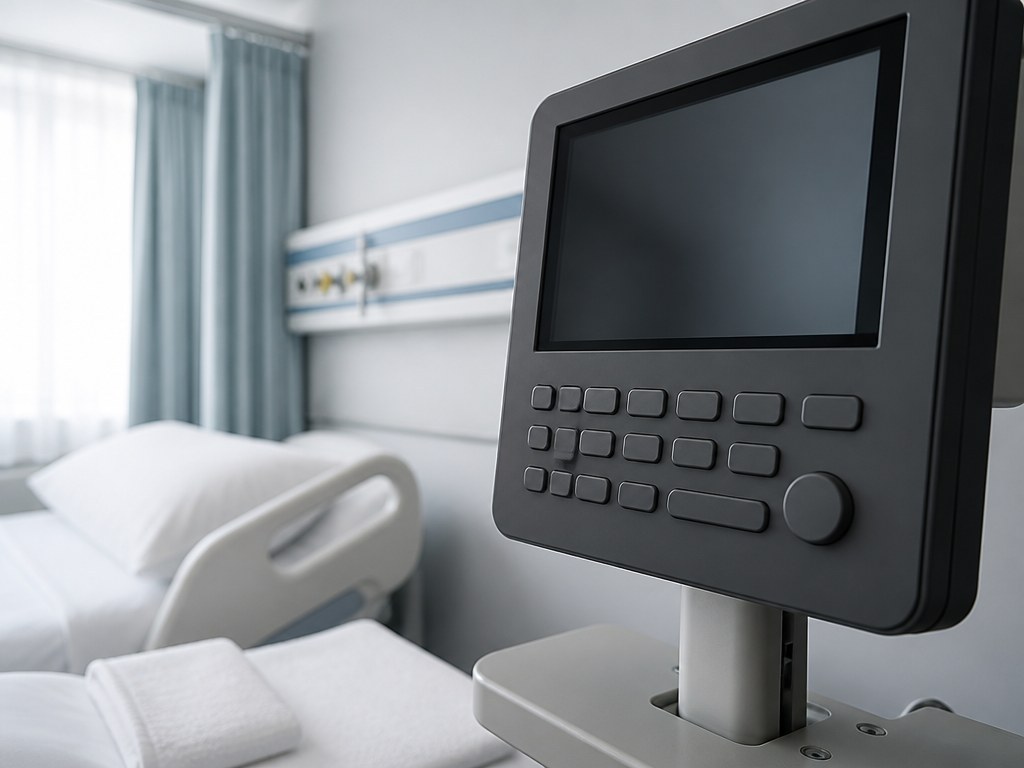
The conversation usually starts the same way. A monitoring-device team needs an antimicrobial surface on the front keypad, the additive is approved, the sample arrives, and nobody notices anything wrong until a nurse says the alarm-silence key “feels dead” compared with the previous unit. The compound still reads the same hardness number on the certificate. The colour still matches. What changed is the elastic recovery — and that is the property the specification sheet never lists.
Why an antimicrobial additive is a mechanical decision, not a coating decision
Antimicrobial silicone keypads for patient monitors are usually made by compounding the active agent into the silicone itself rather than applying it on top, because a surface coating on a repeatedly flexed key will not survive the duty cycle. That puts the additive inside the same matrix that has to act as the key’s spring. Once you accept that, it follows that anything you add to the compound is a potential change to actuation force, return speed and long-term compression behaviour.
This article is about the keypad, not about the antimicrobial performance of the finished monitor. Whether a given active agent achieves the required log reduction on a non-porous surface is a separate question, and it is answered by microbiological testing such as the method described in ISO 22196:2011, which measures antibacterial activity on plastics and other non-porous surfaces. The problem worth talking about here is the one that gets discovered after that test has already passed.
What actually changes when the additive is compounded in
Hardness can move — and the direction is not predictable
Shore hardness is a response to a stiff indenter over a short time. Adding a particulate or ion-exchange carrier to a silicone compound changes the filler network, and that changes the indentation response. Depending on the carrier, the loading level and the cure system, the measured hardness can drift up, drift down, or appear unchanged in the bulk while the surface reads differently.
The reason this is dangerous is measurement practice. If the control compound and the antimicrobial compound are not measured on the same surface, at the same temperature, with the same stabilisation time, and on the same part geometry, the difference you measure may be entirely methodological. Comparing a flat cured sheet against a moulded key crown tells you almost nothing.
Rebound can change even when hardness looks fine
Hardness describes resistance to deformation. Rebound describes how quickly the material gives that deformation back. They are related but not interchangeable, and an additive can shift one without shifting the other. Two compounds that both read 50 Shore A can return to shape at visibly different rates — one snaps back, the other creeps back over a fraction of a second that a user perceives as “sticky”.
That difference matters most on keys that get pressed in bursts. A silence key pressed five times in two seconds does not give the material time to recover fully between presses, so the effective travel of each press is smaller than the first. If the antimicrobial compound recovers more slowly, the fifth press feels noticeably different from the first. This is a real, reportable usability problem, and it will not appear in a hardness report.
How this reaches the operator
Actuation force
Force to actuate is the product of compound stiffness and key geometry. When an additive increases the compound’s resistance, the same membrane and key wall now produce a higher force. Medical device engineers often specify an actuation-force window with a fairly tight tolerance because the same keypad may be operated by a gloved hand at speed. An additive-driven force increase of even a modest fraction can push a design out of that window.
Tactile feedback
Feedback quality is about the shape of the force curve, not its peak. A key that builds force smoothly and then drops sharply gives a clear “click” sensation. A compound that recovers slowly tends to flatten that drop, and the operator loses the confirmation signal. On a monitor, that is the difference between pressing “record” once and pressing it twice to be sure.
Return speed
Slow recovery is reported in user language as buttons that feel mushy, unresponsive or slightly stuck. There is usually nothing electrically wrong. The contact opens and closes correctly. The perception comes entirely from the material taking longer to return the key to its rest position.
Repeated-key operation
The behaviour that matters over a service life is repeatability: does press number ten thousand feel like press number one? Additives that influence the filler network can also influence how the compound settles under sustained compression, so a key that sits slightly pre-loaded by the housing may develop a small permanent set earlier than the unmodified version. This is where a programme that validated only fresh samples meets a field complaint two years later.
What to control in the formulation
Antimicrobial requirements should never be evaluated in isolation from the mechanical ones. The table below lists the parameters that have to be fixed together when a compound is switched.
| Parameter | Why it has to be locked | How to verify it |
|---|---|---|
| Base silicone and cure system | An additive behaves differently in different polymer and cure chemistries | Keep the control and the modified part on the identical base; change one variable at a time |
| Nominal hardness | Sets the starting point for actuation force | Measure on the same part geometry, same stabilisation, same day |
| Antimicrobial additive and loading | Carrier and concentration both affect the filler network | Record the exact loading; do not assume the same loading transfers between bases |
| Pigment | Colourants also load the compound and can dominate small hardness differences | Compare like-for-like colour if the final part is pigmented |
| Cure and post-cure | Determines crosslink density and therefore elastic recovery | Fix the cure profile before comparing compounds |
| Compression set | Predicts whether the key will return after sustained pre-load | Run the set test on the finished geometry, not a flat button |
| Rebound / recovery | The property users actually feel, and the one most often unmeasured | Measure return time or recovery rate under the same pre-load as the assembly |
| Surface treatment and legends | Antimicrobial additives can affect ink and coating adhesion | Test prints and coatings on the modified compound, not on the control |
Evaluating an antimicrobial keypad before tooling
Build against a control sample, always
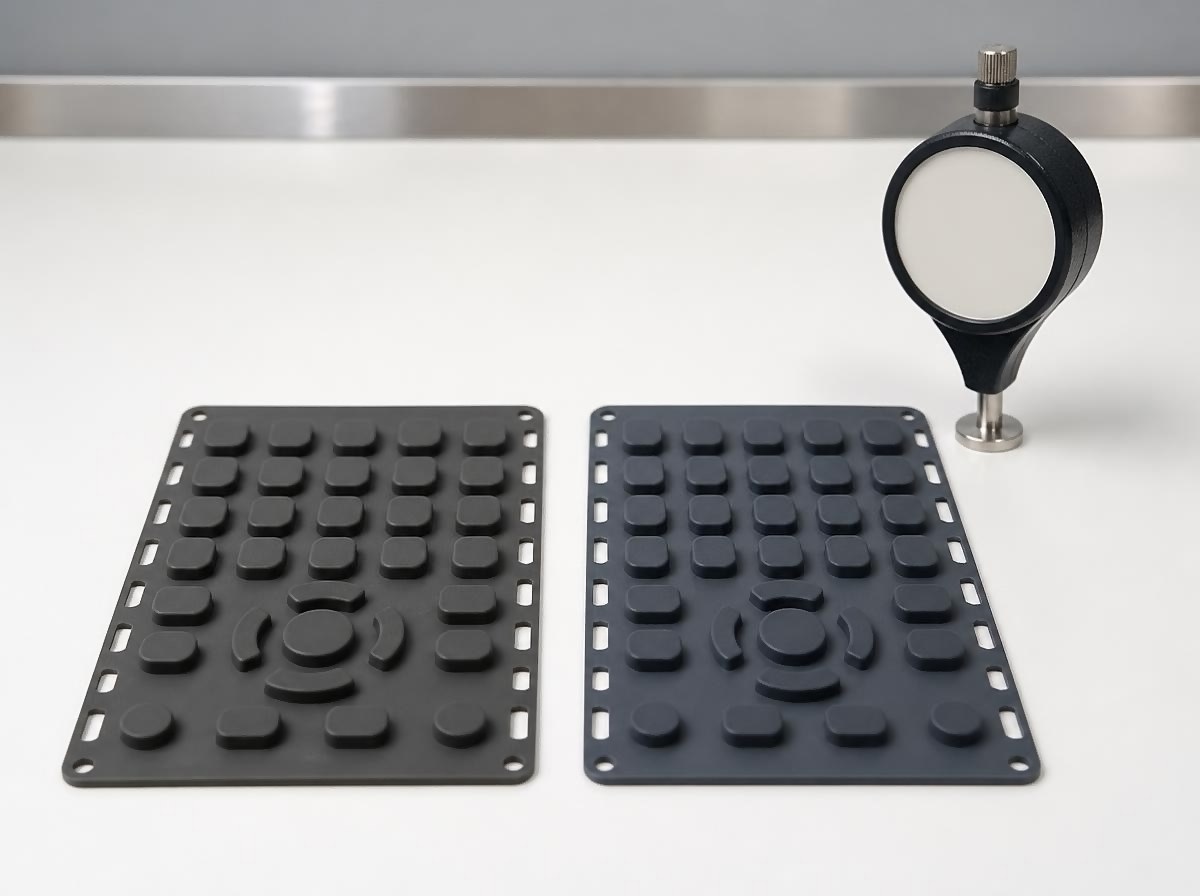
The single most useful habit is to keep the unmodified compound in the programme. Produce the same part geometry in the standard formulation and in the antimicrobial formulation, and run every measurement on both. Without a control, an additive effect and a normal batch variation look identical.
Compare hardness under identical conditions
Same geometry, same conditioning time, same instrument, same operator. Record the reading location — a key crown is not the same as a flange. Where possible, measure a flat pad moulded into the same part so the comparison is repeatable.
Compare rebound separately from hardness
This is the step most programmes skip. Rebound needs its own measurement: apply the same load the assembly will apply, hold it for a defined time, release, and record the recovery behaviour. Doing this at the real assembly pre-load is more informative than a free-standing test, because that is the condition the key actually lives in.
Compare actuation force on the real geometry
Raw-material data does not predict the force of a moulded keypad. Measure the finished part, on at least three keys across the panel, and look at the whole curve rather than a single force value.
Re-check appearance, prints and coatings
Look at colour consistency across the panel, gloss, surface uniformity, and the printed legends. Some carriers can migrate or bloom, and inks that were qualified on the standard compound may bond differently on the modified one. Where the part also has to pass a skin-contact assessment, the biological evaluation route in ISO 10993-10:2021 for sensitisation is the reference most device teams work to — a reminder that the antimicrobial claim and the biocompatibility question are answered by different tests and both have to be planned.
Six mistakes that cost the most time
- Choosing the additive loading from the antimicrobial requirement alone, then discovering the force window has moved.
- Treating hardness as a proxy for how the key feels. It is a proxy for stiffness only.
- Testing raw cured sheets and assuming the moulded keypad behaves the same way.
- Changing the compound without re-measuring actuation force on the finished part.
- Ignoring the cure and post-cure profile, which affects recovery independently of the additive.
- Qualifying only fresh samples, with no ageing or repeated-use condition, and no measurement of return behaviour after cycling.
A development sequence that keeps the two requirements together
- Define the antimicrobial requirement in testable terms, including the method and the acceptance level, separately from the mechanical requirement.
- Define the hardness range and, separately, an actuation-force window measured at the intended assembly pre-load.
- Define a return-speed or recovery acceptance value. If it is not written down, it will not be measured.
- Select candidate base compounds and additive loadings, keeping the base and cure profile fixed.
- Mould the production-intent geometry, not a flat test pad.
- Measure hardness, rebound and actuation force on both the control and the modified parts.
- Run repeated-use and pre-load ageing, then re-measure return behaviour.
- Confirm surface appearance, printed legends and any coating adhesion on the modified compound.
- Freeze the specification with all four numbers — hardness, force window, recovery and antimicrobial acceptance — recorded together.
How this is handled in practice
The programmes that go smoothly are the ones where the antimicrobial decision and the tactile decision are made in the same review. On medical and instrument keypads at FromRubber we keep the unmodified compound running as a control part through the whole qualification, and measure return behaviour at the assembly pre-load rather than free-standing — which is how compound changes that look harmless on paper get caught before tooling.
FromRubber moulds custom silicone rubber parts: keypads, gaskets, seals and technical mouldings. We do not manufacture the patient monitors, control systems or enclosures that our parts go into. What we can do is produce both the control and the modified version of the same geometry, measure them the same way, and hand over the comparison rather than a single set of numbers.
What to take away
Adding an antimicrobial agent to a silicone keypad changes a spring, not just a surface. Hardness may stay inside its tolerance while the return behaviour moves enough for users to notice, and the only way to see that is to measure recovery explicitly, on the real geometry, against a control part. Write the recovery acceptance value into the specification at the same time as the hardness range and the antimicrobial acceptance level — otherwise the third requirement quietly disappears from the programme until a nurse reports it.
References
- ISO 22196:2011, Measurement of antibacterial activity on plastics and other non-porous surfaces — https://www.evs.ee/et/iso-22196-2011
- ISO 10993-10:2021, Biological evaluation of medical devices — Part 10: Tests for skin sensitization — https://www.evs.ee/et/iso-10993-10-2021
- Comparing the Antimicrobial Effect of Silver Ion-Coated Silicone, PubMed record — https://pubmed.ncbi.nlm.nih.gov/34041554/
- Silver micro- and nanoparticles filled silicone for limb prosthetics, Biomaterials Translational — https://biomat-trans.com/journal/BMT/6/2/10.12336/bmt.24.00073
Related reading on this site: tactile feedback in compact silicone button designs, sealing challenges for dust and moisture protection, and the custom silicone rubber keypad range. If you are comparing an antimicrobial compound against your existing one, send both specifications to nani@fromrubber.com or karl@fromrubber.com, or reach us on WeChat / WhatsApp at +86 18676210913. FromRubber — custom silicone rubber parts, Dongguan, China.