Baking Without Scratches: How Silicone Food Tongs Handle Delicate Cakes, Breads, and Pastries
- Share
- publisher
- Suey
- Issue Time
- Apr 14,2026
Summary
Silicone tongs for baking are a force-control tool, not a colourful accessory. This note works through jaw geometry, tip durometer, spring rate and heat soak, explains why tips tear before hinges fail, and sets out the four values to put on a drawing before a bakery orders a thousand pairs.

Tooling note
A cake is damaged by pressure, not by material. Metal tongs scratch because they concentrate load on a hard edge; a soft tong fails the same cake if the jaws are too narrow or the spring too strong. Silicone tongs for baking work when the contact area is wide, the tip is soft enough to conform and the closing force is light enough that the baker controls it with two fingers.
- Contact pressure is force divided by area: widening the jaw does more for a delicate crumb than softening the compound.
- Tip durometer around 40 to 50 Shore A conforms to a crust without marking it; softer tips tear at the mould line.
- Heat is a spec, not a slogan: 200 °C continuous with a defined dwell covers most bakery ovens.
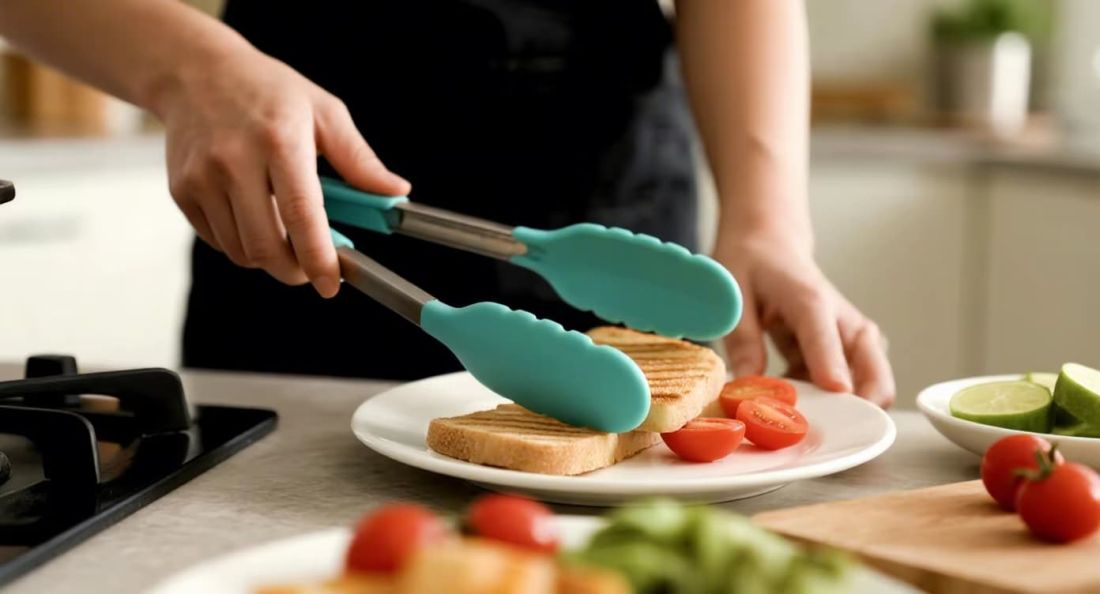
Jaw geometry: why silicone tongs for baking mark a crust
A sponge cake fails in compression: above roughly 10 kilopascals of local pressure the cell walls collapse and do not recover. That number is reached easily by a narrow jaw with a strong spring, even in soft silicone. Widening the jaw from 12 to 20 millimetres cuts the pressure by nearly half at the same grip force, which is why the shape matters more than the material.
The second geometric decision is the tip profile. A flat pad distributes load but slides on a curved crust; a shallow concave pad locates the loaf and keeps the load spread. Serrations help with bread and destroy a mousse cake, so a bakery that handles both needs two tools rather than one compromise.
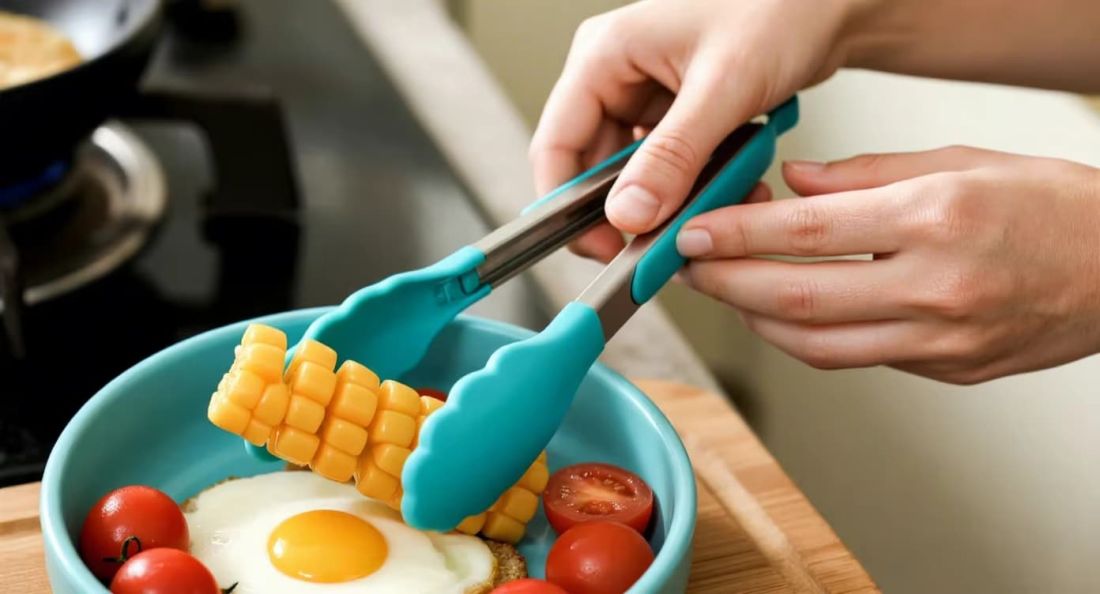
Durometer, spring rate and the feel a baker can control
Tip hardness sets how much the pad conforms. At 40 to 50 Shore A a silicone tip deforms around a crust edge and spreads the load over a few millimetres; below 30 Shore A it conforms further but tears at the mould parting line after a few thousand cycles. Above 60 Shore A the tip starts to behave like a plastic jaw and leaves a mark on soft icing.
Spring rate is the other half of control. A torsion spring that closes the tongs on its own forces the baker to resist it, and resistance is what produces the spike in grip force at the moment of lift. A light spring, or a living hinge moulded in the same silicone, keeps the closing force within a range a hand can modulate. Specify the closing force in newtons, not as “light action”.
- Tip durometer — 40 to 50 Shore A for baked goods; harder only for hot pans.
- Closing force — a stated range, measured at the tip, not at the handle.
- Hinge — moulded living hinge for hygiene, metal spring for repeatable force.
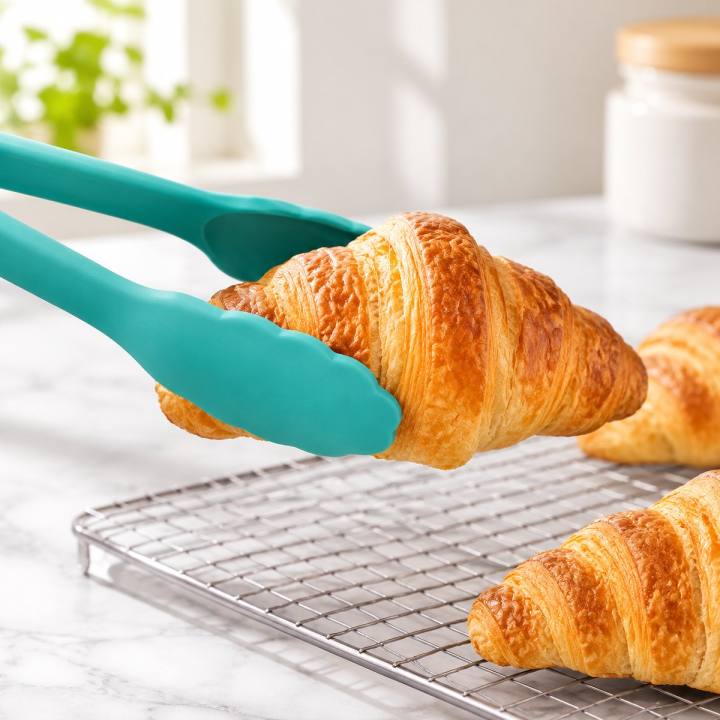
What actually fails on a bakery tong
| Failure | Where it starts | Prevention |
|---|---|---|
| Tip tear | Mould parting line at the jaw edge | Radius the edge; specify flash limit and deflash method |
| Permanent set | Hinge held closed in a drawer | Living hinge with a defined compression set limit |
| Surface stain | Turmeric, cocoa, food dye | Light colours need a stain-resistant compound |
| Hinge fatigue | Metal spring in a wet, sugary environment | Stainless spring, or a moulded hinge with no metal |
| Handle slip | Glossy finish with wet hands | Matte texture on the grip zone, 3 to 8 GU |
Heat soak, cleaning and the numbers to write on a drawing
A tong left on a tray beside an oven door sees radiant heat long before it touches food. The specification should state continuous service temperature, a short-term peak and the dwell at that peak; 200 °C continuous with 230 °C for 30 minutes covers most bakery duty. A compound that meets the number but yellows at 180 °C will still pass, so add a colour-stability check on a heat-aged sample.
Cleaning is the other daily reality. Bakery tongs go through a commercial dishwasher several times a day, and the detergent is alkaline. Specify dishwasher cycles with a pass criterion, keep the design free of closed crevices, and avoid a two-part assembly that traps water at the joint. A one-piece moulded tong with a living hinge is the simplest answer to both problems.
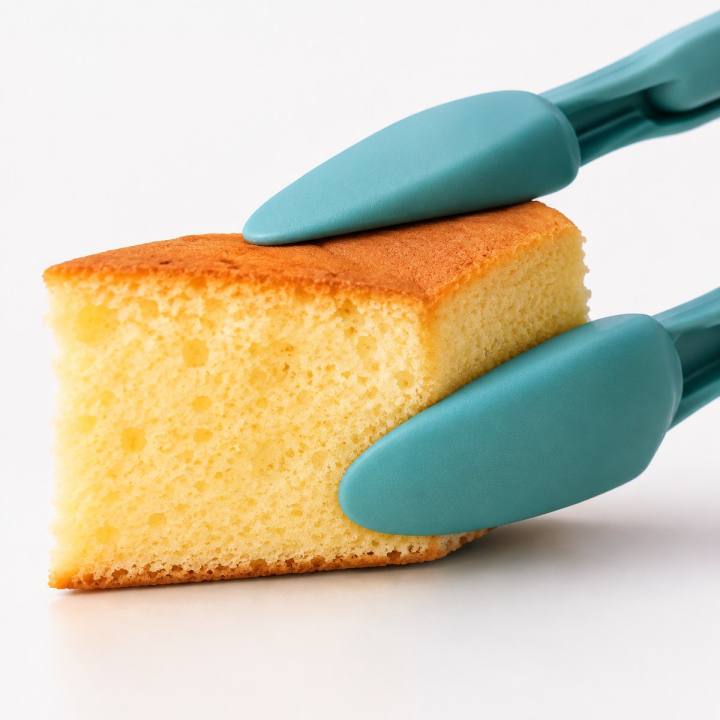
How a custom bakery tool programme is quoted and run
Tongs are a small part with a short tool lead time, which makes customisation realistic even at modest volumes.
Inputs
Goods to be handled, weight range, oven temperature, cleaning method and the brand colour.
Geometry
Jaw width and profile, closing force target, handle length and the hinge type, agreed on a drawing.
Sampling
A prototype pair for a bakery trial, then a production sample with hardness and colour measured.
Volume and packing
Cavity count, colour options, logo method and retail or food-service packaging.
Questions from bakeries and kitchen brands
Are silicone tongs safe at oven temperature?
Food-grade silicone handles 200 °C continuously and short peaks higher, but the tips should not rest against a heating element. State the peak and the dwell in the specification so the compound can be chosen for it.
Why do tips tear at the edge?
Usually a sharp mould edge combined with a soft compound. A radius at the jaw edge spreads the stress, and a slightly harder tip resists tearing without marking the crumb.
Can the tongs be personalised for a bakery chain?
Yes. A moulded logo on the handle costs tooling once; a printed logo costs every unit and wears in a dishwasher. For a chain that washes daily, the moulded route lasts longer.
Do we need a metal spring?
Only if the closing force must be identical across thousands of cycles. A moulded living hinge is more hygienic and cheaper to assemble; a stainless spring gives more repeatable force but adds a crevice to clean.
Send the goods you handle and the oven temperature
FromRubber moulds food-contact silicone tongs, spatulas and bakery tools in Dongguan, with jaw geometry and hardness tuned to the product being lifted. Send the goods, the weight range, the cleaning routine and the colour; we will propose a jaw profile and a compound, then mould a sample pair for a trial in your kitchen.
Request a bakery tool reviewRelated reading: serving delicate greens with silicone tongs and food-contact silicone lids.