Balancing Button Force and Tactile Feedback in a Geiger Counter Keypad
- Share
- Issue Time
- Nov 25,2026
Summary
On a Geiger counter keypad, the user is watching the reading, not the buttons. Force curve shape and consistency matter more than absolute press force.
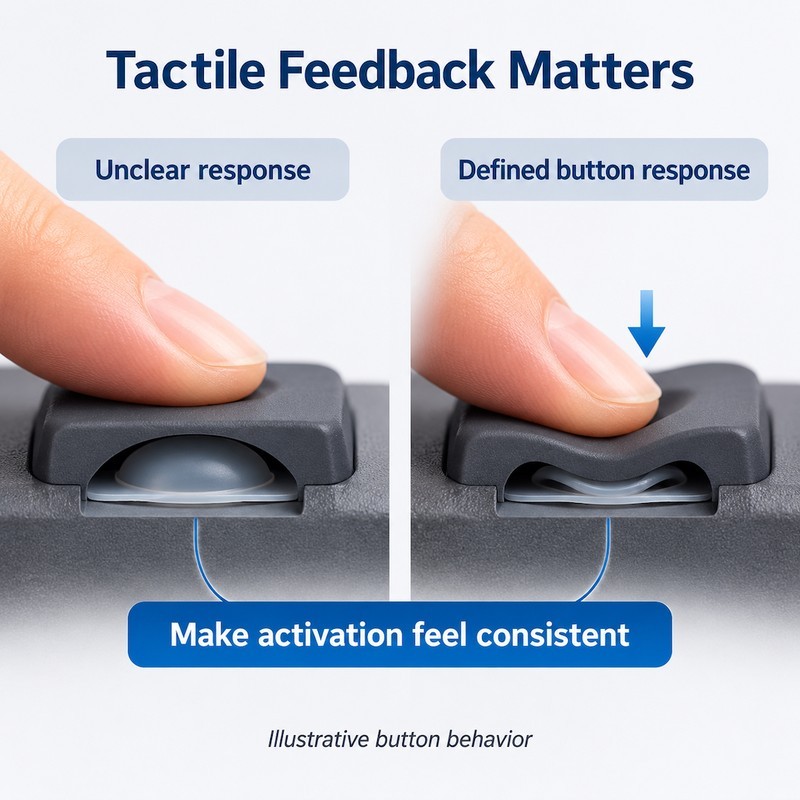
A radiation survey instrument is used while the operator is looking at the reading, listening to the rate of clicks, or watching where the probe is pointing. The keypad is pressed without being looked at. In that situation a button that is slightly too heavy is a minor annoyance, but a button that feels different from its neighbour is a problem, because the operator cannot tell whether the press registered.
Why force and feedback matter more than the exact force value
Buyers often ask for a specific actuation force, as though the number alone decided the feel. It does not. What the finger perceives is the shape of the force curve: how quickly resistance rises, where it drops, and how far the button travels after the drop.
Two buttons with the same peak force can feel completely different if one has a sharp snap and the other a rounded transition. The number is useful for specification and test; the curve is what the user experiences.
Excessive force is tiring in a way users cannot articulate
A survey instrument may be held in one hand for a long walk-through, with the thumb resting on the keypad. Heavy buttons make that posture uncomfortable, and operators respond by pressing with the side of the thumb, which increases off-axis loading on the dome and shortens the life of the part.
The complaint that reaches the manufacturer is usually "the buttons are stiff", which is accurate but not diagnostic. The cause may be the dome, the membrane, the panel behind it, or the contact.
Weak feedback makes a registered press feel uncertain
A button can be light and still give a clear click, provided the dome snaps decisively. It can also be heavy and feel mushy if the snap is rounded and the travel is short.
That is why softening the compound rarely fixes an unclear button. It changes the effort, not the signal.
Inconsistency is noticed before absolute force
Users adapt to a keypad that is uniformly firm or uniformly light within a few presses. They do not adapt to a keypad where one button is lighter than the rest, because every press becomes a small decision. On an instrument used in the field, that uncertainty gets blamed on the electronics.
Consistency across the pad is therefore the first specification and the force value is the second. A pad with a narrow spread between buttons is easier to approve than one with a better average and a wider spread.
What determines the pressing force of a silicone button
Four variables interact: compound hardness, membrane thickness, dome geometry and the support under the button. Changing one changes the others' effect, which is why experimenting with hardness alone is usually inconclusive.
Hardness sets the starting resistance
Harder compounds resist deformation more, so the initial rise in force is steeper. Past the snap, however, the difference between compounds narrows and the geometry dominates the return.
Our guide to choosing silicone rubber hardness covers the practical range for keypads and where each band tends to be used. The short version is that hardness is chosen for the structure, not for the number.
Membrane thickness changes flexibility and return
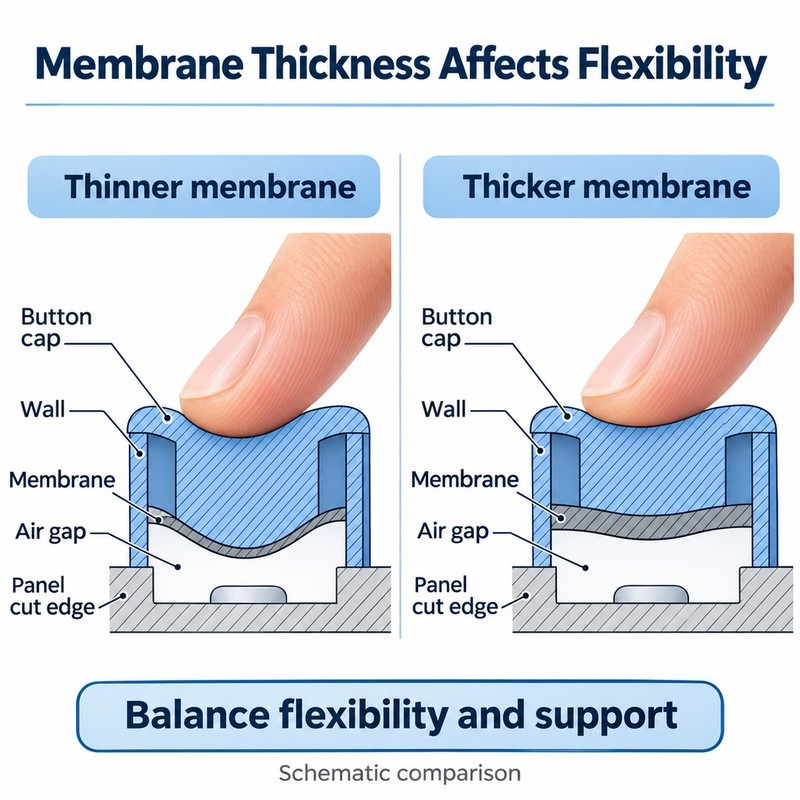
A thinner membrane deflects more easily, so the initial press is lighter. It also stores less energy for the return, so the button recovers more slowly and the next press can start before the dome is fully back.
In a pad that is pressed in quick succession, that shows up as missed presses rather than as a soft feel.
Height and geometry shape the snap
Dome height and wall angle determine whether the button collapses suddenly or progressively. A taller dome with a steeper wall gives a sharper snap and a longer travel; a flatter dome gives a shorter, firmer press that is easier to make consistent across a pad.
Button diameter changes the lever arm. A wide cap on a small dome loads the dome closer to its edge, which softens the snap and makes the button more sensitive to where it is pressed.
How to improve tactile feedback without simply making buttons heavier
Tune the dome before touching the compound
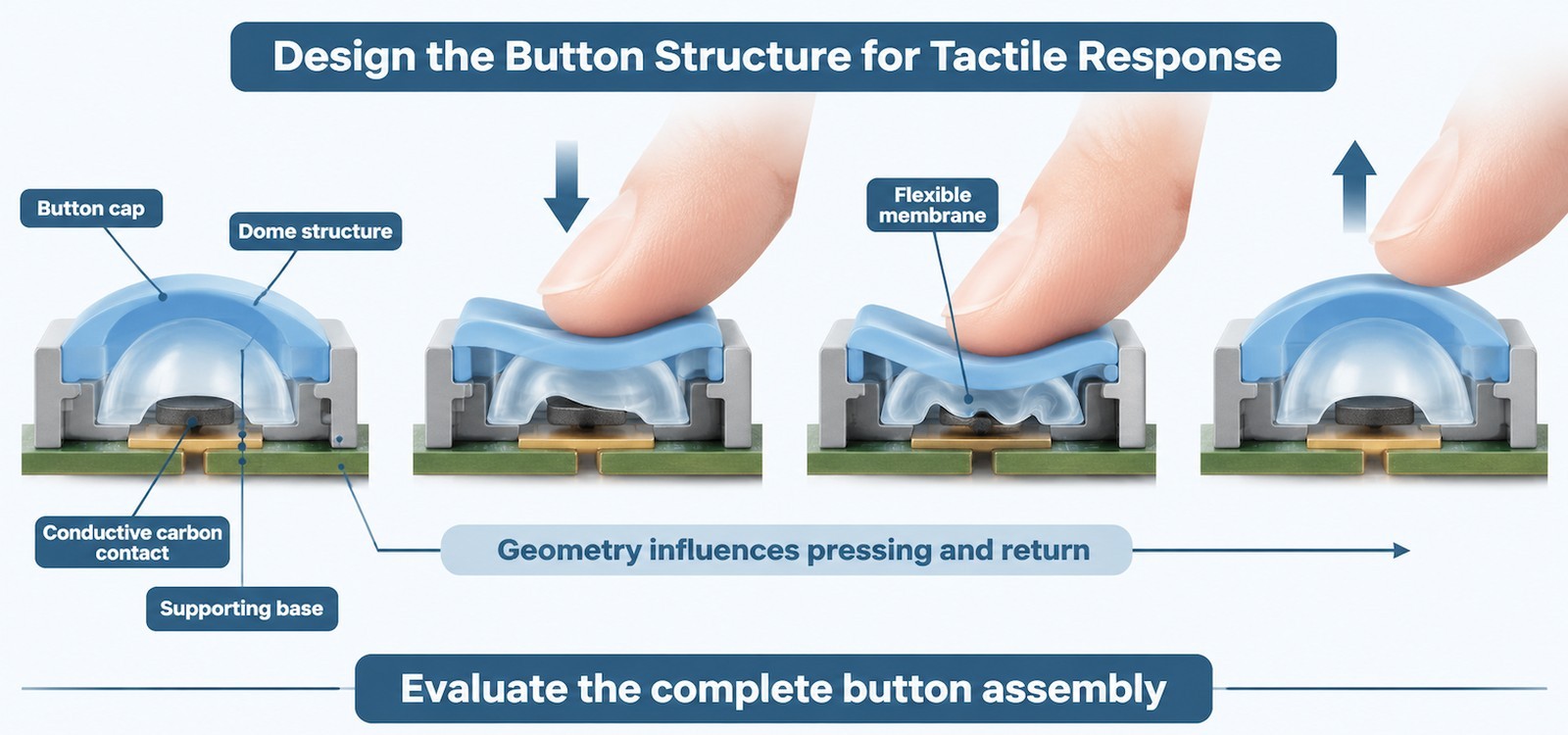
If the snap is unclear, the first question is whether the dome is collapsing at all or just bending. A dome that bends without snapping gives a soft, continuous resistance with no signal at the transition.
Raising the dome or steepening its wall usually restores the snap without changing the compound. It also keeps the return force, which is what makes repeated pressing feel consistent.
Balance travel against resistance
Travel is how far the button moves before it stops. Too little and the press feels abrupt; too much and the button feels loose and the user is never sure where the actuation point is.
On a handheld instrument, the useful target is a travel that can be felt through a glove and a snap that occurs before the bottom-out. Pressing to the bottom should not be necessary to register a press.
Coordinate contacts with the PCB
The click and the electrical closure should coincide. If the contact closes after the snap, the user presses past the click to make the circuit, and the extra travel feels like a fault. If it closes well before the snap, a light touch registers and the click becomes decorative.
The clearance between the carbon pill and the PCB pad is the variable that sets this. It is a simple dimension and it is the one most often left to the assembler.
Choosing hardness for different buttons on the same pad
Softer compounds where the structure is already stiff
A small button with a compact dome and a short wall is structurally stiff. A softer compound can make it feel proportionate without losing the snap. The same compound on a large, flat button would make it vague.
That is the argument for multi-durometer pads, where a soft compound is moulded into one area and a firmer one elsewhere. It is a real option, and it costs a second shot rather than a second tool.
Firmer compounds where consistency matters more than comfort
A firmer compound produces a narrower spread of feel across a pad, because the same geometry variation matters less when the material resists more. For a keypad that must feel identical button to button, that is a useful property.
The trade-off is effort. On an instrument that is used intermittently rather than continuously, the extra effort is rarely noticed.
Test hardness with the actual geometry
Material samples tell you almost nothing about the finished keypad. A 50 Shore A disc pressed between two fingers has none of the structure that produces the snap.
The only meaningful test is a moulded pad in the intended geometry, fitted to the housing, pressed by hand and then measured. If that sounds slow, it is still faster than a tooling change.
Common design mistakes behind an uneven keypad
| User report | Structural cause | Material cause | First adjustment |
|---|---|---|---|
| "The buttons are too stiff" | Dome too flat, travel too short | Hardness too high for the wall thickness | Raise dome height before changing compound |
| "I cannot tell if it registered" | Snap too rounded, contact closes after the snap | Membrane too thick for the dome | Steepen the dome wall and re-check contact clearance |
| "One button feels different" | Local wall variation, uneven support beneath the button | Uneven cure or material distribution | Section a sample and measure wall thickness at each button |
| "It misses when pressed quickly" | Return too slow, travel too long | Membrane too thin, compression set | Increase membrane thickness or stiffen the return web |
| "It fires when I grip the instrument" | Panel deflection or cap proud of the housing | Compound too soft for the support available | Add support behind the pad, reduce cap height |
This table is arranged by what the user reports. The first column is the complaint, not the cause, because that is what reaches the manufacturer.
Do not choose hardness without the geometry
The most common mistake is approving a compound from a data sheet and expecting the keypad to feel a certain way. Hardness is one input among four, and it is not the one that produces the click.
The second most common mistake is changing compound to fix a contact problem. If the electrical closure happens at the wrong point in the travel, no compound will fix it.
Treat the whole pad as one system
Buttons of different sizes on the same pad will not have the same force unless the geometry is adjusted per button. A large primary button next to three small ones needs a different dome or wall thickness to feel like part of the same family.
That adjustment is normal design work and it belongs in the drawing, not in the sample review.
How to test force and feedback before production
Measure at a consistent press position
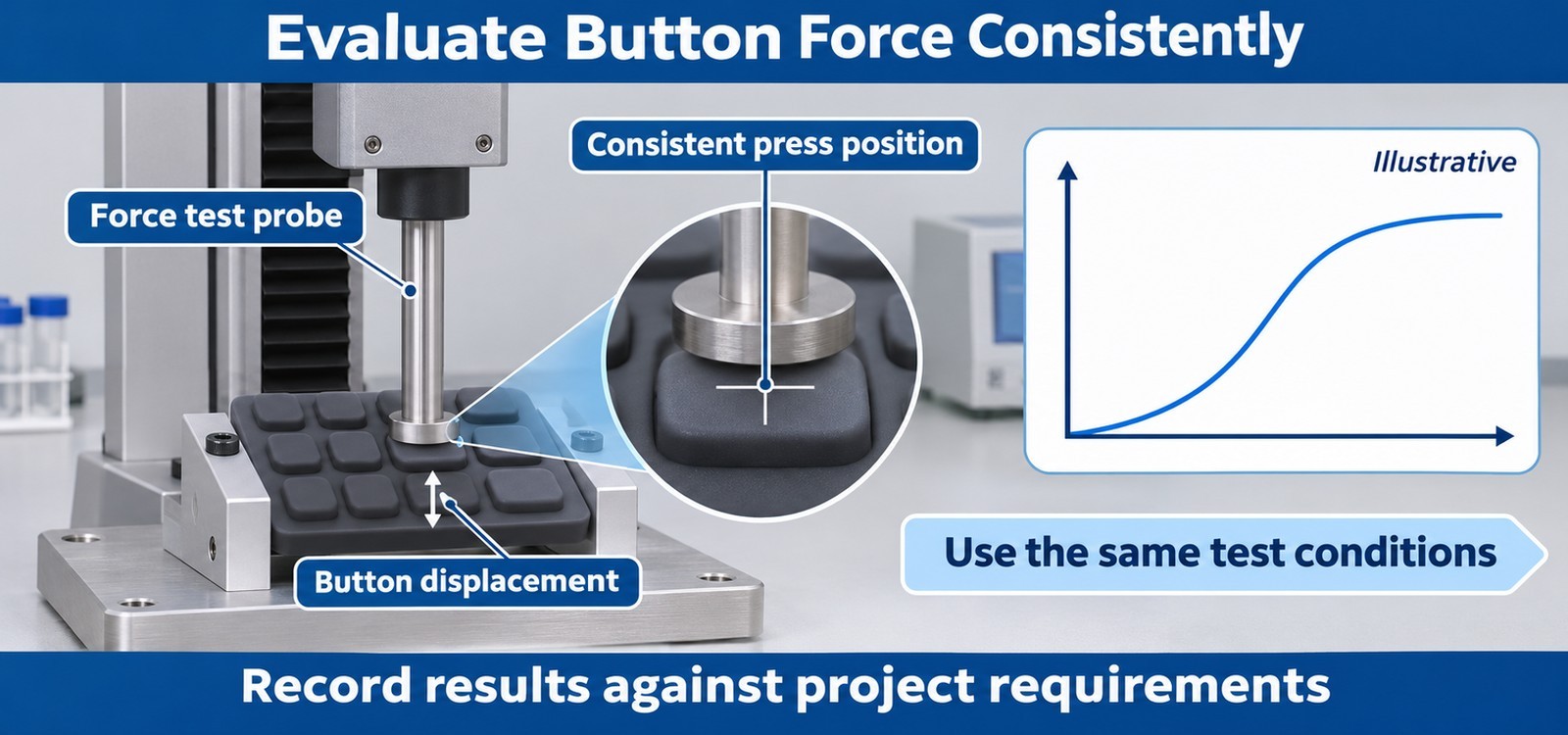
Force varies across the cap surface, especially on wide buttons. Measuring at the centre of one button and near the edge of another produces a difference that looks like a manufacturing fault and is actually a test method fault.
Fix the probe position, the probe diameter and the press speed, then compare buttons. Consistency of method is what makes the numbers comparable between samples and between suppliers.
Our note on actuation force and travel specifications explains why a single force figure is not a complete specification.
Check return and repeated operation
Press each button a few hundred times and watch the return. A button that stays slightly depressed has taken a set, and the next press starts from a different position. On a pad with a shared membrane, one sticking button can change the feel of its neighbours.
We covered a related failure in why a keypad that passes cycle testing can still fail first in system aging. The short answer is that the test rarely reproduces the installed load.
Verify contact actuation and release
Watch the electrical event, not only the mechanical one. A button that closes reliably but releases slowly will double-trigger on a fast operator, and one that closes early will register a press the user did not intend.
Recording closure and release against travel gives a complete picture and is the most useful single document to hand a mould maker when the feel needs to change.
Working with a keypad manufacturer on button feel
Describe the feel in operational terms
Tell the manufacturer how the instrument is used: glove or bare hand, one press at a time or in sequences, whether a double press is harmful, and whether the operator is looking at the keypad. Those answers map onto dome geometry and travel far more directly than adjectives.
If a reference instrument exists, send it. A sample that can be pressed is worth more than a page of description, and it lets the manufacturer measure the curve you are trying to match.
Change hardness and geometry together
A single-variable change is easy to reason about and rarely solves a feel problem, because the variables interact. A dome change without a membrane change often moves the problem rather than fixing it.
Practically, two sample iterations with a combined adjustment converge faster than four iterations changing one thing at a time. That is worth knowing when a project schedule is tight.
Confirm the design through samples
The final approval should record the compound, hardness, dome height, membrane thickness and contact clearance, along with the measured force and travel at a defined position. Those are the values that keep production consistent.
FromRubber moulds custom silicone keypads for instrument makers from two plants in Dongguan, with compound selection, tooling and inspection in house. Our raw material certification page lists the documentation that ships with the compound.
What this means for your project
Specify consistency first and force second. A pad with a narrow spread between buttons will be accepted by users even if the average force is not exactly what the drawing says.
When a button feels wrong, look at the snap before the compound. Geometry produces the click; material only decides how much effort it takes to get there.
Questions buyers ask before a project starts
Is there a standard actuation force for a Geiger counter keypad?
No universal figure exists. The right force depends on the dome geometry, the travel available and how the instrument is held. What can be standardised is the method of measurement and the spread across the pad.
Does a harder compound always give better tactile feedback?
No. It gives a steeper initial rise in force. Whether that reads as clear feedback depends on the snap, which is produced by the dome geometry.
Why does the keypad feel different after a few months in service?
Usually because the membrane has taken a compression set or the compound has hardened. Both change the starting position of the button, and the press then begins from a different point in the travel.
About the manufacturer
FromRubber is the export brand of Dongguan Bohao Electronic Technology Co., Ltd., a silicone and plastic contract manufacturer based in Qiaotou, Dongguan, China. Tool making, compounding, compression moulding, deflashing, post-curing, printing, coating and final inspection all run inside the same two plants, which is why a change to a keypad edge, legend or button height can be checked against the housing without sending the part to a third supplier.
- Established
- June 2010
- Location
- Qiaotou, Dongguan, China
- Plants and floor area
- 2 plants, 12,000+ m2
- Staff
- around 220
- Compression presses
- 32 (30 vacuum-assisted, 2 platen)
- Moulds in stock
- 7,254
- Custom projects completed
- 6,532
- Tooling lead time
- sample 3-5 days, production 10-12 days
Press force and travel are measured on in-house test equipment, including a keypad press-fatigue tester and a surface abrasion tester covered by utility model patents. Incoming compound is checked for hardness, tear strength and yellowing, because a hardness shift moves the force curve before any geometry change shows up.
The quality system is certified to IATF 16949:2016, ISO 9001:2015 and ISO 14001:2015; certificates are available on the certificate download page. Values quoted in this article describe normal project decisions rather than a guaranteed specification. Acceptance limits are fixed on your approved drawing and on the sample approval report for the tool.
Sources and further reading
- Actuation force and travel specifications for a silicone keypad — why one force figure is an incomplete specification
- Actual force and stroke for silicone rubber keypads — how force and stroke are assessed in practice
- How to choose the hardness of silicone rubber raw materials — hardness bands and their structural implications
- Why an instrument keypad fails first during system aging — installed load versus bench cycle testing
- Raw material certification — compound documentation supplied with production
Referenced standards, cited by designation only:
- ISO 2859-1, sampling procedures for inspection by attributes
Button feel is a curve, not a number. Match the snap to how the instrument is held and keep the spread across the pad narrow, and the keypad stops being something the operator has to think about.
FromRubber develops custom silicone keypads for radiation detection and survey instrument builders, covering compound selection, dome geometry, tooling and sample evaluation. Send a drawing, a PCB layout or an existing keypad to start the review.
Project contact: WhatsApp or WeChat +86 18676210913. Drawings and 3D files can also be submitted through the inquiry form on www.fromrubber.com.