Breakthrough Integration: UL94 V-0 Flame-Retardant Silicone Keypad with Backlit
- Share
- publisher
- Suey
- Issue Time
- Jul 15,2025
Summary
Why flame retardancy and backlighting conflict, the constructions that resolve it, the four design consequences of combining both, and the three documents to keep so a substitution cannot quietly break the rating.
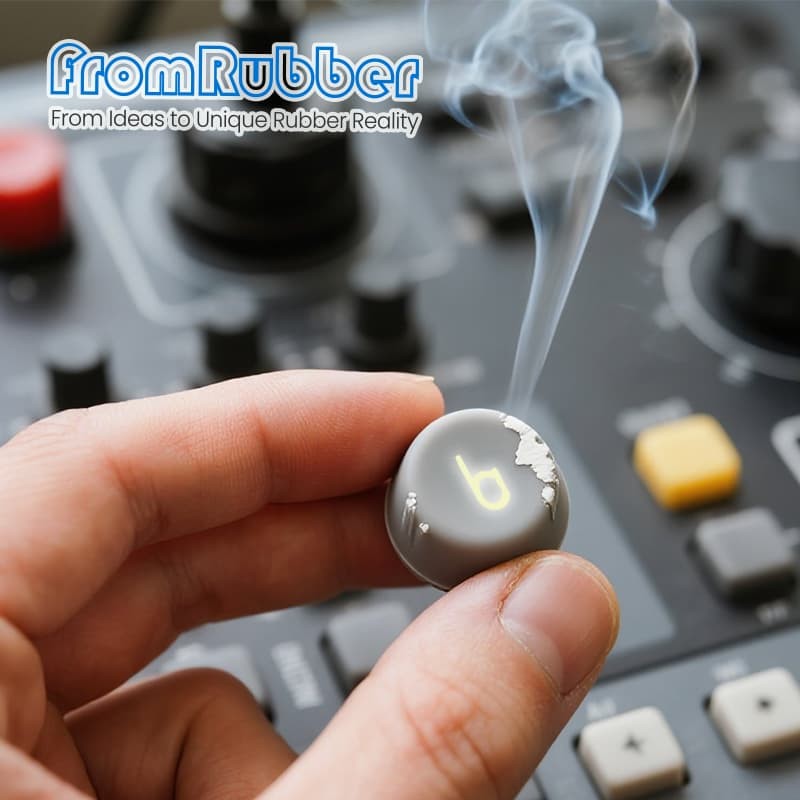
Flame retardancy and backlighting pull in opposite directions. The additives that stop a material burning also scatter and absorb light, and the layers that carry light add combustible material to the stack.
This is how a flame-retardant silicone keypad with backlighting is put together, where the compromise is made, and what has to be tested as a result.
Flame-Retardant Silicone Keypad With Backlight: Why Is It Hard to Build?
The direct answer: a flame-retardant compound is heavily filled, and filling reduces transparency. A panel that must both resist ignition and pass light through its legends has to separate the two functions into different parts of the construction rather than demanding both from one material.
The usual solution is a thin, clear light path in the legend windows and a filled, rated body around it. That keeps the rated material where the volume is and the optical material where the light is.

The Construction Choices
The second row is the usual production answer. It accepts that the window is part of the fire assessment and keeps the optical path short and simple.
| Approach | Effect on light | Effect on rating |
|---|---|---|
| Fully filled rated compound throughout | Low transmission, legends look dim | Simplest to justify |
| Rated body with clear windows | Good contrast, crisp legends | Windows join the assessment |
| Rated silicone plus a separate light guide | Best uniformity | Adds an unrated layer to review |
| Surface coating for light management | Improves transmission | Coating must be assessed |

What Changes in the Design When Both Requirements Apply
Four consequences. Legend windows get smaller and are placed closer to the LEDs, because a long light path through filled material is wasteful. The mask becomes a critical layer rather than a decorative one. The backing and adhesive must be rated too, or they become the weak link in the assessment. And the key force may need re-tuning, because a filled compound is harder than the equivalent general-purpose grade.
The force point is easy to miss. A panel retuned for the rated compound can end up with keys that are noticeably stiffer, which is acceptable on equipment but wrong on a handheld controller.
What to Document
Keep three documents aligned: the compound data sheet with its rating and the specimen thickness, the test report for the construction as built, and a drawing note that names every layer in the stack. When a supplier substitutes a diffuser or an adhesive, that note is what triggers a review instead of a silent change.
If the equipment also sees heat, the thermal and flame requirements should be assessed together on the same construction, because a compound chosen for one may compromise the other. The thermal side is covered in our article on high-temperature resistant keypads, and the backlight path in the custom backlight keypad guide.
Building a Rated and Backlit Keypad With a Factory
This is one of the few keypad categories where the conversation has to start with documents rather than shapes. Before quoting, a factory needs to know the rating the assembly must achieve, the thickness of the thinnest section, and which layers in the stack will carry light. Those three answers decide whether the part can be built at all.
We tool flame-rated backlit constructions as UL94 flame-retardant keypads, and each project keeps its own construction note so a material substitution cannot quietly change what was assessed.
Frequently Asked Questions
Can a backlit keypad be V-0 rated at any thickness?
No. The rating applies to a specimen thickness, and thin legend windows are the hardest part of the construction to justify. Ask for the report that matches the thinnest section of your part.
Does the flame-retardant grade change the colour options?
It can. Additive loading affects pigment performance, so bright or pastel colours may need a different pigment system or may not be achievable at all.
Is a separate light guide acceptable in a rated assembly?
It can be, but it becomes part of the assessment. The practical route is to choose a guide material that already carries a rating, rather than to argue for an unrated one.