Custom Silicone Gaskets for Coffee Machines: Material, Thickness and Heat Resistance
- Share
- publisher
- FromRubber
- Issue Time
- Nov 4,2026
Summary
Most coffee machine gasket specifications describe one temperature, while the part actually lives on a cycle: cold, hot, wet, dry, acidic, rinsed. This article looks at where seals sit in a machine, why the temperature at the gasket is not the temperature on the display, how thickness sets compression, and why compression set ends more seals than heat does.
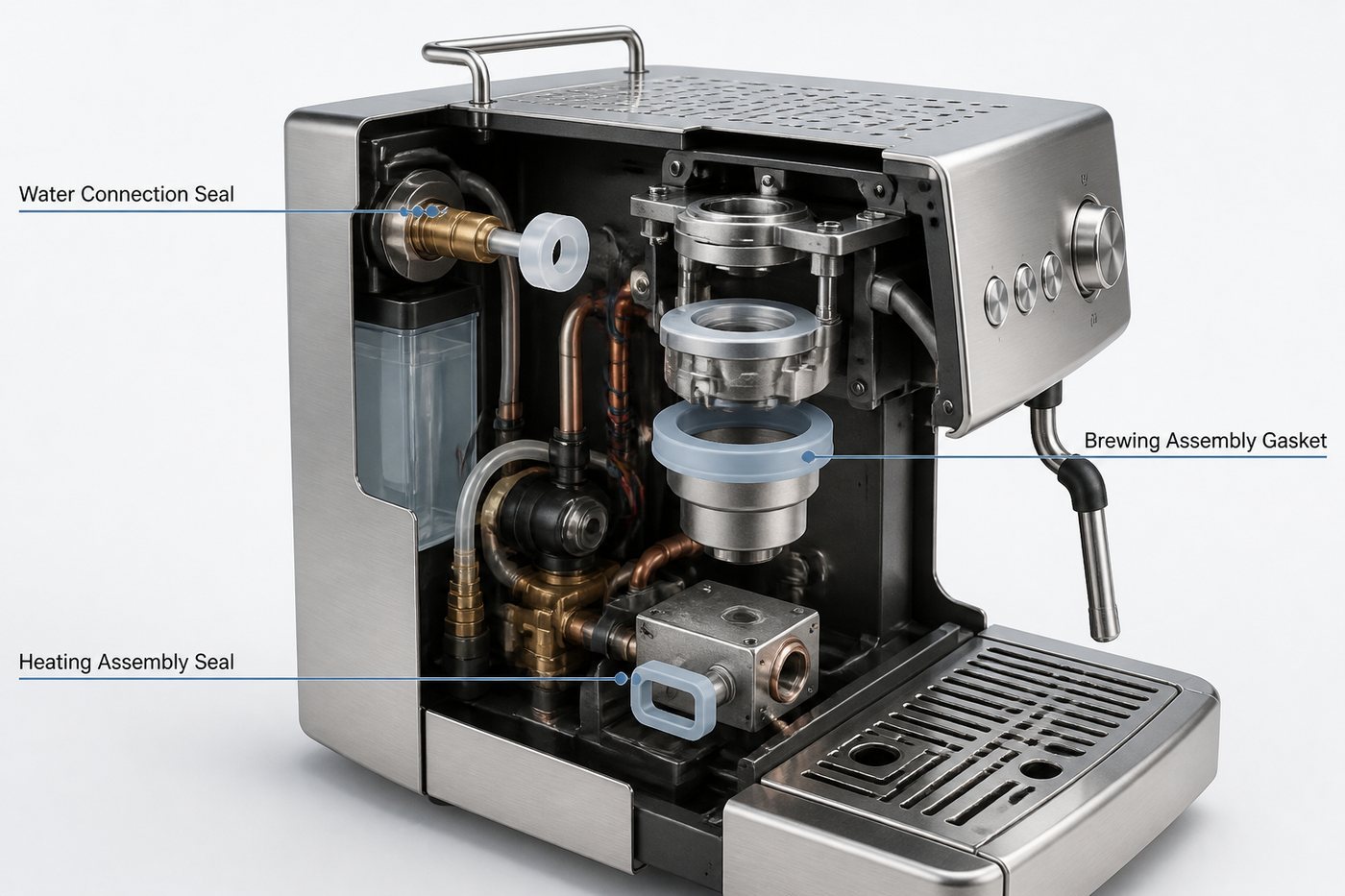
A coffee machine is a hostile place for a rubber part. It is wet, it is hot, it is full of coffee oils, it gets descaled with acid once a quarter, and the brew group is opened and closed several times a day by someone who is not thinking about seal compression. Then the machine sits cold overnight and does it again tomorrow.
Most gasket specifications for coffee equipment are written as if the part lives at one temperature. In service it lives on a cycle: cold, hot, wet, dry, acid, rinse. That cycle, not the peak temperature, is what usually ends a seal's life.
There is a second problem that has nothing to do with material. Coffee machines are assembled and serviced by people, and the parts that seal are often the parts that get removed. A brew group gasket that has to be pushed back into a groove after every cleaning is being installed dozens of times more often than the designer probably imagined. Each of those installations is a chance to twist it, pinch it, or seat it a fraction off.
Both issues point in the same direction: the gasket has to be specified against the service cycle, not against the data sheet.
Where silicone gaskets sit inside a coffee machine
The sealing points fall into three groups, and it is worth separating them because they fail for different reasons.
Water connections and internal tubing
These seals see relatively low temperature for most of their life, but they see pressure pulses from the pump and vibration from the machine. Their usual failure is not heat but movement: a hose that flexes slightly with each pump stroke will slowly work a gasket out of a shallow seat. Clamping the joint, or using a section with a locating groove, matters more here than the compound.
Seals near heating components
Anything mounted on or near the boiler or thermoblock runs hotter than the water it heats, because the metal conducts heat to the seal. The relevant figure is not the water temperature on the display; it is the temperature at the gasket, measured or estimated at the sealing face after the machine has been on for an hour. Specifying to the water temperature is one of the most common reasons a seal hardens early.
Brewing assemblies and removable parts
The shower screen gasket and the brew group seals are the hardest working parts in the machine. They are compressed by a mechanical action, released, cleaned, and compressed again. They also see coffee oils at temperature, which is a different chemical environment from clean hot water. This is where compression set shows up first, and where a gasket that was acceptable when new becomes a drip three months later.
Material properties that actually matter
Heat resistance is usually quoted as a single number, and that number is almost always a material capability rather than a service condition. What matters for a coffee machine is how the compound behaves through thousands of cycles between cold and hot, and how much of its elasticity it keeps at the end of that.
Hardness interacts with that. A harder compound resists extrusion and holds a moulded shape better, but needs more force to seal. A softer one seals at lower load and conforms to a scratched surface, but takes set sooner at temperature. In a brew group that is clamped by a handle rather than by screws, that trade-off is the whole design.
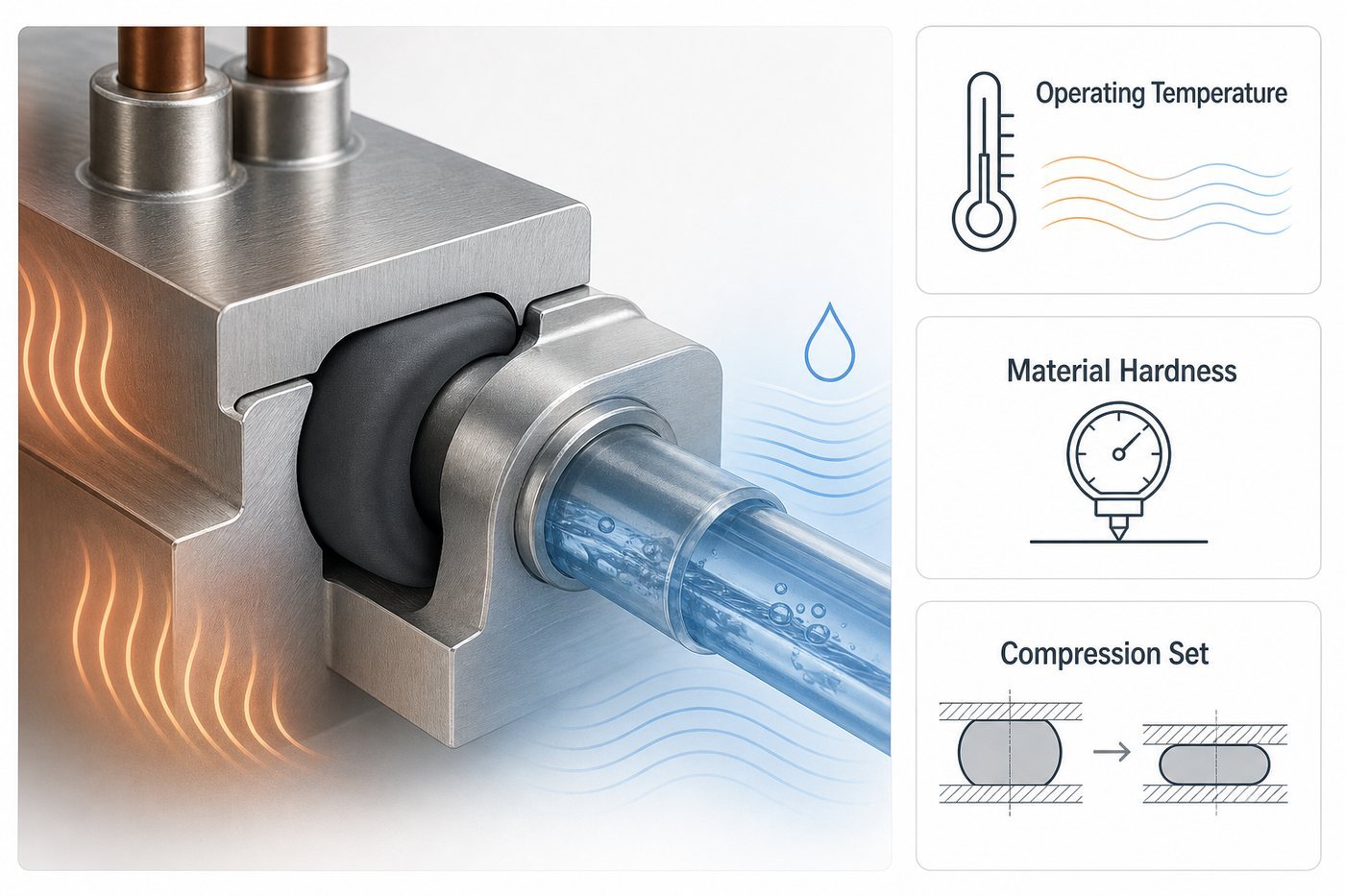
Heat resistance under real operating conditions
Continuous operating temperature and short-term peak exposure are different requirements and should be specified separately. A seal that survives a steam purge is not necessarily a seal that survives eight hours at brew temperature every day for five years. Ask what the gasket temperature is at the sealing face, how long it stays there, and whether the machine has a standby mode that keeps the group warm between shots. That last detail changes the duty cycle more than most specifications acknowledge.
Hardness and compression behaviour
Hardness should be chosen from the force available and the gap to be closed. In a portafilter group, the closing force comes from a bayonet action that also has to feel right in the hand, so a gasket that needs too much force is a product problem as well as a sealing one. In a screw-clamped boiler flange, the force is available and a firmer section is usually more stable.
Compression set and long-term performance
Compression set is the property that decides whether the seal still pushes back after a year of being squashed hot. It is measured by compressing a specimen at a given temperature for a given time and recording how much thickness is lost permanently. A compound can be perfectly heat resistant and still have poor set behaviour, and set is what turns a seal into a flat ring that no longer touches the mating face. The relationship between section thickness and recovery is examined in this article on gasket thickness and service life.
Water and food-contact requirements
Coffee equipment touches a beverage, so material compliance is part of the specification, not an afterthought. Which requirement applies depends on the market and on whether the part is in the beverage path or only adjacent to it. As with any food-contact claim, the confirmation has to come from testing the specific compound, and it is worth settling before tooling because a compound change later can alter hardness and shrinkage.
How thickness changes what the gasket does
Thickness is the dimension most often adjusted when a coffee machine leaks, and the least often measured after assembly. It sets compression, and compression sets everything else.
A gasket that is too thin never generates enough squeeze to close the surface, especially once the machine is hot and the metal has expanded away from it. The joint holds at room temperature and weeps at brew temperature, which is why some leaks only appear after the second shot.
A gasket that is too thick forces the parts apart. On a bayonet group that means the handle turns stiffly, the group does not seat flush, and the gasket itself bulges at the edge where it can be cut. In the middle there is a thickness that closes the joint with the force available and still recovers when the handle is released.
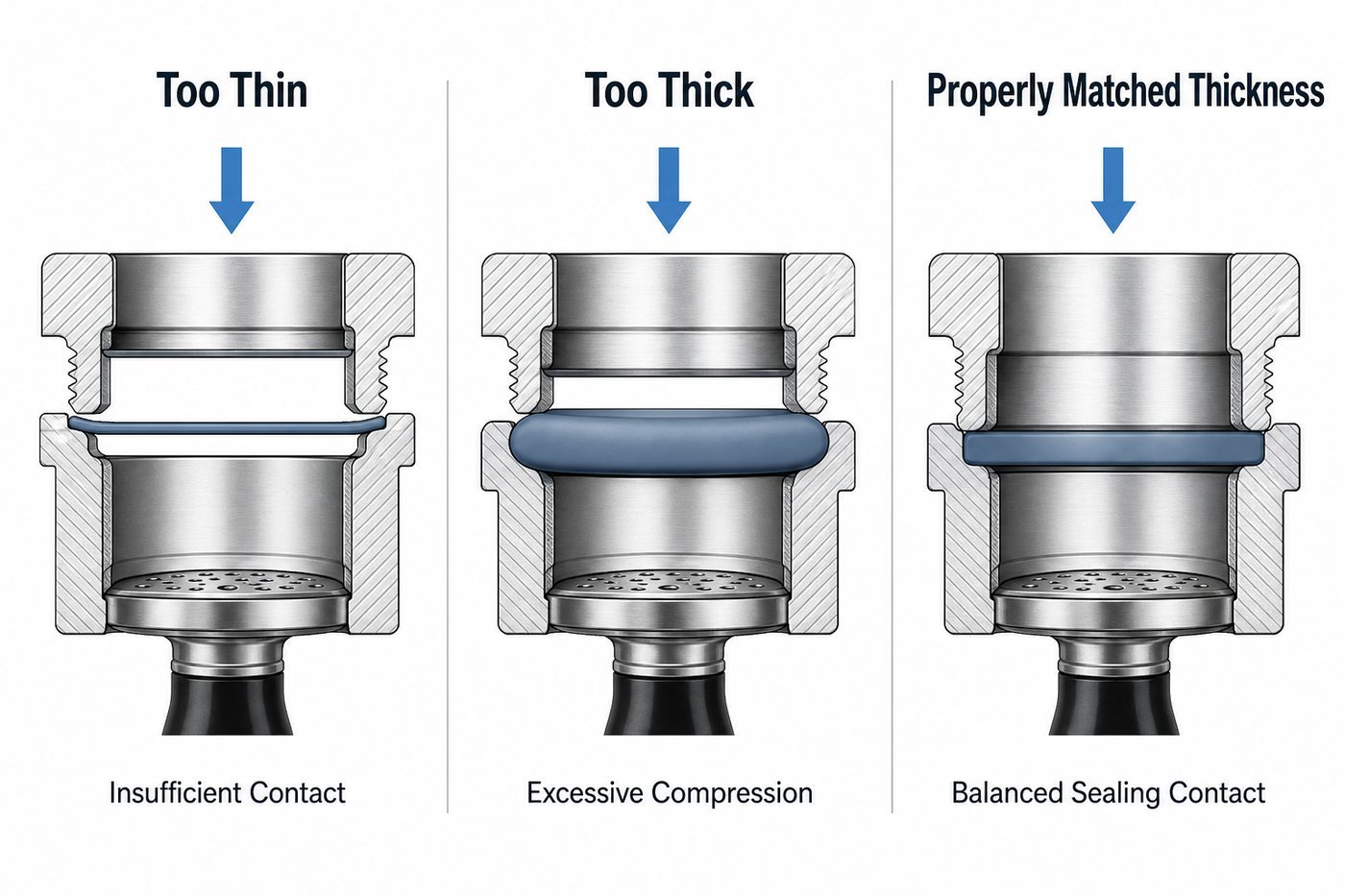
Why a thin gasket leaks
Compression is a percentage of free thickness, so a thin gasket has less absolute travel to give. If the mating faces have any waviness, the thin section follows the low points and loses contact. Thermal expansion makes it worse, because the metal moves further than the rubber can compensate. The result is a seal that works on a cold bench and fails in service, which is a difficult failure to reproduce in a factory test.
Why an over-thick gasket creates assembly problems
An over-thick section raises the closing force, distorts the mating parts, and can prevent the group from latching fully. In a machine with a plastic group housing, the extra force may also crack a boss that was designed around a thinner seal. The gasket is not the only part being loaded when it is too thick.
Matching thickness to the housing structure
Work from the assembled gap, measured hot. Measure the gap with the machine at operating temperature, because that is the condition the seal has to survive, and compare it with the free thickness of the gasket. If the difference is smaller than the minimum compression needed to close the surface, the section is too thin regardless of what the drawing says.
Choosing between gasket structures
The same coffee machine may need three different structures in three places, and using one type everywhere is a common shortcut that shows up as uneven reliability.
A flat moulded gasket suits a wide, flat sealing land with screws behind it: boiler flanges, pump mounts, level sensor seats. It is simple to tool and easy to inspect, and it tolerates a slightly rough face because the load is spread.
A profiled seal with a lip or a hollow bulb concentrates the force, which suits a brew group closed by hand. It seals at lower load and absorbs small misalignment, at the cost of being more sensitive to lateral movement and more expensive to tool.
Sponge appears in coffee equipment mainly as a low-load gap filler or as thermal insulation around a group. It is not a substitute for a solid seal on a pressurised joint.
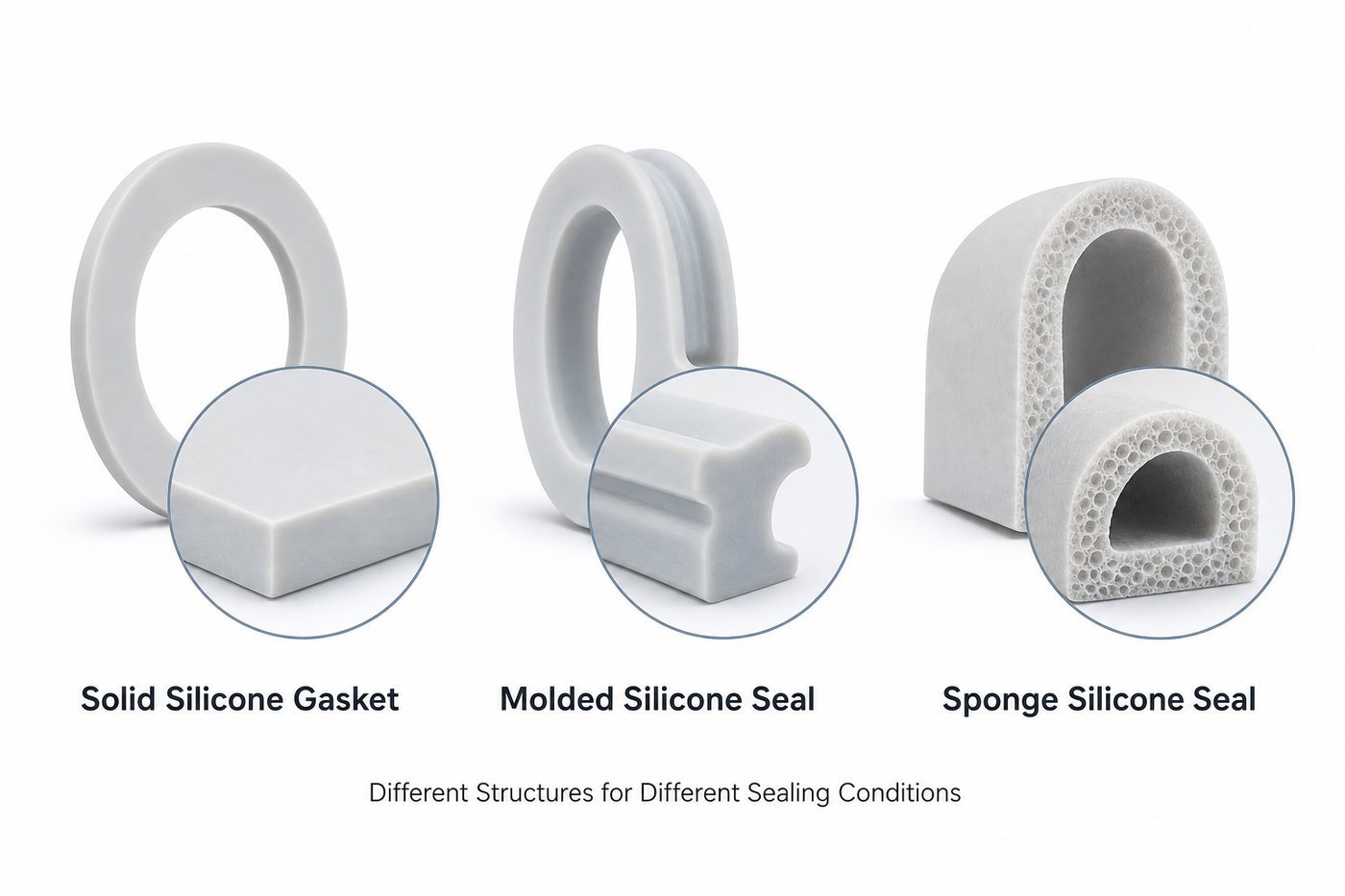
Flat gaskets for static sealing
Best where the joint is screwed down and the faces are machined or moulded flat. Thickness consistency across the part matters more than the profile, because a flat gasket cannot compensate for its own variation.
Moulded seals for complex connections
Where the joint has a step, a port, or an irregular path, a moulded profile with an integrated locating feature removes assembly variance. This is usually the right choice for brew group interfaces and for any connection the customer re-seats.
Solid or sponge for different conditions
Solid where pressure, service life and repeated assembly matter. Sponge where the load is low, the gap is large, and the joint is not required to hold pressure. Choosing sponge to solve a tolerance problem usually relocates the problem to the service department.
| Structure | Seals at low closing force | Resists extrusion | Typical location in a machine |
|---|---|---|---|
| Flat moulded gasket | No | Good, because the load is spread over a wide land | Boiler flange, pump mount, level sensor seat |
| Moulded lip or bulb profile | Yes | Moderate; needs a groove that contains it | Brew group, any joint closed by hand |
| Sponge profile | Yes | Poor | Gap filling and insulation, not pressurised joints |
What actually causes these gaskets to fail
The list below is short, and every item on it is a design or process decision rather than a material defect.
- Exposure to a higher temperature at the gasket than the specification assumed.
- Hardness chosen for feel rather than for the force available at the joint.
- Thickness set from a nominal gap rather than the hot, assembled gap.
- Compression beyond the point where the compound recovers.
- A groove that is too shallow, so the gasket is cut by the mating edge.
- Installation that twists or pinches the seal during reassembly.
- No evaluation under the real cycle of heat, water, coffee oil and descaling.
Information a gasket developer needs
Temperature and pressure, measured rather than assumed
The water temperature on the display, the temperature at the group after an hour, the peak during a steam purge, and the pressure at the joint. Those four numbers change the compound choice more than any other input.
Drawings, groove dimensions and an assembly sample
A drawing of the groove, a sample of the group, and a description of how the part is fitted and removed. For a brew group gasket, the removal method matters as much as the fit, because a gasket that has to be levered out with a screwdriver is being damaged every time it is serviced.
Material, hardness and compliance requirements
State the application, whether the part is in the beverage path, the cleaning chemicals it will see, and the market requirements that apply. Descaling acids and coffee oils are part of the chemical environment and should be named in the enquiry.
How FromRubber works on coffee equipment seals
FromRubber moulds custom silicone seals for coffee and beverage equipment from drawings and samples, including flat gaskets, profiled brew group seals and small moulded components for water circuits. Tooling is built in-house in a CNC shop with 7 machines, and production runs on 32 compression moulding machines, 30 vacuum hydraulic presses and 2 flat-bed presses, across two plants in Dongguan, so a change to a lip profile or a section thickness can be trialled on a sample before a production tool is committed. The two plants cover more than 12,000 m² and employ around 220 people, including a silicone engineering team with 10 to 15 years of experience. Coffee and beverage seals sit within the custom silicone seals range.
If a machine is leaking only when hot, the most useful starting point is the hot gap measurement and one sample of the group. Drawings and samples can be sent through the inquiry page, or discussed on WhatsApp and WeChat at +86 18676210913.
Questions from coffee equipment developers
Is food-grade silicone automatically suitable for coffee equipment?
No. Food-contact suitability depends on the specific compound and on the approval route required in the destination market. The base polymer being silicone tells you nothing about extractables, cure system or documentation, so the material certificate has to be checked for the actual part.
Why does the machine only leak after descaling?
Descaling removes scale that was partly blocking a worn seal, and the acid also attacks the surface of a compound that is not suited to it. A gasket that was already flattened will start weeping once the scale that filled the gap is gone.
Can I use a harder compound to stop the gasket extruding?
Sometimes, but check the closing force first. A harder compound that the group cannot compress properly will leak at the face instead of at the edge. If extrusion is the failure, the gap is usually too large for the section rather than the compound being too soft.
How often should a brew group gasket be replaced?
That is a function of compression set under your duty cycle, not a fixed interval. If the group handle starts turning further before it stops, the gasket has already lost section height and is close to leaking.
The seal in a coffee machine is asked to do three jobs at once: hold pressure, survive heat, and go back to its original shape after being squashed by hand. Material data sheets describe the first two. The third one is decided by thickness, hardness and how the part is installed, and it is the one that shows up as a drip on the counter.
Specify the cycle, not the peak. Then measure the gap hot.