Custom Silicone Keypads: Made to Your Drawing, Your Sample, or Your Idea
- Share
- publisher
- FromRubber
- Issue Time
- Aug 15,2026
Summary
Custom silicone keypads made to your drawing, sample, or idea. OEM/ODM manufacturer with no-DWG tooling, 3-hour quotes, 3-5 day samples, conductive & backlit options, IATF 16949 & ISO 9001 certified.
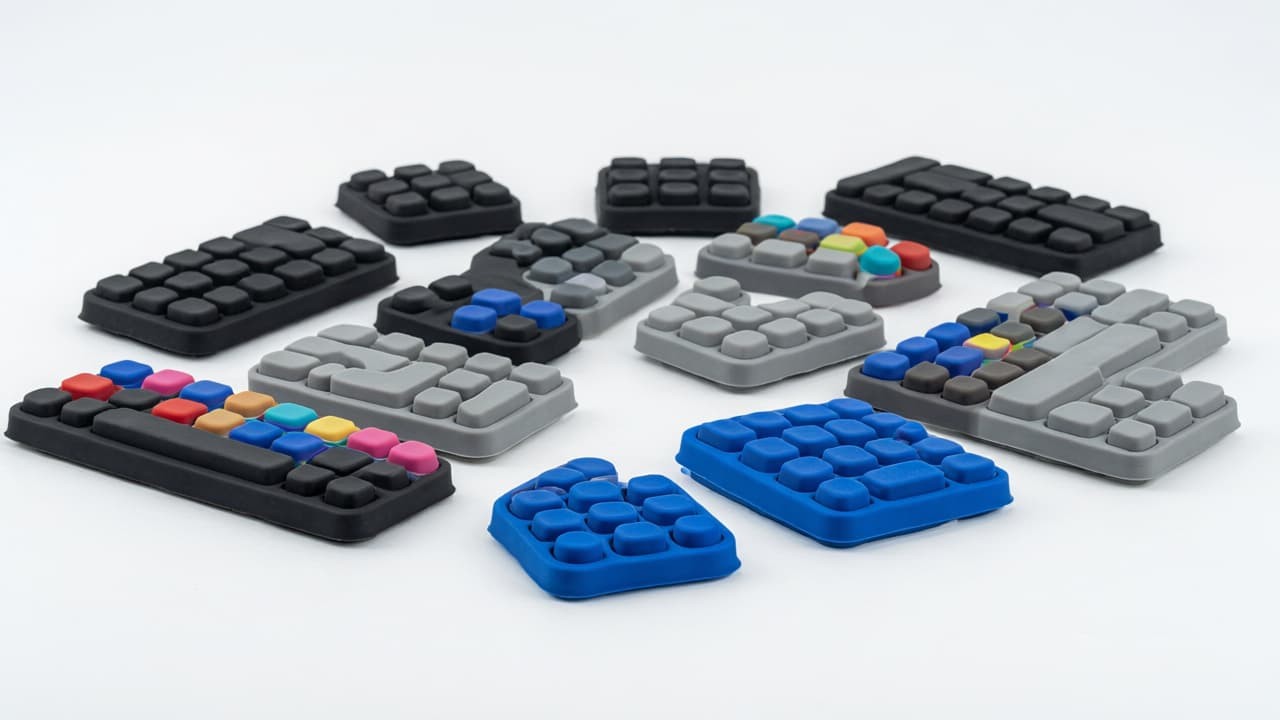
Custom Silicone Keypads — Made to Your Drawing, Your Sample, or Your Idea
⚙OEM / ODM Manufacturer ✓IATF 16949 Certified ⏱3-Hour Quote 📦3–5 Day Samples
Custom silicone keypads are the quiet workhorses behind remotes, POS terminals, medical devices, industrial control panels, and automotive electronics. They absorb millions of presses, seal out dust and moisture, and deliver the tactile feel users judge your product by.
Getting a keypad right depends less on finding "a" manufacturer and more on finding one that can turn your specific requirement — a drawing, a sample, even a rough idea — into a production-ready part. This guide covers what you can customize, how conductive contacts are chosen, how mold and cost structures work, and how a full-process factory controls quality.
1. Why Custom Silicone Keypads
Silicone keypads are molded button interfaces made from a single sheet of silicone elastomer. Each key is a three-dimensional dome whose flexure walls collapse for a defined tactile response. Compared with metal dome switches, flat membrane overlays, or plastic mechanical switches, they offer:
- Tunable tactile feel — actuation force and key travel are designed into the webbing geometry, from soft consumer presses to firm gloved-hand actuation.
- Environmental sealing — the one-piece keymat itself forms the seal, reaching IP65–IP68 without a separate gasket.
- Long service life — silicone is inherently fatigue-resistant; keypads routinely survive millions of cycles.
- Wide temperature tolerance — stable performance from roughly -40°C to 200°C depending on compound.
- Design freedom — molded 3D key shapes, colored buttons, laser-etched backlight windows, and legends bonded into the rubber rather than printed on top.
That combination is why so many OEMs specify silicone keypads for products pressed thousands of times a day in demanding environments.
2. What You Can Customize
A custom silicone keypad is defined by more than its outline. Every dimension below is a specification point you control — and each one affects feel, durability, and cost. Browse our custom silicone rubber keypad series to see what we already produce.
2.1 Key Dimensions and Layout
Key size, height, spacing, travel, and overall shape are tailored to your enclosure and your user's hand. Button shapes — round, oval, rectangular, sculpted — are selected by how frequently they are pressed and what they do.
Correct spacing prevents accidental presses; grouping speeds navigation; orientation cues help users find keys by touch. If you are working from a product casing or PCB, the keypad footprint is designed to match it.
2.2 Color and Legends
Colors are matched to Pantone references. Legends can be molded as embossed or debossed characters, printed by silk-screen, or laser-etched. For backlit designs, laser etching through a sprayed coating exposes translucent silicone so light passes exactly through the character.
Silicone-based inks cure bonded into the rubber, so legends do not rub off in normal use.
2.3 Actuation Force and Feel
Actuation force is set by the compound hardness and the webbing geometry — the thin wall around each key that collapses and rebounds. A typical range is 60–300 gF. If force is too low, keys actuate accidentally; too high, and they fatigue the user.
Snap ratio — the difference between actuation and contact force — drives perceived tactility, and it is engineered in the mold, not adjusted afterward.
2.4 Hardness (Shore A)
Hardness is the most common way to describe feel, and the right value depends on how the actuation force is provided:
| Shore A | Feel | Typical Use |
|---|---|---|
| 30–40 | Soft, flexible | Baby products, soft consumer controls |
| 40–50 | Soft with gentle actuation | Remote controls, children's products |
| 50–60 | Balanced, defined snap | General-purpose keypads, consumer electronics |
| 60–70 | Firm, crisp | Industrial panels, automotive, gloved operation |
We use raw silicone from established brands — Shin-Etsu, Dow Corning, and Toshiba among them — which is nontoxic, odorless, and consistent batch to batch.
Compound choice also drives long-term performance metrics like compression set, which determines whether a keypad keeps its snap after years of use.
3. Surface Finish and Decoration Options
The finish does more than make a keypad look right — it protects the graphics and extends service life. Common options produced in-house:
- Silk-screen printing — multicolor legends and graphics directly on keytops.
- Laser etching — durable recessed legends, or backlight windows that never fade.
- PU coating — abrasion and oil resistance for demanding environments.
- Matte coating — reduces glare and fingerprints.
- Epoxy coating — a hard top layer that gives a plastic-like feel.
- Spray painting — full-topcoat color on the keypad surface.
- Two-shot / multi-color molding — clean color transitions in one keymat.
- Plastic keycaps (P+R) — hard plastic caps fused onto rubber keys for a hard-key feel.
The exact combination is chosen by your application: a remote-control keypad, an outdoor industrial panel, and a POS terminal rarely need the same surface treatment.
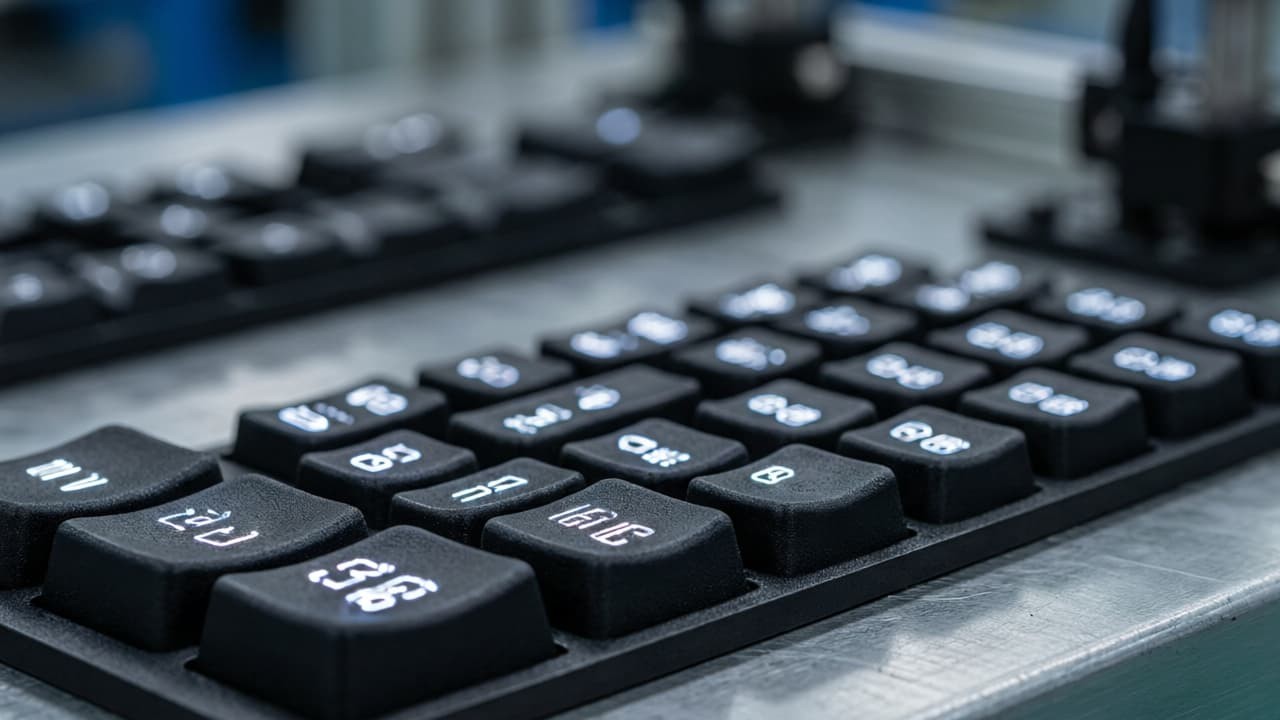
4. Conductive Keypad Options — Choosing the Right Contact
Underneath every key, something has to close the circuit. Silicone keypads are commonly co-molded with a conductive element, and the choice matters for contact resistance, life, and cost:
- Conductive ink (oil-based) — screen-printed conductive pads; economical, suitable for many standard applications.
- Carbon pills — molded conductive silicone contacts, low cost, acceptable resistance (typically under ~200 ohms), good for most keypads.
- Nickel-plated pills — more stable, lower resistance for demanding signal requirements.
- Gold-plated pills — best contact stability and lowest resistance, specified for automotive and other high-reliability applications.
For automotive-grade projects, nickel-plated or gold-plated pills are standard practice, because contact resistance must remain stable across temperature swings and years of vibration.
Choosing the right contact level up front avoids the most expensive kind of rework — discovering in field testing that a low-cost contact cannot hold resistance under your operating conditions.
5. From Drawing — or Sample — to Production
Most manufacturers need a complete 3D drawing before they will start. That assumption quietly eliminates a large share of real projects, because many buyers have only a sample, a product casing, or a concept. A factory that can start from whatever you actually have is set up to handle your project:
- Have a design drawing (STP/STEP, DWG, PDF) — manufacturability review and DFM-style check before tooling.
- Only have an actual sample — it is measured, reviewed, and reproduced. No drawing required.
- Only have an enclosure or PCB drawing — the keypad footprint is designed to fit your casing.
- Only have a product idea — engineers support structure design and turn it into a drawable, moldable part.
If you are being told "we need a 3D file first," that is a limitation of the supplier, not a requirement of the process.
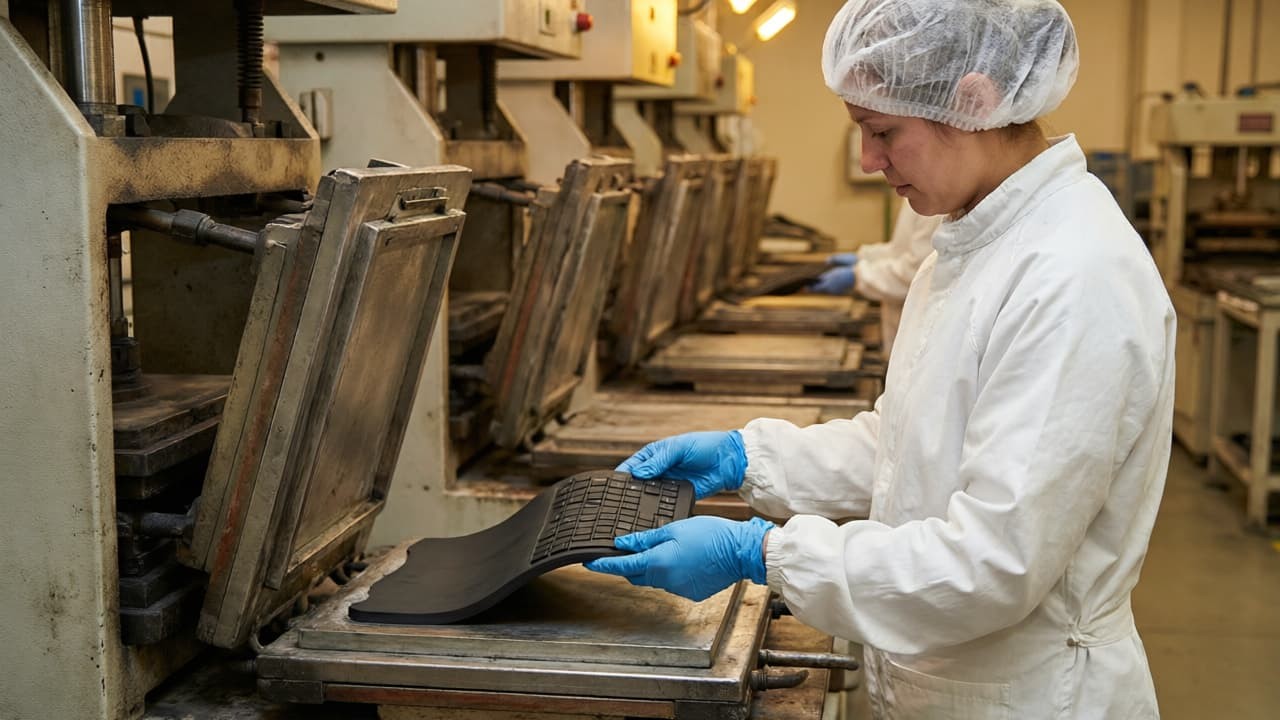
6. Mold and Cost Structure — What You Are Actually Paying For
Mold cost is usually the first number a buyer questions, so here is what it represents and how the economics work.
- Sample (prototype) mold — the fastest way to validate form, fit, and feel. Sample tooling is typically completed in 3–5 days.
- Production mold — the cavity set for mass production, engineered for high cycle counts and consistent quality. Production tooling typically completes in 10–12 days.
- In-house mold shop — molds are designed and built in-house, shortening lead time and keeping the process under one roof.
For low-volume runs, prototype tooling can be the right starting point. When a design stabilizes, production tooling amortizes over the volume.
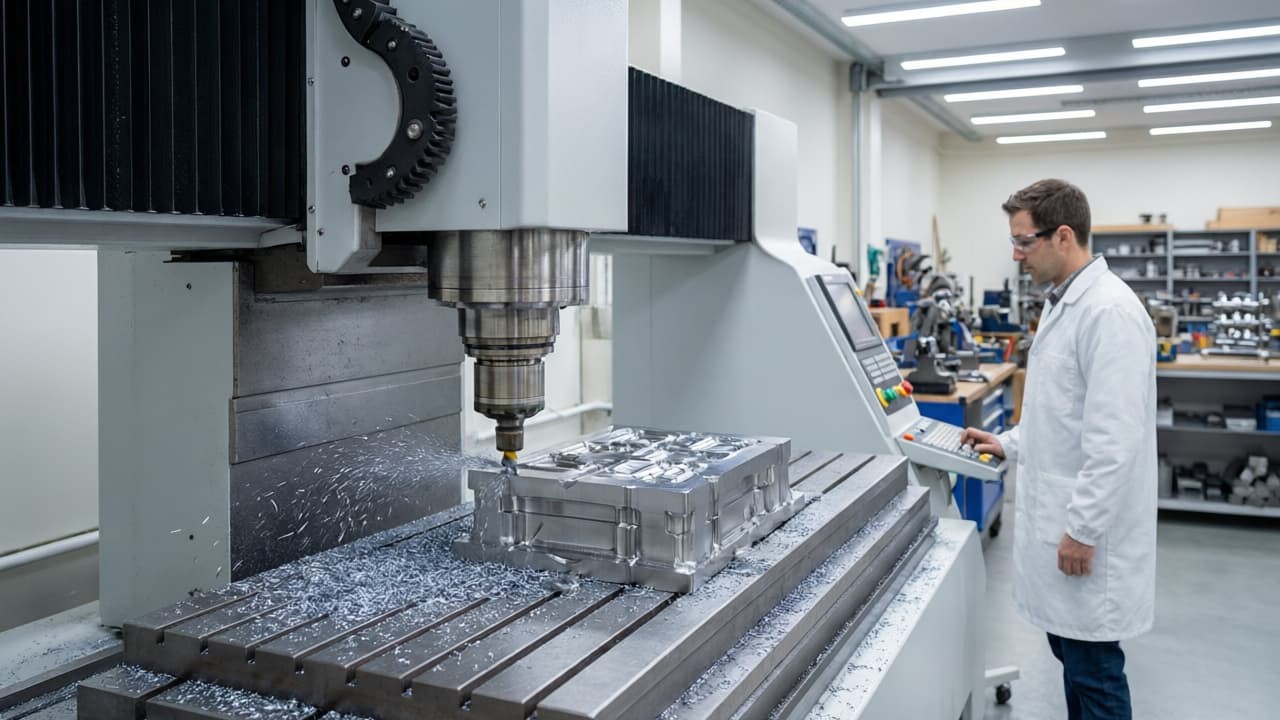
7. Quality Control and Testing
Silicone keypads fail in the field for a few predictable reasons: keys lose their snap, legends wear off, conductive contacts drift in resistance, or the keypad tears at the flexure walls. A supplier's quality system is what prevents those failures — or catches them before shipment.
A full-process quality system typically runs four inspection gates plus final 100% inspection:
- Incoming material (IQC) — raw silicone tested for tear resistance, yellowing resistance, and hardness at the door.
- In-process (IPQC/FQC) — every stage of molding, printing, and coating checked as it runs.
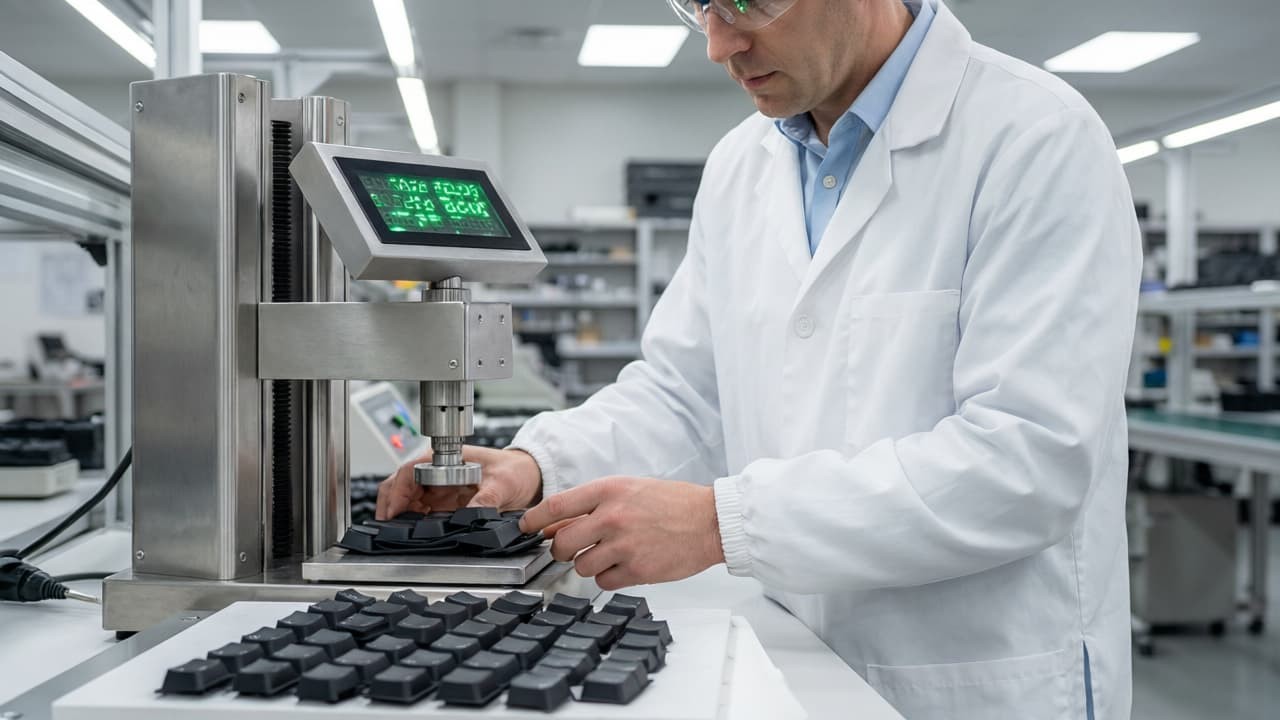
- Final full inspection — parts 100% inspected before packing, using dedicated equipment including an RCA abrasion tester, a key press-life tester, and a rubber friction tester.
- Patented test equipment — press-fatigue test machines, surface-wear testers, and trimming machines developed in-house.
Quality systems can be certified to IATF 16949 (automotive), ISO 9001, and ISO 14001, with RoHS and REACH material options.
8. Where Custom Silicone Keypads Are Used
Silicone keypads adapt to almost any product that needs a durable, tactile interface:
- Remote controls — colorful multi-style keypads for TV, air-conditioning, and appliance remotes.
- POS and payment devices — conductive keypads for terminals, registers, and card readers.
- Meter and instrument controllers — functional conductive keypads for meters and test equipment.
- Banking equipment — card readers, PIN pads, and setup devices.
- Industrial equipment — waterproof, wear-resistant control panels and machinery.
- Automotive — conductive keypads for in-car controls with automotive-grade contacts.
- Medical and communication devices — keypads designed for cleaning regimes and frequent use.
- Learning devices, mobility equipment, power-related devices — and more.
If your product does not fit one of these categories, the manufacturing process is the same — the application simply tells us which material, finish, and contact options to prioritize.
Custom Silicone Keypad FAQs
What is the minimum order quantity?
MOQ depends on the design and mold type. Low MOQs are supported for prototype and small-volume runs.
How fast can I get a quote?
Quotes are typically provided within 3 hours during business hours.
How long do samples take?
Sample tooling completes in 3–5 days, after which finished samples are sent for confirmation.
How long does mass production take?
Production molds complete in 10–12 days; production lead time depends on quantity.
Can you make keypads from a sample instead of a drawing?
Yes — from a physical sample or a product enclosure, with no 3D file needed.
Do you support backlighting?
Yes — through laser-etched characters, two-shot molding, and other backlight-compatible constructions.
Which certifications do you hold?
IATF 16949, ISO 9001, and ISO 14001; RoHS and REACH available.
Can you handle low volume or complex, multi-process keypads?
Yes — small quantities, diverse specifications, and complex process combinations are supported.