Custom Silicone Lick Mat Patterns: What Earns a Mold Slot
- Share
- Issue Time
- Oct 23,2026
Summary
A pattern is cheap to draw and expensive to cut into steel. This article looks at how buyers can separate the lick mat details that do real work from the ones that only add tooling risk, and what to check on the first sample before a mold is approved.
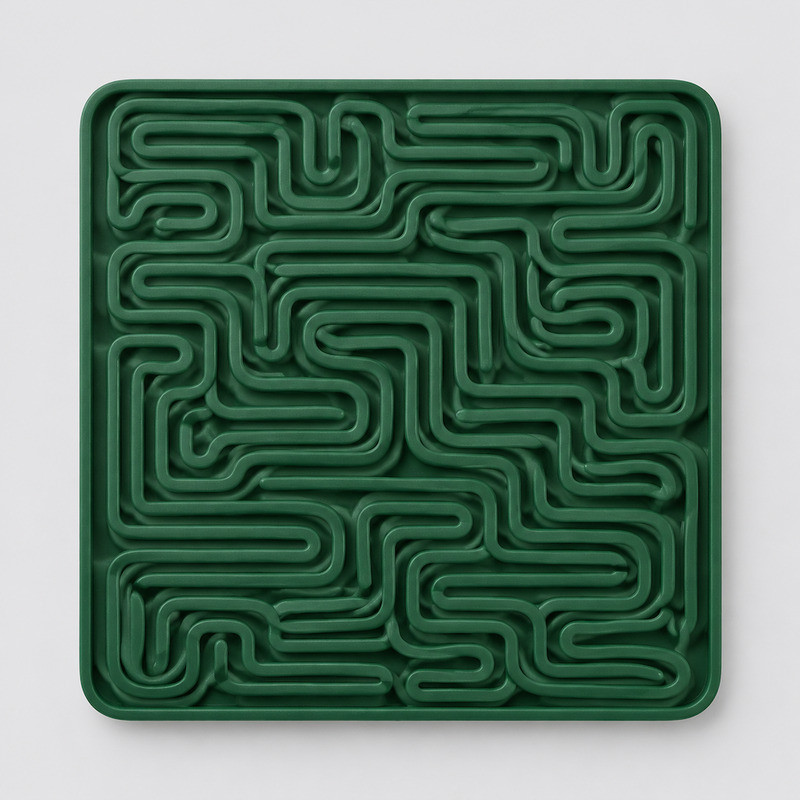
Not every line on the drawing needs to become steel
A brand sends over a render: four divided feeding zones, a honeycomb field, a paw mark in the centre and a thin raised border. It looks clean on screen. Six weeks later the first moulded sample lands on the desk, and the middle of the honeycomb reads soft, the paw mark has lost its edges, and the border looks heavier than the file suggested.
Nothing went wrong in the press. The drawing asked the tool to do more than the geometry could carry. A lick mat is a shallow open mould, and every detail added to it becomes a cavity depth, a wall, an edge radius, a place where air has to escape and a place where material has to arrive. Those four conditions decide whether a pattern survives the trip from CAD to finished part.
That is where custom silicone lick mat patterns stop being a styling decision and turn into a tooling one. The useful question is not how the pattern reads in a flat render. It is which details are doing work on the mat, and which ones are only spending money.
A detail earns its place in a mould when it can answer three things: what it does for the pet or the owner, whether it can be reproduced at the size specified, and whether anyone can clean it afterwards. If one of the three is missing, the detail is a candidate for revision, not for tooling.
Start with what each detail is supposed to do
Before a pattern is cut into steel, sort the elements into three groups: features that manage food, features that manage cleaning, and features that only manage appearance. Almost every mat on the market carries all three at once, and they are not reviewed in the same way. A divider that keeps wet food in one zone is a functional requirement. A pebble field along the outer edge may be there because the previous generation had one.
Walls and channels that keep soft food where it was put
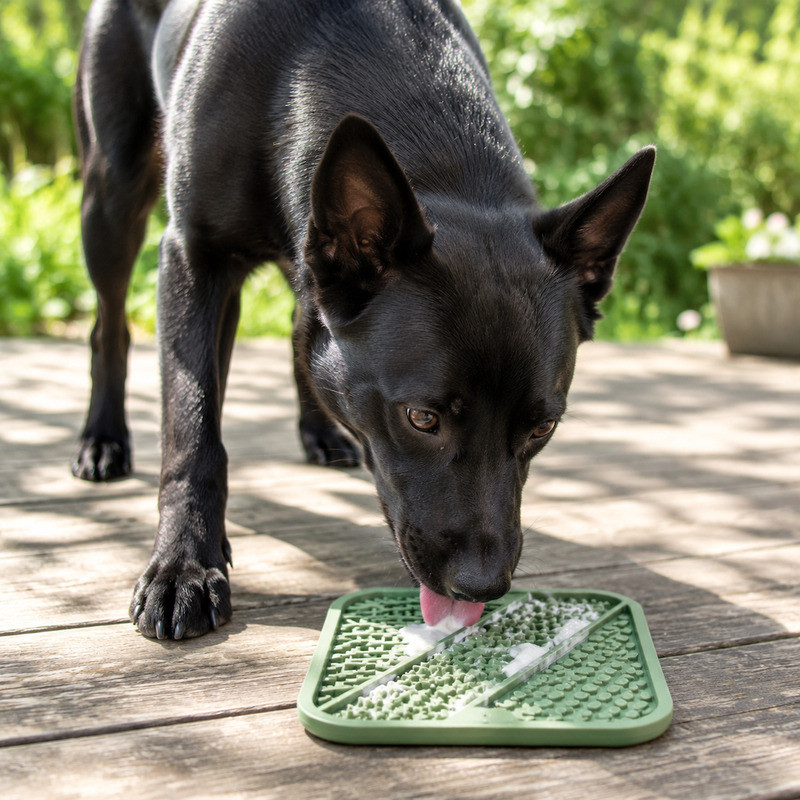
Raised dividers and shallow channels behave like a set of small dams. Their job is to slow the spread of a soft food across the surface so the pet has to work at it instead of swallowing it in one pass. Whether that works depends less on how the pattern looks from above and more on three dimensions: how high the wall sits, how wide the channel is, and whether the transition between the two is abrupt or eased. A wall that is tall but paper-thin at the top will fold under a tongue; a channel that is wide but shallow will not hold much of anything.
Texture that exists mainly to look different
A diamond knurl, a dense honeycomb, a fine line grid: any of these can give a mat its identity on a shelf photo. The honest test is what the texture contributes once the mat is in a kitchen. If a ridge pattern is copied from the category rather than chosen for a food consistency, it usually ends up as tooling cost with no user benefit. That is not an argument against decoration. It is an argument for knowing which parts of the surface are decorative before the toolmaker starts quoting.
The same logic appears in enrichment research. A 2022 pilot study on environmental enrichment for dogs found that different activity types produced noticeably different behavioural effects, and that the food-based activities in the trial were not the strongest performers (Hunt, Whiteside and Prankel, Animals, 2022). The lesson transfers to product design: a feature earns its place by changing what the animal does, not by being present.
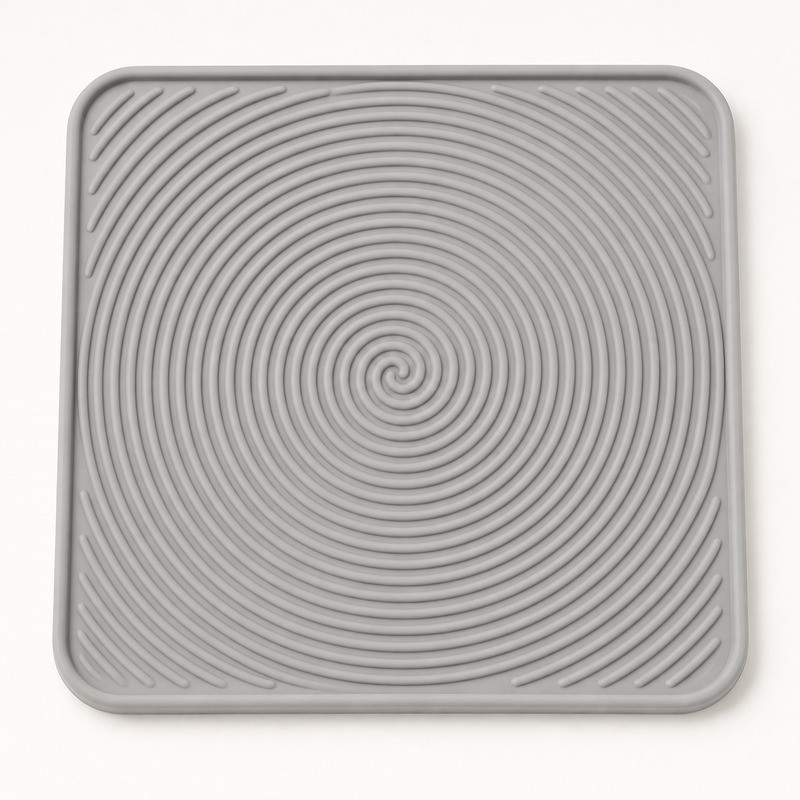
Where custom silicone lick mat patterns earn their place
Across the projects that come through a silicone tool room, three kinds of detail tend to survive the review. They are not glamorous, but they are the ones that hold up in sampling and again in the third production run.
Main channels and raised dividers define the layout
The primary geometry is what the buyer actually asked for: two zones, four zones, a ring around a centre well, a spiral that pushes food outward. Keep this geometry as simple as the concept allows, because it sets the wall height and the base thickness for the whole part. A mat whose main channels change height three times is a mat whose sample will be judged on the wrong feature.
Rounded corners and smooth transitions
Sharp internal corners are worth a second look, not because silicone cannot form them, but because everything downstream gets harder. Material has to flow into a tight corner, air has to leave it, and the finished part has to release without tearing the edge. A small radius costs almost nothing in appearance and removes a category of argument from the first sample review.
Branding is a separate conversation
A logo pressed into the feeding surface competes with the food pattern for the same relief. Put it on the outer rim or the underside and it can be reviewed on its own terms: is the mark large enough that the strokes stay open, is the relief deep enough to read in a matte surface, and does its outline agree with the tool's parting line. A mark that is legible at 60 mm may be unreadable at 18 mm, and no amount of tool polishing changes that.
Where small decoration turns into tooling work
The expensive details are rarely the big ones. They are the small ones that were never questioned because they were easy to draw.
Narrow grooves and tightly packed ridges
Two patterns can have the same nominal depth and behave completely differently, because depth alone says nothing about how much room the material has to enter and how much room the air has to leave. A 1 mm wide groove at 1.5 mm deep is a different proposition from a 3 mm wide groove at the same depth. When the gaps close up, the tool needs finer venting, the press needs a cleaner fill, and the part needs more attention at demoulding.
Fine lines that stop reading at small scale
Silicone is soft, and a soft edge rounds. A hairline that is 0.3 mm wide in the file may come out as a suggestion of a line once the material has cured and the part has been handled. That is not a defect in the ordinary sense. It is the material doing what it does. The practical fix is to widen the feature or accept that it will read as texture rather than as a graphic.
Pattern variation multiplies inspection work
Every additional feature height gives an inspector another thing to compare against a reference. Mats with one wall height and one channel depth can be checked quickly. Mats with four heights, three finishes and a logo need a written standard before the first shipment, or the conversation at goods-in becomes an opinion.
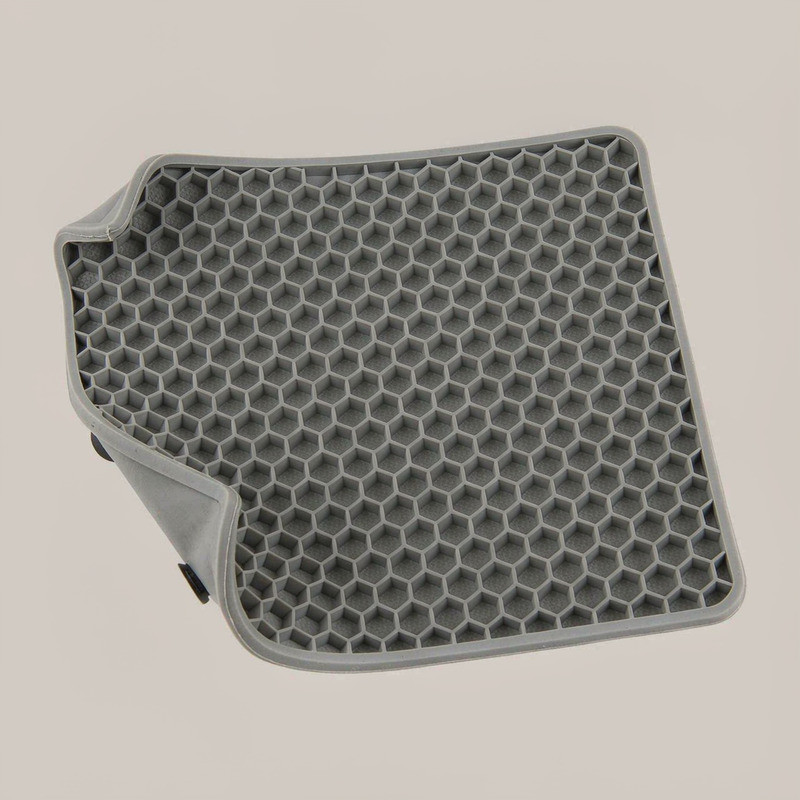
A five-question test before the tool is approved
This is the check used before custom silicone lick mat patterns go to tooling. It takes an afternoon and saves a revision cycle.
| Question | What a "no" tells you |
|---|---|
| What does this detail do for the pet or the owner? | It is decoration. Review it as decoration, and expect to lose it if the tool needs room. |
| Can it be reproduced at the size specified? | Look at the narrowest wall and the smallest gap rather than the overall mat. Those two numbers decide the outcome more than the outline does. |
| Can the surrounding geometry be moulded and released? | The feature may be fine and its neighbour may not. Check the wall beside it, the floor beneath it and the direction the part leaves the cavity. |
| Can the finished feature be inspected? | If two people looking at the same sample would disagree, the requirement is not yet written and production will argue about it. |
| Is the benefit worth the added tool work? | Sometimes it is: a divider that makes the product work, or a mark that carries the brand. A decorative ring nobody notices is not. |
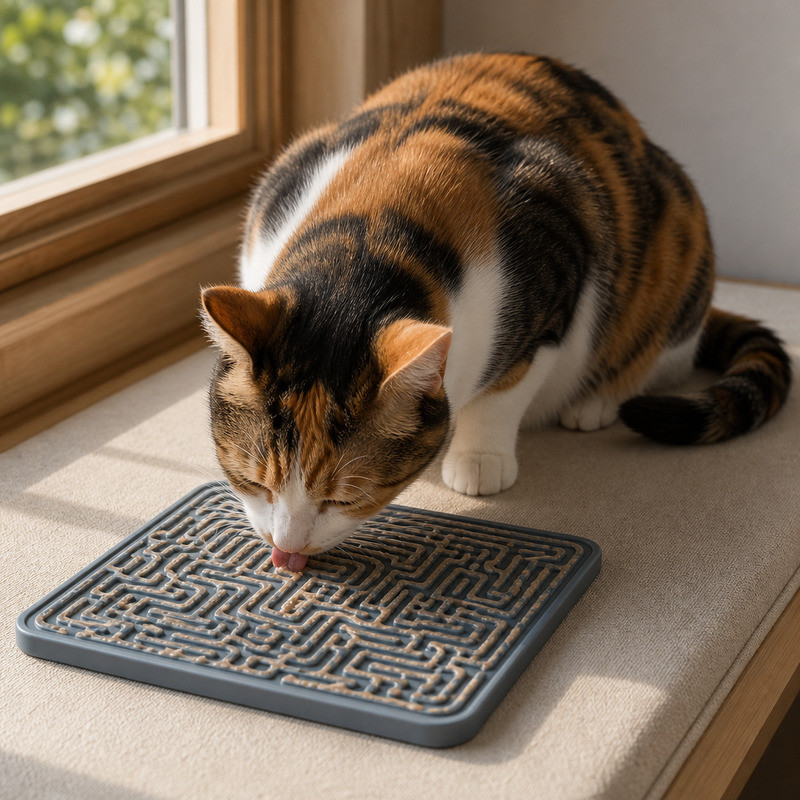
Review the pattern in use, not on a colour swatch
A pattern that photographs well can still be a pattern that owners resent, because the same channels that hold food during a meal hold residue afterwards. This is a design constraint, not a cleaning instruction, and it should be settled while the geometry is still flexible.
The residue question is not hypothetical. A 2023 study of 96 dog food bowls in Italy found that bowls used with wet food carried significantly higher total mesophilic aerobic bacteria counts than bowls used with dry food, even though the caregivers reported regular washing. The authors framed bowl hygiene as a household contamination issue rather than a cosmetic one (Raspa et al., BMC Veterinary Research, 2023). A lick mat is a bowl with a much larger internal surface, so the argument applies with more force: the narrower the channel and the deeper the pocket, the more the pattern depends on the owner's patience.
Two practical consequences follow. First, prefer open-ended channels over dead-end pockets when the feeding concept allows it, because a channel that drains is easier to rinse than a well that holds. Second, test the pattern with the food the product will actually meet. A design reviewed only with dry treats has not been reviewed at all.
What to confirm before the mould is cut
Dimensions, not impressions
Write down groove width, groove depth, wall height, wall thickness at the top, spacing between features, corner radii and overall mat size. Mark which of those numbers are functional and which are negotiable. A supplier who is told only that the pattern should look "like the render" has no lever to pull when a feature turns out to be unreproducible.
Read the first sample as a product
Put the sample on a counter, spread something soft across it, rinse it under a tap, bend it. Look at the pattern where the mat flexes, not only in the middle. Compare the sample with the drawing at actual size rather than zoomed on a monitor, and record what changed before approving production tooling.
Give the toolmaker a brief it can act on
Drawings or CAD, target dimensions, reference photographs, the intended food type, cleaning expectations, and the order quantity are enough to start. Add the material expectation, since hardness affects how a wall behaves under load, and note any requirement that comes from the retail market rather than from the design.
Material choice sits underneath all of this. Where a mat is described as food contact in the target market, the compound and its documentation matter alongside the pattern; in the United States, repeated-use rubber articles are addressed under 21 CFR 177.2600, which sets out extractable limits rather than a single pass-or-fail label.
How FromRubber handles this kind of review
Pattern work at FromRubber usually begins with a redraw rather than a quotation. FromRubber is the trading name of Dongguan Bohao Electronic Technology Co., Ltd., a custom silicone manufacturer in Dongguan, Guangdong, China, working with pet product brands on moulded parts that range from lick mats and feeding mats to bowls, lids and accessories. The company's published quality documentation covers IATF 16949, ISO 9001 and ISO 14001, alongside silicone test reports listed on its raw material certification page.
The first pass is a manufacturability read rather than a price: which features set the tool, which dimensions control the appearance, and where the current geometry is likely to disagree with itself.
That review looks at the same items listed above — channel and wall geometry, the smallest feature in the pattern, logo placement and relief, base thickness under the deepest groove, and the direction the part leaves the mould. Sampling follows the normal route through mould making and silicone compression moulding, with the sample compared against the agreed dimensions before production tooling is released. More on the wider product range sits on the pet supplies page, and the step-by-step route is described in the custom silicone service process.
Not every drawing passes that read unchanged. When a detail cannot hold its shape at the requested size, the useful answer is a specific alternative — widen this line, raise that floor, move the mark — rather than a promise that the sample will be fine.
If the question behind the question is who else makes these products, the site keeps two working lists that sit alongside this article: silicone lick mat manufacturers for pet brands and custom silicone pet feeding manufacturers. Both are written as sourcing aids, with the criteria stated rather than assumed.
Questions buyers ask about lick mat patterns
Are deeper patterns always better than shallow ones for a silicone lick mat?
No. Depth is only useful when the food and the cleaning method support it. A deep pattern with narrow channels slows a meal and then slows the wash-up. A shallower pattern with open channels may suit a product that is rinsed in a sink rather than scrubbed. The right answer depends on the food consistency, the channel geometry and who is doing the cleaning.
Can a small logo be moulded into a lick mat?
Usually it can, within limits set by stroke width, relief depth and the surrounding surface. A mark placed on the feeding face competes with the food pattern; the same mark on the rim or the underside is far easier to keep clean and to read. Feasibility should be checked at the finished size, not at the size it appears on a monitor.
Do complex patterns always cost more to manufacture?
Complexity usually adds tool work and inspection effort, but the size of that effect depends on where the complexity sits. Many shallow features spread over a large area are a different problem from a few deep, narrow ones. The only reliable way to compare two options is to have both reviewed against the same tooling and sampling brief.
Should a pattern be simplified before tooling?
Only the parts that are not doing a job. Removing a functional divider to save tool work damages the product; removing a decorative micro-texture that reads as noise at final size usually improves it. The test is whether anyone can say what the detail is for.
Sources and further reading
- Raspa F. et al., "Pet feeding habits and the microbiological contamination of dog food bowls: effect of feed type, cleaning method and bowl material", BMC Veterinary Research 19:261, 2023. Read the study
- U.S. Code of Federal Regulations, Title 21, Section 177.2600, "Rubber articles intended for repeated use". View the regulation
- Hunt R.L., Whiteside H., Prankel S., "Effects of Environmental Enrichment on Dog Behaviour: Pilot Study", Animals 12(2):141, 2022. Read the pilot study
Pattern dimensions referenced in this article are described as design variables, not as recommended specifications. The appropriate values depend on the product brief, the compound and the tooling approach agreed with the manufacturer.
Send the drawing before the drawing becomes a mould
If you are developing a custom silicone lick mat and the pattern is still open, a manufacturability read is cheaper than a revision. Send the CAD file or a dimensioned sketch, the food type, the cleaning expectation and the target quantity.
Email: nani@fromrubber.com or karl@fromrubber.com · WeChat and WhatsApp: +86 18676210913
See the pet silicone range