Customized Silicone Seals for Automotive Industry in USA
- Share
- publisher
- karl
- Issue Time
- Nov 12,2025
Summary
Automotive silicone seals fail on the validation plan before they fail on the road. This note sets out the material class decision, the fluid and temperature matrix a US programme expects, the test sequence behind a PPAP submission, and the seal designs that survive both heat and oil.

Programme brief
An automotive seal is approved on evidence, not on a datasheet. The evidence has three parts: a material class chosen against the fluid and temperature matrix, a compression set value measured at the service temperature, and a validation sequence that includes aged parts rather than fresh ones. Get the class wrong and no amount of tooling precision saves the programme.
- Silicone (VMQ) covers the widest temperature band but swells in mineral oil; FKM is the oil answer at higher cost.
- Compression set must be measured at service temperature and after fluid exposure, not at 23 °C.
- PPAP asks for evidence on production tooling: first article, capability, material certification and test reports.
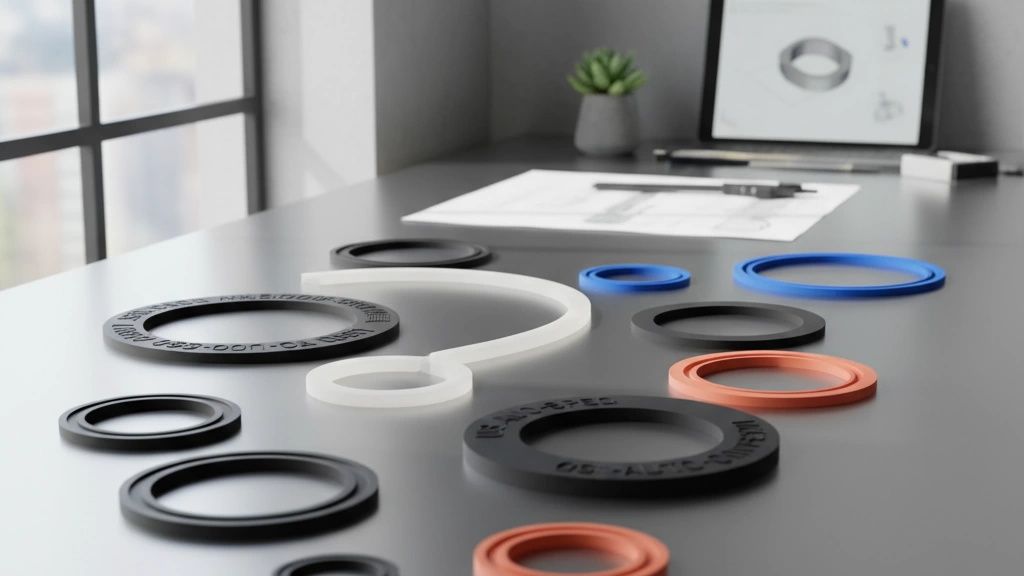
Material class: where automotive silicone seals actually fit
Silicone earns its place where temperature moves faster than chemistry: turbo inlet paths, exhaust-adjacent shielding, connector seals and lamp gaskets that see -40 °C cold soaks and 180 °C heat soaks in the same duty cycle. Its weakness is mineral oil and fuel, where swelling can run several times the volume of the part.
FKM covers the oil and fuel side at roughly two to four times the compound cost, with a narrower cold range. The practical answer for many programmes is a split: silicone where the seal only sees air and heat, FKM where it touches oil, and a clearly marked boundary in the drawing so the two never get swapped on the line.
The temperature and fluid matrix behind the choice
Write the matrix before choosing a compound. Columns are the media the part actually touches: air, crankcase oil, coolant, brake fluid, washer solvent, road salt spray. Rows are conditions: continuous temperature, peak temperature with dwell, and the number of thermal cycles in service life. Each cell gets a pass criterion, usually a volume swell limit and a hardness change limit after immersion.
This is where most seal programmes discover that the specified material never sees the aggressive fluid at all — the seal is in the dry side of the connector. Reviewing the matrix with the harness or powertrain engineer often removes an unnecessary FKM requirement and the cost that came with it.
- Air and heat only — VMQ, checked for compression set at the peak temperature.
- Oil contact — FKM, checked for swell and hardness change after immersion.
- Mixed exposure — two materials with a defined boundary, not one compromise.
What a PPAP submission for a seal actually contains
| Element | What it proves | Common gap |
|---|---|---|
| First article inspection | Dimensions on production tooling | Reported on prototype parts |
| Material certification | Batch traceability to the compound | Certificate for a different lot |
| Compression set at temperature | The seal keeps its force in service | Measured only at 23 °C |
| Fluid immersion | No excessive swell or softening | Tested in the wrong reference fluid |
| Process capability | The tool holds tolerance over a run | Cp calculated on five parts |
| Appearance boundary sample | Flash and flow marks are defined | No agreed limit, disputes every lot |
Design details that decide whether automotive silicone seals survive
Groove fill is the first number. A seal compressed beyond about 30 percent in a static groove will take a set faster than the material datasheet suggests, because the strain is concentrated at the corners. Between 20 and 30 percent leaves room for tolerance stack-up and thermal expansion without over-compressing the section.
The second detail is restraint. A seal that can move under vibration will wear through the coating on a mating surface and then leak. Moulded retention features — a groove that captures the seal, or a bead that locates it — cost a little in tooling and remove a whole failure mode. For dynamic applications, the surface finish of the mating part belongs on the drawing too: a rough surface acts as a leak path no compound can seal.
How an automotive seal programme is quoted and run
A US programme asks for evidence at each stage, so the quotation normally includes the validation work as a line item.
Inputs
Groove drawing, mating surface finish, media list, temperature profile, annual volume and the PPAP level required.
Material and design
VMQ or FKM by media, section and groove fill, retention features and tolerance stack-up review.
Validation
First article on production tooling, compression set at temperature, fluid immersion and a capability study.
Production
Batch traceability, boundary samples for appearance and a documented change-notification process.
Cold climate: the test that predicts a winter leak
A seal that passes a room-temperature compression set test can still leak at -30 °C, because the compound stiffens and cannot follow the groove as the housing contracts. The relevant test is a low-temperature compression set or a TR-10 measurement, run on the actual section rather than on a slab.
The second cold-weather variable is differential expansion. Aluminium housings and silicone seals contract at different rates, and a groove designed at 23 °C can lose contact at -30 °C if the fill ratio was already marginal. Reviewing the groove with the cold condition in mind is cheaper than changing the compound later, and it is the reason a seal drawing should state the service temperature range rather than a single maximum.
Questions from automotive buyers
Can silicone replace FKM to cut cost?
Only where the seal never contacts oil or fuel. In a dry, hot location silicone is often better and cheaper; in an oil-wet location the swell makes it unsuitable regardless of price.
What compression set value is acceptable?
It depends on the groove and the bolt load, but a seal that takes more than about 30 percent set at service temperature has effectively lost its force. Specify the test temperature at the service peak, not at room temperature.
Why does a seal leak only in winter?
Cold stiffens the compound and opens a leak path at a surface that was marginal at 23 °C. A cold compression set or a low-temperature flex test on the actual section exposes it.
Do you supply IATF 16949 documentation?
FromRubber operates under IATF 16949:2016 and supplies the certificates, first article reports and test records a PPAP submission requires; the specific level is agreed at quotation.
Send the groove drawing and the media list
FromRubber moulds silicone and FKM seals for automotive programmes in Dongguan, with compression set, fluid immersion and dimensional capability reported on production parts. Send the groove drawing, the fluids the seal will meet and the PPAP level; we will propose a material class and a validation sequence with the cost of each step stated.
Request an automotive seal reviewRelated reading: silicone versus NBR on an oil pan and custom silicone seals.