Deep Grooves or Fine Textures? Silicone Pet Lick Mat Design
- Share
- Issue Time
- Oct 23,2026
Summary
Deep grooves and fine textures solve different problems, and both can fail in the sink. This comparison looks at depth, spacing, cleaning access and mold geometry so brands can choose a pattern direction before tooling starts.
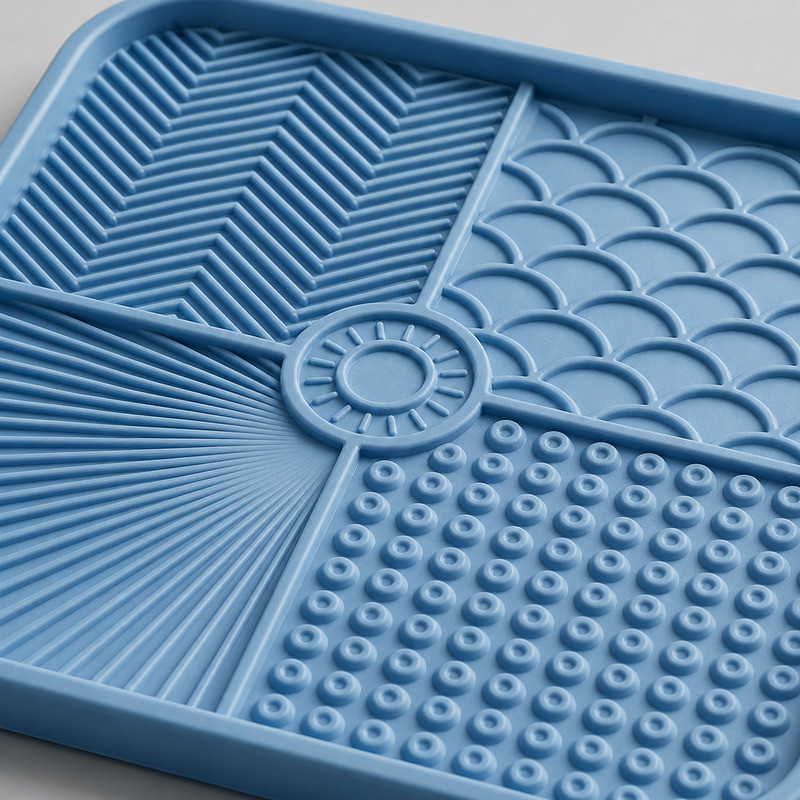
Two mats, one sink, very different evenings
Put two lick mats side by side on a draining board. Same silicone, same footprint, same thickness. One rinses under the tap in about five seconds and goes back in the cupboard. The other needs a brush, a fingernail and a second attempt, because the food has packed into grooves that are too narrow for water to reach and too deep for a sponge to follow. Both were approved from a render. Only one was designed with the sink in mind.
This is the trade-off behind most silicone pet lick mat design decisions, and it rarely gets discussed in those terms. Depth is treated as a strength setting: deeper means more engaging, more substantial, more "slow feeder". In practice depth is a drainage decision as much as a feeding decision, and the number that matters is not depth on its own but the relationship between depth, width and spacing.
Neither direction is inherently better, and most silicone pet lick mat design arguments are really arguments about which failure a team can live with. What follows is an attempt to separate the two so the choice can be made deliberately.
What depth and texture actually change in a silicone pet lick mat design
Deep grooves create defined channels and visible dividers
A deep channel gives soft food somewhere to sit and gives a tongue something to work against. It also draws a clear line on the product: zones read as zones, and the pattern is legible from a metre away. The cost is that a deep feature needs a corresponding wall, and a wall needs a floor beneath it. Depth consumes base thickness.
Fine textures produce a quieter surface
Shallow ridges, small bumps and close line work change the look without changing the silhouette. A fine pattern can suit a product positioned as calm and minimal, and it usually feels smoother under a hand. The catch is that fine features have less room to be wrong: a tenth of a millimetre of rounding is invisible on a 2 mm wall and substantial on a 0.4 mm ridge.
Depth and spacing have to be read together
A deep pattern with wide channels and a deep pattern with narrow channels are not the same design, even when the depth number matches. The narrow version has a higher aspect ratio, which changes how material fills the cavity, how air leaves it, and how easily a brush reaches the bottom. When a sample comes back with soft edges, the usual cause is not the depth but the width-to-depth ratio at that specific feature.
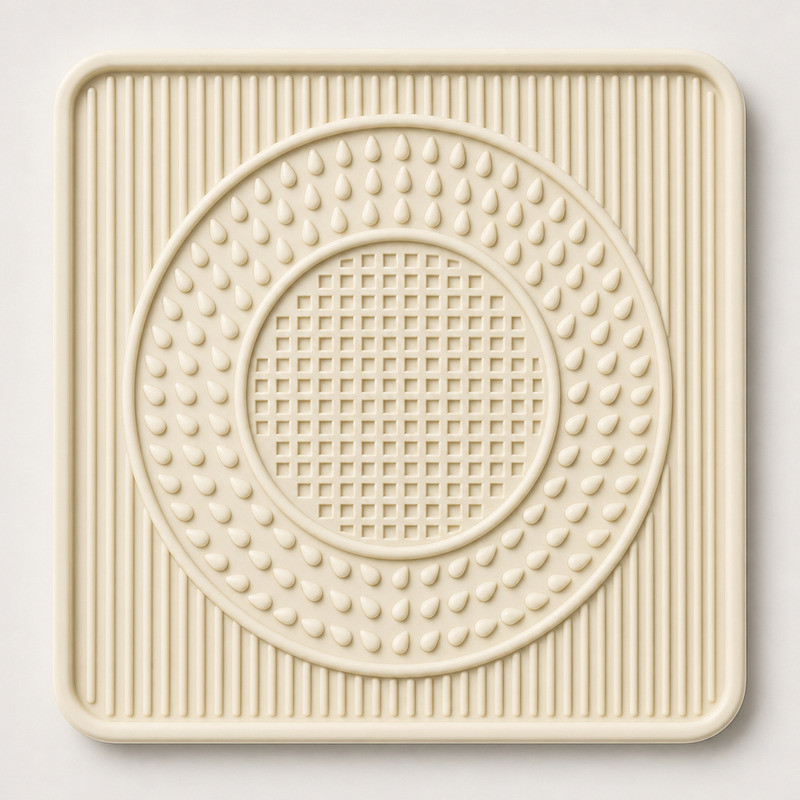
When deep grooves are the right call
When the layout needs separation
If the product concept depends on distinct feeding areas — a wet zone, a dry zone, a well in the middle — the dividers are structural, not decorative. They have to be tall enough to keep a soft food from migrating, and thick enough at the top not to fold. That is a functional requirement and it justifies the tool work.
When there is still room to clean
A deep groove is only acceptable if something can reach the bottom of it. That something is usually a sponge corner, a bottle brush or a thumb, and its width sets a practical minimum. Wide-and-deep cleans well. Narrow-and-deep cleans badly. The design review should name the cleaning tool, because the answer changes with it.
When the surrounding base can carry it
A 4 mm groove in a 5 mm mat leaves a 1 mm floor. That floor will flex differently from the rest of the part, and it will be the first place to look tired after a few months of use. Deep grooves are safer on a thicker base, or on a mat where the deep region is local rather than spread across the whole surface.
When fine texture is the better direction
When the product promise is restraint
Shallow patterns suit mats sold as calm, low-profile or easy to store. They also photograph well without pretending to be something else. A fine texture can carry a brand's identity through tone and finish rather than through depth.
When small features still have enough width
A fine pattern is not automatically a difficult pattern. Short, wide, shallow ridges are straightforward. The difficulty arrives when the design pushes width down and density up at the same time — many ridges, close together, each one narrow. That combination is where tooling conversations get long.
When the cleaning check is done honestly
A shallow pattern is not automatically easier to clean. Dense fine texture can trap a film of food across a large area, and a film is harder to see and easier to ignore than a lump in a groove. Owners do not clean to a laboratory standard either: in a survey of 537 caregivers, reported cleaning frequency ranged from after every meal to never, which means a pattern has to tolerate the lower end of that range as well as the upper one (Raspa et al., 2023). Test the sample with the actual food, rinse it the way an owner would, and look at it dry.
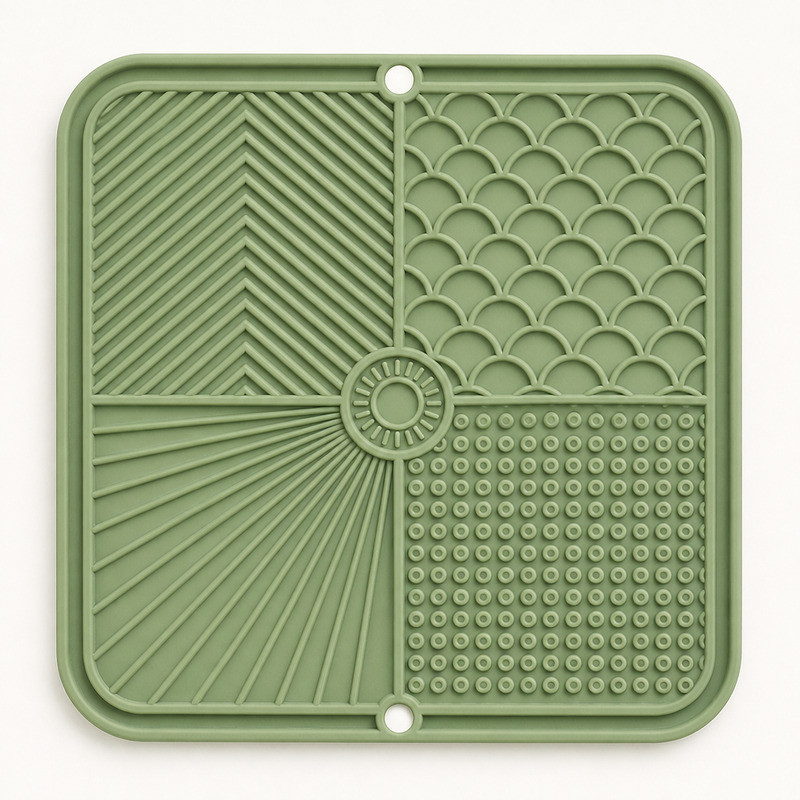
Deep grooves versus fine textures, side by side
The table below compares tendencies, not guarantees. A specific design can break any row of it, which is exactly why the last column exists.
| Design factor | Deep grooves | Fine textures | What to confirm |
|---|---|---|---|
| Visual definition | Strong separation between zones; pattern reads at a distance | Quiet surface; identity comes from finish and rhythm | How the pattern reads at the real product size, not on screen |
| Food control | Holds soft food in defined areas; slows a fast eater | Spreads a thin layer; better suited to pastes and liquids | The food consistency the product is designed for |
| Cleaning access | Good when wide; poor when narrow and deep | Good when open; can trap film when dense | The actual cleaning tool and rinse routine |
| Small-feature reproduction | Less sensitive, because the features are large | More sensitive: rounding is proportionally larger | The narrowest ridge and the smallest gap in the drawing |
| Local flexibility | Deep grooves reduce the floor under them | Little effect on stiffness | The thinnest remaining section, not the nominal base |
| Mould geometry | Tall walls, deeper cavities, more attention to release | Shallow cavities, more attention to venting and polish | Draft, parting line and how the part leaves the cavity |
| Sample inspection | Check wall height, floor thickness, edge definition | Check ridge continuity, spacing and surface finish | Which features are critical and which are cosmetic |
The honest reading of that table is that deep and fine designs fail in different places. Deep designs fail at the floor and at the narrow gap. Fine designs fail at the edge.
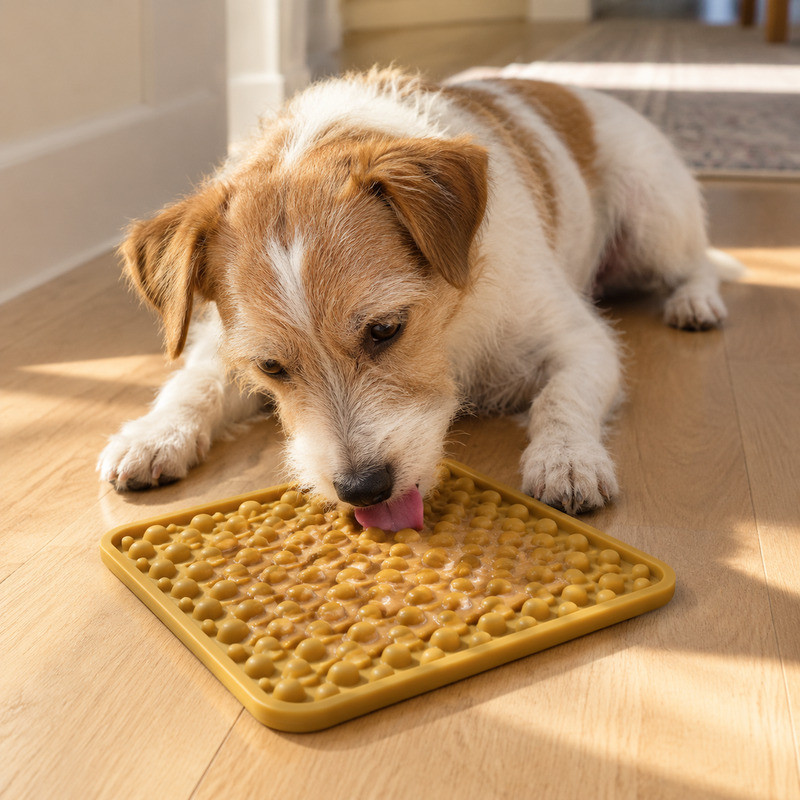
How geometry meets the moulding process
Narrow recesses and tall walls ask more of the tool
The cavity has to be filled before the material starts to cure, and the air inside it has to leave somewhere. A pattern with many narrow recesses concentrates both problems in small spaces. That does not make the pattern impossible; it makes the venting layout and the fill path part of the design conversation rather than an afterthought.
Abrupt thickness changes deserve a section view
Looking at the top view of a mat tells you almost nothing about how it will behave. A cross-section shows the floor under the deepest groove, the wall thickness at the top of a divider, and how quickly the part transitions between the two. Those transitions are where sinking, distortion and tearing usually start.
The approved sample has to match the intent
Before production is released, agree on what "deep enough" and "sharp enough" mean in measurable terms: groove width, groove depth, wall height, spacing, edge radius. Without those numbers, the sample review becomes a comparison of memories, and the second production run becomes a negotiation.
Five decisions that settle the pattern direction
- Name the food. Paste, pate, yoghurt, raw mince and dry kibble behave differently in the same groove. The pattern should follow the food the product is actually sold for.
- Name the cleaning method. Sink rinse, dishwasher, bottle brush, or a wipe with a cloth. Each one sets a different minimum channel width.
- Choose the primary function. Separation of zones, spreading of a thin layer, or visual identity. Pick one as primary; the others can follow.
- Mark the negotiable details. Most patterns contain features that can move by a few tenths of a millimetre without changing the product. Say which ones.
- Compare samples against the same brief. If two directions are being considered, mould both or model both, and judge them with the same food, the same rinse and the same lighting.
A hybrid is often the practical answer: deep channels where separation matters, a simpler shallow texture across the rest of the surface. The hybrid only works when each part of it has a reason. Combining the two for visual richness tends to produce a mat that is hard to clean and slow to mould.
What to send with a design review request
A pattern review moves faster when the supplier can see the intent as well as the outline. Useful material includes the CAD model or a dimensioned drawing, the overall size, the intended food types, the cleaning method, the target retail market and the expected order quantity. Photographs of competitor products help, provided they are labelled as references rather than as specifications.
Where dimensions are already known, list groove width, groove depth, wall height, minimum spacing and corner radii. Where they are not, say which features are fixed by the concept and which are still open — that distinction is what allows a manufacturer to propose a change instead of rejecting a design.
Material and food-contact documentation belong in the same conversation. In the United States, repeated-use rubber articles are covered by 21 CFR 177.2600, and the extractable limits in that section apply to the compound, not to the pattern. The pattern decides whether the product works; the compound decides whether it can be sold in the market it is aimed at.
How FromRubber reviews pattern direction
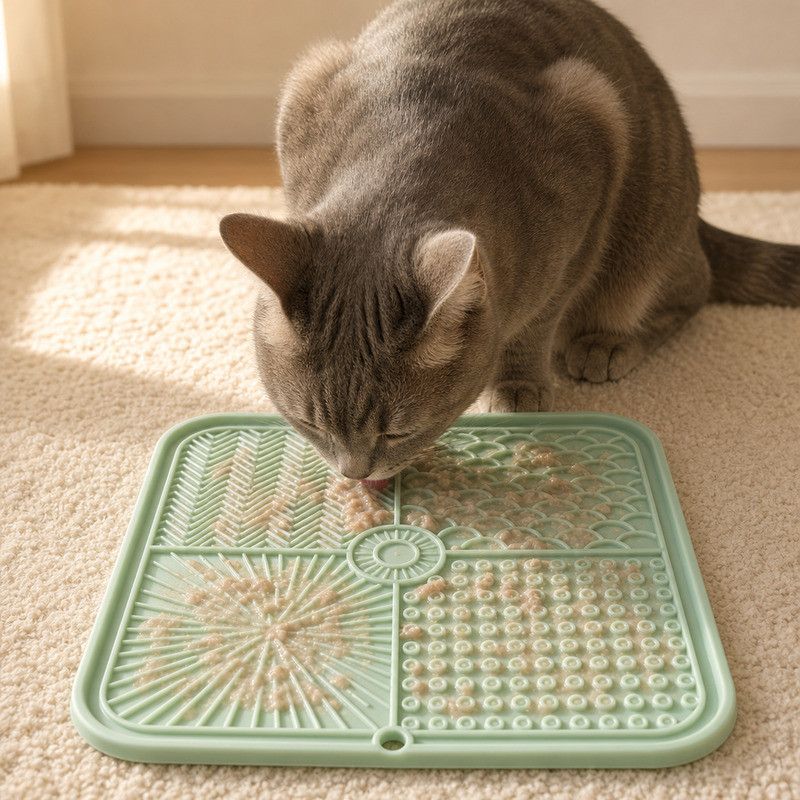
Two drawings of the same mat — one deep, one fine — are where a pattern conversation usually becomes a tooling conversation. FromRubber, the trading name of Dongguan Bohao Electronic Technology Co., Ltd., moulds pet feeding products in Dongguan, Guangdong, China, and reads each drawing as a set of tooling decisions: which features set the cavity, which dimensions control appearance, where the floor is thinnest, and whether the proposed spacing can be filled and released reliably.
That review is deliberately unromantic. It will not tell a brand that deep grooves are better than fine ones, because the answer depends on the food, the cleaning routine and the base thickness. It will say where the current drawing is likely to produce a soft edge, a thin floor or an unreachable pocket, and what could move instead. Two companion lists on the site cover the supplier side: lick mat manufacturers for pet brands and silicone pet feeding manufacturers. Sampling and production follow the routes described under mould making and silicone moulding; the pet product range sits under pet supplies.
Questions that come up when comparing the two
Are deep grooves better than fine textures on a silicone lick mat?
Only when the design needs separation and the cleaning method can reach the bottom of the groove. For a thin layer of paste and a quick rinse, a fine open texture often works better. The two directions answer different questions.
Are fine silicone textures harder to mould?
They can be, because rounding is proportionally larger on a small feature and the tool has less room for error. Very shallow, closely spaced textures need closer attention to venting and surface finish. Difficulty depends on the actual dimensions, not on the label "fine".
Can a mat combine deep grooves with a fine texture?
Yes, and many successful mats do. The usual arrangement is a small number of deep channels that define the layout, with a shallow texture elsewhere for grip and appearance. The combination works when each element has a separate job.
Is there a standard groove depth for lick mats?
No. Depth should follow the food consistency, the base thickness, the cleaning method and what the tool can reproduce. Published figures from other products are useful as orientation, not as a specification for a new design.
Sources and further reading
- Raspa F. et al., "Pet feeding habits and the microbiological contamination of dog food bowls: effect of feed type, cleaning method and bowl material", BMC Veterinary Research 19:261, 2023. Read the study
- U.S. Code of Federal Regulations, Title 21, Section 177.2600, "Rubber articles intended for repeated use". View the regulation
The comparison above describes general tendencies in moulded silicone. Dimensions and tolerances for a specific product have to be agreed with the manufacturer against the actual drawing and tooling.
Choose the pattern with the sink in the room
If you are weighing deep channels against a fine texture, send both versions. A manufacturability read on two drawings is usually faster than a revision on one tool.
Email: nani@fromrubber.com or karl@fromrubber.com · WeChat and WhatsApp: +86 18676210913
See custom silicone capabilities