Does a Coffee Machine Top Silicone Mat Prevent Espresso Cups from Rattling During Pump Vibration?
- Share
- publisher
- Suey
- Issue Time
- Apr 15,2026
Summary
A coffee machine top silicone mat works by adding damping, not by adding friction alone. This note explains how thickness, hardness and contact area change the rattle a pump puts into a cup, why a grooved surface beats a flat one, and which staining and heat limits to specify before a mat becomes a permanent brown ring on a machine.
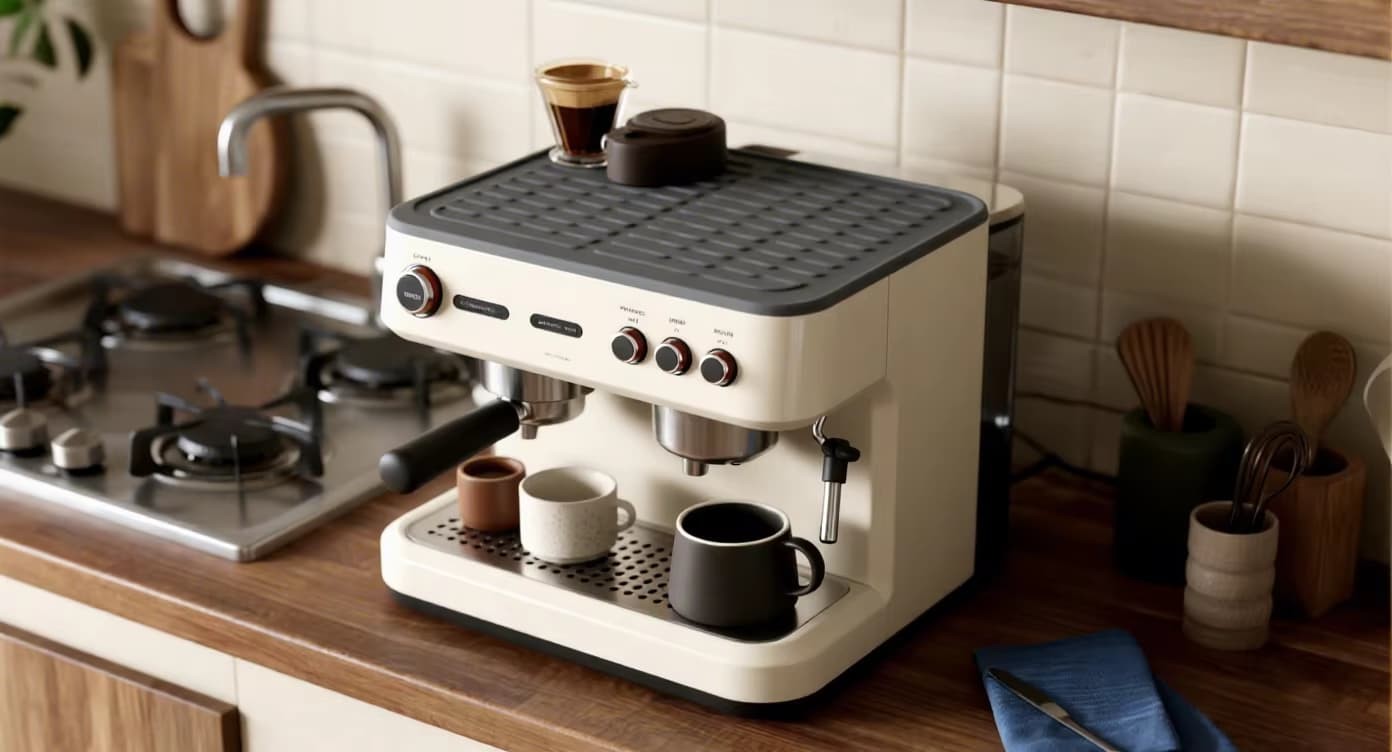
Vibration note
Rattle is a vibration problem, so a mat that only adds friction will not solve it. A coffee machine top silicone mat works when it decouples the cup from the machine surface: enough compliance to absorb pump vibration, enough contact area to stop the cup walking, and a groove pattern that lets spilled coffee leave instead of pooling under the cup.
- Damping depends on thickness and hardness together — a 2 mm mat at 60 Shore A transmits far more vibration than a 4 mm mat at 40 Shore A.
- Grooves do two jobs: they break the water film that makes a cup slide, and they give spilled coffee somewhere to go.
- Coffee oil stains are a compound choice, not a cleaning habit: test 24 hour immersion, not a wipe.
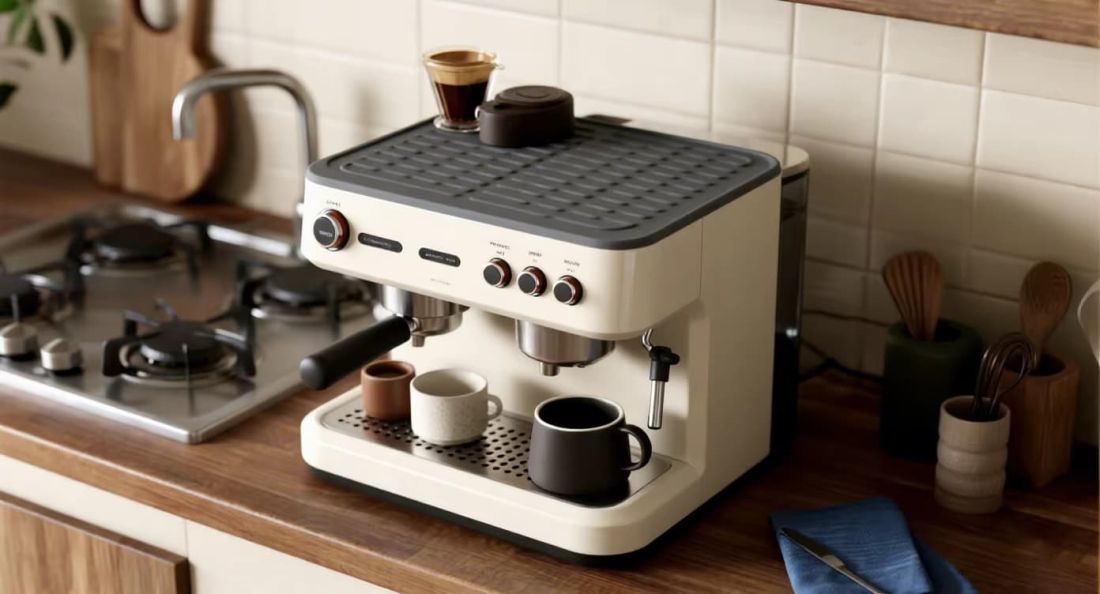
Why a coffee machine top silicone mat changes the rattle
A vibrating pump shakes the machine body, the body shakes the cup, and the cup rattles against the drip tray or the top plate. Inserting a compliant layer changes the path: the mat deforms slightly with each cycle and absorbs energy instead of transmitting it. A thin hard mat behaves almost like the metal it covers, which is why a 1 millimetre pad often makes no audible difference at all.
Friction is a separate benefit. A wet cup on a stainless surface has a water film under it and slides at the slightest nudge; a grooved silicone surface breaks that film and holds the cup. Both effects matter, but they are specified differently, and a supplier who only talks about grip has not understood the complaint.
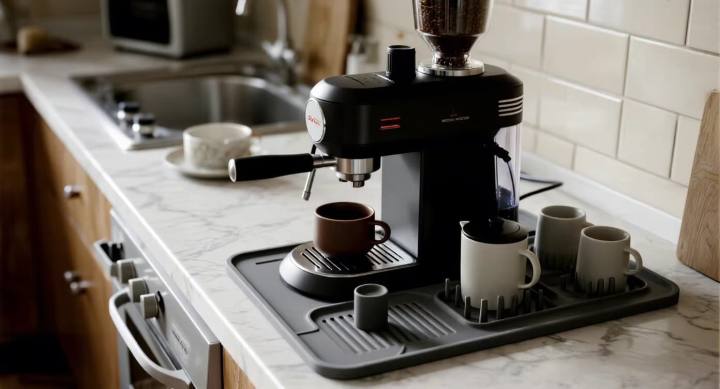
Thickness, hardness and the contact area that decides damping
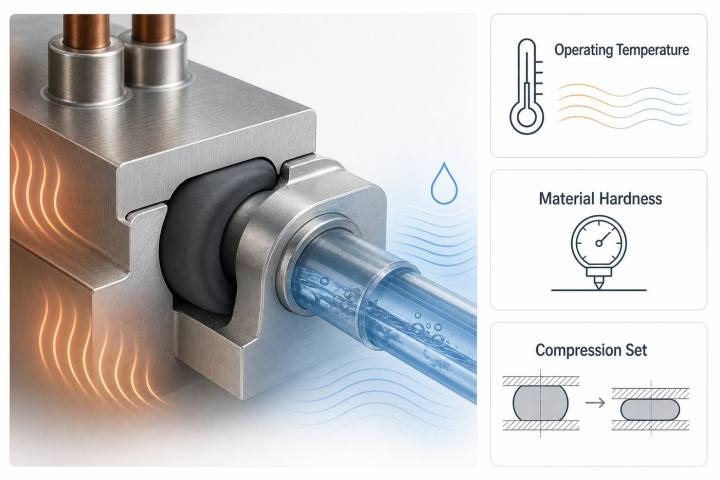
A practical starting point for a domestic machine is 3 to 4 millimetres at 40 to 50 Shore A: thick enough to compress under a cup, soft enough to absorb the pump frequency, and stable enough not to creep under a full mug left overnight. Thicker and softer works better acoustically but becomes difficult to clean and can trap water underneath.
Contact area is the third variable. A mat with large raised pads concentrates load and damps well but leaves gaps where coffee collects; a fully textured mat spreads load and cleans easily but transmits more vibration. The usual compromise is a raised ring under the cup position with a fine texture everywhere else, which puts the compliance where it is needed and keeps the rest wipeable.
- 3 to 4 mm at 40 to 50 Shore A — a sensible damping range for domestic machines.
- Raised ring or pad — concentrates compliance under the cup rather than across the whole mat.
- Fine surface texture — breaks the water film without creating dirt traps.
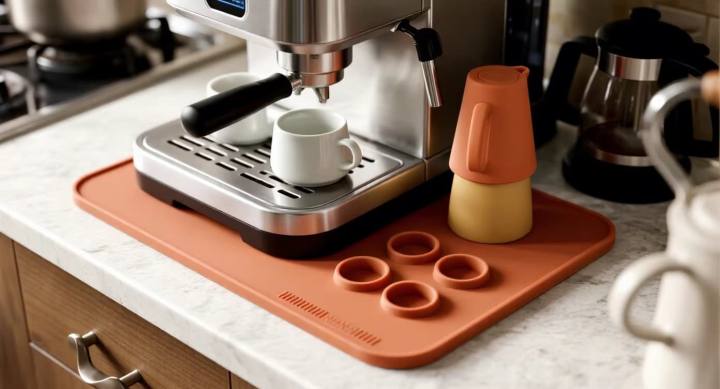
Specifying a mat that survives a coffee machine
| Requirement | Target | Test to write into the order |
|---|---|---|
| Heat | Continuous 100 °C, peaks from steam | Age 72 hours at 120 °C, check deformation and hardness change |
| Staining | No visible ring after 24 hours | Immerse in brewed coffee at 60 °C, rinse, compare to master |
| Drainage | Water leaves the cup zone | Pour 20 ml onto the mat and observe where it pools |
| Slip | Cup does not walk at 2° tilt | Tilt table with a wet cup, three repeats |
| Cleanability | Wipeable, dishwasher safe if claimed | Ten dishwasher cycles, check gloss and edge lift |
Grooves, drainage and the brown ring problem
A flat mat holds a thin film of coffee under the cup and dries into a ring exactly at the cup edge. Grooves break the film and move the residue to a place that is easy to wipe. A radial pattern draining outward works better than a grid, because a grid traps liquid in the cells and the cells are the hardest part to clean.
Staining itself is a compound question. Light-coloured silicones show coffee oil quickly even when the material is fine, and a pigment that is not fully dispersed shows it faster. If the design calls for a pale colour, ask for an immersion stain test on the finished part rather than a general stain-resistance statement, and expect the lightest colours to be the least forgiving in daily use.
Customising a mat to a specific machine
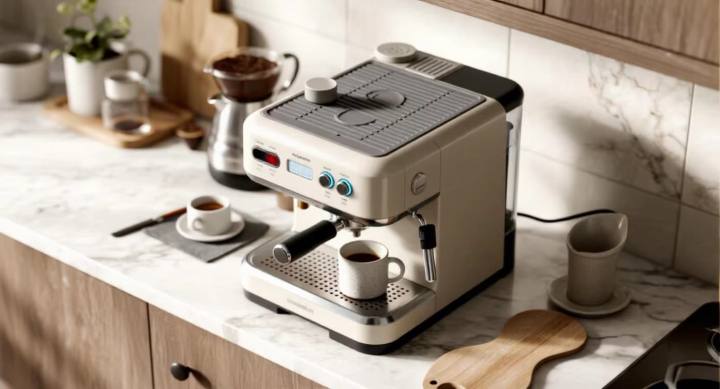
Two machines with similar footprints behave differently under a cup: one transmits a low-frequency pump pulse through a steel top plate, the other damps it in a plastic housing. That is why a mat specified from a photograph often disappoints. Send the machine model, the top surface material and the cup or mug used most, and the thickness recommendation changes accordingly.
The footprint is the second variable. A mat that overhangs the machine catches the drip and looks like an afterthought; one that sits inside the outline looks designed. Cut the outline to the machine, keep a margin for tolerance, and put the drainage where the group head actually drips rather than where the centre of the mat happens to be.
Sampling and approval for a branded mat
A mat is a large, thin part, so it shows moulding problems that a small part hides: flow marks, a wavy edge, a corner that lifts. Approve a sample on a flat surface and check it again after a week, because a thin mat relaxes into its final shape slowly and a corner that lifted on day one will still be lifted on day thirty.
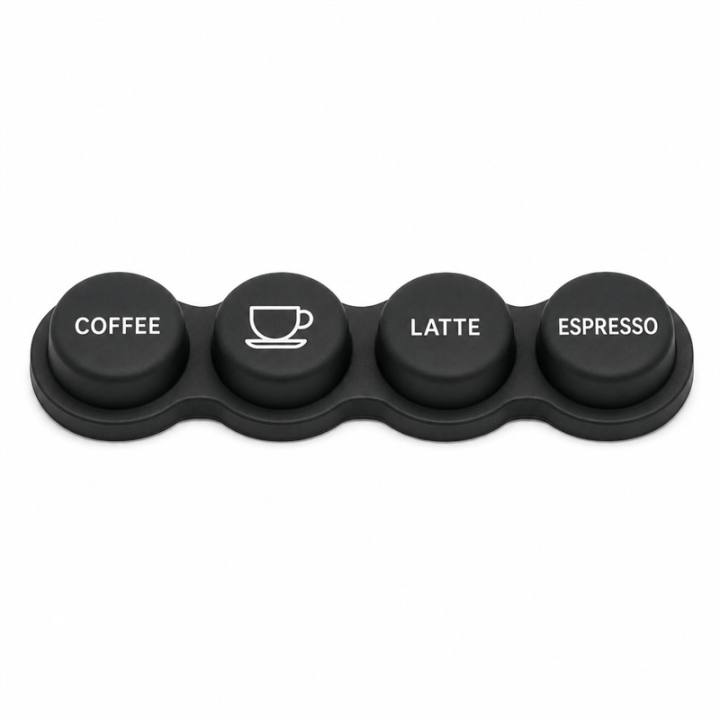
For a branded mat, decide the logo method with the same logic used for pads: moulded for durability, printed for colour. Then specify the packing so the mat travels flat. A rolled mat arrives with a permanent curl that no amount of weight will remove, and it is the complaint most likely to reach a marketplace review.
What to send for a machine mat quote
Four inputs that decide thickness, pattern and price.
Machine outline
A trace or a dimensioned sketch; a phone photo with a ruler works for a first pass.
Cup and mug sizes
Base diameter and typical fill weight, so damping thickness can be set.
Top surface material
Steel, plastic or glass, because the contact behaviour differs.
Branding intent
Moulded, printed or none, and where on the mat it should sit.
Questions about mats and machine vibration
Will a mat stop the cup rattling completely?
It will reduce it substantially if the thickness and hardness are right. Complete silence usually needs a change in the machine mount as well, because the mat cannot absorb vibration that the frame transmits directly to the drip tray.
Is a thicker mat always quieter?
Up to a point. Beyond about 5 millimetres the mat becomes unstable under a loaded cup and traps water underneath, which creates a different problem. Match thickness to cup mass rather than maximising it.
Can the mat be printed with a brand logo?
Yes, but print on a surface that sees hot water and coffee will fail faster than on a dry surface. A moulded logo is the more durable choice on a machine top.
Does the mat need to be food contact rated?
If a cup rim or a spoon can touch it, treat it as a food-contact surface and ask for the finished-part declaration, not a compound certificate.
Send the machine footprint and the cup size
FromRubber moulds machine-top mats and cup pads with defined damping geometry, drainage patterns and stain-tested compounds. Send the machine footprint, the cup base diameter and the surface material it sits on; we will propose a thickness and pattern that quietens the rattle without creating a cleaning problem.
Request a mat design reviewRelated reading: custom silicone cup mats and coasters and branding a silicone pad.