Does the electric toothbrush silicone sleeve cartoon design fade or come off after washing or brushing?
- Share
- publisher
- Suey
- Issue Time
- Apr 8,2026
Summary
Whether an electric toothbrush silicone sleeve fades is decided by how the colour is put into the part, not by the washing. This note compares moulded-in colour, surface print and coating, sets out the rub and dishwasher cycles that actually predict field performance, and explains why a sleeve with a printed cartoon face fails at the edges first.

Colour durability note
A colour that lives in the compound cannot peel, because there is no interface to fail. That is the whole argument for moulded-in colour on an electric toothbrush silicone sleeve: a printed cartoon face is a thin film bonded to a flexible surface, and every wash cycle works on the bond. The test is not whether it fades on the first wash, but how many cycles it takes.
- Moulded colour is pigment dispersed in the compound; print is an interface. Interfaces fail, compounds rarely do.
- Test with a defined cycle: rub cycles, dishwasher cycles and a wipe with an abrasive cleanser, each with a pass criterion.
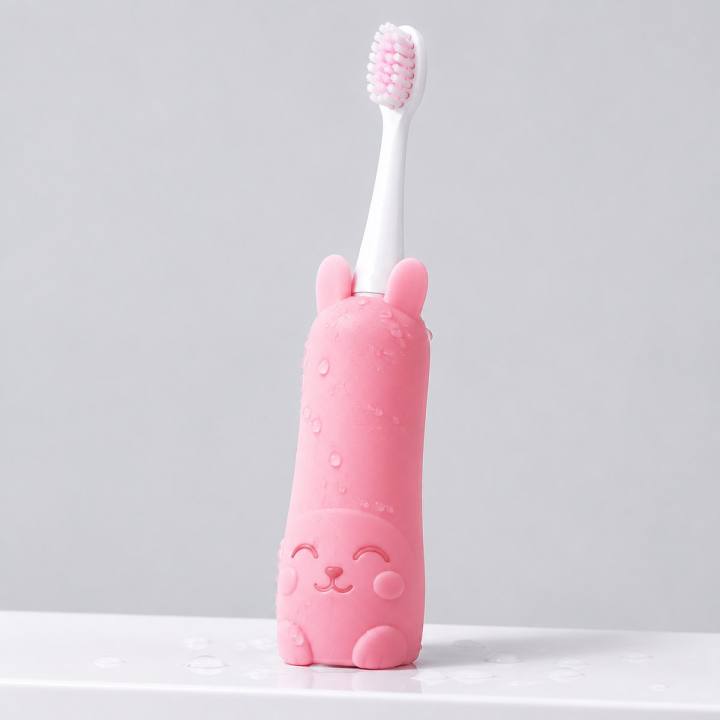
- Print fails at the edges and at flex points first, so a cartoon face with fine outlines is the hardest design to keep intact.

Three ways to colour an electric toothbrush silicone sleeve
Moulded-in colour uses a pigment masterbatch dispersed into the compound before cure, so the colour is the material. It cannot chip, peel or wear through, although it can shift slightly if the pigment is not fully dispersed or if the cure is uneven. Surface print applies ink to a cured part, giving full-colour artwork and gradients at the cost of a bond that has to survive flexing, water and toothpaste.
Coating sits in between and is the least durable of the three on a flexible part: a lacquer or a sprayed film cracks when the sleeve bends, and cracks are where water gets under the film. For a sleeve that is handled wet every day, the practical order is moulded colour first, print second, coating only where the artwork cannot be moulded.
The tests that predict fading better than a wash
A single trip through a dishwasher proves almost nothing. The useful tests are cyclic and they attack different mechanisms. A wet rub test with a defined load and a defined number of strokes measures abrasion. A dishwasher cycle series measures the combination of heat, alkaline detergent and mechanical action. A sunscreen and toothpaste smear test measures chemical attack on the print or the pigment.
Set a pass criterion before the test, then report the cycle count at which it fails rather than a pass stamp. For moulded colour, the meaningful criteria are colour shift against a master and surface gloss change. For print, add edge integrity: photograph the artwork at a known magnification before and after, because the failure starts at an outline and is invisible at arm's length.
- Wet rub — defined load, defined strokes, measured colour shift.
- Dishwasher series — 50 to 100 cycles, checking print edges and gloss, not only colour.
- Chemical smear — toothpaste and sunscreen left in contact, then wiped, then inspected.
- Flex — bend the sleeve over the brush body 1,000 times and look for crazing in the print.
Moulded colour versus printed artwork on a flexible sleeve
| Criterion | Moulded-in colour | Surface print |
|---|---|---|
| Failure mode | Slight shift from pigment dispersion or cure | Edge lift, then peeling and colour loss |
| Artwork freedom | One colour per shot, or two with a two-shot tool | Full colour, gradients, fine detail |
| Tooling cost | Higher for multi-colour | Lower; a shared tool with a print step |
| Per-unit cost at volume | Lower, no print operation | Higher, one pass per colour |
| Dishwasher survival | Excellent | Depends entirely on ink and cure |
| Best fit | Brand colour on a product washed daily | Seasonal artwork on a short-run product |
Design details that keep a cartoon sleeve looking new
Put the artwork where the hand does not rub. The grip area of a toothbrush sleeve sees constant abrasion from a wet hand, and any print there will dull first. Move the character to the upper section, keep the grip as moulded texture, and the design lasts noticeably longer with no change to the ink.
Then simplify the outline. A cartoon face built from three or four bold shapes survives far more cycles than the same face with fine eyelashes and gradients, because there is less edge length to lift. Where the design needs detail, mould it as relief and leave the colour flat — the shadow does the work and there is nothing to peel.
Keeping colour consistent across production lots
Moulded colour is permanent but not automatically identical between batches. Pigment dispersion, cure temperature and the base compound's own tint all shift the result, and the shift is usually invisible on a single part and obvious when two lots sit side by side on a shelf. The control is a physical master kept in the same light as the product, plus a measured tolerance rather than a verbal one.
For a cartoon sleeve, add one more check: the contrast between the character and the body. Two colours can each be within tolerance and still read badly together if the contrast drops at the darker end of the range. Photograph the approved sample and the new lot together under the same light and compare the pairing, not only the individual readings.
Questions about colour and washing
Will a moulded-colour sleeve ever fade?
It can shift slightly under prolonged UV and heat, and a poorly dispersed pigment shows blotches. Against washing and abrasion, moulded colour is effectively permanent because there is no film to remove.
Is a printed sleeve dishwasher safe?
Only if the ink and the cure are specified for it, and even then the edges are the weak point. Ask for a cycle test on the finished part rather than a general statement.
Why did the print come off only on one side?
That side is the one that contacts the hand or the cup. Print wear is a mechanical story before it is a chemical one; the fix is usually placement, not a different ink.
Can we match a brand colour exactly?
To a physical master under a defined light source, yes, within a stated tolerance. A colour match from a screen or a photograph is not a specification.
Send the artwork and the wash environment
FromRubber moulds silicone sleeves and covers with moulded-in colour, moulded relief and print options, and can run cyclic wash and rub tests on production samples. Send the artwork, the colour master and how the product will be cleaned; we will recommend moulded colour or print on the basis of the cycles it has to survive.
Request a colour durability reviewRelated reading: laser etching versus screen printing on silicone and custom silicone sleeves.