Food-Grade Cartoon Silicone Cup Lids: Safety Standards Every Buyer Should Know
- Share
- publisher
- Suey
- Issue Time
- May 7,2026
Summary
Food-grade cartoon silicone cup lids are approved as finished articles, not as a material claim. This buyer's brief covers the migration tests that decide clearance, why pigment and print carry the real risk, the six documents to demand before a PO, and design choices that cut compliance risk without raising unit cost.

Buyer compliance brief
Food-grade cartoon silicone cup lids are cleared as finished articles, not as a material claim. The silicone compound, the pigment masterbatch and the cured print layer all enter the migration test together, so a programme that validates only the base material is validating a product nobody ships. Build the test plan around the lid you actually sell, on the tool you will actually run.
- Platinum-cured, food-contact compound only: peroxide-cured stock carries by-products that post-curing cannot remove.
- The print and the pigment are the migration hot spots, and every new artwork resets validation.
- Documentation travels with the lot: compound declaration, migration report, ink certificates, cure records.
What food-grade cartoon silicone cup lids must actually prove
Food-grade is a declaration about the finished article in its intended use, not a grade you buy from a compounder. For silicone drinkware the reference points are FDA 21 CFR 177.2600 in the United States, LFGB section 30 in Germany, and EU 10/2011 for elastomer food-contact articles in Europe. Each extracts the article under defined time and temperature conditions and compares the residue with a limit.
That is why a lid cleared at 70 °C for two hours is not automatically cleared for coffee at 95 °C, and a lid tested in water is not cleared for milk, juice or citrus. The test conditions must mirror the real contact scenario — and that scenario includes the cartoon print on the outer rim, where fingers and lips touch the part.

Three tests that separate a compliant silicone cup lid from a claim
Most supplier datasheets stop at hardness and tensile strength. Those say nothing about what the lid releases. Ask for the three results below, and ask for the measured values rather than a pass stamp.
- Overall migration — total non-volatile residue after immersion, reported in mg/dm² of contact area. This is the first screen and the one most often missing.
- Specific migration — targeted analysis for siloxanes, catalyst residues and pigment carriers. Request the analyte list.
- Sensory and odour panel — a lid can pass chemistry and still taint a drink. Trained sensory assessment catches volatile carry-over a lab report will not.
Why the cartoon print is the riskiest element of the part
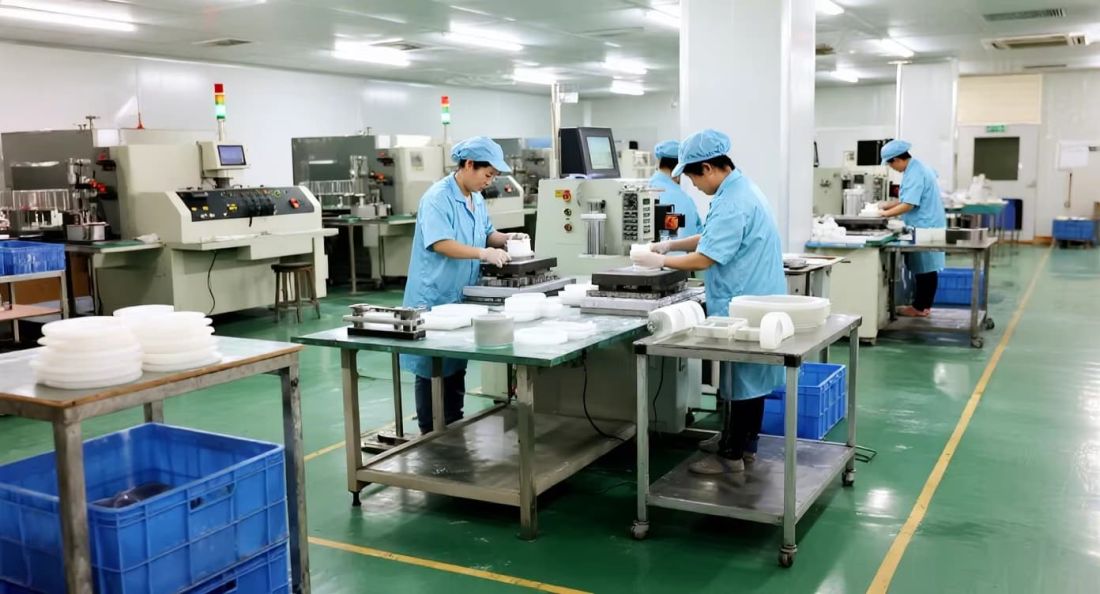
Silicone ink systems cure at high temperature, and the process window is narrower than most buyers assume. Under-cure leaves photoinitiators and solvents mobile; over-cure embrittles the film and opens micro-cracks that trap residue. Every additional colour is another ink, another cure pass and another migration analyte — which is why the colour count should be frozen at concept stage, not negotiated later.
Pigments carry their own risk. Cadmium, lead and certain azo dyes are the classic failures, and a thermoplastic masterbatch that suits polypropylene can inhibit platinum cure entirely. Specify a heavy-metal-free, food-contact masterbatch that is chemically compatible with addition-cure silicone, and have the moulder confirm cure integrity with a tack test on every colour, every batch.
The six-document pack to request before the first purchase order
If a supplier cannot assemble this pack, the compliance claim is marketing rather than evidence. Review it before the PO and again at every annual supplier review.
Compound declaration
Full formulation disclosure under NDA plus the compounder's food-contact statement. A line reading “food grade” on an invoice is not a declaration.
Migration report
Accredited-lab report stating test conditions, contact area and measured values — not only a conclusion.
Pigment and ink certificates
Heavy-metal and PAH statements for every colour, including the white base layer under the cartoon design.
Cure verification records
Per-batch tack and hardness checks. This is the control that protects you between third-party tests.
Change-control log
Any compound, pigment, ink or tool change documented and re-validated before shipment reaches you.
Lot traceability
Lot number linking lid, compound batch and print run, so a field complaint closes in hours instead of weeks.
Design choices that lower compliance risk without raising unit cost
These five decisions are settled on the drawing. All of them reduce validation exposure, and none of them adds a process step.
| Design decision | Compliance effect | Commercial effect |
|---|---|---|
| Print confined to the outer skirt | Keeps ink out of the liquid-contact zone | No cost change; artwork area shrinks slightly |
| Two colours maximum, single side | Fewer inks to test and cure | Shorter print cycle and lead time |
| Undercut-free sealing lip | Uniform compression, no thin walls that crack and trap residue | Longer tool life, lower reject rate |
| Post-cure built into the cycle | Stable extractable profile lot to lot | Adds minutes per cycle, removes re-test risk |
| Compound grade frozen for the programme | No re-validation on a colour change | Protects the launch date |
Questions buyers ask before approving a printed lid
Is LFGB stricter than FDA for silicone lids?
They test differently rather than one being stricter. LFGB weighs sensory evaluation heavily and uses different simulants and exposure times; FDA 21 CFR 177.2600 sets extractable limits after water and hexane reflux. A lid sold into both markets needs both test sets, not the tougher-looking one.
Can we reuse an existing migration report for a new cartoon design?
No. A new artwork changes ink chemistry, film thickness and cure load, so treat it as a new article: re-run overall and specific migration on the production tool and add the new pigments to the certificate pack.
Does a thicker lid make the product safer?
Not directly. Thickness governs compression set and durability, not migration. Over-thick sections lengthen cycle time and can create internal voids that trap moisture — a quality defect that reads as a safety issue in the field.
Send the artwork and the destination market, get a compliance route map
FromRubber moulds and prints food-contact silicone drinkware in Dongguan. Share the lid drawing, the target market and the ink colours; we will return a test plan, a tooling concept and a straight statement of what must be re-validated before you commit to volume.
Request a compliance and tooling reviewFor OEM programmes, include the sealing-surface drawing and the intended contact temperature so the test conditions are set correctly the first time. Related reading: how safe silicone cup lids are made.