From Succulents to Lenses: 10 Unexpected Uses for a Silicone Dusting Ball
- Share
- publisher
- Suey
- Issue Time
- May 8,2026
Summary
Ten uses for a silicone dusting ball — plants, optics, PCBs, watches, records, 3D printers — explained by the contaminant, why contact cleaning fails, and the nozzle or ESD grade each job needs.
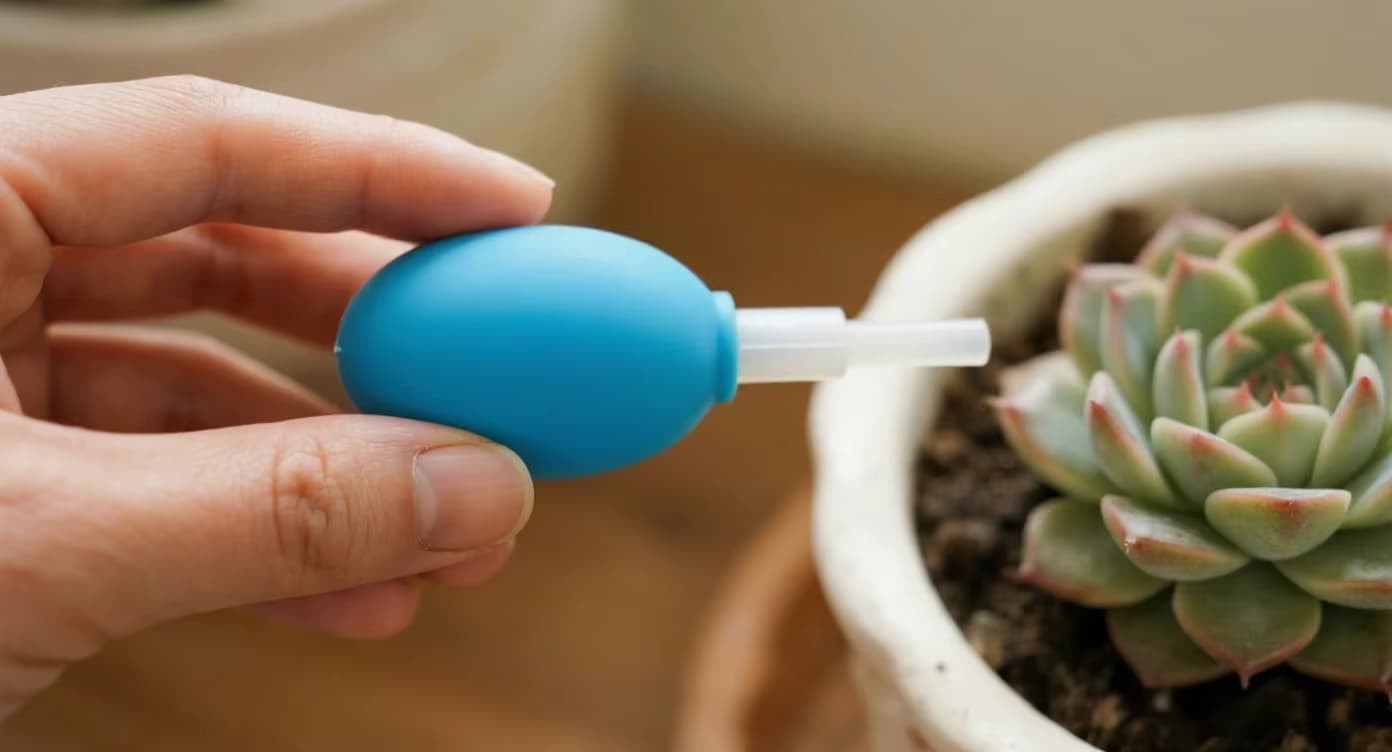
A silicone dusting ball works in ten unrelated jobs because it does one thing precisely: it moves a small volume of dry air at low velocity, from a nozzle that cannot scratch. Succulent leaves, coated lenses, switch stems and vinyl grooves fail under the same two conditions — wet or abrasive contact — and the bulb avoids both.
The engineering decision is not whether to use one, but which one. Bore diameter sets velocity, compound hardness sets how finely the squeeze is metered, and an ESD-safe grade decides whether the tool may go near a PCB. Those three variables separate a tool that lasts years from one that splits at the shoulder.
Why one tool covers ten different surfaces
Every application here shares a constraint: the contaminant is loose and the substrate is delicate, coated, charged or unreachable by cloth. That rules out brushing, wiping and wet cleaning, and leaves air as the only contact-free option.
- Velocity, not volume — a wide mouth lifts dust from a leaf; a fine bore reaches a panel line on a model.
- Dry air only — no propellant or condensate left on a coated lens or bare PCB.
- Static control — an anti-static compound stops lint being pulled back onto the surface.
- No abrasion — the nozzle is soft silicone, so accidental contact with a mirror box or a watch balance does no damage.
That is why one unit appears in a plant collection, a repair bench and a laser cutter: the requirement repeats, not the product category.
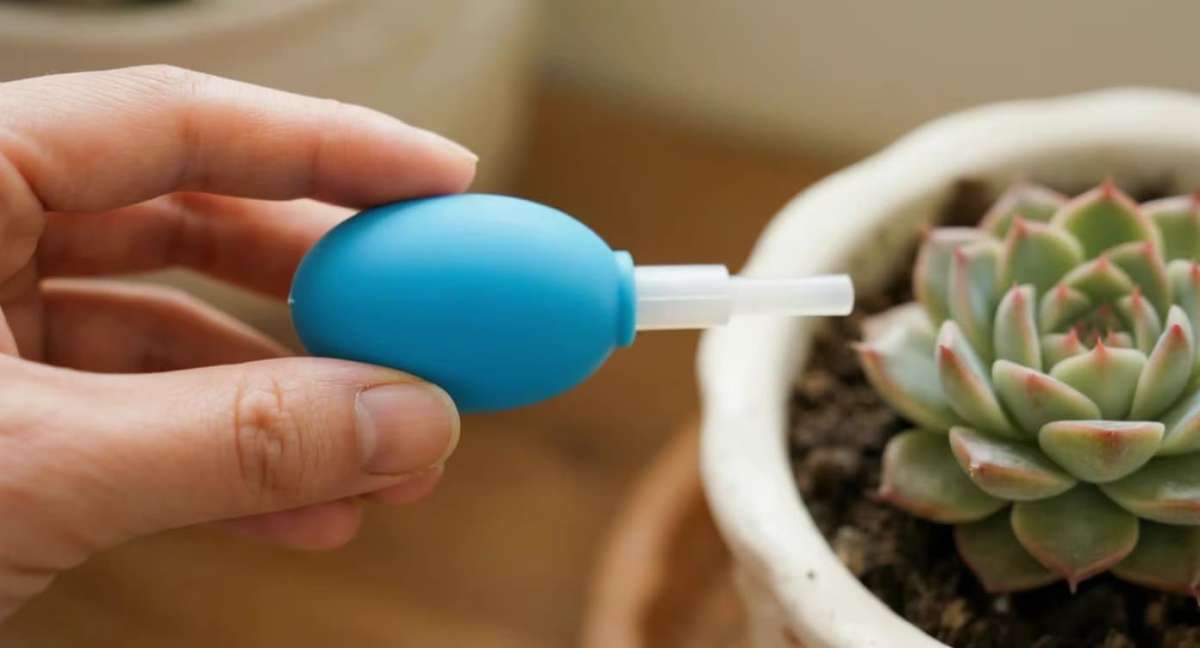
On fleshy leaves the goal is to lift dust without contact; on optics it is to remove debris before any wet cleaning begins.
Ten uses and the nozzle each one actually needs
Each row is a contaminant-and-surface combination; the last column decides whether the tool works.
| Application | Contaminant | Why contact cleaning fails | Nozzle or compound choice |
|---|---|---|---|
| Succulents and houseplants | Dust blocking light on fleshy leaves | Wiping bruises the leaf and removes farina | Wide mouth, low velocity |
| Camera lens and sensor | Loose grit before wet cleaning | A dry wipe drags grit across the coating | Fine bore, anti-static compound |
| Keyboards and switches | Hair, crumbs, dust between keycaps | Canned air can spit condensate | Fine angled tip for gaps |
| Jewellery and watches | Dust in links and settings | Brushes dislodge stones and polish metal | Soft tip, controlled squeeze |
| PCBs and electronics | Dust causing hot spots and leakage paths | Contact tools risk ESD and track damage | ESD-safe compound |
| Models and miniatures | Dust in panel lines before paint | Wiping smears and disturbs placed parts | Fine bore, dry air |
| Binoculars and telescopes | Dust on eyepieces and objectives | Wiping dry optics scratches coatings | Fine bore, soft shoulder |
| Vinyl records and styli | Dust that becomes pops and surface noise | Dry brushes generate static and leave residue | Anti-static compound |
| Makeup brushes | Powder residue between washes | Rubbing drives powder deeper into bristles | Wide mouth, gentle puff |
| 3D printers and laser cutters | Dust on build plates, rails and optics | Compressed air drives debris into guides | Angled tip for reach |
Read it vertically and the family collapses into three variants: wide mouth, fine bore, and ESD-safe.
Where the wrong bulb causes damage
Two applications carry real risk when the tool is chosen badly. On a multi-coated lens or sensor cover glass, a nozzle that touches the surface or a puff strong enough to drive grit sideways turns a dust problem into a scratch no cleaning will fix.
The second is electronics. A compound that generates static can leave a latent charge on a board, which surfaces later as an intermittent fault rather than an immediate failure. That is why repair benches specify material, not shape.
Generic rubber bulbs fail differently: they crack at the neck, outgas and shed particles into the airstream meant to clean — none of it visible on a spec sheet.
Never wipe a dry lens before blowing it. The first pass exists to remove the grit that a cloth would otherwise drag across the coating — the order of operations protects the surface more than the choice of cloth does.
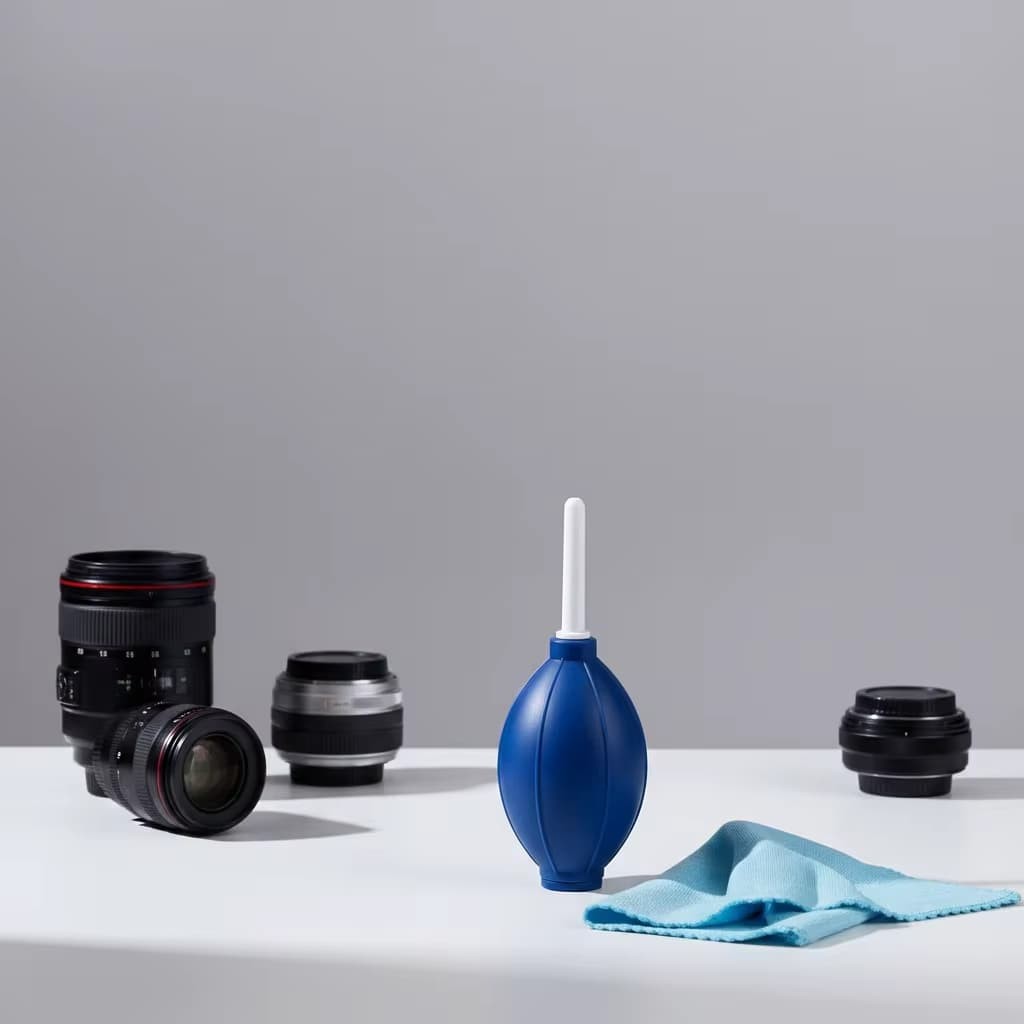
On coated optics the nozzle never touches glass; the air does the work and the tool stays a fixed distance away.
Specifying a silicone dusting ball for an OEM range
Brands usually start from one mould and differentiate on three points, all set at tooling and impossible to change per order.
Compound and static grade
Medical-grade silicone is the baseline; an anti-static or ESD-safe grade is a separate compound, chosen before the mould is cut because it changes shrinkage and therefore the tool.
Nozzle and body
Nozzle length, bore and angle decide which of the ten uses a product can claim. A single retail SKU usually takes a medium bore with a slight angle — fine for plants and keyboards, not for sensor chambers.
Colour and branding
Custom colours and moulded branding let one mould serve several brands or a seasonal range. The packaging claim matters too: an ESD-safe version and a plant-care version should not share a box.
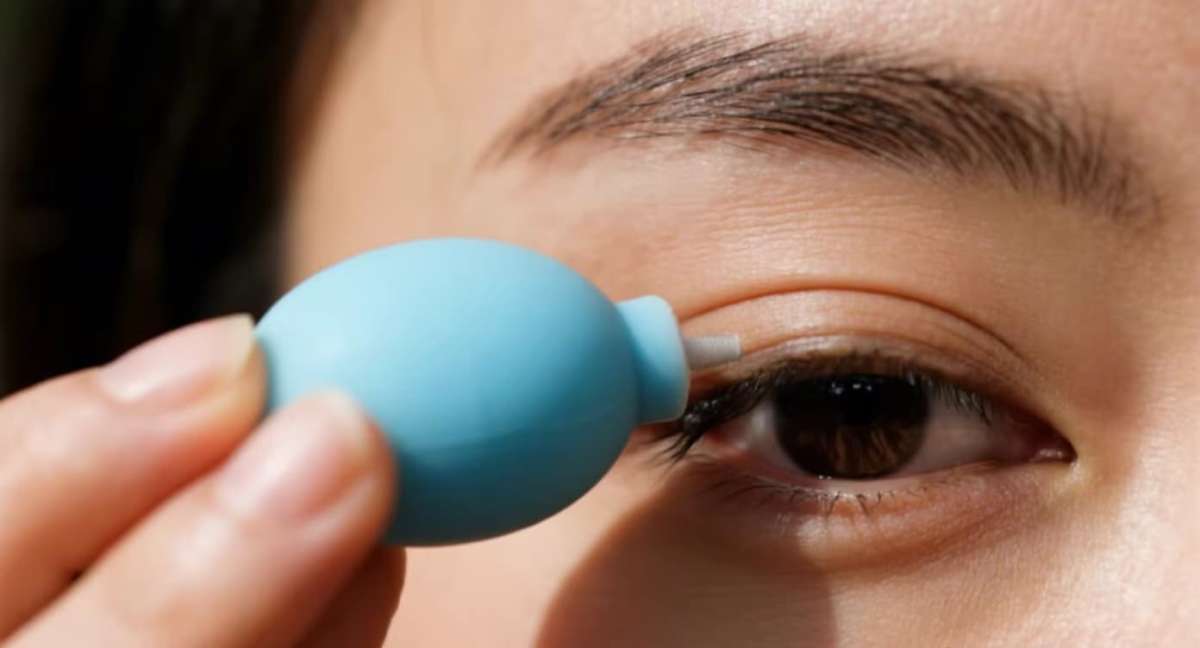
One mould, three variants: bore and compound are the differences that justify separate SKUs.
Questions buyers ask before ordering
Is one blower enough for optics and plants?
Physically yes, commercially no. A tool used on plants carries pollen, and a plant-care SKU need not pay for an ESD-safe compound. Keep them as separate SKUs.
Does anti-static really change performance?
It changes what happens after the puff. Standard silicone holds a charge that pulls lint back onto the surface; an anti-static compound dissipates it, which is why it is specified for records, PCBs and lens work.
How long does a silicone bulb last?
Years, if it is not stored compressed or left in sun. Failure shows first as a tacky surface or a split where the wall thins at the neck.
Can the nozzle be changed for a different market?
Only by changing the mould. Bore and angle are moulded geometry, so a brand planning two applications should tool two variants up front.
Build a dusting ball range on one platform
Send the applications you intend to claim; we will propose bore, compound and static grade per variant, then quote tooling on a mould that serves the whole range.
Compare the salon version in our eyelash dusting ball guide, or review silicone OEM manufacturing.