How Does Bag Opening Support Affect a Silicone Sink Hanging Basket?
- Share
- publisher
- FromRubber
- Issue Time
- Nov 2,2026
Summary
The opening of a silicone sink hanging basket is a closed frame in bending. This article explains why rim depth resists ovalisation better than wall thickness, where reinforcement should sit, and how to use a simple ovalisation index when approving a sample.
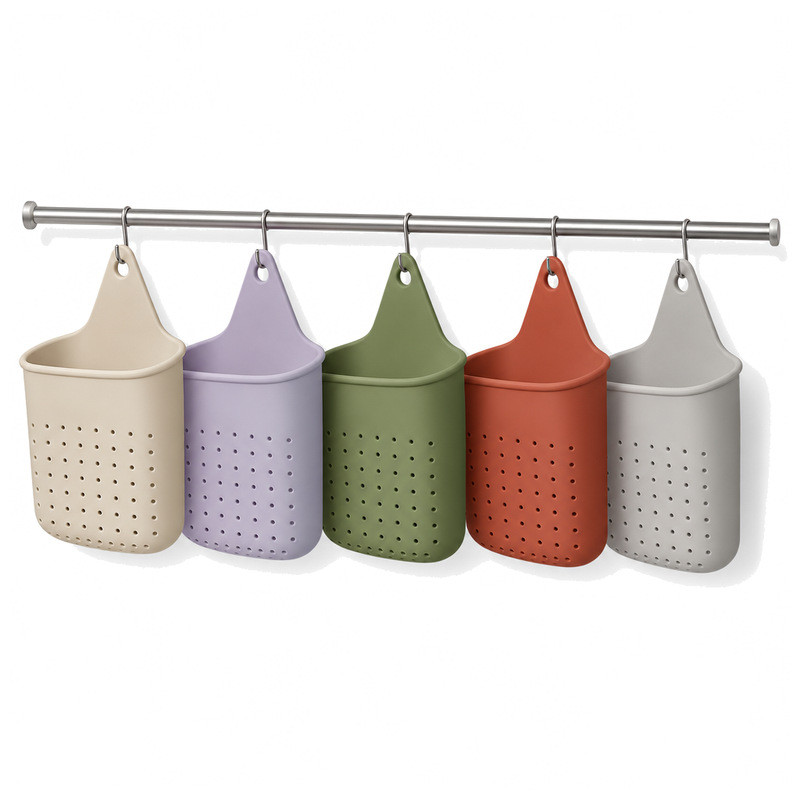
The bag looks correct in the photograph and behaves badly at the sink. Two months in, the mouth has closed to a slot, the front edge has folded inward, and the customer is holding it open with one hand while trying to scrape a plate with the other. Nothing has broken, so it is hard to call it a fault, and it is the first thing anyone notices about the product.
An opening is a frame, not an edge. It keeps its shape only if the rim behaves as a closed loop with enough depth to resist bending. Adding thickness around a soft rim does much less than adding depth to it, and it is the difference between a bag that is easy to fill and one that has to be held open.
Look at the rim on a hanging basket and you are looking at a beam bent into a loop. When the bag is loaded, the walls pull outward and the loop is pushed into an oval. Whether it stays round is decided by the rim's section, not by the bag's overall softness.
That reframing matters because it changes what you adjust. Most opening complaints are answered with a harder compound, which stiffens everything including the parts that should stay soft.
Why Does the Opening Matter in a Silicone Sink Hanging Basket?
The mouth does three jobs that pull against each other. It has to stay open enough to receive scraps, wide enough to let a hand or a brush in, and soft enough that the rim does not hurt when the user presses against it while scraping a plate.
It is also the first thing anyone sees. A rim that has sagged makes an otherwise sound product look worn out, and it is the detail that ends up in review photographs.
The opening collapses when the basket is empty
An empty basket is not a neutral state. The moulding has residual stress from curing, the rim has some memory of the shape it was released in, and gravity is already pulling the front edge down. A rim with too little depth curls inward under its own weight, and once it has curled it tends to stay curled because the material takes a set.
That is why some baskets arrive looking fine and look tired after a week of hanging. The change is small, gradual, and permanent. It is also easy to miss in a sample review, because the sample is usually inspected on a table rather than on a rail.
Food scraps become difficult to put into the basket
Once the mouth closes into an oval or a slot, the usable aperture is smaller than the drawing says. The user compensates by pushing scraps against the rim, which bends it further, which narrows the opening again. The product teaches the user to fight it.
The loss is not linear with the deformation. Squeeze a circular opening into an ellipse with a 2:1 axis ratio and the perimeter stays the same while the enclosed area falls by roughly 16 percent, which you can check from the standard ellipse perimeter approximation. On a real rim the loss is usually worse than the geometry alone suggests, because the walls also fold inward at the top of the throat and take up space inside the opening.
Removing the basket contents becomes less convenient
Emptying is the second half of the job. A narrow or collapsing mouth means the user tips the basket further than they want to, and wet contents slide over the rim instead of out of it. The rim then becomes an edge that has to be wiped, which is exactly the cleaning problem the product was meant to avoid.
There is a dimensional consequence too. A mouth that is comfortable to fill from a plate is often too narrow to empty into a bin without a second hand. If the product is designed around filling and not around emptying, the second half of the use cycle is where the complaints come from.
Which Bag Opening Designs Can Improve Shape Retention?
A thicker rim can help the opening hold its shape
Thickening the rim does work, and it is the first thing most drawings do. The limitation is in the arithmetic: for a band of material, resistance to bending rises with the cube of its depth and only linearly with its thickness.
Practically, that means doubling the rim's wall thickness roughly doubles its resistance to ovalising, while doubling the rim's vertical depth increases it by around eight times for the same material added in a different direction. If the choice is between a 3 mm thick rim that is 4 mm deep and a 2 mm thick rim that is 10 mm deep, the second one will hold its shape better and weigh less.
The thicker option has a second cost. A thick rim is stiff against the user's hand, and on a kitchen product the rim is exactly where a hand rests. Stiffness added there is felt immediately, which is why buyers often reject a heavier rim even when it solves the shape problem.
A rolled or rounded edge can improve handling
A rounded edge is the right shape for a hand. It also removes the sharp lip that catches on a cloth and the thin edge that whitens first when the user presses on it.
A rolled edge is a different proposition. Rolling the rim over doubles the material back on itself, which creates a hollow section with two thin walls rather than one deep one. That section resists local crushing well and resists overall ovalisation poorly, and the fold line inside the roll is a place where water sits and residue dries. Our note on why a rolled rim creates a slot that never dries covers the hygiene side; the structural side is that a rolled rim looks more substantial than it is.
If a rolled look is wanted for the brand, the same appearance can usually be achieved with a solid, radiused rim that is deeper than it is wide, which keeps the visual weight and gives the section somewhere to work.
A wider rim can provide more structural support
Rim width, meaning how far the rim projects inward or outward from the wall, contributes to stiffness in a different way. A wide horizontal flange resists the rim folding down, because the material is now at a distance from the fold line. It does little for ovalisation, because that deformation happens in the plane of the opening.
Width also has a space cost. A wide flange eats into the usable aperture, so a 15 mm flange on a 110 mm opening leaves 80 mm to work with. And on a hanging product, a wide flange at the back can foul the rail or the cabinet door.
The useful combination is usually a rim that is deep, moderately wide and locally reinforced at the two points where it is most likely to buckle, rather than uniformly heavy all the way round.
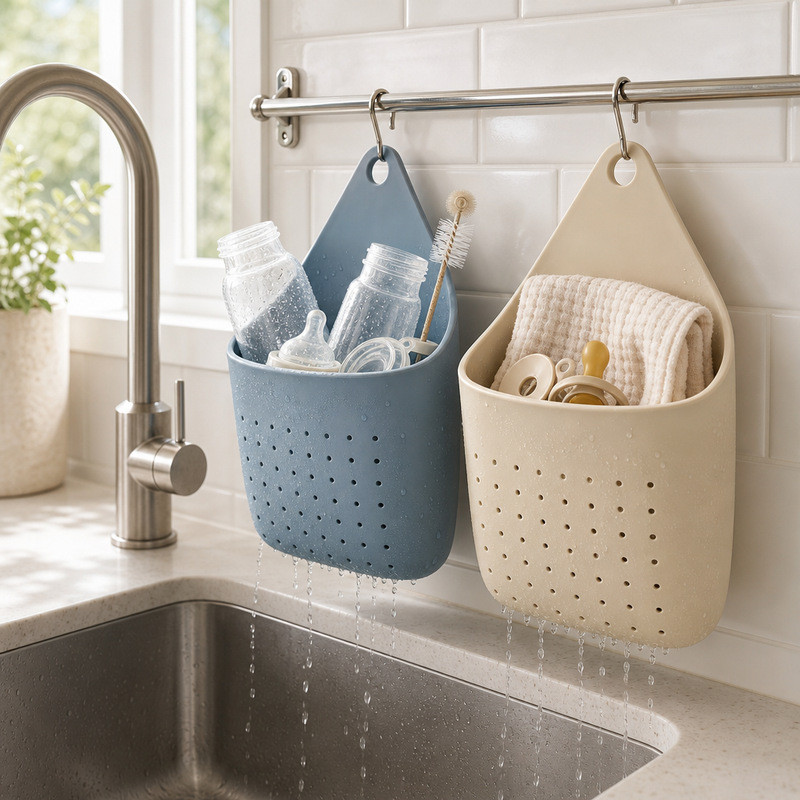
Tall items are the hardest test of an opening. A bottle enters at an angle, rests against the rim while the user reaches for something else, and comes out with a twist. A rim that is stiff enough to resist that repeated leverage still has to be soft enough not to chip the bottle.
That is a section problem rather than a hardness problem: a deep, rounded rim can be soft at the surface and still resist being pushed out of shape.
How Do Material Hardness and Wall Thickness Affect the Opening?
Softer silicone is not always better for the opening
Below about 40 Shore A the material becomes very willing to fold, which is pleasant in a collapsible product and unhelpful in a rim that has to stay open. At the other end, a 70 Shore A rim stops ovalising and starts feeling like a plastic bowl with a rubber coating.
The step between grades is bigger than the numbers suggest. Moving from 50 to 60 Shore A raises the elastic modulus by roughly 47 percent, and moving from 60 to 70 raises it by another 53 percent, based on the modulus values tabulated in the standard Shore durometer reference. A two-step hardness change is therefore a large mechanical change, not a tweak.
The practical consequence: choose the compound for the way the bag should feel in the hand, then get the opening's stability from the section. The reasoning behind grade selection in moulded silicone parts is set out in our note on choosing between 40 and 60 Shore A, and the same trade-offs apply here.
Local thickness changes can improve support without making the whole basket rigid
Local reinforcement is the compromise most projects end up at, and it works if it is placed where the rim actually bends. Two techniques are worth considering before a full redesign.
- A deeper rim over part of the perimeter. Increasing the rim's depth over the front third and tapering back to a shallower section at the sides adds stiffness where the user presses, and leaves the sides soft enough to squeeze.
- A short external gusset at each shoulder. Where the strap meets the rim, the loop changes section and that is where ovalisation starts. A small triangular gusset on the outside face, 2 to 3 mm thick and 15 to 20 mm long, adds local depth without changing the inside surface or creating a place for residue to collect.
Both are tooling-friendly. Neither adds material to the inside of the bag, which is the surface that has to stay clean and smooth.
Opening support should match the bag body design
The rim cannot be designed in isolation, because the walls are what push it out of shape. A tall bag with thin walls applies more outward force at the top than a short bag with the same rim, simply because there is more wall hanging from it and more contents pressing on it.
There is also a geometric relationship worth checking on the drawing: the wider the bag's body relative to the opening, the more the walls have to converge to meet the rim, and the more that convergence acts as a funnel pushing the rim outward when the bag is full. A body that is barely wider than its mouth is much kinder to the rim.
If the body has to be wide for capacity, the rim needs the depth to match, or the strap needs to be positioned so that it takes some of the spreading load rather than leaving it all to the rim. How that load reaches the eye, and why the strap root usually fails before the rim does, is covered in the load path that decides whether the strap holds.
What Should Be Checked During Silicone Basket Sample Testing?
Check whether the opening stays open during normal use
Measure the mouth across two axes, front to back and left to right, with the bag empty and hanging. Then load it to the expected weight and measure again in the same two places. The ratio between loaded and unloaded width is a simple ovalisation index, and it is far more useful than a description.
Agree the acceptable ratio before the sample arrives. A five percent change is normal in a flexible product; a fifteen percent change is a rim that will look collapsed in a photograph.
Test loading and removing different types of items
Use the items the product is actually for, including the awkward ones: a dinner plate, a bottle, a bunch of herbs, a fistful of peel. Do it standing at a sink, with wet hands, without putting the bag down.
Count how many times the user has to hold the rim open with the other hand. That number is the usability metric that matters, and it is usually obvious within ten repetitions.
Inspect the rim after repeated bending
Flex the rim outward and back fifty times, then look at the inside of the bend. Whitening at the fold means the section is being pushed past what it can take, and it will eventually crack. Look at the shoulders where the strap meets the rim as well, since that is where the section changes and where a crack will start.
Check the rim's recovery after an hour. A rim that returns to its original width has elastic behaviour; a rim that stays slightly wider has taken a set, and the difference tells you whether the problem is the section or the compound.
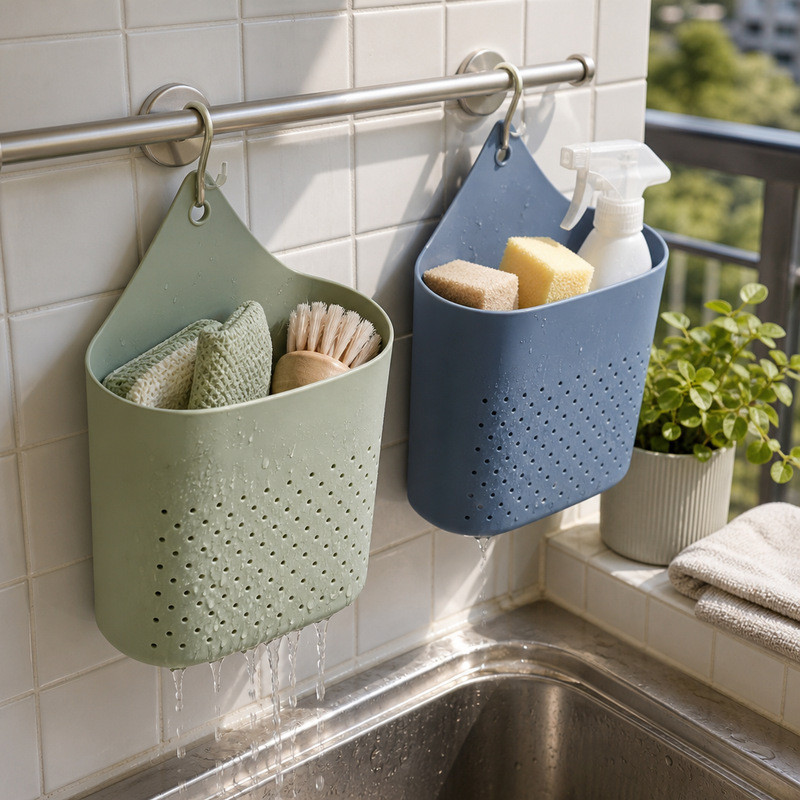
The rim also has to cope with being used as a scraper. Users run a knife or a plate edge across it, which puts a local point load on the section at the point where it is least supported.
That is an argument for a rounded, slightly deeper rim rather than a thin one: the load is spread over more material, and there is no thin edge to nick.
What Should Buyers Discuss With a Silicone Basket Manufacturer?
- The target mouth dimensions, measured inside, and how much of that aperture has to remain usable when the bag is loaded.
- Whether the rim should be deeper, wider or locally reinforced, and whether any of that reinforcement may be visible.
- The target hardness and whether the rim is allowed to differ from the body in section, even if it is the same compound.
- Whether the bag has to fold flat for storage, which limits how deep the rim can be.
- Whether the rim needs a specific edge treatment for hand feel or for a logo.
- The largest object the bag has to accept, measured at its widest point.
- Whether the rim will be used as a scraper edge in the intended use, and how hard.
Conclusion: A Well-Supported Opening Makes the Basket Easier to Use
Rim depth, rim width, local reinforcement and compound hardness all affect whether an opening stays open. Depth does the most work per gram of material, and it does it without making the product feel rigid in the hand.
The check that matters is simple: hang the sample, load it, and measure the mouth. If it holds its width under load, the design is doing its job; if it does not, no amount of colour and texture will fix how the product feels to use. For a brand weighing which of these changes is worth tooling on a first SKU, features worth developing for a private label range sorts them by cost.
Why does the opening of my silicone basket close up when it hangs?
Because the loaded walls pull outward and the rim is not deep enough to resist the resulting ovalisation. The rim is bending in the plane of the opening, and that bending is governed by the rim's section rather than by the bag's overall thickness.
Is a harder compound the answer to a collapsing rim?
It helps and it costs feel. Hardness raises stiffness everywhere, including the parts that should stay soft. Adding depth to the rim solves the same problem locally and leaves the rest of the bag pleasant to handle.
Can the rim be reinforced after the first sample?
Usually yes, if the reinforcement is added on the outside face and stays within what the tool can accommodate. Adding depth to the rim changes the cavity, so it is a tool modification rather than a parameter change, and it is worth doing before production tooling rather than after.
How wide should the opening be?
Wide enough for the largest object the bag must accept and for a hand holding a cloth. Measure the object at its widest point rather than its nominal size, and check that the mouth keeps that clearance once the bag is loaded.
Sources and related reading
- Why a collapsible colander will not stay open — the same rim-stability question in a folding product.
- Rolled rims, slots and residue — what a rolled edge costs in cleaning terms.
- Choosing between 40 and 60 Shore A — how hardness grades are selected in practice.
- Shore durometer hardness and elastic modulus — the tabulated relationship behind the percentage changes quoted above.
- ASTM D2240 — Durometer hardness of rubber — the test method used to state a Shore A value.
The mechanics described here are general principles of thin-wall silicone design. Opening stability varies with the actual section, compound and mould, and the ovalisation index should be agreed and measured on your own sample.
Discussing a basket opening?
Send the mouth dimensions, the largest item the bag must accept, and a section through the rim. If the product also has to fold flat, say so early: it changes how deep the rim can be.
- Email: nani@fromrubber.com or karl@fromrubber.com
- WeChat / WhatsApp: +86 18676210913
- FromRubber, Dongguan Bohao Electronic Technology Co., Ltd. — custom silicone parts for kitchen and household products. Baskets, colanders and the tools that go with them are covered by the same kitchen appliance and kitchenware solutions.