How Does Fabric Type Affect Small Silicone Patch Adhesion?
- Share
- publisher
- FromRubber
- Issue Time
- Oct 9,2026
Summary
A small silicone patch that works on one garment fabric may lift or detach on another. This article separates the fabric properties that matter, explains why patch geometry changes the adhesion question, and sets out a compatibility assessment workflow.

A patch that has worked for two seasons on a cotton hoodie comes back from a new programme with complaints. The garment is the same style, the brand is the same, the patch file has not changed. The only difference is that the fabric was switched from a cotton fleece to a brushed polyester blend. Same patch, same press, different result.
This is the situation that makes fabric compatibility difficult to reason about. The patch is not simply "good" or "bad" on a fabric; performance emerges from the combination of the patch, the attachment system, the fabric surface and the way the garment is used. Fibre composition is one input among several, and on its own it predicts very little.
One clarification before going further: a silicone patch may be attached by heat transfer, by a separate bonding layer, by sewing, or by another construction. These are different mechanisms and they tolerate fabric variation to different degrees. Assuming one adhesive behaviour applies to all of them is a common source of confusion.
Which Fabric Properties Actually Matter
Fibre composition
Polyester, nylon, cotton and blends have different surface chemistry, different melting behaviour and different responses to heat. They should not be treated as interchangeable, but composition alone does not decide the outcome either.
Woven versus knitted construction
A woven fabric presents a relatively flat, stable surface. A knit presents loops and moves under load. The difference affects both how much real contact area the bonding system sees and how much the fabric deforms after application.
Surface texture
Smooth, brushed, textured and pile surfaces all behave differently. A brushed surface has less continuous contact than a flat one, and the fibres at the surface may be more easily disturbed during pressing.
Stretch and recovery
A fabric that extends and recovers applies cyclic loading to the patch perimeter. The more the fabric moves relative to the patch, the more the bond line has to accommodate.
Weight and thickness
Lightweight and highly compressible textiles can behave differently under the press than heavy stable ones, partly because the applied pressure is distributed differently through the material.
Finishes and coatings
Water-repellent treatments, softeners, coatings and laminations change the surface that the patch has to bond to. In some cases the patch is bonding to the finish rather than to the fibre underneath.
None of these factors guarantees a good or bad result on its own. They act together, and the practical answer comes from testing the actual fabric rather than from ranking fibre types from best to worst.
Colour is a useful reminder that "the same fabric" is rarely the same. The grid on the right shows patches produced in a single run across a range of colourways. Pigments, dye classes and finishing routes often differ between colourways of one base fabric, and those differences can change how the surface behaves under heat.
If a patch adheres well on one colourway and poorly on another from the same supplier, the base fabric is probably not the variable that changed.
How Different Fabrics Tend to Behave
The categories below are starting points for a compatibility discussion, not a ranking. Fibre name alone predicts very little; construction, finish and lot consistency usually matter more.
| Fabric | Surface and mechanical characteristics | Attachment or durability concern | What to check on a sample |
|---|---|---|---|
| Polyester | Heat-sensitive; supplied as dense flat knits through to open meshes, with and without finishes | Construction and finish vary far more than the fibre name suggests | Test the specific fabric, not a previous polyester programme |
| Nylon | Frequently coated, calendered or treated for water resistance | The patch may be bonding to the coating rather than to the fibre | Confirm what the patch actually contacts, and how that layer ages |
| Cotton | Woven or knitted, flat or brushed, stable or elasticated | Behaviour under application follows the construction, not the fibre | Identify the construction and how much that area moves |
| Polyester-spandex and nylon-spandex blends | An elastomer is added, typically around 2–5% in everyday blends and 10–20% in performance activewear | The fabric recovers, so the bond line is loaded repeatedly instead of once | Stretch and recovery behaviour on the garment, not just flat adhesion |
| Brushed and fleece fabrics | Raised surface structure with an uneven contact plane | Uniform contact is harder to achieve and surface fibre can be disturbed | Inspect contact conditions after pressing rather than trusting the settings |
| Coated, laminated and water-repellent fabrics | A separate surface layer sits between the patch and the base textile | Attachment durability is capped by the durability of that layer | Check whether the layer survives the care regime the garment specifies |
Dye class is a related variable that is easy to overlook: published guidance on dye migration notes that heat, dye chemistry and fabric chemistry interact, which is one reason two colourways of the same base fabric can behave differently. For each category, the useful evaluation follows the same three questions: what are the relevant surface and mechanical characteristics, what attachment or durability concerns follow from them, and what should be checked on a sample before the programme is released.
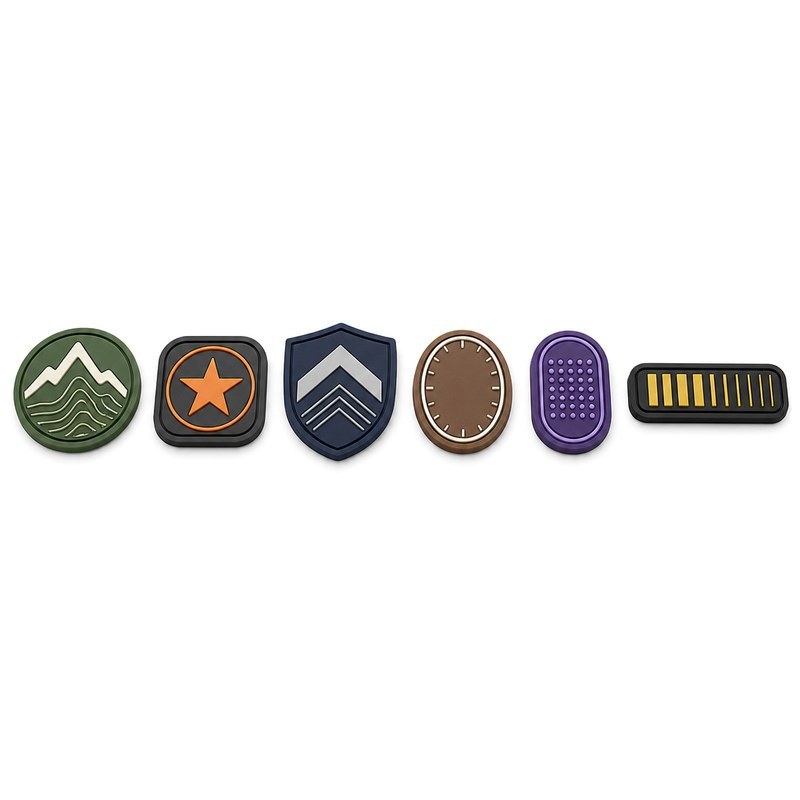
Shape matters as much as fabric. The range on the left includes compact forms, elongated forms and shapes with narrow projecting sections. Each of those geometries loads the bond line differently when the garment moves.
When comparing fabrics, keep the patch geometry constant. Change the fabric and the geometry at the same time and the result tells you very little about either.
Why Patch Size Changes the Adhesion Question
A small patch has less total bonded area to resist the same forces, which is why perimeter behaviour dominates. On a small patch, the edge represents a larger share of the total footprint than on a large one, so edge lifting is proportionally more visible and more consequential. Narrow projections and thin sections concentrate stress further, and the stiffness of the patch decides how that stress is distributed across the bonded area.
This does not mean small patches are inherently unreliable. It means their performance depends more heavily on geometry, attachment system, fabric and use conditions being matched to each other.
A pairing like the round and tab set on the right is a practical way to test the same fabric with two different perimeter-to-area ratios. The compact round form has a short perimeter relative to its area; the tab has more edge for the same footprint.
Running both on the same fabric under the same conditions is more informative than testing one shape and generalising the result.

Deciding Whether a Fabric Is Suitable
- Confirm the exact fibre composition and the fabric construction.
- Identify any coating, finish, lamination or surface treatment.
- Confirm the intended attachment method and the equipment that will be used.
- Send the actual garment fabric to the patch supplier, not a description of it.
- Apply a representative sample using the specified process and settings.
- Inspect edge contact and look for visible defects along the perimeter.
- Evaluate stretch or flex performance where the garment will be worn under load.
- Run appropriate washing and durability checks against the garment's stated care conditions.
- Record the approved fabric, the process settings and the sample reference.
Testing on a generic swatch of a similar fabric does not represent the final garment, because the finish, the construction and the production lot are all part of the result.
Diagnosing Adhesion Problems
Lifting at the edges immediately after application. Look first at contact: pressure distribution, platen condition, seams or folds in the pressing area, and whether the patch geometry suits a bonded attachment at that size.
Detaching after stretching. Investigate how much the fabric deforms and recovers, whether the bonding system can flex with it, and whether the patch construction distributes stress or concentrates it.
Peeling after washing. Review the quality of the initial bond, the fabric finish, the laundering conditions and whether durability was validated at all. A finish that degrades in washing takes the bond with it.
Working on one colourway or lot but not another. Compare the surface treatments and processing of the two fabrics. Where the base construction is nominally identical, the finishing route is the usual explanation.
Staying attached but deforming. This is a stiffness mismatch between the patch and the garment, and it is addressed in the patch construction rather than in the application process.
These are starting points for investigation rather than conclusions. Where the garment specification requires it, controlled testing is more reliable than a visual judgement.
What to Include in a Fabric Compatibility Request
- Fibre composition of the fabric, including elastane content where present.
- Knit or woven construction, and fabric weight or thickness where available.
- Surface treatments, coatings or finishes.
- Patch size, thickness and geometry, with the artwork attached.
- Intended attachment method and available application equipment.
- Garment location and how much that area moves.
- Expected stretch, washing and wear conditions.
- Reference photographs, and failed samples where a problem already exists.
A complete specification makes sample development more useful and reduces the number of revisions, because the supplier is testing against defined conditions rather than assumptions.
Frequently Asked Questions
Does silicone patch adhesion depend on the fabric type?
It depends on the combination of fabric surface, fabric construction, any finish, the attachment system and the application conditions. Fabric type is one factor in that set rather than the deciding one.
Can a small silicone patch be attached to polyester?
Yes, provided the specific polyester fabric and the intended attachment method are evaluated together. Polyester covers a very wide range of constructions and finishes, so the fibre name alone is not enough to answer the question.
Why does a patch stick to cotton but peel from a synthetic fabric?
The surface the patch contacts is probably different: a finish, a coating or a different surface structure can change bonding compatibility. The failure interface should be inspected before assuming a cause.
Are silicone patches suitable for stretch fabrics?
They can be, when the patch construction and the attachment system are matched to the way the fabric deforms. The same patch and process may perform differently on a two-way and a four-way stretch fabric.
Should every fabric be tested before bulk production?
Every materially different fabric construction, finish or colourway should be validated with a representative sample. Carrying a result across from an apparently similar fabric is one of the most common causes of unexpected field failures.
Sources and further reading
- How silicone heat transfer labels differ from other labelling and attachment methods, including where the bonding layer is activated. https://www.colorpglobal.com/news/the-difference-between-silicone-heat-transfer-labels-other-labeling-methods/
- What you should know about dye migration: how heat and dye chemistry interact with decorated garments. https://www.extremescreenprints.com/post/what-you-should-know-about-dye-migration
- Fabrics that stretch: a B2B sourcing guide covering spandex content ranges, stretch direction (2-way and 4-way) and why recovery is the spec that most often causes bulk-order problems. https://www.mh-chine.com/blog/products/fabrics-that-stretch
- ISO 6330:2021 — domestic washing and drying procedures for textile testing, used when defining laundering conditions for durability checks. https://www.jamesheal.com/standards/iso-63302021
- Tensile testing of fabrics to ISO 13934-1, covering maximum force and elongation of woven and knitted fabrics. https://www.shimadzu.com/an/apl/16706/index.html
Fabric compatibility has to be evaluated as part of the complete attachment system. Fibre composition on its own does not predict performance, and the most reliable answer comes from a representative sample on the actual production fabric.
About this guide
This article was prepared by the engineering team at FromRubber (Dongguan Bohao Electronic Technology Co., Ltd.), which produces custom silicone patches, clothing labels and heat transfer labels. Fabric compatibility is assessed on the customer's own production fabric during sample development rather than inferred from a material description.
Related product pages: Custom Rubber Patch Products, sew-on silicone patches for caps, bags and jackets and waterproof silicone labels for outdoor gear.
Also in this series on silicone labels and patches: Small Silicone Logo Design on Clothing: How to Keep Thin Lines Visible? · How Small Can a Small Silicone Logo Be on Clothing? · Why Does a Silicone Heat Transfer Label Fail on Stretch Fabric? · Silicone Heat Transfer Label on Polyester: What Causes Peeling?