How Does a Rubber Grommet Fit Around an Automotive Wire Harness?
- Share
- Issue Time
- Sep 21,2026
Summary
How a rubber grommet fits an automotive wire harness through a body panel or firewall. Covers the panel cross-section, matching the inner opening to the finished harness, harness size problems, vibration, and the difference between a grommet and a sealing component.
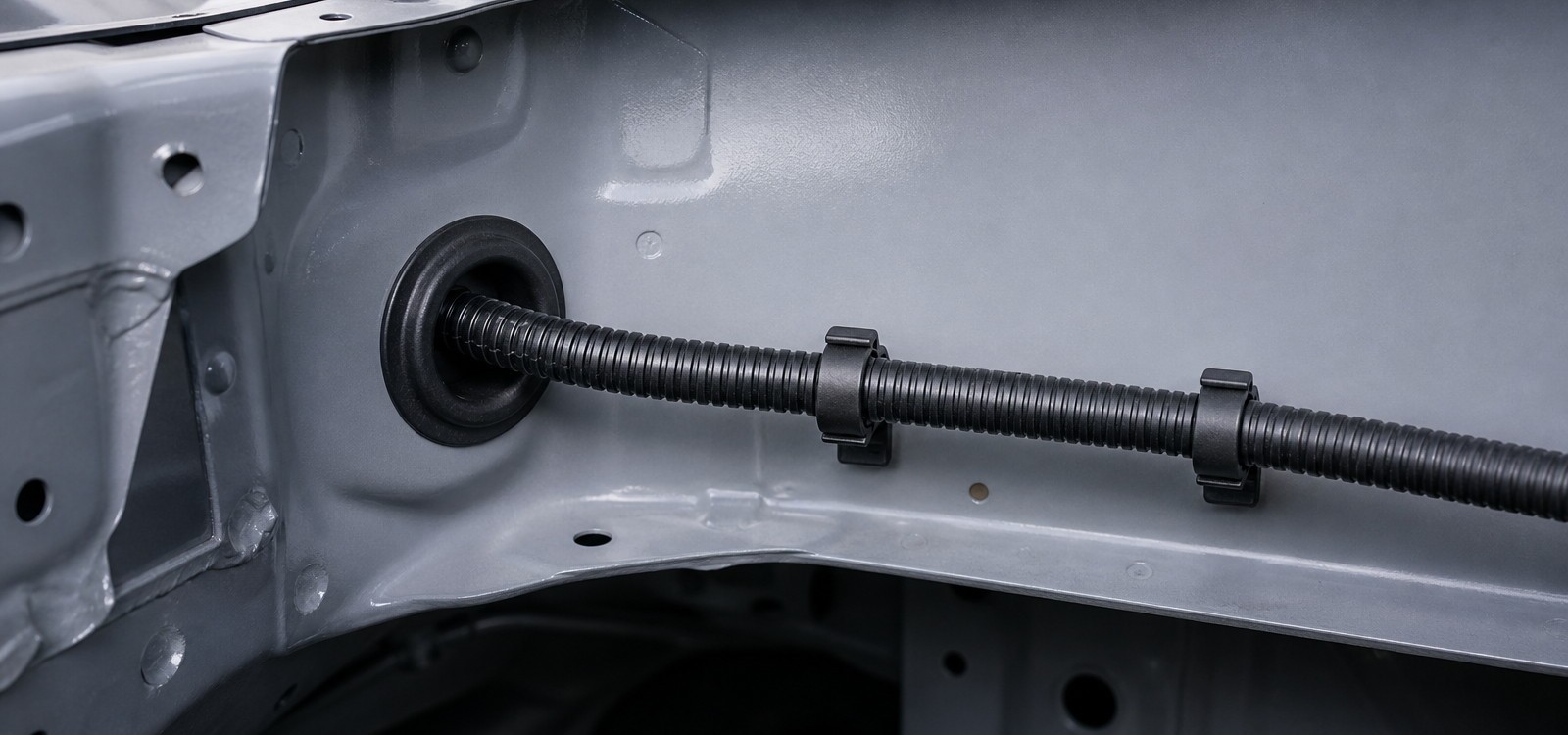
Almost every dimension in a vehicle is fixed once the design is released. The wire harness is the exception. It gets bundled, wrapped, sleeved, re-routed and re-clipped, and the diameter that finally passes through the Rubber Grommet is very often not the diameter anyone designed around. That is why the grommet-to-harness interface produces so many late fit problems, and why it is worth treating the harness as a live dimension rather than a number.
What Does a Rubber Grommet Do Around an Automotive Wire Harness?
A grommet at a body panel opening is doing a specific and fairly narrow job. Understanding which parts of that job are in scope makes the fitting decisions much easier.
- Protect the harness from sharp metal edges — the primary function, and the one that fails first when the part is undersized or badly seated
- Prevent direct wire-to-metal contact — including contact with the burr side of a stamped or pierced opening
- Position the harness at the pass-through — holding the bundle where the routing intended it rather than letting it settle against the opening
- Reduce movement at the panel opening — limiting how much the bundle can shift relative to the sheet
- Provide a sealing interface where one is required — but only where the part has been designed as a sealing component
That last point deserves emphasis. A basic pass-through grommet is not automatically a seal. Where the vehicle requires a defined level of protection against dust and water at that interface, that requirement has to be designed into the part geometry and confirmed by test, not assumed from the presence of a rubber part. Where a protection level is specified for electrical equipment on road vehicles, it is stated as an IP code and verified against the relevant test method rather than inferred from appearance.
How the Rubber Grommet Fits the Automotive Panel
The panel interface works on exactly the same principle as any industrial enclosure: a groove closes around the sheet and the flange carries the reaction. What changes in a vehicle is the environment the interface has to survive.
The cross-sectional relationship runs from the panel hole, into the grommet groove, out through the flange, and into the harness opening at the centre.
- Panel hole diameter — sets the interference at the groove and therefore the base retention
- Panel thickness — on automotive body panels this varies considerably between a flat firewall section and a reinforced or doubled area, and the groove has to suit the location it is actually fitted to
- Groove dimensions — deeper grooves are common where the part also has to resist rotation from harness movement
- Flange seating — has to cope with a panel that may be curved, spot-welded or seam-sealed, so flange conformity matters more than on a flat enclosure wall
- Installation direction — determined by access, which is frequently the constraint that decides the whole profile
Access decides more than the drawing does. A firewall opening that can only be reached from the engine bay side, at arm's length, behind a component, cannot take a grommet that needs to be seated with two hands and a tool. Installation access is a design input, not an assembly detail.
How to Match the Grommet Inner Opening to the Wire Harness
This is where automotive grommet work differs most from general cable pass-through design.
Single cable
The straightforward case, and the least common in a vehicle. The bore is set slightly under the finished conductor-plus-insulation diameter so the rubber grips the jacket.
Bundled harness
A bundle is not a circle. Tape, sleeving and conduit change both the diameter and the cross-sectional shape. The dimension that matters is the smallest circle that contains the finished bundle in the condition it will be in at the panel, which means after wrapping and after the clips have been fitted.
Harness diameter variation
The same harness part number can vary in diameter along its length depending on how many branches join it and where the wrap overlaps. Measuring one section and applying it to the whole run is a common source of error. Measure at the pass-through location specifically.
Protective conduit
Conduit is often added after the initial design, and it increases the outer diameter substantially. If the grommet was specified before the conduit was introduced, the part will be undersized on the vehicle.
Corrugated tubing
Corrugated tubing is the awkward case because its diameter varies along its length. The bore has to clear the crest while still holding the trough, which sets a fairly narrow usable window. Sizing to the crest is the correct starting point.
Connector clearance during installation
Connectors are usually much larger than the harness they terminate. Where a connector has to be pulled through the opening, the grommet either has to pass over it temporarily or the routing has to be arranged so the connector never crosses the panel. This single point drives a large share of automotive grommet design decisions.
In all of these cases the relevant dimension is the finished harness outer diameter rather than any individual wire diameter. An individual wire tells you almost nothing about how the assembly will fit.
The harness is a living dimension
Every other dimension at the interface — the hole, the sheet thickness, the flange — is fixed by the body structure. The harness changes with wrap type, conduit, clip spacing and routing, and it can change again after a design revision that has nothing to do with the panel.
That asymmetry is the reason a harness pass-through should be specified with a design range rather than a target diameter, and why a sample harness is more useful than a drawing during development.
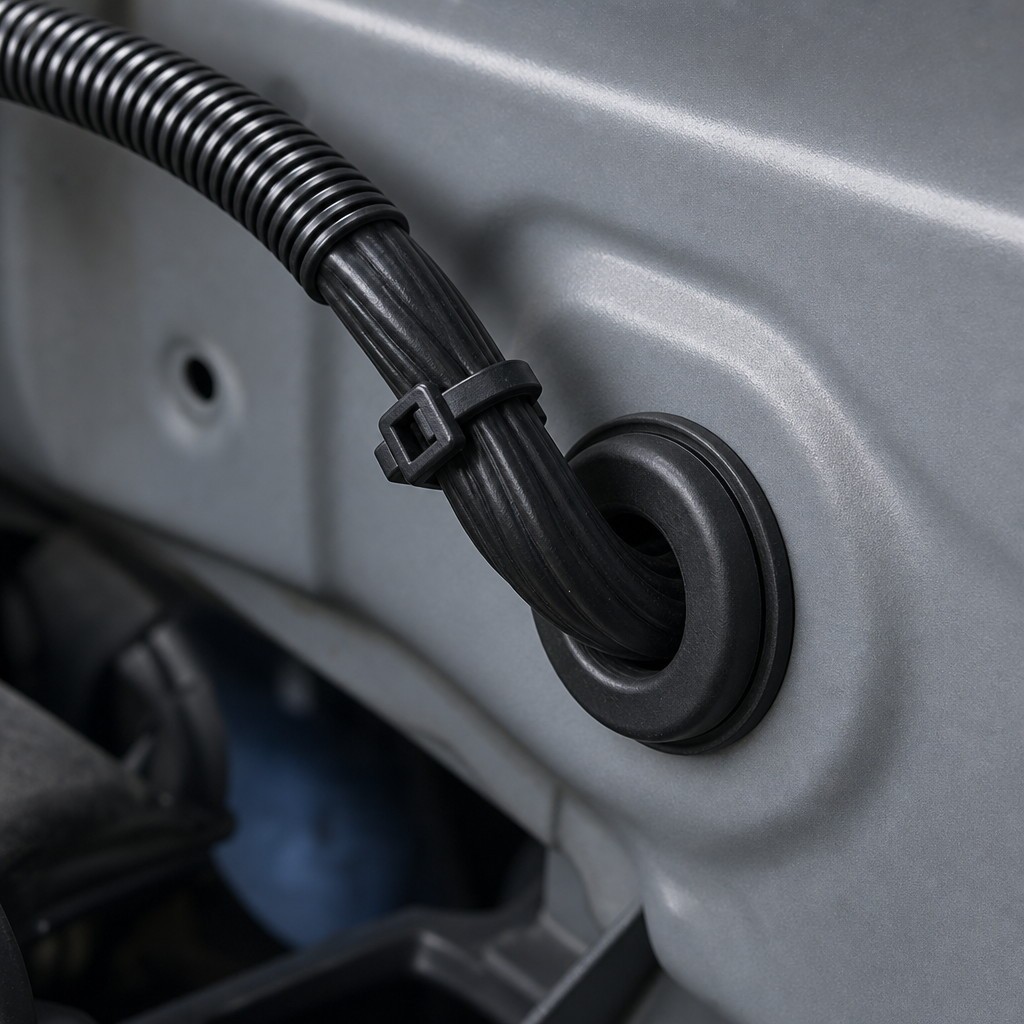
What Happens When the Harness Is Too Large or Too Small?
Harness too large
- High insertion force during assembly, often at a station with poor access
- Excessive rubber deformation, which pushes the groove outward and can reduce panel retention
- Risk of installation damage, particularly at the flange root and the bore edge
- Sealing interfaces distorted where the part is a sealing design
Harness too small
- Excessive clearance, so the bundle is not held at the intended position
- Harness movement and abrasion against the opening and against adjacent structure
- Reduced protection because the bundle is no longer kept clear of the metal edge
- A potential sealing gap where the part is intended to close around the bundle
How Automotive Vibration Affects Grommet and Harness Fit
Vibration does not simply add wear. It changes the mechanics at the interface by reducing the friction that is helping to hold the part in place.
- Repeated movement — small cyclic displacement works the groove against the panel and can gradually reduce interference
- Harness weight — a long unsupported run converts to a steady load at the grommet, usually in a direction the groove resists least well
- Vibration — sustained high-frequency movement lowers the effective friction at the interface
- Bending — a bend close to the panel turns harness movement into a lever acting on the flange
- Side loading — a clip that holds the harness at an angle loads the grommet laterally
- Relative movement between harness and panel — the important one, because it is the differential motion that abrades and loosens rather than the motion itself
The practical conclusion is that the grommet should be evaluated with the harness routing in front of you, not on its own. Clip positions, bend radii and the amount of unsupported harness on either side of the panel change how the part behaves far more than a material change would.
Two interfaces, two jobs
At an automotive pass-through there are really two separate interfaces: the grommet to panel, which is about retention, and the grommet to harness, which is about protection and position. They can be solved independently, and a part that is optimised for one is not automatically good at the other.
Where a project has a fit problem, it is worth establishing which of the two is failing before changing anything, because the corrections point in different directions.
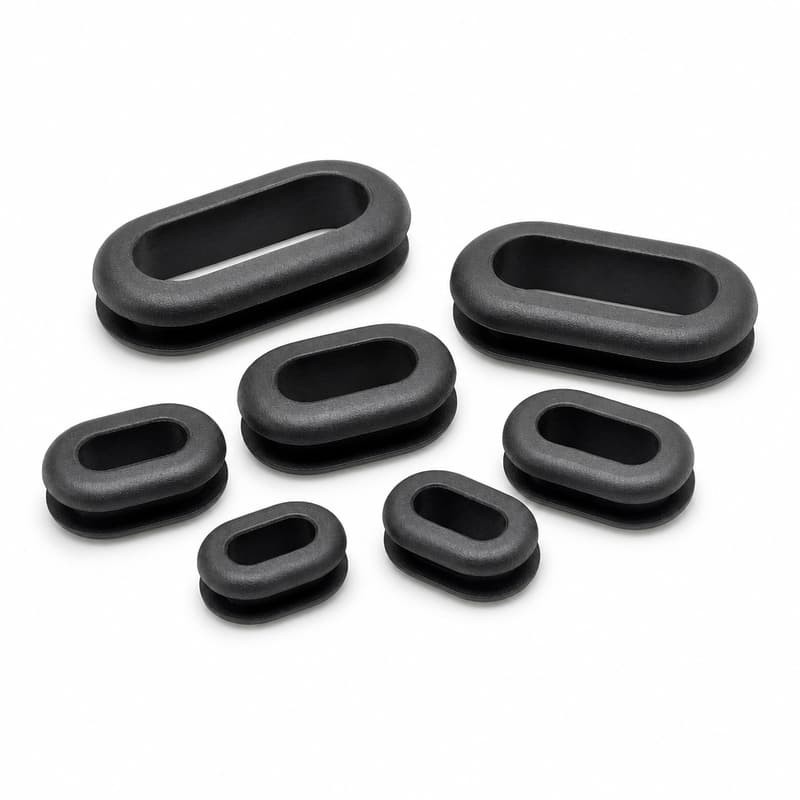
Rubber Grommet vs. Dedicated Automotive Cable Sealing Components
Terminology in this area is loose, and the looseness causes specification errors. These are not interchangeable parts.
- Basic pass-through grommet — protects the harness from the panel edge and positions it. Does not seal against a defined ingress level.
- Sealing grommet — designed with geometry intended to close against both the panel and the harness, and verified against a specified protection level. Where dust and water ingress is a stated requirement, this is the relevant category.
- Strain relief component — takes mechanical load off the termination. A grommet does not do this unless it has been designed for it.
- Multi-hole harness grommet — separates several runs through a single panel opening, with a bore per circuit rather than one shared opening.
- Custom automotive sealing component — a purpose-designed part where the panel opening is irregular, the harness branches inside the grommet, or the sealing requirement cannot be met by a round profile.
Assume nothing about which of these a drawing refers to. A part described as a grommet on one project may be a sealing component on another, and the geometry that follows from each is different.
Common Automotive Wire Harness Grommet Fit Problems
| Problem | Possible Cause | What to Check |
|---|---|---|
| Harness difficult to install through the grommet | Inner opening too small | Finished harness outer diameter including conduit, and connector clearance |
| Grommet moves in the panel | Poor panel retention | Groove dimensions against the actual hole and panel thickness at that location |
| Rubber is cut or torn | Sharp panel edge or burr | Hole edge condition on both faces of the panel |
| Harness rubs against structure | Poor routing rather than a grommet fault | Clip positions, bend radii and unsupported harness length |
| Water or dust enters the opening | Insufficient sealing interface | Whether the part was specified as a sealing grommet and tested to the required protection level |
| Grommet deforms permanently after fitting | Excessive bore interference | Bore against harness diameter, and the temperature the part sees in service |
What Dimensions Are Needed to Develop a Custom Automotive Rubber Grommet?
- Panel hole diameter, measured at the actual location rather than taken from a general body drawing
- Panel thickness at that location, including any doubled or reinforced section
- Harness outer diameter at the pass-through, measured in the finished condition
- Connector dimensions, if any connector has to pass through the opening
- Installation direction and access from both sides of the panel
- Routing requirements, including clip positions and minimum bend radius on each side
- Temperature range at the location, including any local heat source nearby
- Fluid exposure, including fuel, oil, coolant, brake fluid and washer fluid as applicable
- Vibration environment and the amount of unsupported harness close to the panel
- Required sealing level, stated as a protection level where ingress protection is required
- Material specification, including any customer standard the part must satisfy
When Is a Custom-Moulded Rubber Grommet Needed?
Standard profiles cover a large share of automotive pass-throughs. These are the cases where they generally do not.
- Irregular or non-round panel openings, where the flange and groove have to follow the aperture
- Large harness bundles that exceed the bore range of a standard part
- Multiple harness branches entering or leaving through one opening
- Complex flange geometry needed to conform to a curved or reinforced body section
- Specific sealing requirements that a plain round profile cannot meet
- Restricted installation space where the profile has to be reduced in one direction
- Production requirements such as a defined position on the line, an orientation feature or an assembly aid
Frequently Asked Questions
How should a Rubber Grommet fit around a wire harness?
The bore should grip the finished harness so the bundle is held in position without being compressed. That means the bore is slightly smaller than the harness outer diameter at the pass-through, and it means measuring the harness in its finished condition — wrapped, sleeved or run through conduit — rather than measuring individual wires.
Should the grommet inner diameter equal the harness diameter?
No. A bore equal to the harness diameter gives no interference and therefore no grip, so the bundle is free to move and to abrade against the opening. The bore is normally slightly under the harness diameter so the rubber holds the bundle and continues to protect the edge under movement.
How does panel thickness affect automotive grommet fit?
The groove has to close around the sheet thickness at that specific location. Body panels vary considerably between a flat section and a reinforced or doubled area, so a groove that fits one location may not fit another on the same vehicle. Where the thickness varies, measure at the pass-through rather than relying on a nominal body gauge.
Can one grommet accommodate multiple wires?
Yes, and there are two ways to do it. A single larger bore can carry a bundle, which is simpler but gives no separation between circuits. A multi-hole part gives each run its own bore, which keeps circuits separated and positions each harness individually. The choice usually follows from whether the circuits need to stay apart or can be bundled.
What information does a manufacturer need for an automotive grommet?
The measured panel hole and thickness at the pass-through, the finished harness diameter including conduit, connector dimensions if anything has to pass through, installation access, the temperature and fluid environment, and the required sealing level if ingress protection is specified. A sample harness and a sample panel section shorten the development considerably compared with a drawing alone.
Sources
- ISO 20653:2023, Road vehicles — Degrees of protection (IP code) — Protection of electrical equipment against foreign objects, water and access. https://www.iso.org/standard/76116.html
- ASTM D2000-18, Standard Classification System for Rubber Products in Automotive Applications. https://www.astm.org/d2000-18.html
- IEC 62444:2010, Cable glands for electrical installations. https://webstore.iec.ch/en/publication/7034
- ISO 3302-1:2014, Rubber — Tolerances for products — Part 1: Dimensional tolerances. https://www.iso.org/standard/62492.html
About this guide
FromRubber is the export brand of Dongguan Bohao Electronic Technology Co., Ltd., a manufacturer of custom moulded silicone and rubber components. Harness pass-through work normally starts from the measured panel section and a finished sample harness rather than a drawing, and continues into profile design, material selection, durometer choice and prototype tooling for validation on the actual assembly.