How Should Silicone Makeup Brush Holders Be Designed to Prevent Brushes from Falling Over?
- Share
- Issue Time
- Nov 6,2026
Summary
Stability depends on the loaded centre of gravity, not the moulded height of the holder. Covers how brush height, base footprint, opening diameter and silicone hardness interact, plus a practical test routine for samples.
A silicone brush holder fails in the most public way possible: the brushes lean, then one falls out, then the whole set looks badly made. The design review usually blames the base for being too small. In practice the base is only half of the problem, and often not the deciding half.
Stability on a flexible silicone holder is a question of moments, not of wall thickness. It depends on how far the load sits from the edge of the footprint, and the load is not the holder. It is the brush. This article works through what actually tips a holder over, how opening sizes should be specified, and what to test before committing to a production mould.
Why Do Some Silicone Makeup Brush Holders Fail to Keep Brushes Upright?
Three failure patterns account for most complaints, and each has a different root cause. Separating them is the first step, because the fix for one will not solve the others.
Narrow Bases Can Make Tall Brush Holders Unstable
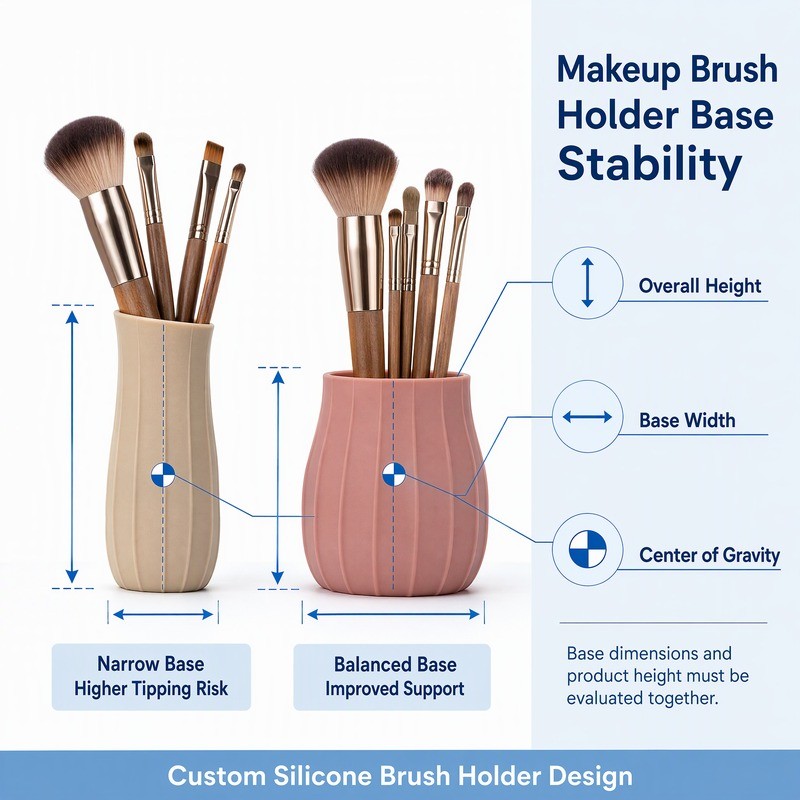
A holder tips when the centre of gravity of the loaded assembly moves outside the footprint of its base. Two numbers decide how close that is: the height of the combined centre of gravity, and the distance from the centre line to the edge of the base.
Here is the part that is routinely missed. The combined centre of gravity includes the brushes, and a long powder brush extends well above the holder rim. A holder 90 mm tall carrying a brush that protrudes another 100 mm behaves like a 190 mm assembly, not a 90 mm one. Widening the base by a few millimetres changes the tipping threshold far less than shortening the exposed brush length or lowering how deep the brush sits.
This is why a holder can pass a stability check with short eye brushes and fail immediately when a full-size face brush is added. The test that matters uses the tallest and heaviest brush in the intended set, positioned at the edge of the footprint rather than in the centre.
Placing the two configurations side by side makes the geometry visible. The narrow holder puts the counterweight of the base almost directly under the brush cluster, so a small lateral push moves the combined centre of gravity past the rim.
The wider base does not need a thicker wall or a heavier build. It needs the footprint extended in the direction the brushes actually lean, which is usually forward and to one side rather than symmetrically outward.
Oversized or Loose Brush Openings Cannot Hold Brushes Securely
An opening that is too large does not hold anything. The brush rests against one side of the hole at an angle, so its weight is carried by a single contact point and the shaft acts as a lever against the rim. The result is a holder that looks full but behaves as if every brush were balanced on an edge.
The variation in handle diameters across a normal brush set is wider than most buyers expect. Eye brushes, liner brushes, foundation brushes and powder brushes can differ substantially in shaft diameter, and a set assembled from several suppliers will differ more. A single nominal opening cannot grip all of them, so the opening layout has to be designed around a stated range rather than a single value.
Soft Support Structures May Bend Under the Weight of Makeup Brushes
Silicone is chosen for the holder because it is soft, grippy and safe on a vanity. The same softness works against structural support. Where an opening is surrounded by a thin ring of low-hardness material, the ring deflects under the lateral load of a leaning brush, and the opening gradually takes a permanent set.
This is not a reason to specify a harder compound everywhere. It is a reason to vary the structure: thin flexible lips at the opening for grip, thicker sections behind them for support. A uniform wall thickness throughout the holder forces a single compromise on every feature.
How Should the Base Structure Be Designed for Better Stability?
Base design is where the tipping threshold is set. Three parameters do most of the work.
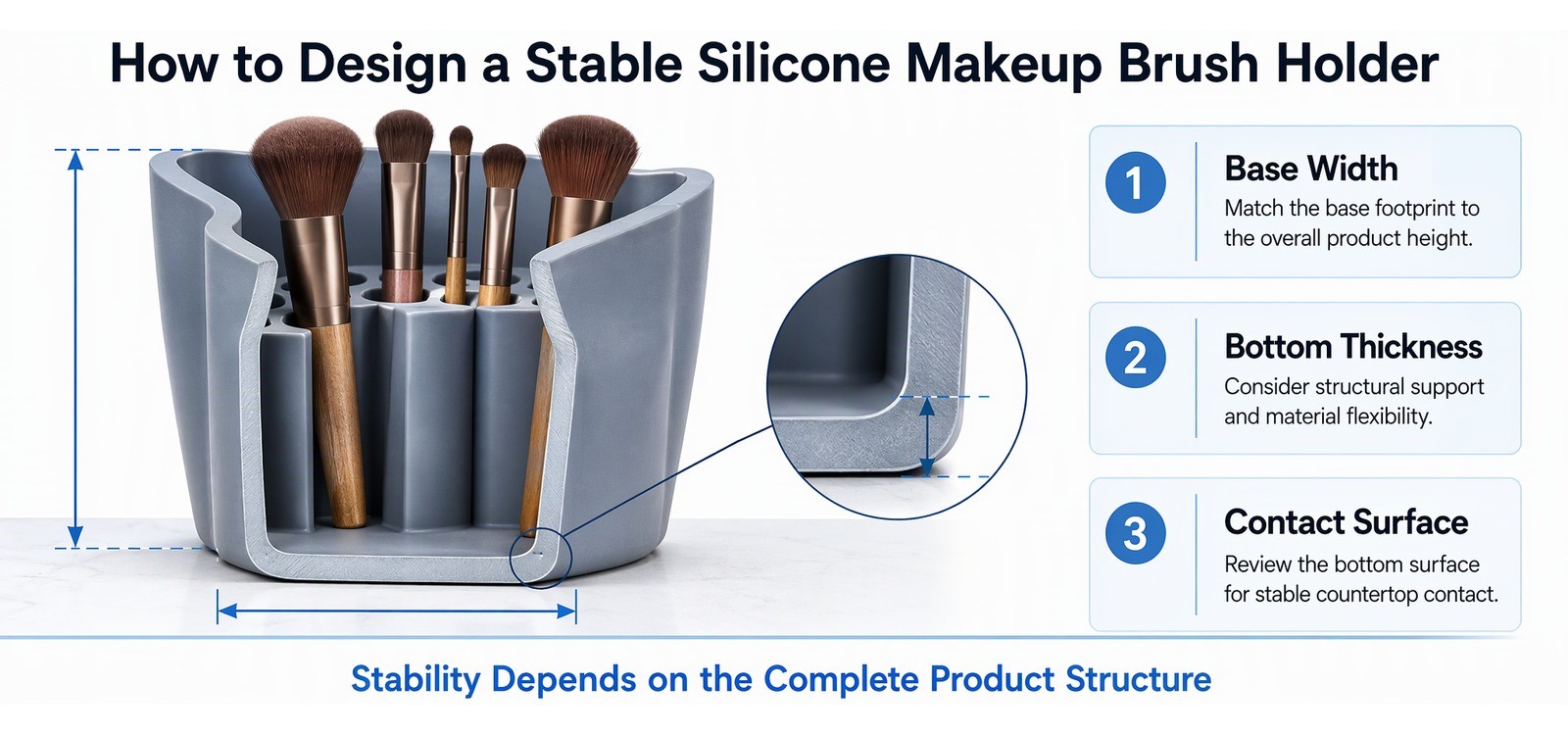
Match the Base Width to the Overall Product Height
Use the loaded height, not the moulded height. A working ratio between footprint width and the height of the tallest brush above the counter gives a design target that can be checked early, before any tooling exists. If the ratio falls below what the intended brush set needs, the options are a wider base, a shorter holder, deeper seating so more of the brush sits inside, or a heavier base section.
Direction matters too. A holder that is wide front to back but narrow side to side will resist a forward push and fail against a sideways one. The footprint should follow the way the brush cluster actually leans, which depends on how the openings are arranged.
Use a Suitable Bottom Thickness to Support the Holder
The base does two jobs: it spreads contact and it adds mass low down. A base that is too thin deflects when the holder is lifted with brushes in place, and a deflected base no longer sits flat, which reduces effective contact area and increases rocking. A base that is too thick adds material cost and weight without improving stability once the footprint is adequate.
The useful approach is to thicken selectively. A raised perimeter ring with a slightly recessed centre gives stiffness where the load path runs while keeping the section economical.
Consider the Contact Area Between the Holder and the Countertop
A soft base conforms to a surface, which sounds ideal and is not always. On a polished counter the silicone grips well. On a slightly uneven surface, only the high points touch, and the holder rocks. Rocking is more damaging than sliding because it progressively walks the holder toward an edge.
A shallow recess with a defined rim, or a light moulded texture on the underside, keeps the contact predictable. The underside should be flat enough to sit without rocking and textured enough not to skate.
How Should Brush Openings Be Sized for Different Makeup Brushes?
Opening design is usually treated as a styling decision. It is a tolerance decision, and it should be specified like one.
Account for Different Brush Handle Diameters
Start from the actual brush set. Measure handle diameter at the point where the brush will be gripped, not at the widest decorative feature and not at the ferrule. Group the measured diameters into two or three bands, then allocate openings to those bands rather than distributing holes evenly for visual balance.
Moulded silicone openings are subject to normal dimensional tolerance, and that tolerance is a meaningful fraction of a small hole. ISO 3302-1:2014 sets out tolerance classes for moulded solid rubber products and is a reasonable common reference when a drawing does not name a class. Specifying an opening to a tolerance the process cannot hold produces parts that are correct on paper and inconsistent in use.
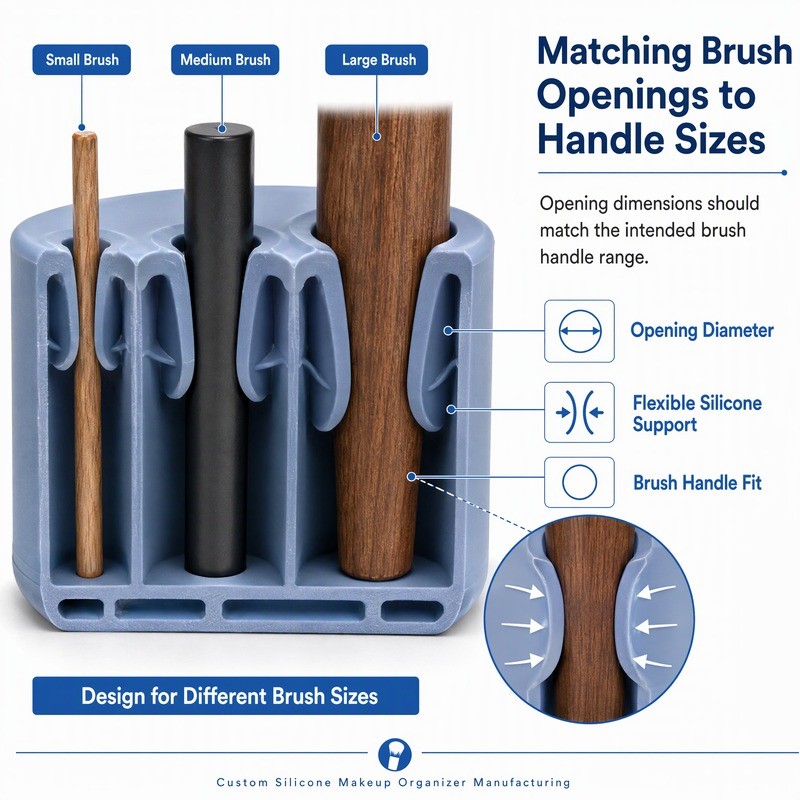
The cutaway shows why the grip works when the opening is close to the handle and fails when it is not. A flexible lip that is only slightly smaller than the shaft deforms evenly and holds along its whole circumference. An opening much larger than the shaft contacts at one point only, and the brush pivots around that point.
The practical rule is to size the opening slightly under the nominal handle diameter and let the lip do the work, then confirm the insertion force by hand on a moulded sample rather than by calculation.
Use Flexible Openings Without Making the Support Too Loose
Elasticity is the mechanism, so the amount of interference between opening and shaft has to be controlled. Too little and the brush slides; too much and the lip rolls under the shaft, the brush jams halfway, and users pull harder than the structure was designed for.
Interference also interacts with hardness. The same nominal undersize behaves very differently on a soft compound and a firm one, so an opening dimension carried over from one material to another is not transferable without a new sample check.
Design Different Compartments for Small and Large Brushes
Grouping by size does more than hold brushes better. It also controls how the cluster leans. Large brushes placed toward the centre and small ones around the perimeter keep the combined load closer to the axis. The opposite arrangement moves mass outward and reduces the margin before tipping.
Spacing between openings deserves the same attention. Brushes that touch each other push each other out of vertical, and a holder that is visually full but mechanically crowded will lean within a few weeks of use.
How Do Silicone Hardness and Wall Thickness Affect Brush Holder Performance?
Material and section work together. Choosing one without the other produces a holder that is either too floppy to hold anything or too stiff to insert a brush comfortably.
Softer Silicone Is Not Always Better for Structural Support
Soft compounds give a pleasant touch and excellent grip, and they conform to a brush shaft without marking it. They also deflect under load and take a permanent set when left loaded for long periods. Firm compounds hold shape but transmit force to the brush and feel rigid at the opening.
A holder often benefits from more than one hardness within the same product, or from a structure that places soft material only where grip is needed. Neither approach is inherently better; both are choices that should follow the load case.
Wall Thickness Affects Flexibility and Shape Retention
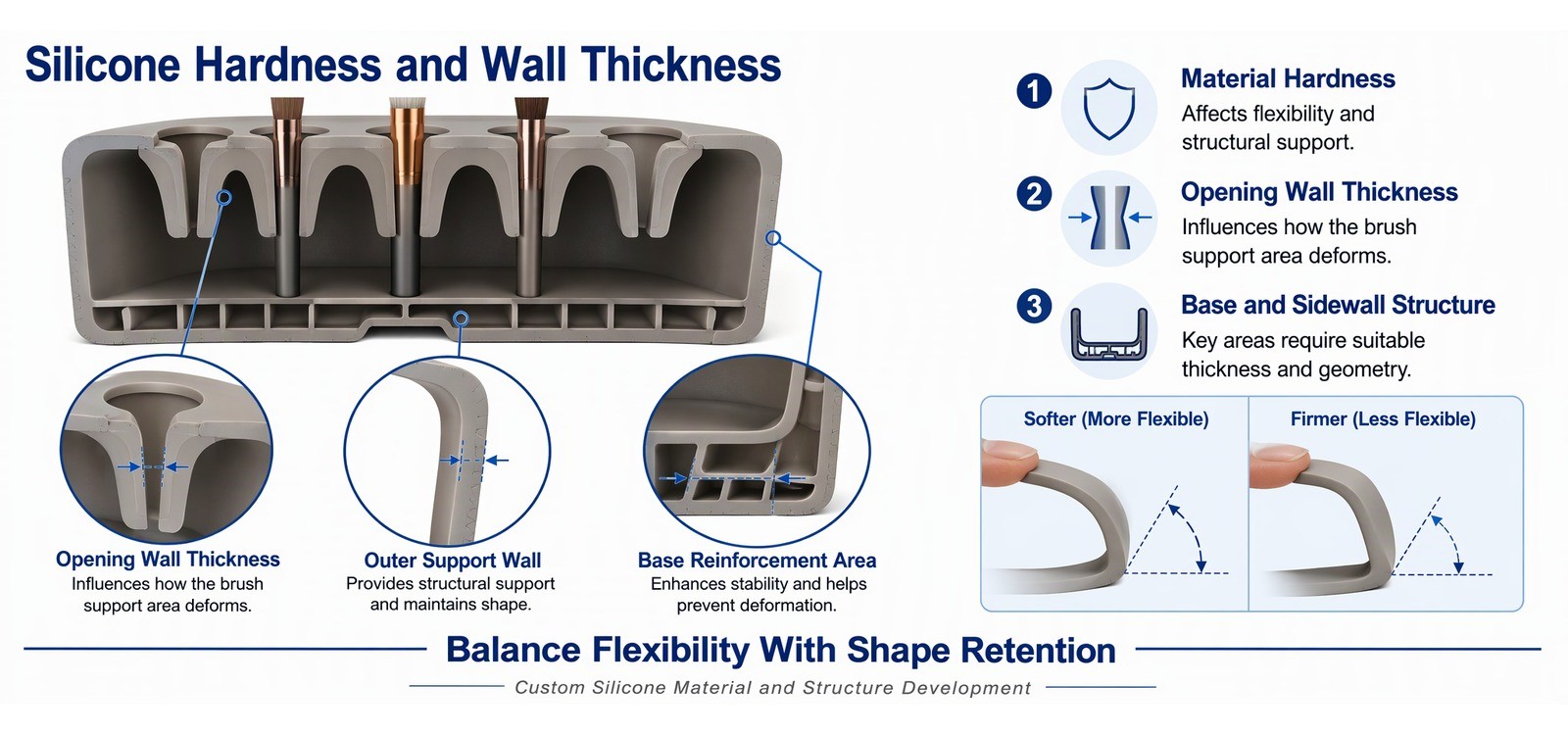
Opening wall thickness controls how much the lip can deform before it collapses. Outer wall thickness controls whether the whole body stays upright. Base thickness controls flatness under load. These are three separate decisions that are frequently made as one, which is why many holders are overbuilt at the base and underbuilt at the opening.
Reinforcing Key Areas Can Improve Structural Performance
Reinforcement does not have to mean thickening. A short rib behind an opening, a small fillet where the outer wall meets the base, or a slightly denser section under the tallest opening all add support with less material than a uniform increase.
The areas that benefit most are predictable: immediately around the openings, the transition between the base and the side wall, and any point where the wall changes direction. A fillet at that last location is often the difference between a holder that survives a year of daily use and one that splits at the corner.
What Should Be Tested Before Mass-Producing a Custom Silicone Brush Holder?
Testing a brush holder does not require a laboratory. It requires a defined routine that reflects how the product will be used, repeated on more than one sample.
Test Different Brush Sizes and Handle Weights
Load the holder with the heaviest and tallest brush in the intended set, placed at the outermost opening. Push laterally at the top of the brush with a fingertip and note whether the base lifts. Repeat with a full set, because a partially loaded holder behaves differently from a full one.
Check Stability on Flat and Slightly Uneven Surfaces
Test on a flat counter and on a surface with a small step or a slight slope. Rocking appears on the second surface long before it appears on the first, and rocking is the failure mode that walks a holder off a shelf.
Evaluate Deformation After Repeated Brush Insertion
Insert and remove the largest brush repeatedly, then inspect the opening for a rolled lip, whitening or permanent ovalisation. A lip that has taken a set has lost the interference that held the brush.
Review the Holder's Dimensions With the Intended Packaging
Stability is irrelevant if the product does not survive shipping. Check the assembled dimensions against the retail box, and check whether the holder can compress under stacking load without taking a permanent deformation.
What Should Beauty Brands Provide When Customizing Silicone Brush Holders?
Share the Brush Dimensions and Target Storage Capacity
Provide handle diameters, brush lengths and the number of brushes by type. These four numbers determine the opening layout, the seating depth and the loaded height that the base must resist.
Confirm the Overall Shape, Color, and Surface Finish
Appearance and structure interact. A tall, narrow silhouette is a design choice that constrains stability, and it should be agreed with that constraint visible rather than discovered at the sample stage.
Review Sample Fit Before Approving the Production Mold
Fit the actual brushes, not a representative dowel. Handles taper, ferrules vary and decorative features change the gripping diameter, all of which matter at the opening.
One Note on Hygiene That Belongs in the Structure
Brush holders collect residue, and openings that trap moisture create a less pleasant environment than open, drainable geometry. A published study of cosmetic brushes and applicators found that tools which retain moisture and residue carry a higher contamination risk, and that cleaning habits among users are inconsistent. The study assessed 57 cosmetic brushes and surveyed 370 participants, reporting that 44.3% rarely cleaned their brushes and 27.8% reported skin problems possibly linked to contaminated tools.
None of that makes a holder responsible for hygiene, and no silicone structure should be described as self-cleaning. It does mean that an open base that drains, an opening that does not cup water, and a surface that can be wiped are structural choices worth making at the design stage rather than adding later.
Frequently Asked Questions About Custom Silicone Makeup Brush Holders
What makes a silicone makeup brush holder stable?
The relationship between the loaded centre of gravity and the edge of the footprint. The load includes the brushes, so the height that matters is the tallest brush above the counter, not the moulded height of the holder.
How do you choose the right opening size for makeup brushes?
Measure handle diameter at the gripping point, group the set into two or three diameter bands, and size each opening slightly under its band so the flexible lip holds along the full circumference. Confirm insertion force on a moulded sample.
Does silicone hardness affect makeup brush holder stability?
Yes. Hardness controls how much an opening deflects and how much the body resists leaning. It also affects whether an opening recovers its shape after a brush is removed repeatedly.
Can silicone makeup brush holders be customized for different brush sizes?
Yes, and they should be. Different opening diameters, different seating depths and grouped compartments are all normal tooling decisions once the target brush set is known.
Getting the Structure Right Before the Tool Is Cut
Most unstable holders are not badly made. They were designed around a holder height and an even hole pattern, without the brush set in the room. Once the tallest brush is treated as the load and the base is sized against it, the geometry usually resolves itself without adding material.
FromRubber develops custom silicone brush holders and organisers, and the review that prevents this problem is structural rather than cosmetic: brush dimensions in, opening layout and base proportions out, then a moulded sample fitted with the real brushes before the production mould is approved. Send the brush set dimensions or a sample through the inquiry page, or message us on WeChat or WhatsApp at +86 18676210913.
About the source
FromRubber is the brand of Dongguan Bohao Electronic Technology Co., Ltd., a custom silicone and rubber parts manufacturer that produces compression-moulded components for beauty, electronics and industrial customers. The notes above come from production work on custom silicone tooling rather than from a general materials handbook. The parts discussed are grouped under custom silicone rubber parts. For a specific project, the engineering team can be reached on WeChat or WhatsApp at +86 18676210913.
- flash and uneven edges on silicone makeup tools
- mould design and parting lines for silicone beauty tools
Sources and further reading
- Attar RMS, Imam MA. Assessing the Levels and Types of Bacterial Contamination in Cosmetic Brushes: Implications for Beauty and Hygiene in Jeddah City. International Journal of Microbiology, 2025. Full text on PubMed Central
- ISO 3302-1:2014, Rubber — Tolerances for products — Part 1: Dimensional tolerances. ISO 3302-1:2014 standard page
- FromRubber note on why silicone tools are entering professional kits
- Related reading on silicone brush pads and palette surfaces