How UV Exposure Affects Outdoor Silicone Keypads
- Share
- publisher
- FromRubber
- Issue Time
- Nov 19,2026
Summary
Yellowing is the visible part of UV ageing and the least useful part to measure. This article looks at what UV actually changes in a silicone keypad, why surface hardening matters more than colour, and how to build a test plan around the installation rather than the datasheet.
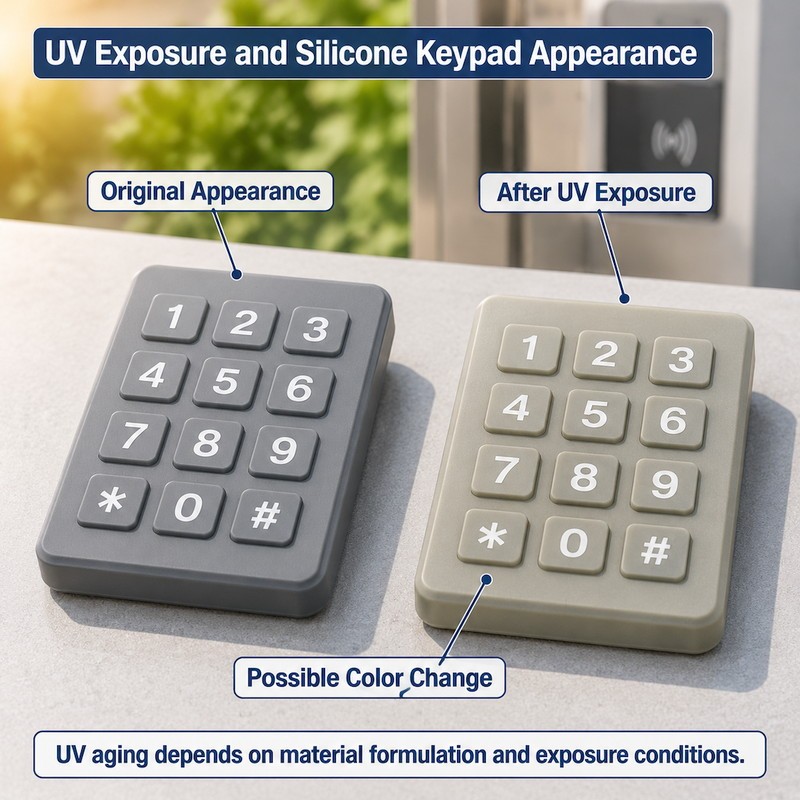
The first sign of UV damage on an outdoor access keypad is usually a complaint about colour. The failure that actually matters arrives a year later, when the keys no longer feel the same and the gasket no longer seals.
Silicone is one of the better outdoor elastomers, which is why access controllers use it. That does not make it immune. Sunlight changes the surface chemistry, the pigment system and the crosslink density at the same time, and those three changes do not happen at the same rate on the same part. A keypad that is judged only by its colour is being judged on the least useful of the three.
This article looks at where UV acts, what it changes that you can measure, and how to write a specification that tests the things that break in service rather than the thing that is easiest to photograph.
How Does UV Exposure Affect Silicone Keypads Used Outdoors?
Why Long-Term Sunlight Exposure Can Change Silicone Keypad Appearance
UV photons carry enough energy to break bonds in the polymer backbone and in the pigment system. In a filled, pigmented silicone the visible result is a shift in hue — usually a drift towards yellow or a loss of depth in dark colours — plus a dulling of the surface as the top few micrometres change composition and scatter light differently.
How fast this happens depends on the compound, not just on the colour. Two grey keypads can look identical on a sample card and behave completely differently after two summers, because one uses a pigment package and stabiliser set designed for outdoor exposure and the other was matched to a colour chip under office lighting.
That is why “UV resistant” on a data sheet is a weak claim. It says the material passed something, somewhere, without telling you what was measured or how the result relates to a wall-mounted controller facing south.
How UV Exposure Can Affect Surface Properties Over Time
Below the colour change, the surface is doing something more consequential. UV and the oxygen it activates increase crosslink density in a thin layer at the surface. The skin becomes harder and less extensible while the bulk stays soft. On a flat gasket that is a nuisance. On a button that has to flex a few hundred thousand times, it is a fatigue problem: the hardened skin cracks, and the crack becomes the starting point for a tear.
This shows up first as a change in feel. A key that had a soft, progressive break becomes abrupt, or starts to stick at the top of its travel. Operators describe it as “stiff” or “not clicking properly”, and by the time that complaint arrives the surface has usually been changing for a year.
Hardness is the measurement that catches this early. A durometer reading taken on the button top, compared with the same reading taken on a shielded area of the same part, is a direct indicator of surface ageing that colour comparison will miss.
Why Printed Legends and Decorative Layers May Age Differently From Silicone Rubber
The silicone, the ink and any clear coating are three materials with three different UV responses. Silicone usually yellows gradually. Ink can chalk, fade or lose adhesion at the edges. A clear coat can yellow faster than either, and because it sits on top, its yellowing is what the customer sees.
The result is a keypad where the legend is still mechanically sound but visually dirty, or where the coating has failed while the ink underneath is intact. Judging the whole assembly by the appearance of its top layer leads to replacing parts that had years of life left, and to accepting parts whose ink is about to lift because the coating hid the interface.
Which Outdoor Conditions Make UV-Related Damage More Noticeable?
How Direct Sunlight and Exposure Duration Influence Material Aging
Dose is intensity multiplied by time, and installation geometry decides both. A keypad on a north-facing wall under a canopy may see a fraction of the UV dose of the same keypad on a south-facing post in direct sun. Two identical products installed a few metres apart can age years apart.
Orientation also decides which part of the keypad takes the dose. A vertical panel that faces the sun gets the light almost straight on at the top of the buttons, with the lower flanges in shadow. A panel tilted upwards collects light across the whole surface and runs hotter. If you are writing a test plan, the installation angle is as important as the location.
Why Heat and UV Exposure Should Be Evaluated Together
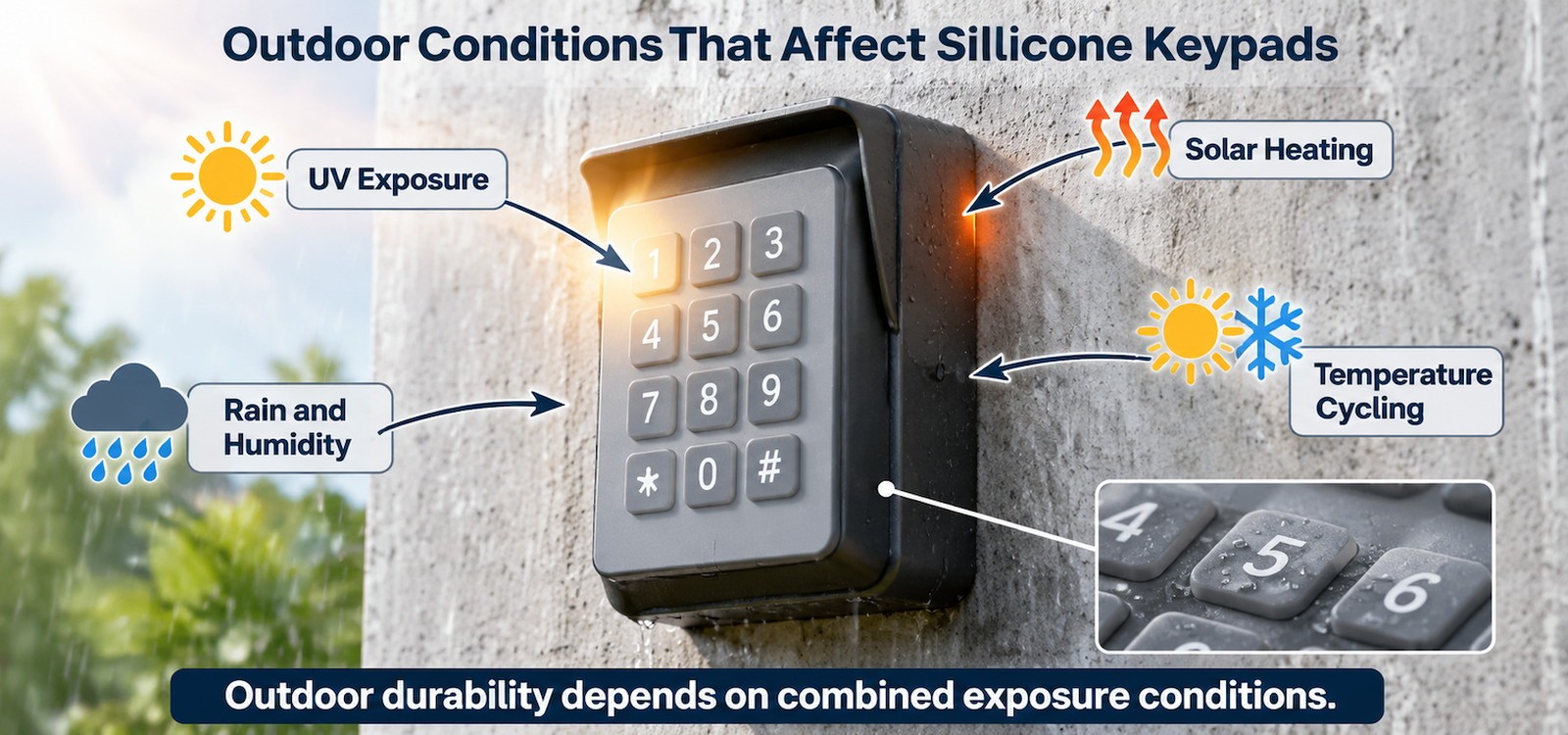
Photodegradation is temperature-dependent. A dark housing in direct sun can run well above ambient air temperature, and the keypad surface is the part of the assembly with the least thermal mass and the most exposure. Testing a sample at 23 °C under a UV lamp therefore understates what happens on a black controller in July.
The practical consequence is that two materials with the same nominal UV package can rank differently once surface temperature is included. This is why accelerated tests that control irradiance but not black-panel temperature produce results that do not reproduce in the field.
How Rain, Humidity and Temperature Cycling Add to Outdoor Wear
Water accelerates what UV starts. Moisture enters micro-cracks, expands when it freezes or when the part heats, and drives the crack deeper. Condensation on a cool morning sits on the surface for hours. Thermal cycling then works the interface between the silicone and the housing, which is where the sealing performance is decided.
Salt is a separate mechanism in coastal installations and deserves its own line in the specification rather than being folded into “outdoor”. Salt crystals in a surface crack are abrasive; salt film on a legend holds moisture against the ink.
How Should Silicone Materials Be Selected for Outdoor Access Controllers?
Choosing Silicone Formulations With Suitable Weather Resistance
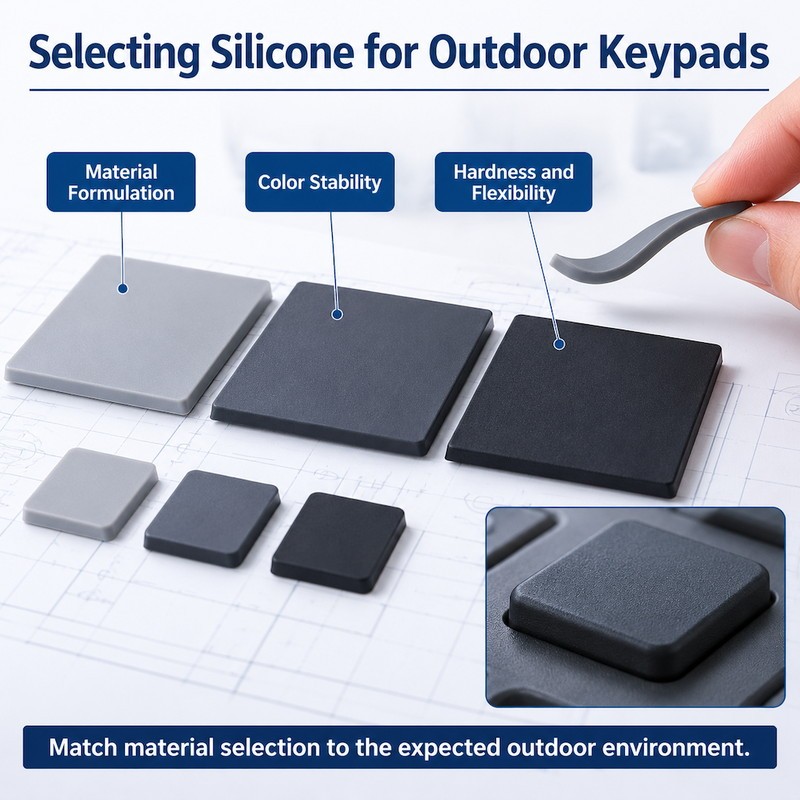
Selection starts with the exposure, not the data sheet. An inland wall-mounted reader in a temperate climate and a coastal gate station in a subtropical one need different answers even though both are “outdoor”. Ask for the compound family, the pigment system and whether the grade is intended for exterior use — then ask how that was verified.
Additives that improve one property can cost another. Some flame retardants and some softeners reduce weathering performance. If the product also needs a flammability rating, the two requirements have to be resolved together at the compound selection stage, not by picking the cheaper of two grades.
Balancing Material Hardness With Button Pressing Performance
Outdoor keypads tend to be specified harder than indoor ones, on the reasoning that a harder material resists wear and picks up less dirt. The trade is real: a harder compound needs more force to actuate, and a user in gloves on a cold morning has less tolerance for a stiff key. Hardness also affects how the button recovers after a long press, and a compound that is too soft can take a set under sustained load in summer heat.
The useful approach is to set hardness from the actuation requirement and the dome geometry, then verify that the chosen compound survives the exposure. Selecting hardness to resist UV reverses the logic and usually produces a keypad that is unpleasant to use.
Selecting Colors That Remain Consistent During Outdoor Use
Dark colours hide soiling and show gloss change; light colours show yellowing and dirt. Neither is inherently more stable. What matters is whether the pigment package was chosen for exterior exposure and whether the colour was approved under the lighting the product will actually be seen in.
Ask for a colour tolerance that survives weathering, expressed against a grey scale rather than a single reference chip, and agree how much shift is acceptable. “Colour as approved sample” is not a specification for a product that will spend five years in the sun.
How Can Silicone Keypad Design Improve Outdoor Durability?
Designing Button Profiles to Reduce Water and Dirt Accumulation
Water does not need to enter the housing to cause problems. It sits in the gaps between buttons, carries dust, and dries into a film that stiffens the key edges. A button profile with a small radius at the base and a clear drainage path to the edge of the pad sheds water better than a profile with a deep groove around each key.
Spacing matters too. Very tight key spacing looks compact in a drawing and creates capillary gaps that hold water. A slightly wider gap with a rounded land between keys dries faster and is easier to clean.
Protecting Printed Legends From Direct Environmental Exposure
The legend takes both UV and finger contact at the same point, which is the worst combination. Recessing it slightly, or placing it on a shoulder rather than the crown, reduces direct exposure and rubbing at once. Where a legend must sit on the contact surface, a UV-stable ink and a coating chosen for exterior use are the minimum, and the coating needs its own weathering check rather than being assumed to protect what is under it.
Considering Keypad Interfaces and Sealing Structures During Development
The keypad is one part of an enclosure. Outdoor ingress performance is decided by the flange compression, the housing joint, the connector openings and the display window together. A keypad with a perfect flange cannot seal a housing whose two halves are held by four screws at the corners and bow in the middle.
This is worth saying plainly because keypads are often specified as if they were sealed components. They are sealing elements inside a system, and the system has to be reviewed as a whole. The keypad and enclosure sealing guide covers that interface in more detail.
What Tests Should Be Considered for Outdoor Silicone Keypads?
Evaluating UV Resistance With Accelerated Weathering Tests
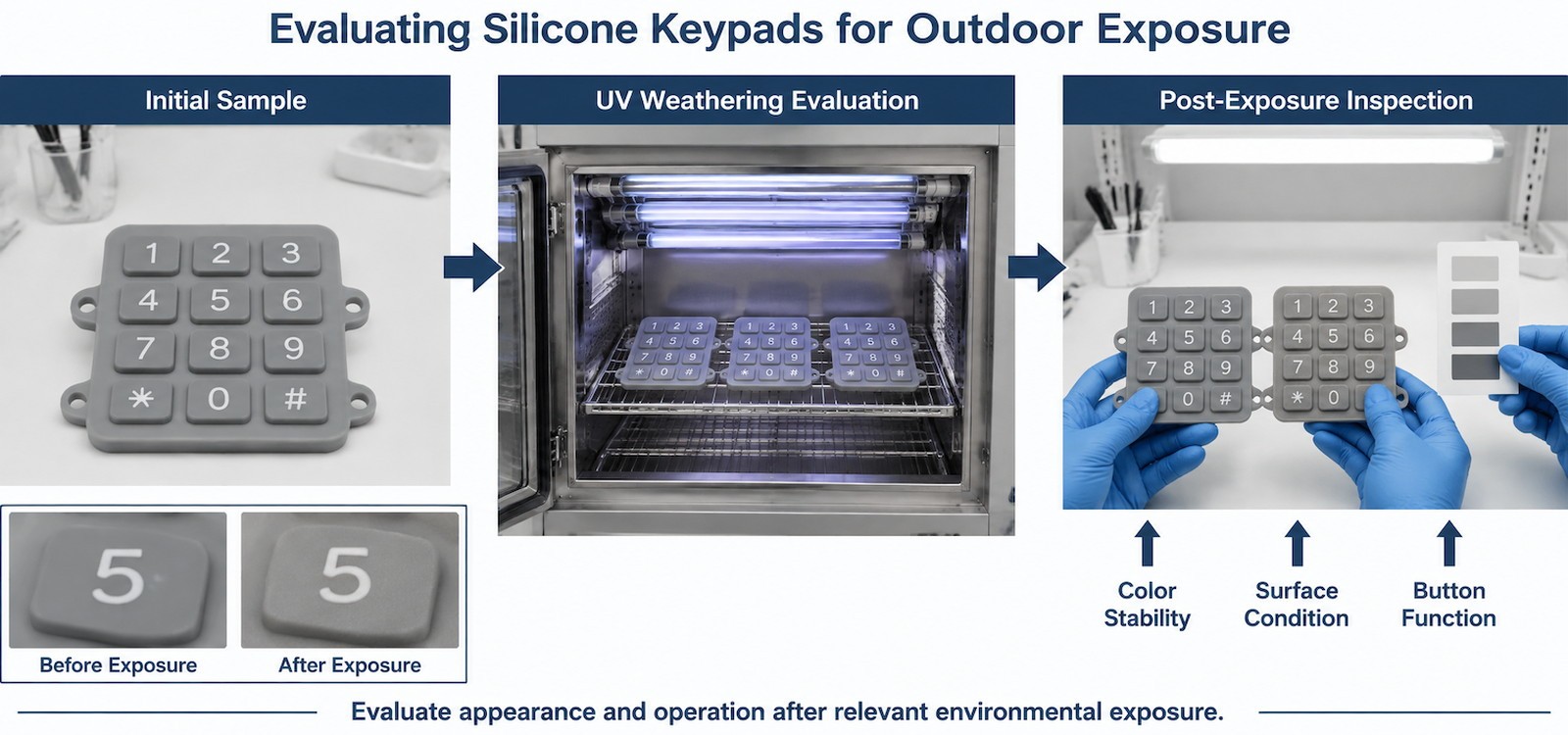
Fluorescent UV lamp exposure, typically described in test standards along the lines of ISO 4665 for rubber or ASTM G154 for non-metallic materials, is the usual starting point. Xenon-arc exposure is closer to full-spectrum sunlight and slower. Whichever is used, record irradiance, black-panel temperature, humidity cycle and duration — a result without those four numbers cannot be compared with anything.
Accelerated testing ranks materials. It does not tell you that a part will last seven years outdoors. Anyone who presents it that way is either simplifying for a brochure or has not read the standard.
Checking Color Stability and Surface Condition After Exposure
Colour change is normally assessed against a grey scale, in the manner described in ISO 105-A02, by a trained observer under defined lighting. Surface condition is assessed separately: gloss change, chalking, cracking and the condition of printed legends. Photograph both under the same light before and after, because memory is unreliable at small differences.
Hardness is the measurement most often skipped and most useful. A durometer reading on the exposed button top, compared with the shielded flange of the same sample, quantifies the surface hardening that precedes cracking. It is a five-minute check with equipment most moulders already own.
Testing Button Function After Environmental Aging
After exposure, the part should be assembled and pressed. Check actuation force against the original value, look for sticking or a change in the break point, and press the keys at the temperature extremes the product will see. A keypad that passes a colour check and fails an actuation check after exposure has failed.
| Exposure factor | What changes | How it shows up | What to specify or verify |
|---|---|---|---|
| UV dose (intensity × time) | Surface chemistry, pigment stability | Yellowing, chalking, gloss loss | Compound and pigment intended for exterior use; grey-scale tolerance |
| Surface temperature | Rate of the same reactions | Faster change on dark housings | Test with black-panel temperature controlled, not ambient only |
| Moisture and condensation | Crack propagation, coating adhesion | Hairline cracks, lifted coating edges | Humidity cycle in the exposure test; adhesion check after exposure |
| Thermal cycling | Flange compression, interface fit | Ingress at the housing joint | Assembled cycling, then an ingress check on the complete unit |
| Salt (coastal) | Surface film, legend edges | Dulling, ink edge lift | Separate salt exposure if the site is coastal |
| Cleaning agents | Ink binder, coating | Legend fade, tacky surface | Name the agent and concentration in the drawing |
What Should Buyers Specify When Customizing Outdoor Access Controller Keypads?
Providing the Expected Sunlight Exposure and Installation Environment
Give the installation orientation, whether there is a canopy, the latitude band or climate, the expected housing colour and the service life you are designing for. A supplier who knows the panel faces west under a porch can suggest a coating; one who is told only “outdoor” cannot.
Confirming Silicone Hardness, Color, and Legend Requirements
Hardness, colour and legend should be agreed as a set, because they interact through the compound choice. If the colour must match an existing product line, say whether that match has to hold after weathering or only at goods-in. The two answers lead to different pigments.
Reviewing the Keypad and Enclosure Interface Before Mass Production
Check the flange thickness against the housing groove, the compression available at the screws, and whether the housing will bow between fasteners. Do it on an assembled prototype, outdoors if possible, not on a drawing. Most ingress failures on access controllers are interface failures, and they are cheaper to find before the tool is cut.
Final Considerations for Outdoor Silicone Keypad Development
Outdoor durability is not a material property you can order. It is the result of a compound chosen for the exposure, a pigment system that holds its colour, a legend and coating that age at a similar rate to the rubber, and an enclosure that keeps water out of the places the keypad cannot protect. Colour is the easiest thing to measure and the least useful thing to rely on.
FromRubber, trading name of Dongguan Bohao Electronic Technology Co., Ltd., has been moulding silicone parts in Dongguan since 2010 and holds IATF 16949, ISO 9001 and ISO 14001 certification, which mostly means the process records exist when a weathering question turns into a batch question. We mould and print outdoor keypads on the same site, so a legend that fails after exposure can be traced to the ink and cure that produced it. If you are specifying an outdoor keypad and want the material and legend options reviewed against your installation, send the drawing and the site conditions. WhatsApp and WeChat: +86 18676210913; the contact page lists the rest.
One caution on accelerated testing. Lamp-based weathering compresses time by increasing irradiance, and the correlation with real outdoor exposure is material-specific. Use it to compare candidates under identical conditions, and treat any claimed year-equivalent as an estimate that needs field data behind it. The verification normally used here is accelerated weathering to ISO 4665 or ASTM G154 with black-panel temperature recorded, followed by a grey-scale colour assessment to ISO 105-A02 and a durometer reading on the exposed face against a shielded area of the same part.
Frequently asked questions
Does yellowing mean the keypad has failed?
No. Yellowing indicates the material has absorbed UV, which is expected. The question is whether hardness, elasticity, legend adhesion and sealing performance have also changed. A yellowed keypad with unchanged actuation force is a cosmetic issue; a keypad with no visible colour change but a hardened button top is the more serious case.
Can a UV-stable clear coat protect a printed legend outdoors?
It can reduce direct exposure to the ink, but the coating becomes the exposed surface and has to survive UV itself. Ask for the coating’s own weathering data, not just the ink’s, and check adhesion after exposure rather than before.
Is a darker keypad better for outdoor use?
Not automatically. Dark colours hide soiling and show gloss change; they also run hotter in sun, which accelerates the underlying reactions. Light colours show yellowing sooner but may run cooler. The compound and pigment system matter more than the shade.
How long should an outdoor keypad last?
That depends on dose and duty cycle, and it is a system question rather than a material one. The workable approach is to state a service life and an installation environment, then verify the material and the assembly against a test plan that reflects both. A blanket lifespan figure without those inputs is not meaningful.
What is the most common mistake in outdoor keypad specifications?
Testing the keypad alone. Most field failures involve the housing joint, the connector opening or the flange compression, none of which appear in a test performed on a bare keypad sample.