How to Balance Wall Thickness and Flexibility in Silicone Makeup Brush Storage Sleeves?
- Share
- Issue Time
- Nov 10,2026
Summary
A sleeve that is too thin collapses on insertion; one that is too thick will not let the brush out. This article explains why ring stiffness dominates the behaviour, how the rim, body and base need different sections, and how to validate thickness decisions on prototypes and in the mold.
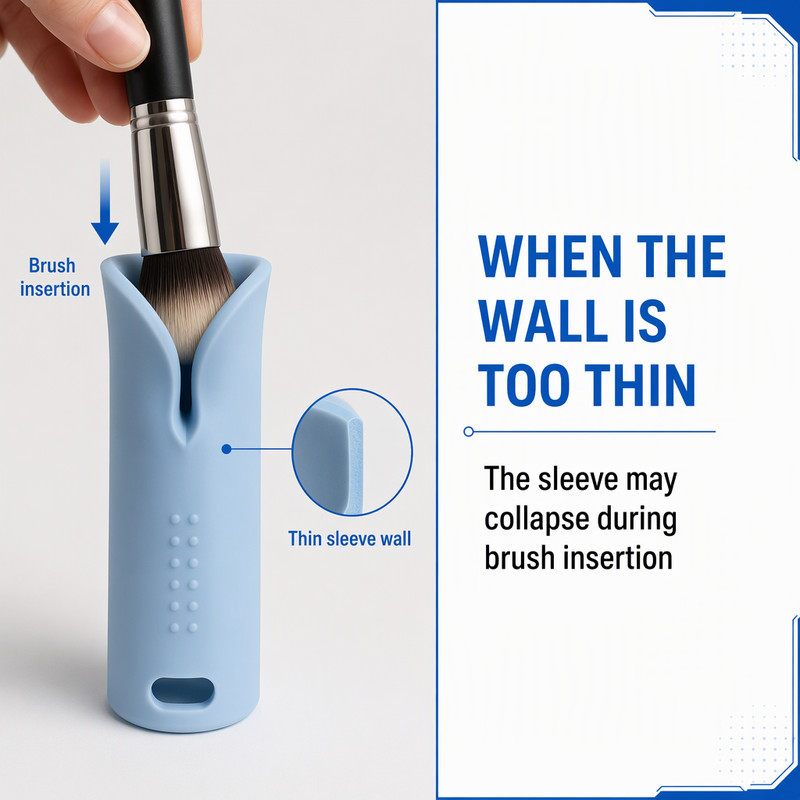
A silicone makeup brush storage sleeve looks correct on the table: straight, even, the right height. The first brush goes in and the sleeve folds inward around it like a sock. The brand's answer is to thicken the wall, which works, and then the user cannot get the brush out without two hands and a wiggle.
Both versions are the same design mistake in opposite directions. A sleeve is not a tube with one wall thickness; it is a structure with three different jobs, and the thickness has to change accordingly.
What Happens When a Silicone Makeup Brush Sleeve Is Too Thin?
A thin wall is not automatically a flexible wall. It is a wall with low ring stiffness, which means it resists ovalising poorly. The moment a brush that is slightly wider than the opening is pushed in, the mouth deforms, the wall follows, and the sleeve loses the shape that was supposed to protect the brush.
Ring stiffness rises with the cube of wall thickness. That single relationship explains most of the behaviour in this article: a wall that is 20% thinner is not 20% more flexible, it is roughly 50% softer in resistance to ovalising.
The practical consequence is that thickness should be chosen against the largest brush in the intended range, not against the average one.
The Sleeve May Collapse When the Brush Is Inserted
Insertion is the highest load the sleeve sees. The mouth has to open, the body has to accept the ferrule, and the bottom has to stop the brush without being pushed out of shape. A thin body absorbs the insertion force by bending, which is comfortable for the user but leaves the sleeve creased around the brush.
Thin Walls Can Make the Opening Difficult to Handle
The opening is where the user's fingers apply load, and it is the part of the sleeve with the least support behind it. A thin lip rolls over rather than guiding the brush in, so the user pushes harder, which increases the deformation and makes the roll worse.
This is why the opening usually needs more material than the body, and why that extra material should be placed as a rim rather than as a general thickening of the top section.
Uneven Thin Sections Can Create Weak Points
A wall that changes thickness abruptly has a stress concentration at the step. On a sleeve, those steps usually appear at the bottom corner and at the transition from the body to the rim, because those are the places where the drawing changes from one thickness to another.
What Problems Can Occur When the Silicone Sleeve Is Too Thick?
Thickening is the usual fix for collapse, and it works up to a point. Past that point, the sleeve becomes a rigid tube that protects the brush and annoys the user.
Excessive Thickness Can Reduce Overall Flexibility
A thick wall opens with difficulty and closes with force. For a sleeve that is meant to be squeezed, folded or pushed into a bag pocket, that stiffness is a usability problem. It also increases the load on the seam or on the rim, which is where the part will eventually fail.
The Sleeve May Become Bulky for Portable Storage
Every tenth of 1 mm of wall adds diameter and mass. In a travel case, the sleeve competes with the brush inside it for space, and a sleeve that is 2 mm larger in diameter may no longer fit the slot it was designed for.
Thick Sections May Require More Careful Molding Considerations
Thick sections cure more slowly than thin ones, and a part with both will have a cure gradient through its wall. That gradient produces internal stress, which shows up as warping after demolding or as a change in dimension after a few days.
Thick sections also shrink more in absolute terms, so a thick bottom and a thin wall move by different amounts. The transition between them is where the distortion appears.
Which Structural Areas Need Different Thickness Considerations?
The useful way to design a sleeve is to divide it into zones with different jobs, then set thickness per zone and design the transitions deliberately.
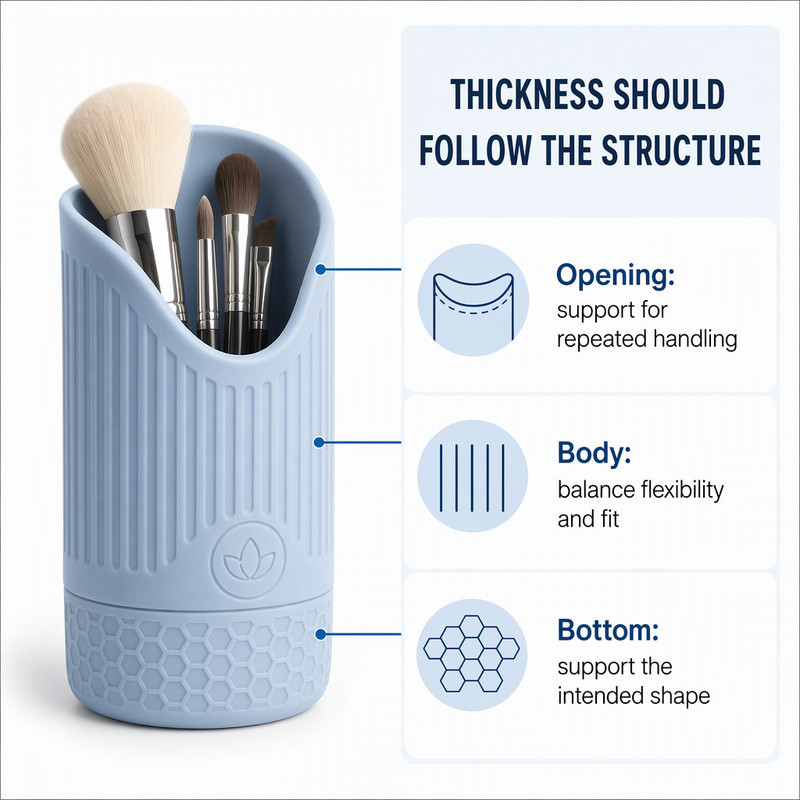
The rim is a guide and a hinge at the same time. It has to be stiff enough to stay open and thin enough at its inner edge to flex when a brush passes. A small bead of material around the outer edge achieves both; a uniformly thick top section achieves only the first.
The body is a fit. Its wall thickness sets how much the sleeve can compress around the brush, and therefore how much retention the user feels. A body that is too stiff will not accept a brush that is slightly oversize; one that is too soft will let the brush rattle.
The base is a stop. It carries the impact of the brush and the weight of the sleeve when it stands, so it usually wants more material than the body, with a radius rather than a sharp corner.
The Opening Needs Enough Support to Prevent Unwanted Collapse
The opening sees repeated stretching every time the product is used, so it is the first place to fatigue. A rolled rim, a thickened bead or an internal rib just behind the lip all add support without stiffening the whole sleeve.
The Main Sleeve Body Needs a Balance Between Flexibility and Shape Retention
The body's job is to hold the brush without gripping it so hard that the wall bulges. Its thickness should be set from the largest brush diameter in the intended range and from the hardness of the compound, because those two together decide how much the wall can deflect before it creases.
A slightly tapered body, wider at the opening and narrower at the base, gives a more progressive fit than a straight tube and hides small differences in brush diameter.
The Bottom Section Needs Enough Stability to Support the Intended Shape
If the sleeve is meant to stand on a vanity, the base needs a flat contact area and enough thickness to resist cupping. If it is meant to hang or lie in a case, the base can be thinner and lighter, but it still needs a radius where it meets the wall.
Corners and Transition Areas Need Smooth Thickness Changes
Every change of thickness is a change of stiffness, and every change of stiffness concentrates stress. A gradual taper over a few millimetres costs very little material and removes the step that would otherwise become a tear line.
How Do Silicone Hardness and Wall Thickness Work Together?
Thickness and hardness are two ways of controlling the same behaviour, and they are not interchangeable. Thickness changes stiffness by a cubic relationship; hardness changes it roughly in proportion. That difference decides which lever to use.
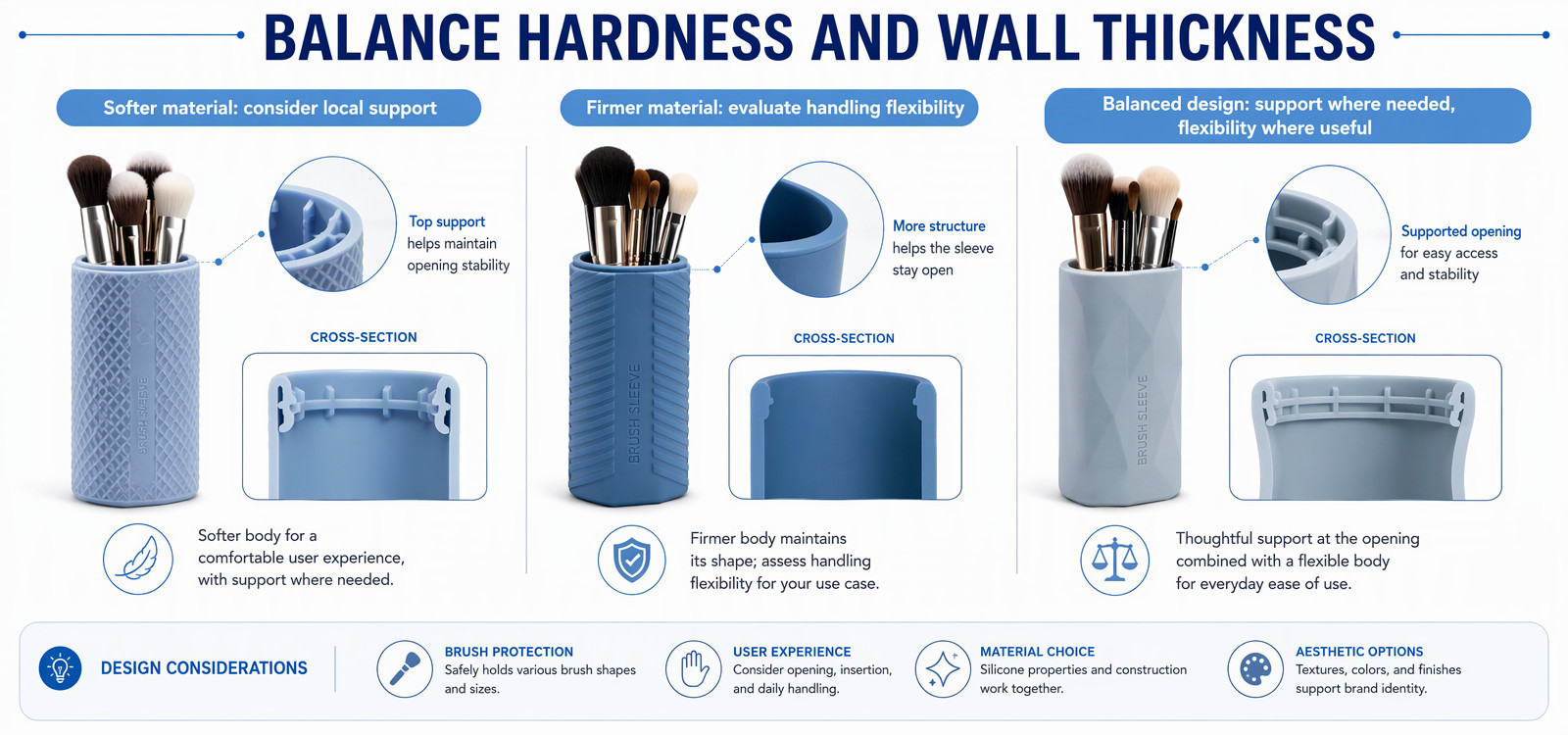
Softer Silicone May Need Additional Structural Support
A soft compound gives a pleasant, compliant feel at the opening but deforms under load everywhere else. The fix is local: a bead at the rim, a thicker base, a short rib behind the lip. Increasing the whole wall thickness to compensate for a soft compound produces a heavy sleeve that still feels vague.
Firmer Silicone Can Maintain Shape Without Excessive Wall Thickness
A firmer compound holds the sleeve open with a thinner wall, which keeps the product light and compact. The trade-off appears at the opening, where the same firmness makes insertion harder and can make the lip feel sharp against the brush handle.
Material Selection Should Match the Sleeve's Intended Function
A protective sleeve that travels in a bag needs to compress without creasing permanently. A storage holder that stands on a vanity needs to hold its shape under its own weight and under the brush. Those are different requirements, and they usually point to different hardness and thickness combinations.
Buyers often specify hardness first because it is the number on the datasheet. For a sleeve, the more useful starting point is the handling requirement, with hardness chosen afterwards to deliver it.
How Can Manufacturers Optimize Wall Thickness During Custom Silicone Development?
Optimisation is a sequence of narrowing decisions: fit, then structure, then physical samples, then molding feasibility. Skipping a step usually means repeating it later at higher cost.
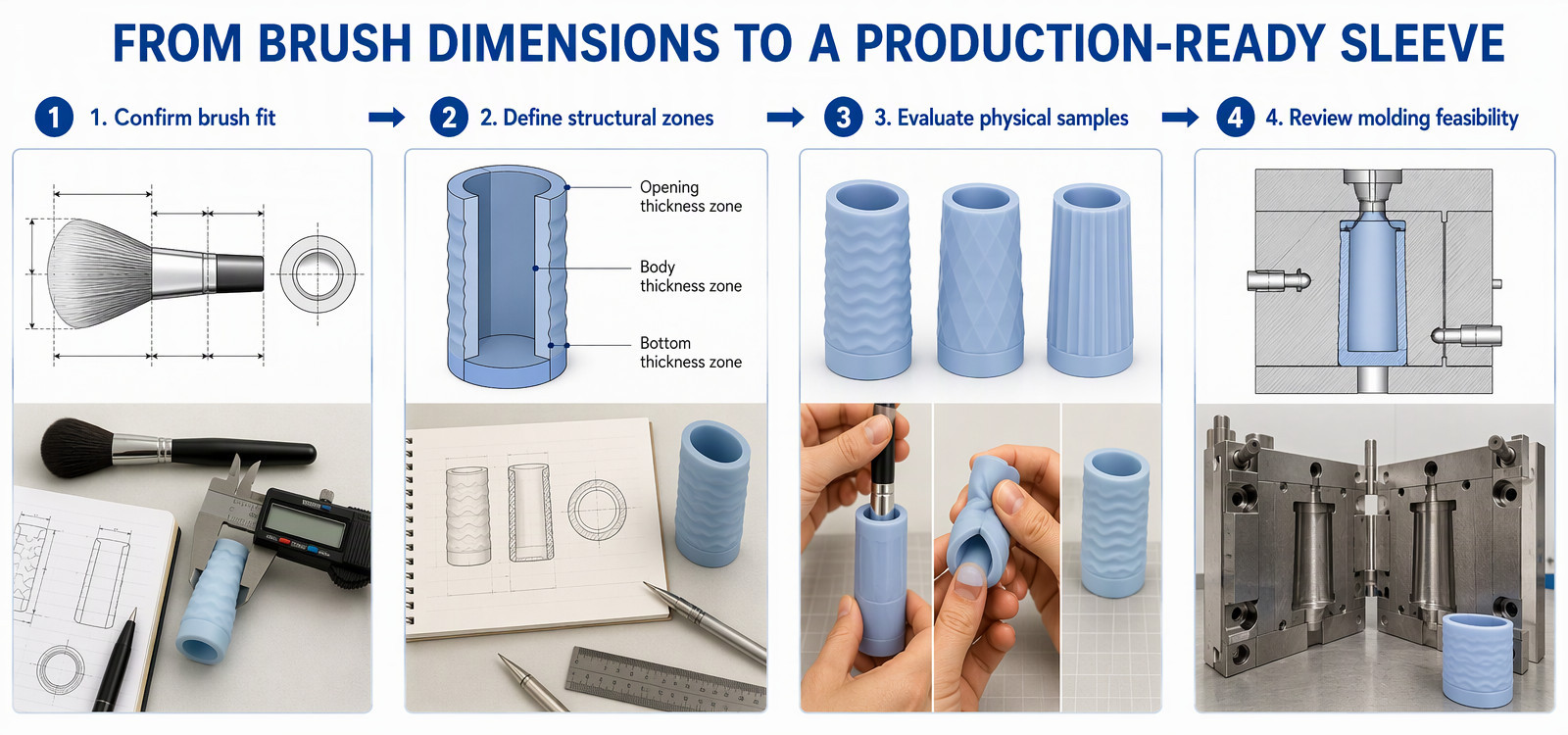
Define the Brush Size and Required Internal Space First
Measure the brushes the sleeve is intended for, at the ferrule and at the widest point of the handle, and decide how much clearance the user should feel. Clearance is a design decision: a tight sleeve feels secure and is harder to load, a loose one is easy to use and lets the brush move.
Where the sleeve is sold with a brush set, the range is known and the design can be tuned to it. Where it is sold empty, the design has to accept a compromise, and a slightly tapered body handles that compromise better than a straight one.
Use Structural Prototypes to Compare Different Thickness Designs
Drawings do not show how a wall behaves when a brush is pushed through it. Two or three prototypes with different rim and body thicknesses, made from the same compound, answer the question in a way that a section view cannot.
Check Mold Filling and Curing Consistency Around Thick and Thin Sections
A sleeve with a thick rim and a thin wall is a part with two very different thermal masses. The thin wall cures first, the rim cures later, and the part can distort as it cools. Tool design can reduce this by balancing heat around the cavity and by avoiding isolated thick masses.
Thickness uniformity is largely set by the tool rather than by the process; work on micromachined molds and repeated casting has shown that part thickness consistency follows mold geometry and casting sequence, not post-molding correction.
Evaluate Repeated Insertion and Removal Before Finalizing the Design
A sleeve that works once may not work 50 times. Insert and remove a representative brush repeatedly, then inspect the rim for a permanent set, the body for creases, and the base corner for a stress mark.
The most common result of this test is a rim that has opened slightly and no longer grips. That is a design signal, not a material failure: the lip needs a different section, or the retention should come from the body rather than from the opening. Our notes on keeping brushes upright in silicone holders and on slot fit in silicone brush organizers cover the retention side of the same problem.
What Should Buyers Provide When Requesting a Custom Silicone Makeup Brush Storage Sleeve?
- Reference drawings, a physical sample, or clear photographs with dimensions.
- Brush dimensions at the ferrule and at the widest point of the handle, plus the number of brushes the sleeve must accept.
- Desired internal clearance and whether the sleeve should grip the brush or simply cover it.
- Required opening structure: plain lip, rolled rim, slit or tapered mouth.
- Preferred flexibility, and whether the sleeve must stand upright when empty.
- Wall thickness if already established, and the tolerance that matters for fit.
- Colour, surface texture, and any branding method such as embossing or printing.
- Packing method and portability requirements, including whether the sleeve ships with a brush inside.
Frequently Asked Questions About Silicone Makeup Brush Storage Sleeve Design
How thick should a silicone makeup brush sleeve be?
There is no universal value, because thickness has to be set against the brush diameter and the compound. The practical rule is to start from the largest brush in the range, choose the thinnest wall that still resists ovalising during insertion, then add material only at the rim and the base.
Why does my silicone makeup brush holder collapse?
Because the wall is too thin for the brush it has to accept, or because the compound is too soft for that wall. Ring stiffness falls steeply with thickness, so a small reduction in wall has a large effect on the sleeve's ability to stay round.
Does thicker silicone always make a brush sleeve more durable?
No. Thicker walls resist deformation better but increase internal stress during cure, add weight and reduce flexibility. Past a point, the sleeve fails at the rim or the base corner rather than in the body, and durability does not improve.
How does silicone hardness affect sleeve flexibility?
A softer compound deforms at lower load, which feels more compliant but reduces shape retention. Hardness changes stiffness roughly in proportion; thickness changes it roughly with the cube, which is why geometry is usually the more effective lever.
Can manufacturers make the opening thicker than the sleeve body?
Yes, and it is often the right choice. A thicker rim with a thinner body behind it gives support where the user applies force and flexibility where the sleeve has to fit. The transition between the two should be gradual rather than stepped.
How can a silicone brush sleeve maintain its shape without becoming too rigid?
By moving support to where the load is: a bead at the rim, a radius at the base corner, and a slightly tapered body. That keeps the middle of the sleeve flexible while preventing the collapse that makes the product feel cheap.
A Well-Designed Silicone Brush Sleeve Needs More Than Uniform Wall Thickness
Uniform thickness is easy to draw and rarely correct. A sleeve works when the rim, the body and the base are given different sections for different jobs, and when the transitions between them are designed rather than left to the corner radius.
FromRubber develops and molds custom silicone makeup brush sleeves, holders and organizers for beauty brands, wholesalers and OEM buyers, including parts with mixed wall sections and reinforced rims. Send brush dimensions, a reference sample or a drawing through the inquiry form and the structure can be reviewed before tooling, or contact us on WeChat and WhatsApp at +86 18676210913.
Sources and further reading
- Lee, C. et al. (2019). Using Micromachined Molds, Partial-curing PDMS Bonding Technique, and Multiple Casting to Create Hybrid Microfluidic Chip for Microlens Array. Part thickness uniformity follows mold geometry and casting sequence rather than post-molding correction. pmc.ncbi.nlm.nih.gov
- FromRubber technical notes: uneven thickness in silicone makeup tools, brush holder stability.