How to Choose Silicone Hardness for Facial Cleansing Pads with Different Bristle Structures?
- Share
- Issue Time
- Nov 10,2026
Summary
Shore A describes indentation on a flat surface, not how a bristle bends. This article explains why geometry outweighs hardness in bristle response, how to match compounds to fine, long and thick bristle structures, and how to evaluate options on samples before committing to tooling.
A brand specifies 50 Shore A for a new cleansing pad because 50 Shore A felt right on the last product. The sample comes back, the lab confirms 50 Shore A, and yet the field feedback says the pad scratches. Nothing in the specification was violated. The specification was simply measuring the wrong thing.
Hardness describes how a flat surface resists a small indentation. A bristle is not a flat surface. It is a slender column that bends, and how it bends depends far more on its diameter and height than on the number printed on the material datasheet.
How Does Silicone Hardness Affect the Performance of Facial Cleansing Bristles?
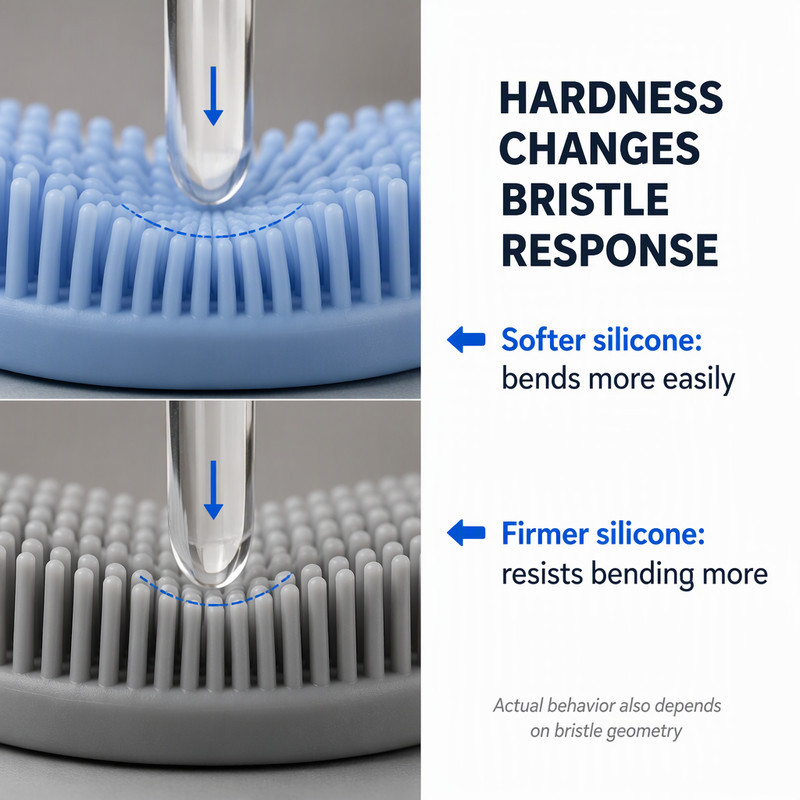
Hardness changes the stress needed to deform the material by a given amount. On a bristle, that translates into how much force the tip exerts on the skin for a given deflection, how quickly the bristle returns after it is pushed aside, and how much it resists collapsing when the pad is pressed flat. All three are felt by the user; none of them is measured by a durometer.
In practice, the difference between a soft and a firm compound shows up first at low deflection. A soft bristle starts bending almost as soon as it touches, so the contact area grows quickly and the pressure per unit area stays low. A firm bristle holds its shape until the load rises, then bends over a shorter distance.
For a cleansing pad, that produces two different sensations from the same nominal design: a soft compound feels broader and gentler but can feel vague, because the tips collapse instead of tracking the surface. A firm compound feels more precise, but if the tips are thin the same firmness reads as scratchy.
The useful conclusion is that hardness should be chosen after the bristle geometry is fixed, not before. Choosing hardness first locks in a feel that the geometry may not be able to deliver.
Softer Silicone Allows Bristles to Bend More Easily
A softer compound distributes load across more tips because each tip yields earlier. That is an advantage on a dense field of fine bristles, where individual tips are too slender to carry much load anyway.
Firmer Silicone Helps Bristles Maintain Their Shape
A firmer compound keeps a bristle straighter under the same load. On thicker bristles this is what produces the satisfying, slightly springy feel that buyers describe as "precision". On thin bristles the same compound produces a tip that does not yield, which is exactly the sensation users describe as scratching.
Hardness Also Affects Rebound and Repeated Use
Rebound is where hardness and geometry stop being separable. A bristle that bends and returns without lag feels lively; one that returns slowly feels dead. The lag comes from the viscoelastic nature of the compound and from the geometry of the root, which acts as a hinge.
Hardness is also not the same as tear strength or compression set. A compound can be firm and tear easily at the root, or soft and resist tearing well. This is why a hardness number alone cannot be used to predict service life, and why buyers should ask for the full material specification rather than a single value.
Which Silicone Hardness Is Suitable for Different Bristle Structures?
There is no universal answer, but there is a consistent method: hold the intended sensation fixed, then vary hardness and geometry together until both the feel and the molding behaviour are acceptable. The three geometries below behave differently enough that they should be treated as separate design cases.
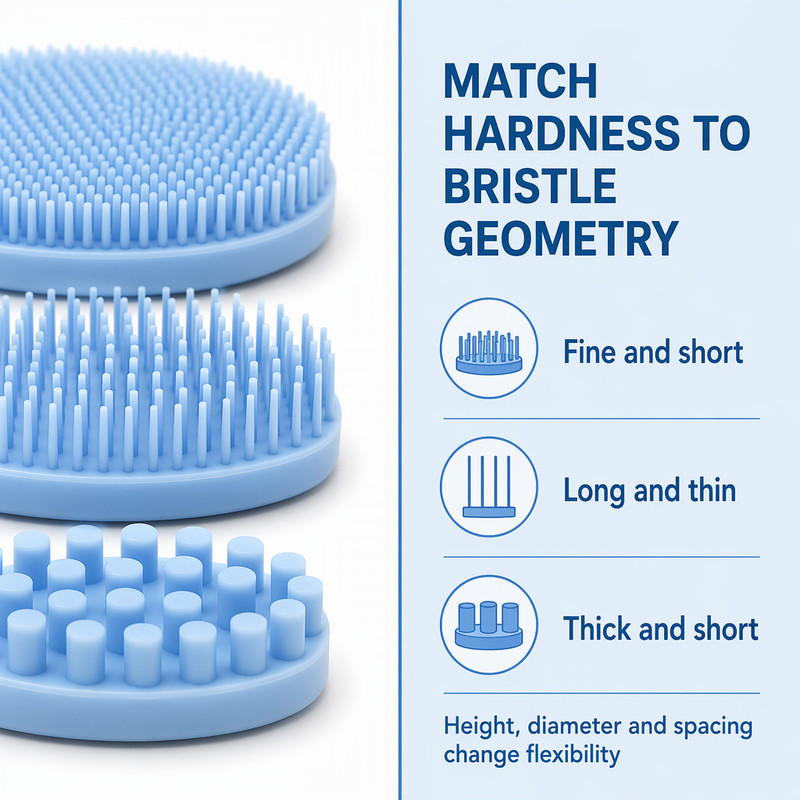
Fine and short bristles are the most forgiving in appearance and the least forgiving in molding. They fill relatively easily because the cavity is short, but they are also the ones that show flash and tip rounding most clearly.
Long and thin bristles are the opposite: they are dramatic in feel and difficult in production, because the cavity is deep, the tip is far from the vent, and release friction acts along a long slender column.
Thick and short bristles are structurally stable and easy to fill, but they can feel blunt. Their design problem is not manufacturing; it is finding a compound soft enough to feel pleasant without making the bristle feel like a rubber peg.
Fine and Short Bristles Require a Different Balance of Flexibility and Support
Because the bristle is short, the bending arm is short, so the tip feels firmer than its hardness suggests. A compound that would feel soft on a long bristle can feel crisp on a short one. For this geometry, a slightly softer compound usually restores the intended gentleness without risking collapse.
The constraint is filling. Very fine cavities need a compound that flows easily at the molding temperature, and a softer compound is generally easier to push into a fine cavity than a stiff one. Fine and short is therefore the geometry where soft compounds have the fewest penalties.
Long and Thin Bristles Need Careful Control of Flexibility
Long bristles amplify every property. A small change in hardness produces a large change in how far the tip travels under load, and a small change in diameter produces a much larger change in stiffness than the same percentage change in hardness.
This is the geometry where the root deserves the most attention. A long bristle concentrates bending stress at the transition to the base, so the root needs a generous fillet and enough section to avoid tearing, while the working length stays slender enough to feel soft.
Thick and Short Bristles Need Enough Flexibility Without Feeling Too Rigid
Thick bristles are stiff because of their diameter, so the compound has to supply the softness that geometry cannot. That usually means a softer compound than a buyer would expect from the drawing, and it means paying attention to surface finish, because a thick tip with a sharp edge feels harder than the same tip with a rounded edge.
Mixed Bristle Patterns May Require More Careful Material Evaluation
Many cleansing pads combine zones: a dense fine field in the centre, thicker bristles at the edge, sometimes a smooth area for product application. With one compound, the thick zone will feel firmer than the fine zone. That may be intentional, and it may be a complaint waiting to happen.
The evaluation should therefore be done on the complete pad, not on individual bristles. A pad that feels correct bristle by bristle can feel uneven as a whole, because the hand averages the response across the contact area.
Why Should Buyers Avoid Choosing Silicone Hardness Based on Shore Values Alone?
Shore A is a useful, cheap, well-understood number, and it is a poor predictor of feel on its own. Two compounds at the same Shore A can differ in modulus, tear strength, rebound and flow behaviour, and two bristles of the same compound can feel completely different if their dimensions differ.
Bristle Diameter and Height Change the Actual Bending Behavior
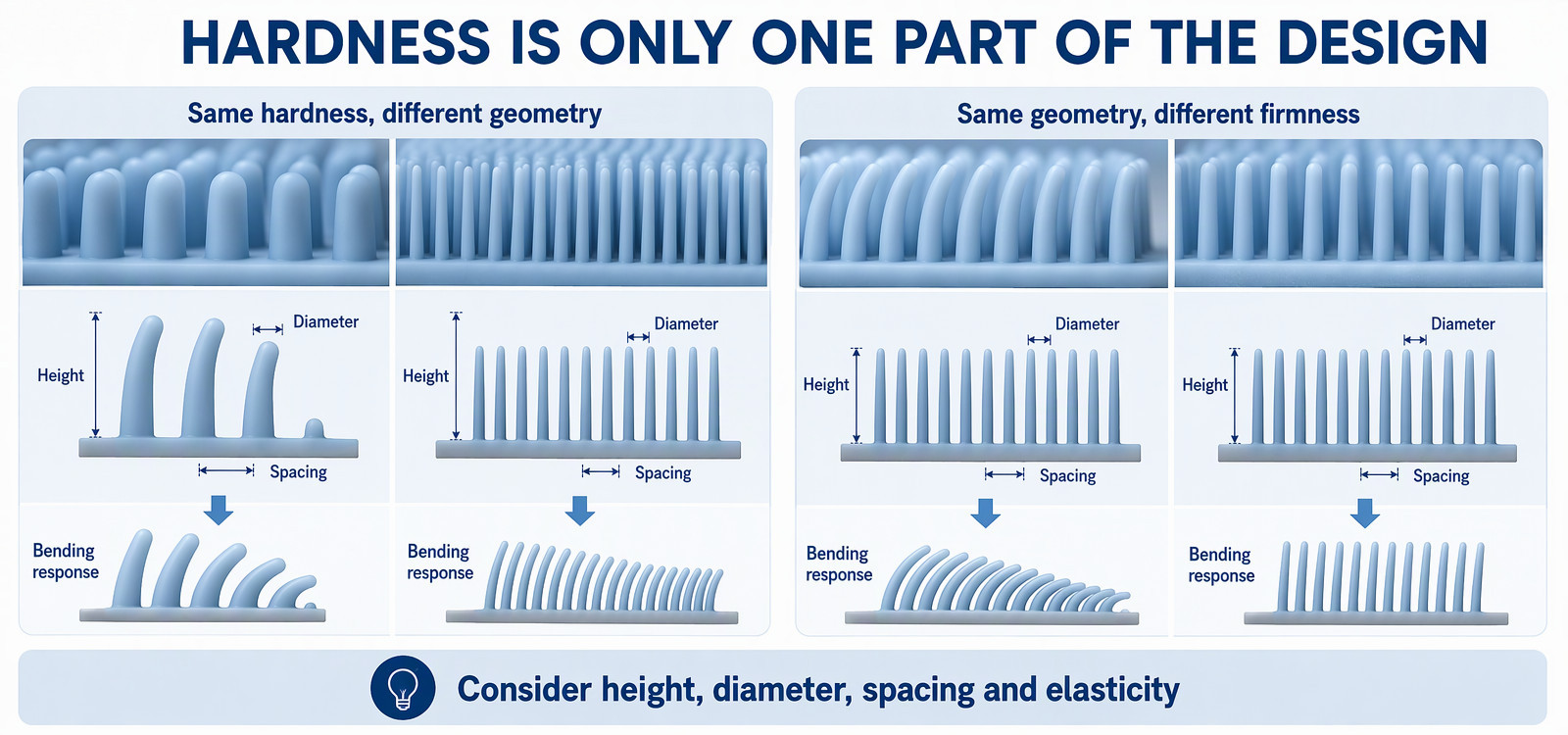
For a slender column loaded at the tip, stiffness scales with the fourth power of diameter and inversely with the cube of length. That relationship is the single most useful thing a product developer can know about silicone bristles, because it explains why a 20% increase in diameter makes a bristle roughly twice as stiff, while a 20% increase in hardness might change the feel by a small fraction of that.
It also explains a common surprise: a pad made from a softer compound can feel firmer than expected because the bristles were thickened during tool correction to fix a filling problem. The material changed in one direction and the geometry changed in the other, and the geometry won. A published correlation model for flexible polymers shows that the relationship between Shore hardness and tensile modulus is not a single straight line across the scale, which is one more reason a hardness number cannot stand in for a mechanical property.
Bristle Spacing Influences How the Cleaning Surface Responds to Pressure
Closely spaced bristles support each other. When the pad is pressed, neighbouring tips touch and the field behaves like a stiffer structure than any single bristle would suggest. Widely spaced bristles act individually, so the pad feels softer and the pressure per tip rises.
Silicone Formulation Can Influence Performance Beyond Hardness
Filler loading, polymer chain length and cure system all change properties that the user can feel but the durometer cannot show. Tear strength decides whether a bristle survives a fingernail. Rebound decides whether the pad feels lively after ten strokes. Compression set decides whether the field looks flattened after being stored under a cap.
A specification that lists only hardness leaves all three undefined. Our longer notes on 40 Shore A versus 60 Shore A and on how hardness affects the feel of molded silicone parts describe how that range behaves in production.
How Can Manufacturers Evaluate Silicone Hardness During Product Development?
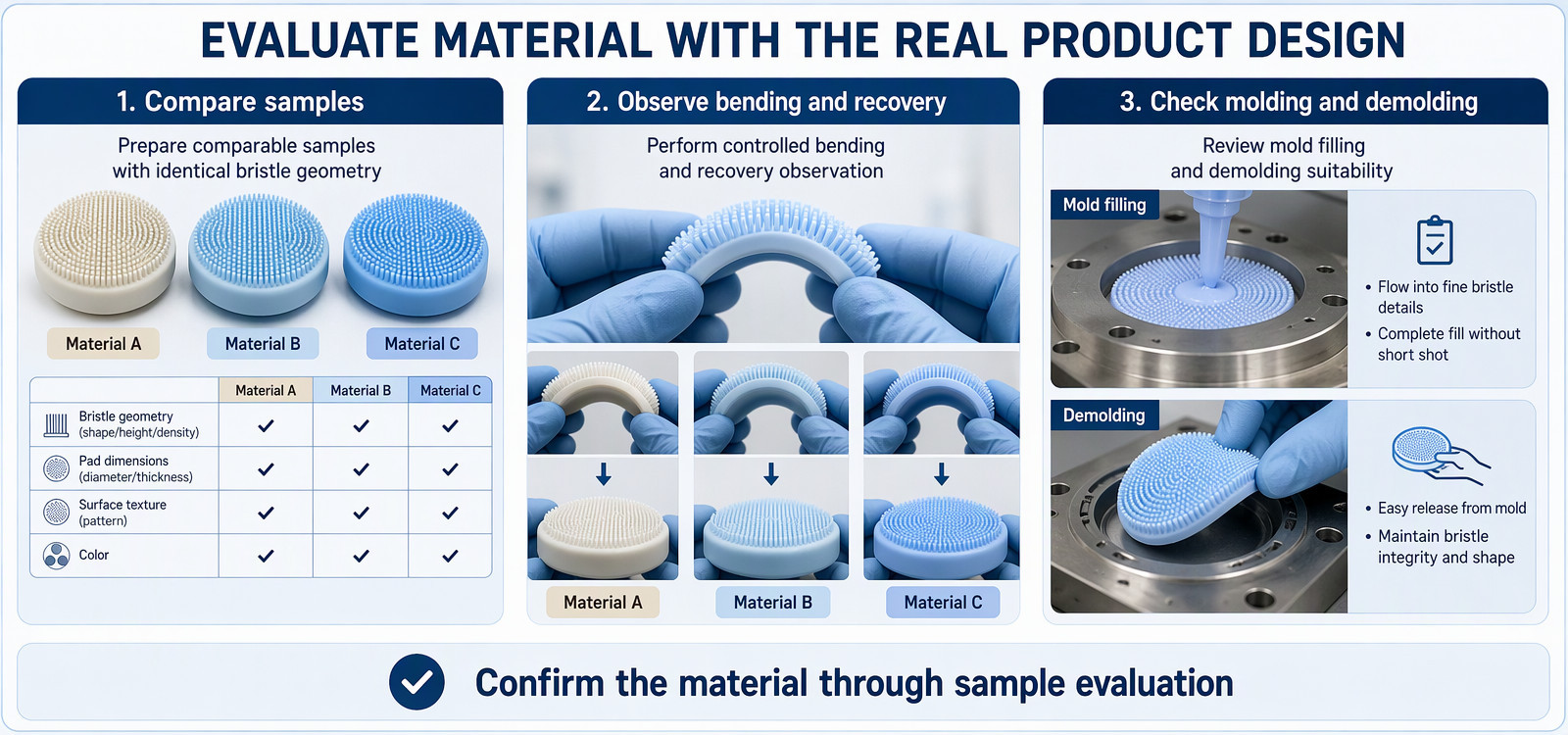
Evaluation is a sequence, not a single test. The goal is to compare options under conditions that isolate one variable at a time, then confirm that the preferred option can actually be molded.
Compare Different Hardness Samples Using the Same Bristle Geometry
If the samples differ in both hardness and geometry, the result cannot be attributed to either. Prepare a small set of pads from the same tool with two or three compounds, label them, and keep them at the same temperature before evaluation.
Test Bristle Bending and Recovery Under Repeatable Conditions
A simple, repeatable test beats an expensive, inconsistent one. Press the pad against a flat transparent surface with a defined load, observe the deflection from the side, release, and note whether the tips return immediately, slowly, or not at all.
The observation that matters most is recovery after a sustained load, because that is what happens in a bathroom: the pad sits under a cap or in a case, pressed against a surface, for hours. A compound that recovers in a second on the bench may take a permanent set overnight.
Evaluate Mold Filling and Demolding Performance
The best-feeling compound is useless if it will not fill the tool. During the trial, check for short tips at the far end of the plate, flash at the parting line and bristles that lean after release. These are the three signatures that a compound is at the edge of the process window.
What Information Should Buyers Provide When Customizing Silicone Facial Cleansing Pads?
The more of the following is fixed before sampling, the fewer iterations the project needs.
- Intended sensation in plain language: gentle, firm, precise, massaging, and where on the face it will be used.
- Bristle height, diameter and spacing, or a reference sample that can be measured.
- Overall pad dimensions, base thickness and edge treatment.
- Hardness preference if one exists, with the scale, and whether it is a hard requirement or a starting point.
- Any requirement on rebound, tear resistance or compression set.
- Colour, surface finish and whether the part will be printed or laser marked.
- Cleaning and storage conditions the product will see, including whether it will be stored under compression.
- Target order quantity and packing method, because both affect cavity count and cost.
Frequently Asked Questions About Silicone Hardness for Facial Cleansing Pads
What silicone hardness is suitable for facial cleansing pads?
There is no single value, but most pads sit in the softer half of the scale because the bristles are thin and the contact should be gentle. The correct value depends on bristle diameter and height, so it should be confirmed on a sample with the final geometry rather than chosen from a datasheet.
Are softer silicone bristles always better for facial cleansing?
No. Softer bristles distribute pressure better, but very soft bristles in the outer rows fold over and reduce the effective cleaning area. A pad can be too soft to function, especially when the bristles are long.
Does higher Shore hardness make silicone bristles less flexible?
Yes, at the material level, but the effect is smaller than the effect of geometry. Bending stiffness rises with the fourth power of diameter and falls with the cube of length, so a small dimensional change usually outweighs a moderate hardness change.
How does bristle length affect the choice of silicone hardness?
Long bristles amplify the effect of hardness, so a compound that feels right on a short bristle can feel too soft or too floppy on a long one. Long bristles usually need a slightly firmer compound or a thicker root to keep the intended control.
Can manufacturers customize silicone hardness for different bristle structures?
Yes. Compounds can be selected per project, and in some cases two compounds are used in one product to give different zones different behaviour. That is a tooling and process decision as much as a material one, so it should be discussed before the mold is cut.
Match Silicone Hardness to Bristle Geometry Before Finalizing the Mold
Hardness is one input among several, and it is the easiest one to change late. Geometry is the expensive one. That is why the sensible order is geometry first, then hardness, then a physical sample, then the mold. A buyer who compares three samples of the same shape learns more in an afternoon than a stack of datasheets can provide.
FromRubber develops and molds custom silicone beauty tools, including cleansing pads and brushes with fine bristle structures, for brands and OEM buyers. Material selection, tool design and sample evaluation are handled by the same engineering team, so a hardness change and its molding consequences are reviewed together. Send a drawing or a reference sample through the inquiry form, or contact us on WeChat and WhatsApp at +86 18676210913.
Sources and further reading
- New Mathematical Model for Correlation Between Tensile Elastic Modulus and Shore "A" and "00" Hardness for Flexible Polymers (2026). The modulus–hardness relationship is piecewise rather than linear, and was measured across silicone rubber and other flexible polymers. pmc.ncbi.nlm.nih.gov
- FromRubber technical notes: 40 Shore A versus 60 Shore A, hardness and part feel.