How to Design Silicone Face Mask Mixing Bowls and Spatulas as a Matching Beauty Set?
- Share
- Issue Time
- Nov 6,2026
Summary
A mask set works when the bowl sets the spatula's working width. Covers bowl capacity and inner geometry, spatula blade proportion and edge shape, where the two parts may differ in hardness, and why a set needs two moulds and paired validation.
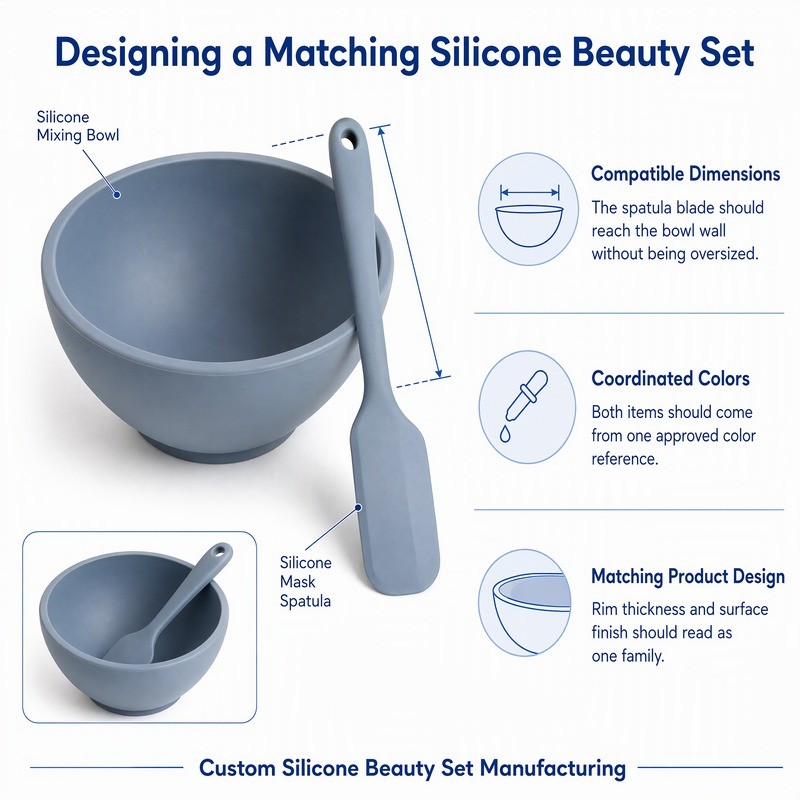
A mixing bowl and a spatula are usually developed as two products that happen to share a colour. Then the first sample set arrives and the spatula is too wide to follow the bowl wall, or too narrow to reach the last of the mask, and the set stops feeling like a set.
Sets are not a packaging decision. They are a geometry decision, because each part defines what the other can usefully be. This article looks at how a silicone face mask bowl and spatula should be matched, where the two products can legitimately differ, and what changes in tooling and validation once they are sold together.
Why Should Silicone Face Mask Mixing Bowls and Spatulas Be Designed Together?
Because the useful working width of the spatula is a function of the bowl's internal curve, not of the spatula alone. Developing them in parallel is the only way to fix that relationship before a mould exists.
A Matching Set Needs More Than the Same Color
Colour is the easiest part of a set and the part buyers check first, which is why it gets disproportionate attention. Visual consistency is necessary and not sufficient. Two products in the same shade can still feel unrelated in the hand if the rim thickness, the surface texture and the edge softness do not belong to the same family.
Functional compatibility is the harder half. The spatula has to reach the bowl wall at the point where mask residue collects, which is the lower third of the inner curve. If the blade is shorter than the bowl's radius at that height, a band of product is unreachable and the user compensates by tilting the bowl or using a finger.
A set also has to work as a pair in use, not just as a pair on a shelf. The spatula needs somewhere to rest without sliding into the bowl, and the bowl needs a rim that a wet hand can hold while the other hand mixes.
The pair in the example shares one silicone tone and one rim treatment, so they read as a family. The proportion is what makes them work: the spatula blade is sized to the bowl's internal diameter rather than to a standard handle length.
That relationship is easiest to see in the small inset, where the spatula sits inside the bowl. If the blade looks short against the bowl, it will be short in use.
Bowl Shape Affects How Easily the Mask Can Be Mixed
A bowl with a flat base and a sharp corner between base and wall is difficult to mix in. Powder and liquid accumulate in the corner, the spatula cannot follow the angle, and the user ends up with lumps at the bottom edge.
A continuous curve from base to wall solves it. The transition should be generous enough that a flexible blade can follow it under light pressure, which generally means a radius in proportion to the bowl diameter rather than a small fixed fillet.
Bowl depth relative to diameter affects mixing as well. A deep, narrow bowl keeps the product contained but restricts the arc of the spatula; a shallow, wide bowl is easy to work in and splashes more. The right proportion depends on the intended batch size, not on aesthetics.
Spatula Design Should Match the Bowl's Inner Surface
The spatula has two jobs: mixing, which needs a broad face, and scraping, which needs a thin edge that conforms to the bowl. Both are served by a blade that is widest at the tip and thinnest at the working edge, with enough flexibility to bend against the wall without folding.
The edge profile is the detail that decides whether the tool feels precise. A blunt edge pushes product ahead of itself; a properly thinned edge slides under residue and lifts it. On a moulded silicone spatula, that edge is also the most demanding feature in the tool, because it needs to fill completely at very small section thickness.
How Should a Silicone Face Mask Mixing Bowl Be Designed?
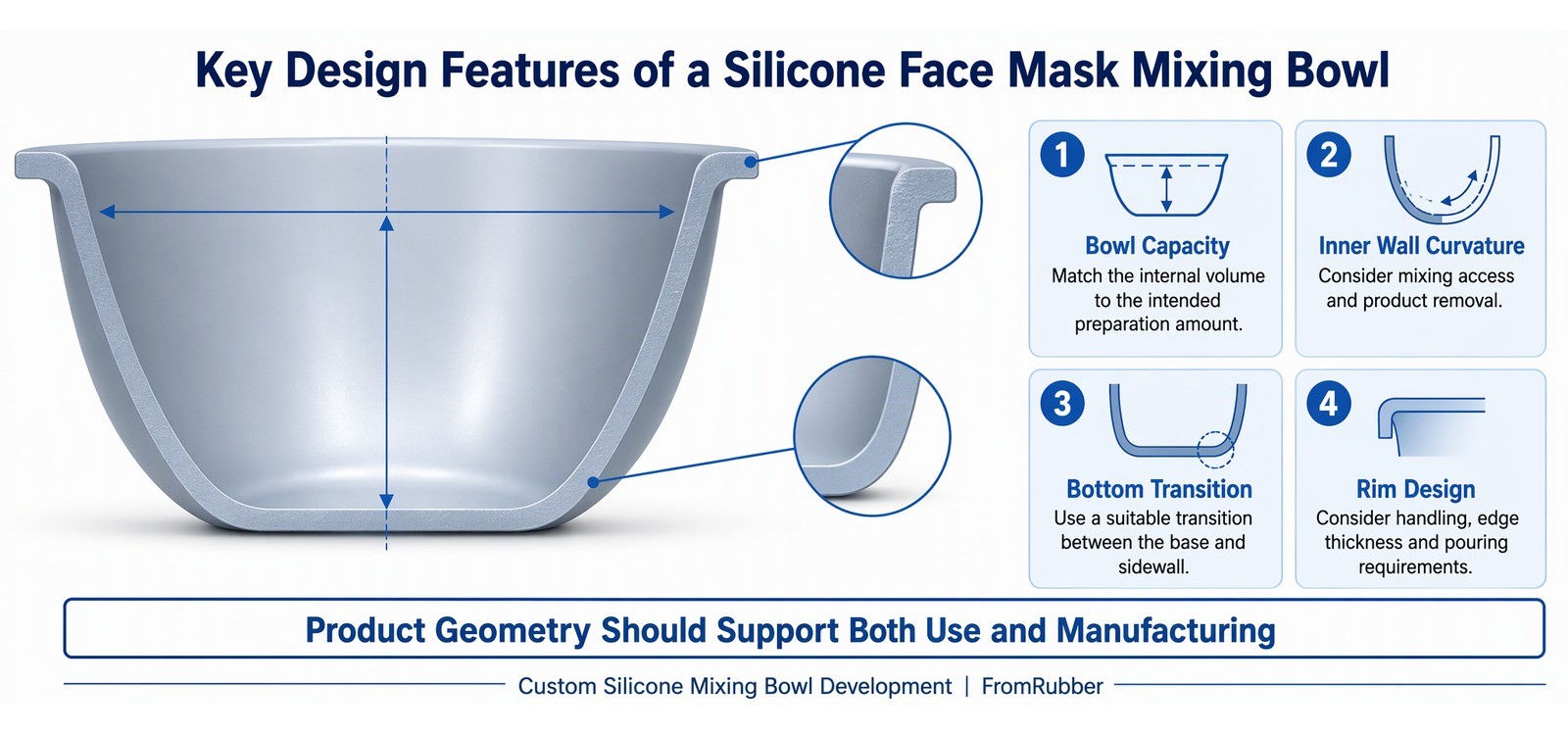
Three decisions set the bowl's usefulness: capacity, internal shape and rim.
Choose a Bowl Capacity That Matches the Intended Mask Preparation
Capacity should be chosen from the amount of mask a single use requires, with working room above it. A bowl filled to the rim cannot be mixed without spilling, so the practical usable volume is well below the geometric capacity.
Depth and diameter then follow. For a small single-use portion, a wide shallow bowl is easier to work in than a narrow deep one, because the spatula has room to move. For a larger batch, depth becomes necessary to contain the product.
Use an Inner Shape That Supports Easy Mixing and Removal
The internal surface should be continuous, with no ledges where product can sit. Where a decorative feature or a grip detail is wanted on the outside, it should not be mirrored on the inside.
A slight taper from rim to base also helps removal: the product gathers toward the centre as it is scraped down, rather than spreading across a flat floor.
Design the Rim for Convenient Handling and Pouring
A rim that is too thin cuts into a wet hand; a rim that is too thick feels clumsy and collects product on its inner face. The useful compromise is a rolled or slightly thickened rim that gives the fingers something to hold while keeping the inner lip thin enough to scrape against.
If the bowl is intended to pour, one section of the rim needs to be shaped for it. A pour spout formed as a shallow dip in the rim is more effective than a symmetrical bowl, and it does not require an extra part.
How Should the Silicone Spatula Be Designed to Match the Bowl?
This is where set development differs from developing two products separately. The spatula's dimensions are derived, not chosen.
Match the Spatula Width to the Bowl's Inner Diameter
A blade that is too wide cannot follow the curve; it bridges across the bowl and only the centre of the edge touches. A blade that is too narrow leaves a band of product untouched and requires more passes.
The workable relationship is a blade width that follows the flat portion of the inner wall at the height where residue collects, with a slightly rounded tip that can reach into the base transition. Practically, that means the blade should be wide enough to span most of the bowl's inner radius without exceeding the curvature it has to follow.
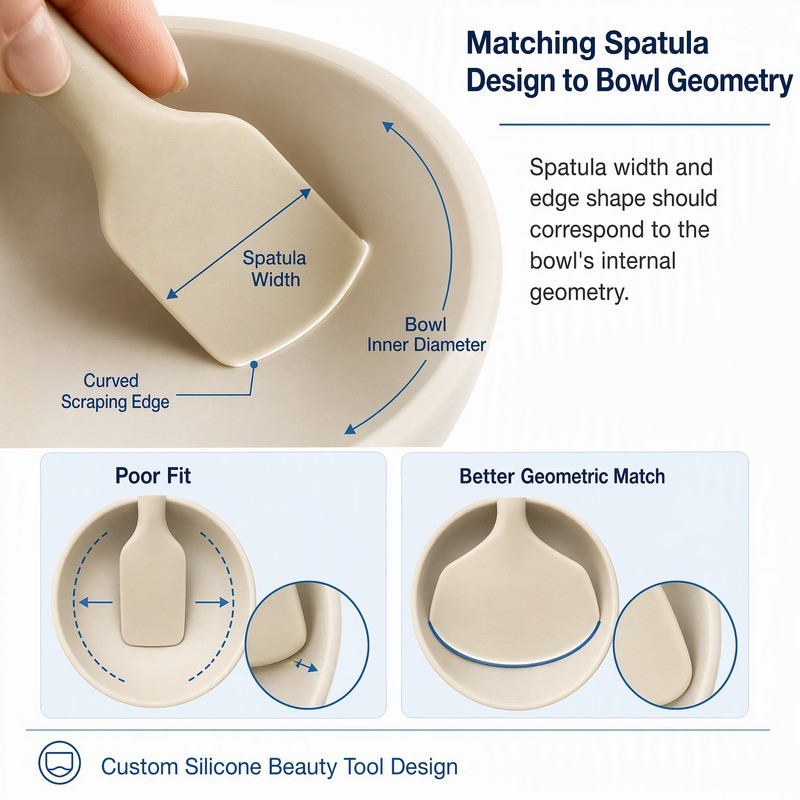
The comparison is easy to miss on a drawing. A wide blade looks more capable, and it is, until it is placed against a curved wall. Then the contact area drops to a narrow strip and the effective scraping width is smaller than that of a properly proportioned narrow blade.
The fix is often a slight curve across the blade edge, matched to the bowl radius. That change costs nothing in tooling and is the difference between a set that works and one that merely matches.
Choose a Flexible Blade Shape for Mixing and Spreading
Mixing and spreading impose different demands. Mixing needs a blade stiff enough to move a viscous mass without folding over; spreading needs a blade flexible enough to follow the skin or the bowl without digging in.
One geometry can serve both if the stiffness varies along the blade: a thicker spine near the handle for mixing and a thinner, more flexible outer third for spreading and scraping. That variation is a moulding decision as much as a design one, since it depends on the compound flowing into a thin section reliably.
Design the Handle for Comfortable Grip and Control
Handle length should relate to bowl depth. A short handle forces the hand into the bowl; a long handle gives control but reduces the precision of the blade tip. A handle roughly comparable to the bowl diameter is a workable starting point for a set of this size.
The cross-section matters for a wet hand. A flat oval resists rotation better than a round section, and a light texture on the grip area is more effective than a glossy finish. The transition from handle to blade needs a generous fillet, because that is where bending stress concentrates when the blade is pressed against the bowl wall.
How Can Both Products Maintain a Consistent Material and Appearance?
Match Silicone Hardness to Each Product's Function
The bowl needs enough shape retention to stay upright when filled and to resist collapsing when squeezed during cleaning. The spatula needs compliance at the blade. Those requirements do not have to be met by the same hardness.
Using a slightly firmer compound for the bowl and a softer one for the spatula is a normal and often better choice, provided the surface finish and colour read as one family. A set that uses one hardness everywhere usually compromises one of the two products.
Coordinate Color and Surface Finish Across the Set
Colour consistency across two moulds is harder than within one, because cavity finish, wall thickness and cure conditions differ between the tools. Approving both parts from moulded samples at production thickness is the only reliable check.
Finish is equally important. A matte bowl with a gloss spatula looks like a mistake even when the pigments match. Fixing the target finish for the set before either tool is polished avoids rework on two moulds instead of one.
Review Material Compatibility With the Intended Cosmetic Products
Silicone is generally resistant to many cosmetic ingredients, and resistance is not the same as indifference. Prolonged contact with oils, solvents or acidic actives can cause swelling, softening or extraction, and the effect depends on the specific compound and the specific formulation.
The correct approach is to test rather than assume. ISO 1817:2026 describes methods for evaluating the change in properties of vulcanised or thermoplastic rubber after immersion in test liquids, which is the standard basis for a compatibility statement. A supplier should not claim chemical resistance for a formulation that has not been tested against it.
What Manufacturing Challenges Should Be Considered When Developing a Silicone Beauty Set?
Separate Mold Designs May Be Needed for Different Product Structures
A bowl is a deep open form with relatively uniform wall thickness. A spatula is a long, thin, tapering part with a delicate edge. These are different tooling problems, and they usually require two moulds with different parting line logic, different venting and possibly different press settings.
That has a commercial consequence worth raising early: a set carries two tooling costs, and the per-unit cost advantage of a set comes from packing and shipping, not from sharing a mould.
Different Wall Thicknesses Can Affect Molding and Shape Consistency
Within the bowl, a thick base and a thin rim create uneven cure. The thin section cures first while the thick base is still soft, which can produce sink or distortion when the part is demoulded. Gradual transitions between sections reduce the problem; abrupt steps amplify it.
On the spatula, the thin working edge is the section most likely to underfill. Accepting a slightly thicker edge in the first sample, then refining once the tool is proven, is often faster than starting with the thinnest possible edge and fighting it through several trials.
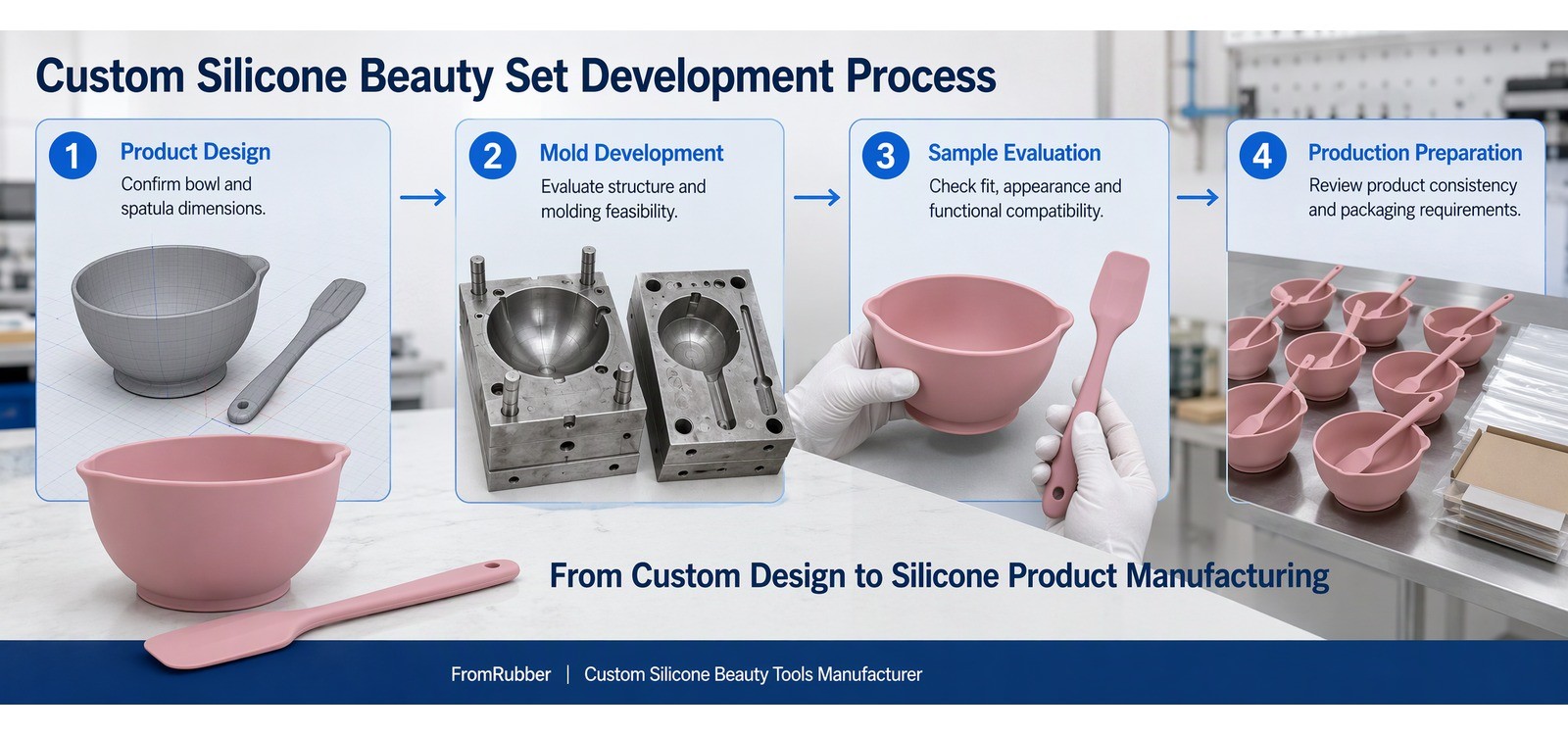
Sample Testing Should Cover Both Individual Products and the Complete Set
Each part should be evaluated on its own for dimensions, edge quality and surface finish. Then the pair should be evaluated together, because the failures that matter most only appear in combination: the blade that cannot reach the bowl wall, the spatula that slides into the bowl, the rim that is too narrow for a wet hand holding both.
How Should Silicone Face Mask Mixing Sets Be Prepared for Private-Label Packaging?
Arrange the Bowl and Spatula to Prevent Movement During Shipping
Two loose silicone parts in a box will find each other in transit. The spatula will press against the bowl rim, and a flexible rim that is pressed for weeks can arrive with a set. A moulded insert, a folded card tray or a shaped cavity in the retail box prevents that, and the choice affects the product dimensions.
Consider Set Packaging Dimensions Before Finalizing Product Sizes
Set packaging is governed by the diagonal, not the individual parts. A bowl and a spatula placed side by side can require a box substantially larger than either, and a small reduction in bowl diameter often reduces the box size by more than the same reduction in spatula length.
Coordinate Colors, Branding, and Product Presentation
Colour across two moulds, print or moulded branding, and the way the pair is presented all belong to one appearance standard. Deciding the standard once, and applying it to both parts, prevents the common outcome where each part is individually correct and the set is not.
Check Whether Additional Beauty Accessories Fit the Set Concept
Many mask sets grow to include a brush or a storage accessory. That can be a good decision, but each addition changes the bowl-to-spatula relationship that the set was built around, and it changes the packaging. Adding a third part is a new development, not an extension.
What Should Buyers Provide When Requesting a Custom Silicone Beauty Set?
Share the Intended Bowl Capacity and Spatula Dimensions
State the mask volume per use and the bowl diameter you have in mind, plus any constraint on spatula length from the packaging.
Confirm Material Hardness and Color Requirements
Specify hardness separately for each part if the functions differ. Provide a physical colour reference rather than a screen colour.
Provide Reference Samples or Product Drawings
A sample of an existing product, even a competitor's, communicates more about edge feel and hand feel than a drawing does.
Review the Complete Set Before Mass Production
Test the pair together with the actual mask formulation, and test the packed set as it will ship.
Frequently Asked Questions About Silicone Face Mask Mixing Sets
Can silicone face mask mixing bowls and spatulas be customized as a set?
Yes. The set is normally tooled as two moulds developed against one specification, so that bowl diameter, spatula width and the shared colour and finish are agreed together.
Should the mixing bowl and spatula use the same silicone hardness?
Not necessarily. The bowl benefits from slightly firmer material for shape retention and the spatula from softer material at the blade. Consistency of colour and finish matters more for the set than identical hardness.
How do you choose the right spatula size for a silicone mixing bowl?
Set the blade width against the flat portion of the bowl's inner wall at the height where residue collects, and shape the edge to follow the bowl radius. A blade wider than the curve bridges it and loses contact.
Can silicone face mask mixing sets be developed with custom colors and packaging?
Yes. Colour, finish, branding and packaging are all part of set development, and packaging dimensions should be settled before the bowl and spatula sizes are frozen.
Treat the Pair as One Product
A mask mixing set succeeds when the two parts were designed against each other: bowl radius setting blade width, bowl depth setting handle length, and a shared appearance standard applied to two separate moulds. When they are designed independently and matched at the packaging stage, the result is usually two acceptable products and one disappointing set.
FromRubber develops custom silicone beauty sets and reviews the relationship between parts, not just each part on its own, before tooling is released. If you are planning a bowl and spatula set, send the intended capacity, the mask volume per use and any packaging constraint through the inquiry page, and the team will respond with a paired geometry proposal. WeChat or WhatsApp: +86 18676210913.
About the source
FromRubber is the brand of Dongguan Bohao Electronic Technology Co., Ltd., a custom silicone and rubber parts manufacturer that produces compression-moulded components for beauty, electronics and industrial customers. The notes above come from production work on custom silicone tooling rather than from a general materials handbook. The parts discussed are grouped under custom silicone rubber parts. For a specific project, the engineering team can be reached on WeChat or WhatsApp at +86 18676210913.
- flash and uneven edges on silicone makeup tools
- mould design and parting lines for silicone beauty tools
- designing a stable silicone makeup brush holder
- sponge case structure, ventilation and closures
Sources and further reading
- ISO 1817:2026, Rubber, vulcanized or thermoplastic — Determination of the effect of liquids, the standard basis for any chemical compatibility statement. ISO 1817:2026 standard page
- ISO 3302-1:2014, Rubber — Tolerances for products — Part 1: Dimensional tolerances. ISO 3302-1:2014 standard page
- FromRubber capability overview for custom silicone and plastic manufacturing
- Related reading on silicone surfaces for mixing cosmetic products