How to Design Silicone Makeup Sponge Cases for Travel and Daily Storage?
- Share
- Issue Time
- Nov 6,2026
Summary
A sponge case is a small climate, not just a container. Covers cavity sizing from the sponge's widest point, ventilation that does not weaken the shell, closure options in repeated use, and how wall thickness decides whether a case protects or compresses.
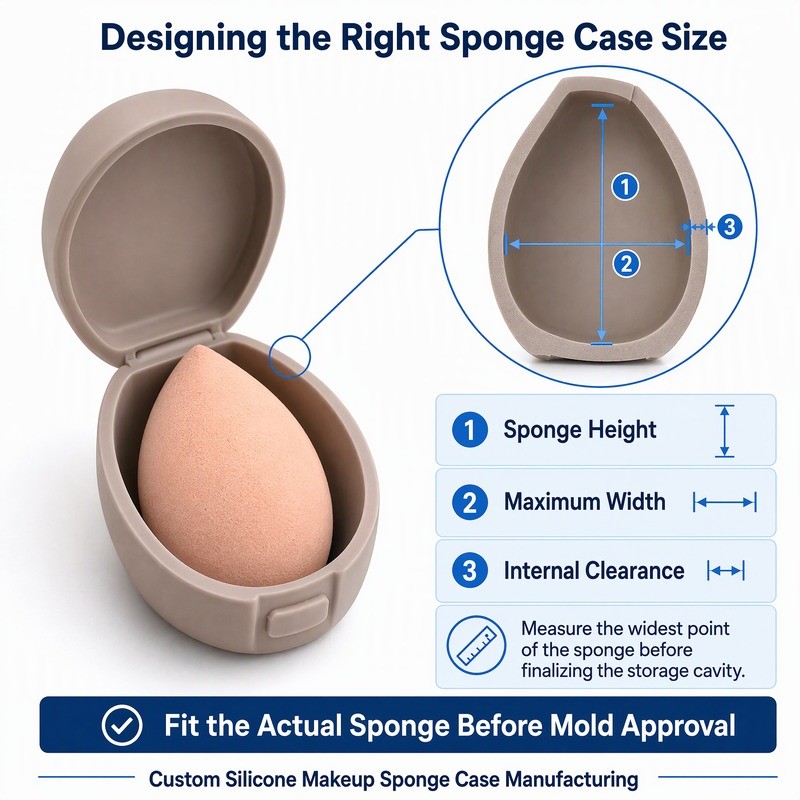
A makeup sponge case looks like a container. It is actually a small climate. The same closed shell that keeps dust off a sponge also holds the moisture that came off it this morning, and the two jobs pull the design in opposite directions.
Most sponge cases on the market solve one requirement and quietly fail the other: sealed enough to protect, sealed enough to stay damp. This article works through the structural decisions that matter when a case is developed for both travel and daily use, including why a smaller version of a general-purpose silicone container is usually the wrong starting point.
What Should a Silicone Makeup Sponge Case Do in Daily Use and Travel?
Three requirements define the product. They are easy to state and easy to compromise unintentionally.
Keep the Sponge Protected From Dust and External Contact
Inside a makeup bag, a sponge is in contact with brush handles, zipper pulls, fabric and whatever else has been in there. A case needs to separate the sponge from that environment without pressing it. The relevant design question is not whether the case closes, but how much of the sponge surface is actually enclosed once it is inside.
A shallow tray with a lid that rests on top of the sponge provides almost no protection against lateral contact, because the sponge is exposed at the sides. A deeper cup that surrounds the sponge up to its widest point gives real separation even if the lid fit is simple.
Provide Enough Space for Different Sponge Shapes
Teardrop, bevel-cut and round sponges have very different envelopes. A teardrop is tall with a narrow tip and a broad base; a bevel-cut sponge has a flat face that changes how it sits; a round sponge is uniform but wide. A cavity sized to one shape will grip the second and crush the third.
Wet and dry states add a second variable. A damp sponge expands slightly and is far more compressible, so a cavity that fits a dry sponge snugly will press a wet one against the walls. Compression in storage is what deforms a sponge into a flat-sided shape that no longer applies makeup evenly.
Make the Case Easy to Carry Without Taking Up Too Much Space
Travel sizing is a negotiation between protection and bulk. A case that is generous around the sponge is comfortable to use and takes up the space of a small pouch. A case that is compact fits a pocket and marks the sponge.
Wall thickness is the lever that is usually overlooked. Reducing wall thickness from 3 mm to 2 mm saves volume without reducing internal space, but it also reduces the case's ability to hold its shape when packed against other items. The sensible approach is to keep the cavity generous and thin the shell selectively, rather than shrinking the cavity to reduce the outside dimension.
How Should the Case Structure Accommodate Different Makeup Sponges?
Structure follows measurement. Two measurements decide most of the design.
Measure the Sponge at Its Widest Point
Height is the measurement people reach for first, and it is the least useful on its own. A tall sponge with a narrow base can sit in a shallow case; a short, wide sponge cannot. The widest point sets the minimum internal diameter, and the height sets how deep the cavity has to be to enclose the sponge rather than just support it.
Record both, plus the height at which the widest point occurs. That third number determines where the cavity needs its maximum dimension, which is not always at the base.
Clearance should be deliberate rather than incidental. Too little and the sponge is compressed on closing; too much and it moves inside the case during travel, which abrades the surface against the shell.
A modest, even clearance around the widest point gives the sponge room to sit without being squeezed. Vertical clearance is less critical, because the sponge can rest on the base of the cavity.
Leave Enough Clearance for Easy Insertion and Removal
The opening is a separate dimension from the cavity. An opening tighter than the widest point forces the user to compress the sponge every time, which shortens its life and defeats the purpose of a protective case. An opening much larger than the sponge means the sponge can fall out when the case is opened upside down.
A workable arrangement is an opening slightly narrower than the widest point, with a short flexible lead-in that guides the sponge in, and a cavity that opens out immediately behind it. The lip holds the sponge; the cavity protects it.
Choose Between a One-Piece Case and a Multi-Part Design
A one-piece case with an integral hinge has no separate lid to lose, no assembly step and no joint to align. It also puts the whole product in a single mould, which simplifies colour matching and packing. The trade-off is that the hinge area is a thin silicone web that sees repeated flexing, so its geometry and thickness decide the product's useful life.
A two-part design allows a firmer body and a different lid material or colour, and it can seal more positively. It also doubles the tooling and introduces a fit tolerance between two flexible parts, which is where most two-part silicone cases develop their first problem.
How Should Ventilation Be Designed for Silicone Makeup Sponge Storage?
Ventilation is where the two duties of a case collide most directly, and where the marketing language used in the category tends to outrun the engineering.
Why Airtight Storage May Be Unsuitable for Damp Sponges
A sponge used this morning carries water, and in a sealed case that water has nowhere to go. It migrates into the air inside the case, saturates it, and then condenses on the coolest surface, which is usually the shell. The sponge stays in a saturated atmosphere for as long as the case remains closed.
Research on cosmetic applicators points in the same direction. A 2025 study of 57 cosmetic brushes and 370 users noted that applicators which retain moisture and residue carry a higher contamination risk, and that 44.3% of surveyed users rarely cleaned their brushes. That does not mean a case causes contamination, and no case should be described as preventing it. It does mean that a design which traps moisture is working against the user's own cleaning routine.
Place Ventilation Openings Without Compromising Protection
Ventilation holes work best where they create a flow path rather than a single opening. Holes high on one side and low on the opposite side allow air to move through the case as temperature changes, instead of relying on diffusion through one small aperture.
Placement also has to respect structure. Holes placed on a flat panel remove material from the least stiff part of the shell; holes placed on a curved transition or next to a moulded rib remove less strength for the same open area. Where the case is likely to be squeezed in a bag, ventilation should never sit on the surface that takes the compression.
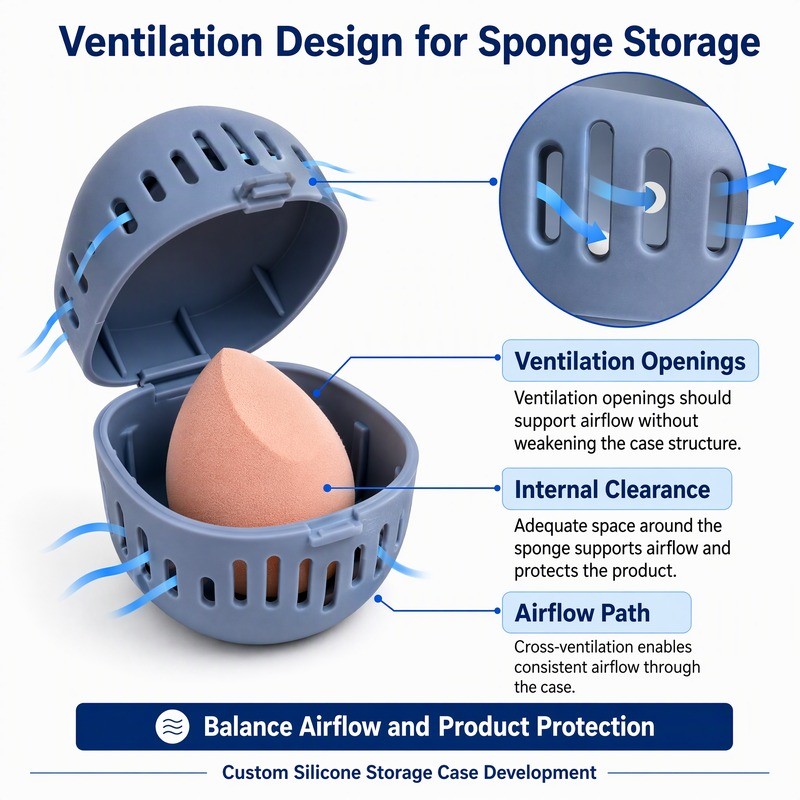
The example shows the arrangement that holds up best in practice: openings grouped on the lid and on the lower body, offset so air crosses the cavity rather than passing straight through one wall.
It also shows the internal clearance that makes ventilation meaningful. Holes are of little use if the sponge is pressed against them, because the sponge itself then blocks the path.
Consider Drainage and Cleaning During Product Development
A case is washed, and water gets in. If the internal geometry has a sump, water stays there. A base with a slight fall toward a small drain opening, or a base that is open at the lowest point, dries far faster than a flat-bottomed cup.
Cleaning access matters as much. A cavity with a narrow neck and a wide body cannot be wiped by hand, and residue that cannot be removed becomes the thing the user notices. Where the geometry needs to be deep, a removable inner cup or a two-part construction solves the problem at the cost of an extra component.
Which Closure Design Works Best for a Silicone Makeup Sponge Case?
There is no universal answer, because each closure trades opening effort against security and cost. What can be compared is how each behaves in repeated use.
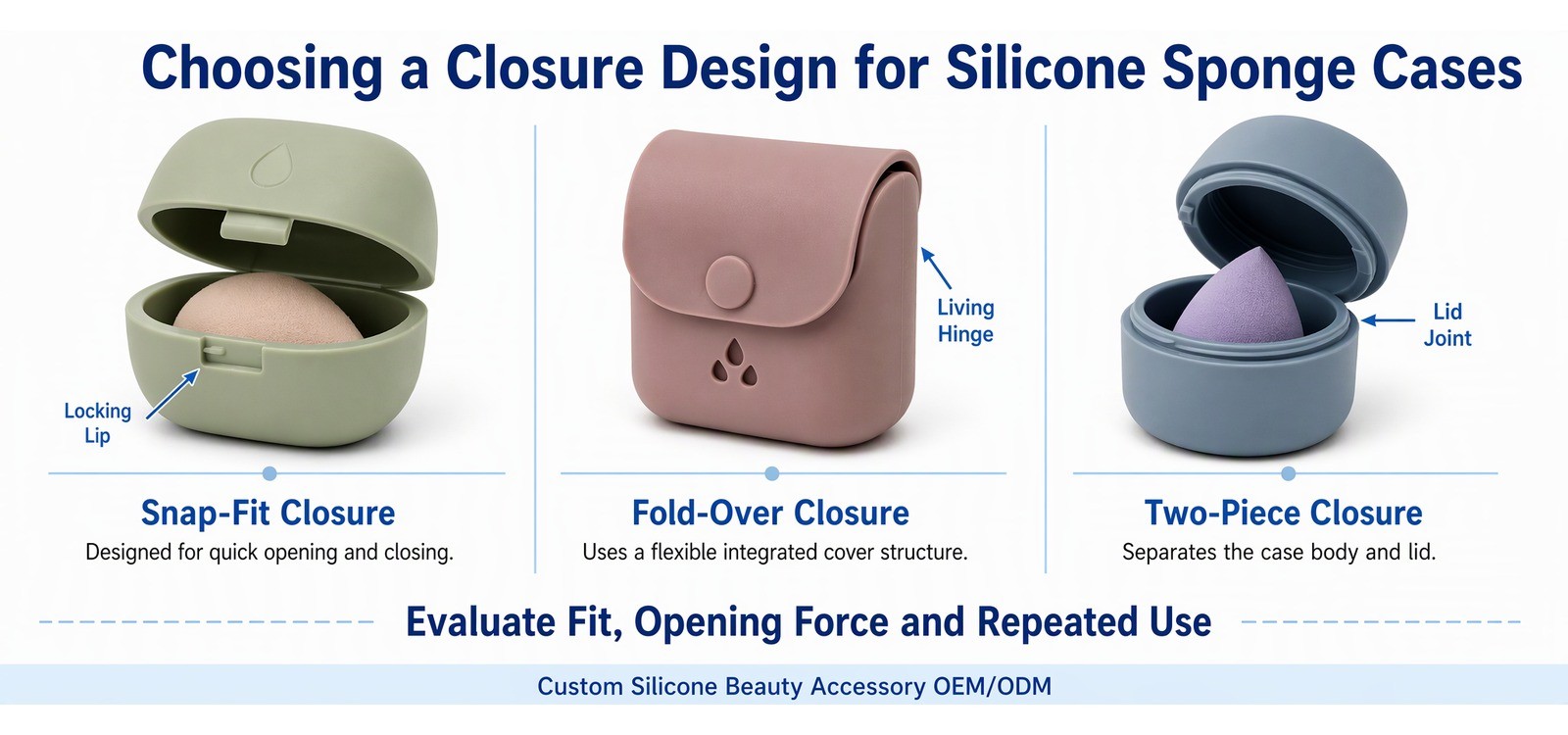
Snap-Fit Designs for Quick Daily Access
A moulded lip that snaps over a matching rim is fast to open and gives a clear tactile confirmation that the case is closed. It is the right choice for daily use, where the case is opened and closed twice a day.
The design risk is fatigue. The lip is a flexing feature, and if it is too thin it softens within months; if it is too thick it becomes difficult to open with wet hands. The snap depth, the lip thickness and the hardness of the compound have to be tuned together, and the only reliable test is a repeated open-close cycle on a moulded sample.
Fold-Over or Flexible Closures for Compact Storage
A fold-over flap with an integral living hinge produces a flat, pocketable form and eliminates the separate lid. It is well suited to travel where space is the constraint.
The hinge is the critical feature. A silicone web flexes without cracking, but it also accumulates a permanent set if the case is stored closed for long periods. Designing the hinge with a generous radius and a controlled thickness, and avoiding sharp corners at its ends, is what separates a hinge that survives a year from one that tears at the third month.
Avoid Closures That Are Too Loose or Difficult to Open
A closure that opens in a bag is worse than no closure, because the user does not know it has happened. A closure that requires two hands and a fingernail will be left open at home, which defeats the drying strategy.
The practical target is a closure that opens with one thumb and closes with light pressure, verified by several people rather than by the designer alone. Hand strength varies enough that a design tested by one person is not tested at all.
What Material and Wall Thickness Should Buyers Consider?
Choose Silicone Hardness Based on the Required Case Structure
A case that must hold its shape in a bag needs a firmer compound than one that is meant to be squeezed. A soft shell feels pleasant and conforms, and it also deforms enough to press on the sponge. The relevant question is not which hardness is better but which deformation the product can tolerate.
Balance Wall Thickness With Flexibility and Shape Retention
Wall thickness changes three things at once: how much the case flexes, how much it weighs, and how much material it uses. A thin wall gives a soft, packable product with a shorter structural life. A thick wall gives a firm product at higher cost.
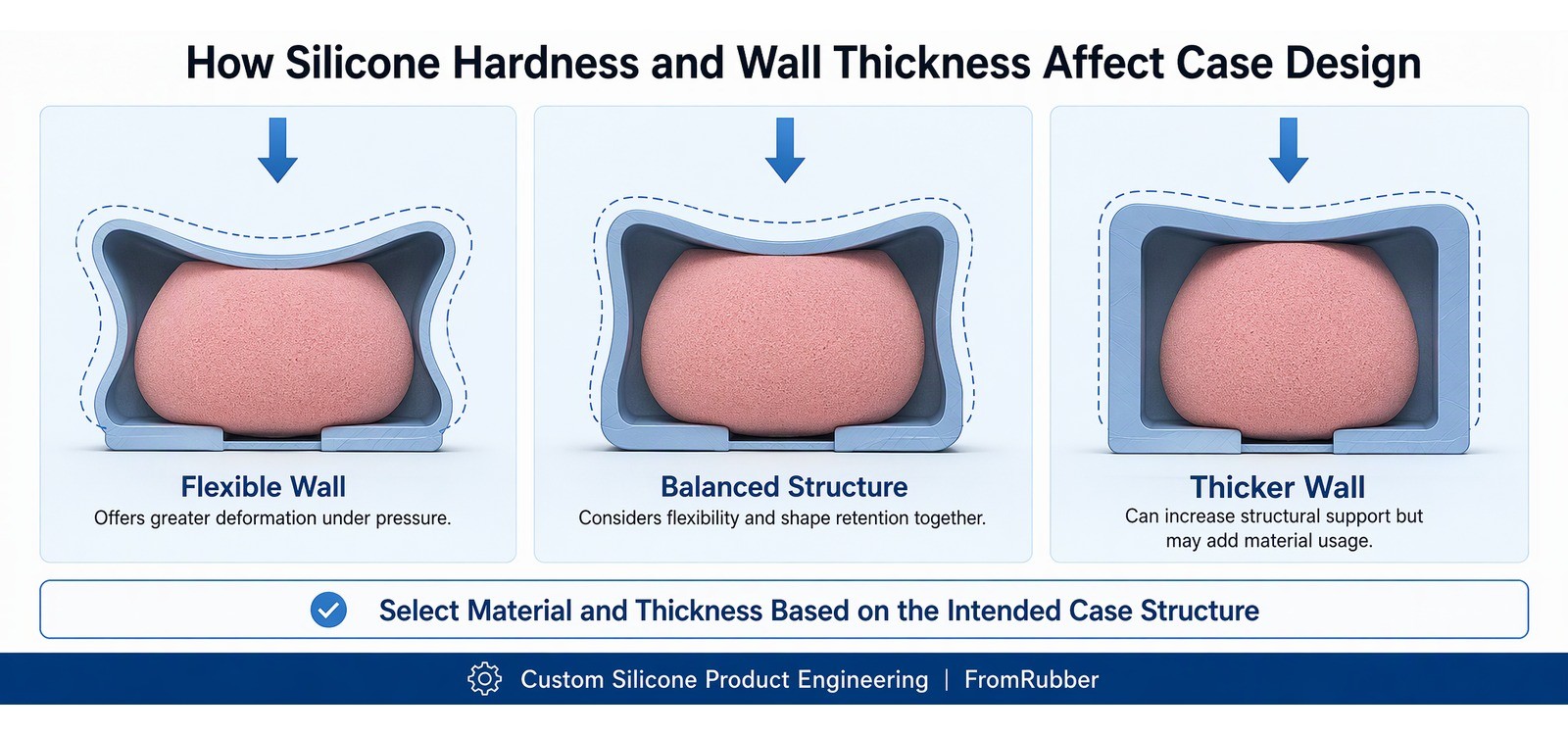
The useful method is to vary thickness by region. The lid can be thinner because it carries little load; the side walls need enough section to resist bag compression; the base needs enough to stay flat. A single number applied to the whole shell is a compromise that usually overbuilds one area and underbuilds another.
Consider Color Matching and Surface Finish for Private Labels
Silicone colour is affected by wall thickness, because light passes through thin sections differently than through thick ones. A colour approved on a thick test plaque can look lighter on a 2 mm wall. Approving colour on a moulded sample of the actual product, at the actual thickness, avoids a mismatch that is difficult to argue about later.
Surface finish does similar work. A light matte texture hides handling marks and fingerprints; a gloss finish shows them but reads as more premium. Neither is more durable, but the matte surface is more forgiving across a long production run.
What Should Be Confirmed Before Manufacturing Custom Silicone Sponge Cases?
Define the Sponge Size and Storage Condition
Provide the widest point, the height, the height at which the widest point occurs, and whether the case will hold the sponge wet, dry or both. Those four answers determine the cavity.
Finalize the Ventilation and Closure Structure
Decide the ventilation principle before the shell geometry is fixed, because holes placed after the fact remove material from wherever is convenient rather than wherever is strong.
Check the Molded Sample With the Actual Sponge
A sample tested with a substitute object proves nothing about compression, insertion feel or how the sponge sits after a week of use. Use the real product, in both wet and dry states.
Review Packaging Dimensions for Travel Products
Travel products are bought for their external dimensions. Confirm that the assembled case fits the intended pouch or pocket, and that the retail packaging does not add a step that the case cannot survive.
Frequently Asked Questions About Silicone Makeup Sponge Cases
Can a silicone makeup sponge case store a damp beauty sponge?
It can hold one, but a fully sealed case will keep the moisture inside. A design with cross-flow ventilation and drainage gives a damp sponge a better chance to dry. No silicone case should be described as preventing microbial growth; that claim requires testing on the finished product.
Should a silicone makeup sponge case have ventilation holes?
If the case will hold damp sponges, ventilation helps. If it is only for dry storage, a closed shell protects better. The design decision depends on the use case, and both versions can be tooled from the same concept with a change to the shell.
What size should a travel makeup sponge case be?
Size it from the sponge: internal width slightly larger than the widest point, internal depth enough to enclose the sponge rather than rest on it, and external dimensions set by the pouch or pocket it must fit.
Can silicone makeup sponge cases be customized with different colors and shapes?
Yes. Colour, finish, closure type, ventilation layout and outer shape are all tooling decisions. What should not be customised away is the internal clearance, because that is what protects the sponge.
Design the Climate, Not Just the Container
The difference between a sponge case that works and one that sits in a drawer is rarely the outer shape. It is whether the cavity was sized from the real sponge, whether the shell lets moisture leave, and whether the closure survives a year of being opened with one hand.
These are structural questions that need answering before a mould is cut. FromRubber develops custom silicone storage cases and reviews cavity geometry, ventilation placement and closure behaviour against the actual product the case is meant to hold. If you have a sponge sample and an idea for the case, send the dimensions or the sample through the inquiry page, and the engineers will respond with a cavity and shell proposal. WeChat or WhatsApp: +86 18676210913.
| Closure | Strength in use | Main design risk |
|---|---|---|
| Snap-fit | Fast one-hand opening with clear feedback | Lip fatigue if the snap section is too thin |
| Fold-over | Flat, pocketable form with no separate lid | Living hinge takes a set or tears at the ends |
| Two-piece | Firmer body and positive sealing | Fit tolerance between two flexible parts |
About the source
FromRubber is the brand of Dongguan Bohao Electronic Technology Co., Ltd., a custom silicone and rubber parts manufacturer that produces compression-moulded components for beauty, electronics and industrial customers. The notes above come from production work on custom silicone tooling rather than from a general materials handbook. The parts discussed are grouped under custom silicone cases. For a specific project, the engineering team can be reached on WeChat or WhatsApp at +86 18676210913.
- flash and uneven edges on silicone makeup tools
- mould design and parting lines for silicone beauty tools
- designing a stable silicone makeup brush holder
Sources and further reading
- Attar RMS, Imam MA. Assessing the Levels and Types of Bacterial Contamination in Cosmetic Brushes: Implications for Beauty and Hygiene in Jeddah City. International Journal of Microbiology, 2025. Full text on PubMed Central
- ISO 22196:2011, Measurement of antibacterial activity on plastics and other non-porous surfaces, the test method any antibacterial claim would have to reference. ISO 22196:2011 standard page
- FromRubber product group for custom silicone cases
- Related reading on silicone case defects and their causes