How to Design a Silicone Hanging Drain Bag for Easier Cleaning and Less Residue Buildup
- Share
- publisher
- FromRubber
- Issue Time
- Oct 28,2026
Summary
A hanging drain bag can pass every drainage test and still collect onion skin in the bottom seam. This article treats the interior as a cleaning surface, explains where residue settles and why, and lists the geometry to settle before the mould is opened.
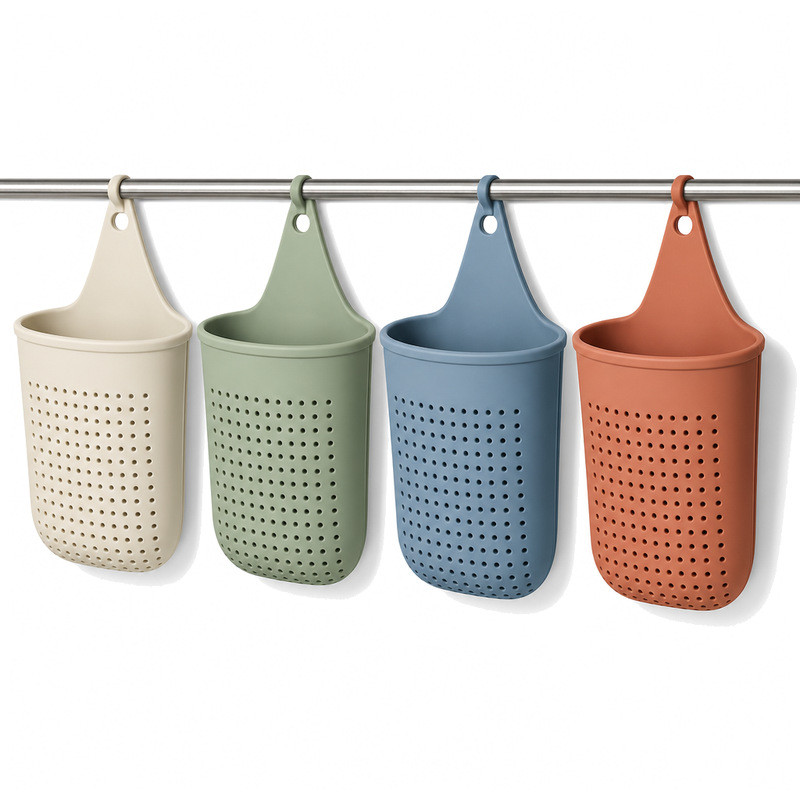
The bag drains beautifully. Water finds the holes, runs out in a steady curtain, and the sink stays clean. Then the user turns it over and finds a ring of onion skin and a smear of flour paste stuck in the seam at the bottom, and no amount of running water moves it. The product passed every drainage test and failed the test that actually decides whether it gets used twice.
Cleaning is the least glamorous part of a kitchen product and the one most likely to generate a one-star review six weeks after purchase. It is also almost entirely a design outcome, decided long before anyone holds the sample.
Residue does not collect randomly. It collects where water stops moving, where a surface changes direction abruptly, and where a user's fingers cannot reach. All three can be designed.
Why Can Residue Build Up in a Silicone Hanging Drain Bag?
Tight Corners and Deep Recesses Can Be Difficult to Rinse
A hanging bag usually has a rounded or seamed bottom, and the inside of that bottom is where two surfaces meet. If the junction is a small radius, water arriving from above reaches the bottom and slows down, and anything suspended in it settles into the corner. Rinsing from above does not remove it, because the flow never gets behind the material that is already sitting there.
The useful way to think about it is in relation to particle size. A corner radius that is smaller than the food particles the bag is expected to handle will trap them; a radius comfortably larger than those particles lets them slide out. That turns an abstract "make it smoother" instruction into a number that can be drawn: a 2 mm internal radius will hold onto onion skin and herb stems, a 6 mm radius will let them pass.
Small Drainage Openings Can Trap Food Particles
A bag designed for rinsing herbs needs small openings to keep leaves in. A bag designed to hold vegetable scraps needs larger ones. When the opening is only slightly larger than the typical particle, particles lodge at the entrance, and once one is stuck the opening is effectively closed and the residue behind it stays wet.
The size question is not about drainage, it is about what the product is meant to retain. Answering that first makes the hole size almost obvious.
Textured Surfaces Can Create More Areas for Residue to Collect
Texture has real functions: it stiffens a thin wall, hides scratches, and gives a product a recognisable surface. It also multiplies surface area, and every groove is a place where a thin film of food can dry on. A fine, shallow texture is usually worse than a bold one, because shallow grooves hold residue without giving a brush anything to reach into.
Hanging Attachments Can Create Hard-to-Reach Areas
The tab is often the dirtiest part of the product, not because food touches it, but because it is never cleaned. A tab that folds back over the rim, or a rim that is rolled over the tab junction, creates a slot that water runs past and never into. If the user cannot see it, they will not clean it, and it will eventually smell.
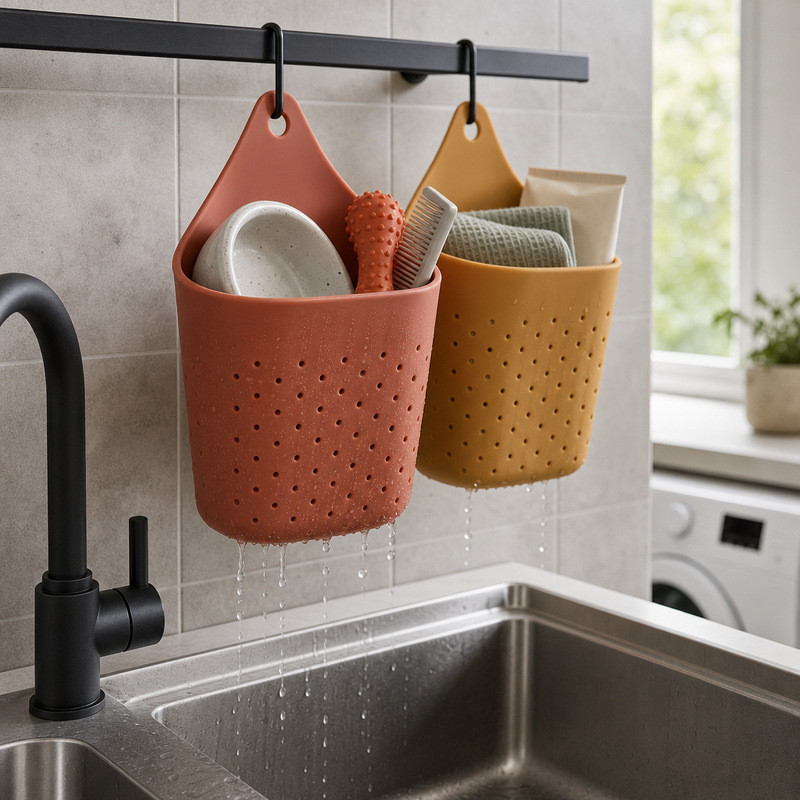
A caddy holding sponges and brushes is not a food product, but it demonstrates the design point clearly. The bottom of the bag is a shallow basin, and whatever drips into it stays until someone wipes it out.
Products that are easy to rinse are the ones whose internal surfaces lead somewhere, with no shelf for material to rest on.
How Should the Bag's Shape Be Designed for Easier Cleaning?
Keep the Interior Accessible During Rinsing
Access is the first requirement. The opening needs to be wide enough for a hand or a brush, the depth needs to be within reach, and the walls need to be flexible enough to be pressed apart. A tall, narrow bag with stiff walls can be perfectly hygienic in theory and impossible to clean in a domestic sink.
Avoid Deep Pockets That Do Not Serve a Clear Purpose
Every recess should have a reason. If a pocket exists to stiffen the wall or to locate the hanging tab, it can stay, but it should be shaped so that water can pass through it rather than settle in it. Recesses that exist only for appearance are the ones that turn into complaints.
Design the Bottom to Drain Without Creating Unnecessary Traps
The lowest point of the inside surface should be the lowest point of the outside surface, and there should be an opening at or very near it. This sounds obvious and is frequently missed: a bag with a rounded exterior and a flat interior floor has an internal low point with no hole beneath it, and a permanent puddle.
A continuous curve from wall to base, with the perforations following the curve, lets residue slide towards the opening instead of collecting against a step.
Make the Hanging Connection Easy to Inspect and Clean
The tab should be a single, open shape with a smooth transition into the rim, with no folded-back lip and no enclosed slot. If the tab must be reinforced, thicken it on the outside where it does not create an internal crevice. The test is simple: can a finger and a stream of water reach every surface of the tab in one pass?
How Should Drainage Holes Be Balanced Against Cleanability?
The Openings Must Match the Intended Contents
Openings do two jobs at once: they let water out and they let residue out. The second job is the one that gets forgotten. A hole that is just large enough for water is usually too small for the food that will be rinsed through it, and every particle that lodges makes the next one more likely.
Hole Spacing Should Leave Enough Material for a Practical Structure
Dense patterns leave narrow ligaments, and narrow ligaments flex under load. When they flex, the holes change shape, and a distorted hole holds residue more aggressively than a round one. Spacing is therefore a cleaning variable as well as a structural one, which is a connection that rarely appears on a drawing.
A Large Number of Small Holes Is Not Always the Best Solution
Effective open area, not hole count, governs flow. A smaller number of well-placed openings on the curved lower surface can drain faster and rinse cleaner than a dense field of tiny holes across a flat bottom, because each opening is positioned where water and residue actually arrive.
Test Whether Residue Can Be Removed From Around the Openings
Use the product with the food it is meant for, then clean it the way a customer would: a quick rinse under a tap, a squeeze, a shake. Look inside with a torch. Where residue remains after that routine is where the design needs work, and the answer is usually geometric rather than chemical.
| Design feature | Residue risk | Check to run |
|---|---|---|
| Sharp inside corner at the bottom | Particles settle and cannot be flushed out | Rinse from above and inspect the corner with a torch |
| Flat interior floor with a rounded exterior | Permanent shallow puddle | Fill, drain, and see where water remains |
| Fine shallow surface texture | Thin film dries into grooves | Rinse and wipe with a cloth; check for grey residue |
| Rolled or doubled rim | Slot that water passes but never enters | Run a finger along the rim; look for a gap |
| Holes smaller than the food handled | Particles lodge and blind the opening | Test with the smallest intended food |
| Narrow ligaments between holes | Flexing distorts openings and grips residue | Load the bag and inspect hole shape |
Imagine a single stream of water entering at the top of the bag. It should be able to reach the bottom, turn, and leave through an opening without ever encountering a surface that faces away from it. A shadow zone is any internal surface the rinse flow cannot reach head-on, and residue collects there because nothing moves it.
Drawing the path on a section view is a five-minute exercise that catches most cleaning problems before tooling. Our note on how entry geometry and usable depth affect cleaning applies the same method to a different product.
Should You Use a Smooth Surface or Add Texture to the Drain Bag?
Smooth Areas May Be Easier to Rinse, but the Whole Design Still Matters
A smooth surface gives residue fewer places to key into, which helps. It does not compensate for a corner that cannot be reached or a hole that is too small. Smoothness is a supporting decision, not the main one.
Decorative Grooves Should Have a Clear Purpose
Grooves that stiffen a thin wall or define a colour break are doing work and should stay. Grooves added for visual interest alone add surface area, hold water, and complicate the mould. If a groove is not structural and not necessary for the brand, the product is usually better without it.
Textured Details Need to Be Reviewed Before Mold Development
Texture depth and spacing affect how the part fills, how it releases from the tool, and how consistently the surface is reproduced. A texture that is too fine for the material may not form at all; one that is too deep may drag during demoulding. These are tooling questions, and they are worth raising while the drawing is still open.
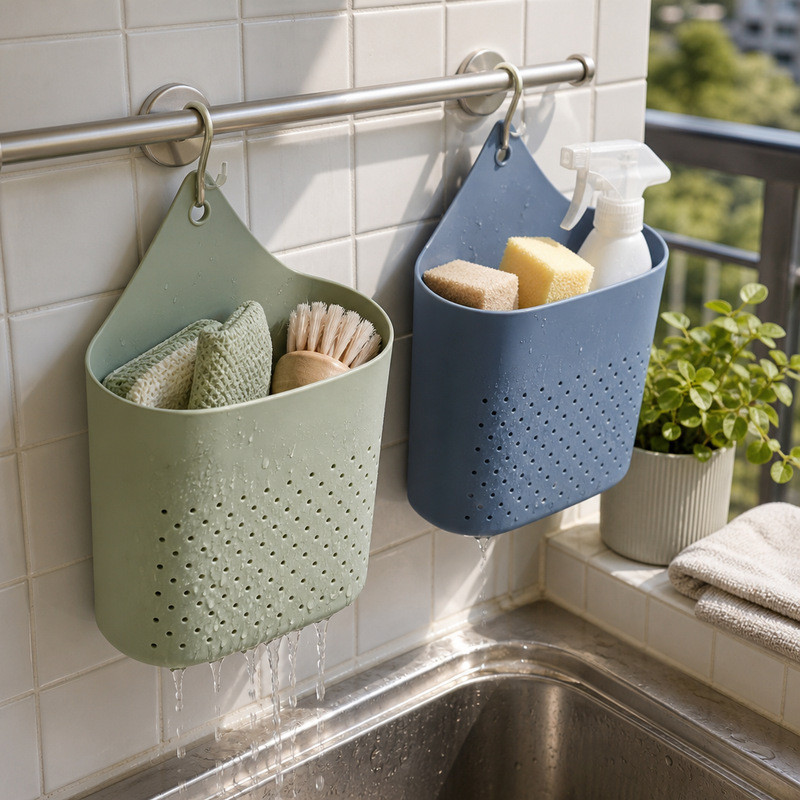
Buyers often discover a second use for a hanging product after launch, and the product is then judged on that use. A drain bag that also holds cloths will be asked to rinse clean of fibres as well as food.
Designing the bottom as a single continuous curve with an opening at the lowest point serves both cases without changing anything else.
How Can the Silicone Material and Wall Thickness Affect Cleaning?
Flexible Walls Can Help Users Reach the Interior, Depending on the Design
A flexible bag can be turned partly inside out for rinsing, which is the most effective cleaning method available to a domestic user. Whether that is possible depends on the geometry: a bag with a narrow neck and a wide base cannot be inverted, while one with a wide opening and a gently tapered body can.
Excessive Stiffness May Make Some Areas Harder to Access
Thicker walls resist inversion and resist being pressed apart. The result is a product that looks robust and is awkward to clean. For a drain bag, a moderately flexible wall is usually the better choice, with stiffness placed in the rim and the tab where the load goes.
Material Selection Should Match the Intended Use and Cleaning Conditions
The compound, the hardness, and the surface finish should be chosen against the actual use: what will be rinsed through the bag, at what temperature, and with what cleaning method. Food-contact compliance, heat resistance, and dishwasher suitability are properties of a specific material and a specific product construction, and they need to be confirmed for the material you actually specify rather than assumed from the word silicone. Our notes on food-contact testing for kitchen silicone describe how those confirmations are handled in practice.
How Can You Check Cleanability Before Approving a Sample?
Use the Product With Representative Contents
Choose foods that genuinely represent the intended use, including the awkward ones: onion skin, flour paste, coffee grounds, herb stems. These leave different residues and block different openings, and a sample that survives a tomato test may fail all three.
Follow the Expected Cleaning Method
Clean the sample the way the packaging will tell customers to clean it, not the way a laboratory would. If the instruction is a quick rinse, test a quick rinse. Record where residue remains and how much effort removes it.
Inspect Corners, Openings, Textures, and Hanging Points Separately
Check each area on its own so that a general impression does not hide a specific problem. A bag can be 90 percent clean and still fail, because the 10 percent is the part the customer sees when they turn it over.
Recheck Drainage After Cleaning
Confirm that nothing has remained around the openings that would affect the next use. Residue in a hole is both a hygiene issue and a drainage issue, and it compounds over a week of daily use.
What Should Be Reviewed Before Developing the Custom Silicone Mold?
Four things should be settled on the drawing: the internal geometry of the bottom and its junction with the walls, the position and size of the openings relative to the lowest internal point, the shape of the rim and tab so that neither creates a slot, and the surface finish across the interior.
Each of those has a tooling consequence. A continuous internal curve is easier to mould than a stepped one. Openings on a curve need cores that follow the curve. A tab that is thick on the outside only avoids a thin internal shelf. Surface texture affects release. Reviewing them together is what prevents a product that drains well and cleans badly.
How Can a Custom Silicone Manufacturer Support This Design Process?
The most useful support is a review of the interior as a cleaning surface rather than only as a container. That means looking at the bottom radius, the opening placement, the rim and tab geometry, and the surface finish, and pointing out where residue will collect before the tool is cut.
FromRubber has been moulding custom silicone in Dongguan since 2010 and reviews drawings for kitchen and household projects at the design stage, before tooling. The silicone food storage and snack bags we produce share the same construction questions, and the custom silicone parts range covers the wider family. Cleanability can only be judged against a specific use and a specific sample; we would rather test it than promise it. If you have a design in progress, send it over and we will mark the areas we would change.
Frequently Asked Questions
Why does residue remain in my silicone hanging drain bag after rinsing?
Most often because the bottom is a shallow basin with no opening at its lowest internal point, because a corner radius is smaller than the food particles, or because a rolled rim or tab creates a slot that water passes but never enters.
Are smooth silicone surfaces always easier to clean than textured ones?
Smooth surfaces give residue fewer places to key into, but shape, access, and hole size matter more. A smooth bag with a sharp bottom corner still traps food.
Should a silicone hanging drain bag have more or fewer drainage holes?
Fewer, well-placed openings on the curved lower surface often outperform a dense field of small holes, especially for cleaning, because each opening sits where water and residue arrive.
Can a hanging drain bag be designed with fewer hard-to-reach corners?
Yes. A continuous internal curve from wall to base, with the openings following it, removes most of the places where residue collects, and it is usually easier to mould than a stepped alternative.
What should I send a manufacturer when developing a custom silicone drain bag?
Drawings or 3D files, dimensions, intended contents, drainage requirements, cleaning expectations, preferred material properties, estimated quantity, and reference samples where available.
Sources and further reading
- How shape affects cleaning in moulded silicone products — the geometry-first cleaning review used here.
- Easy to clean, hard to stain: silicone liners in practice — what the material contributes to cleaning, and what it does not.
- Food-contact testing for kitchen silicone — how compliance is confirmed for a specific material and product.
This article discusses design geometry, not measured cleaning performance. Residue behaviour depends on the actual food, the surface finish, and the cleaning method used, and should be assessed on your own sample with the contents the product is intended to handle.
Designing a drain bag?
Send a section view of the bottom and the intended contents. The lowest point of the inside surface, and what sits under it, usually decides how the product will be reviewed by customers.
- Email: nani@fromrubber.com or karl@fromrubber.com
- WeChat / WhatsApp: +86 18676210913
- FromRubber · Dongguan Bohao Electronic Technology Co., Ltd.
- Qiaotou Town, Dongguan, Guangdong, China
- IATF 16949:2016 · ISO 9001:2015 · ISO 14001:2015