How to Design the Opening of a Silicone Makeup Brush Holder for Easy Access
- Share
- Issue Time
- Nov 11,2026
Summary
An opening in soft silicone is an interference fit, not a hole. It has to pass the ferrule, hold the brush upright, release it without a fight and return to shape after every cycle. This article explains why holders go tight on day one and loose by month six, and how rim section, corner radius and taper control that.
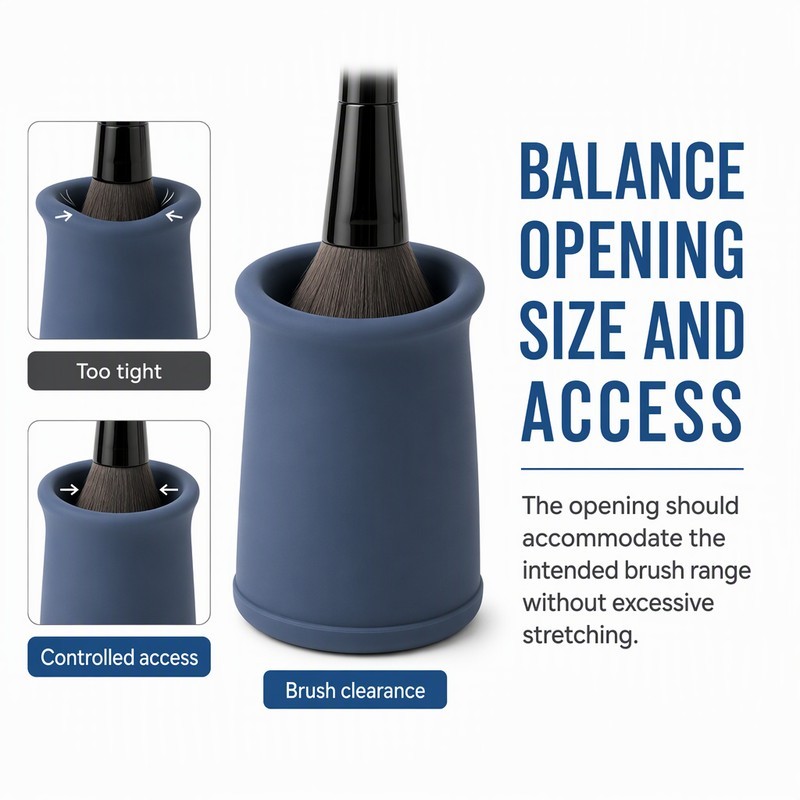
Two complaints arrive about the same part, and they contradict each other. One buyer says the opening is so tight that brushes have to be forced in and the handles come out greasy from handling. Another says the holder has gone slack and the brushes splay sideways after a few months on a vanity. Both are describing the same design decision, made once, without anyone asking what the opening was supposed to do over time.
An opening in a silicone makeup brush holder is not a hole. It is an interference fit that has to accept a range of diameters, hold them upright, release them without a fight, and come back to its moulded shape after every cycle. Treating it as a hole is how a holder ends up too tight on day one and too loose by month six.
Why Does the Opening Design Matter in a Silicone Makeup Brush Holder?
How Does Opening Size Affect Brush Insertion and Removal?
The opening has to pass the widest part of the brush, which is usually the ferrule, not the handle. Sizing from handle diameter is the single most common error in the category, and it produces a holder that fits on the drawing and rejects the brush in the hand.
There is also a directional effect. Insertion is easier than removal, because a brush head entering point-first wedges the silicone open, while a ferrule withdrawing drags on the rim and pulls the wall with it. A design tuned on insertion will always feel tighter on the way out.
What Happens When the Opening Is Too Tight?
The immediate symptoms are handling complaints and a rim that has been permanently stretched at two or three contact points. The longer-term symptom is more interesting: every insertion strains the rim past its elastic range locally, so the material creeps. After a few hundred cycles the opening is measurably larger at those points and the holder has developed a lean.
There is a material consequence too. A rim held under continuous strain takes a compression set, and a set rim does not recover when the brush is removed. That is the mechanism behind a holder that looks fine empty and sags when loaded.
What Problems Can Occur When the Opening Is Too Loose?
Brushes lean, and a leaning brush applies a bending moment to the wall rather than a compressive load. Soft walls deflect under bending far more readily than under compression, so a loose holder loses its shape from the top down — the rim ovalises, then the wall follows.
Loose also means the holder stops protecting the brush head. A splayed powder brush stored under no support keeps the splay, and the customer reads that as a product fault even though the brush was the cause.
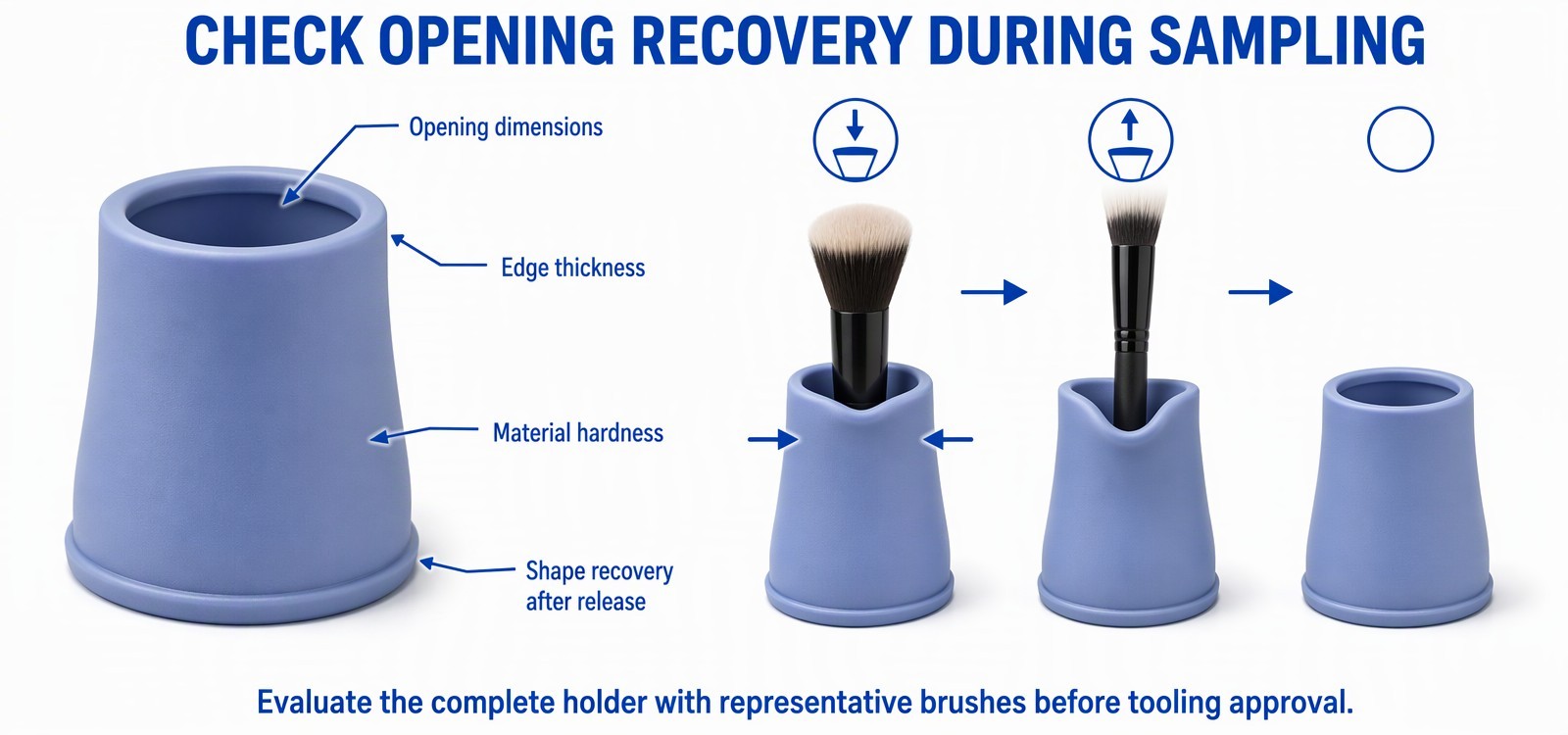
The design target is easier to state than to hit: the rim should deflect visibly when a brush goes in, and return to its moulded profile within a second of the brush coming out. If it deflects and stays deflected, the section is too thin or the compound is too soft for the strain.
Where the holder is one part of a wider tool set, the same rim logic shows up in other silicone vessels. Our notes on how opening support behaves in a soft silicone basket describe the identical trade-off between access and shape.
How Should the Opening Shape Match the Brush Holder Design?
Should the Opening Be Round, Oval, or Rectangular?
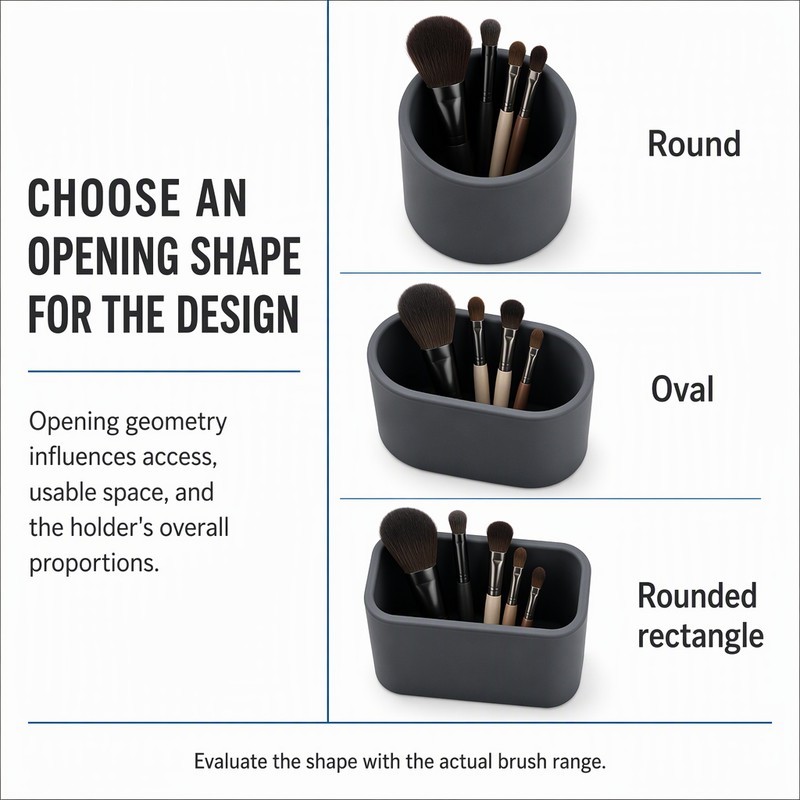
Round is the most efficient for a single brush and the least efficient for a group: it wastes the perimeter that brushes could share. Oval adds capacity along one axis and lets the user see the brush heads. A rounded rectangle gives the most usable perimeter but concentrates strain at the corner radii.
In practice the shape follows the brush assortment. Liners and pencils want a small round or oval opening; a mixed vanity set wants a wide oval; a professional set of large brushes wants a rounded rectangle with generous corners.
How Do Corner Radii and Edge Transitions Affect the Opening?
Corners are where the opening fails. A tight radius raises local strain during insertion, and because silicone strain-softens at high elongation, the corner is also where the permanent deformation starts. The rule we apply is that the smallest corner radius should be large enough that the rim's thickness at the corner stays close to its thickness on the straight.
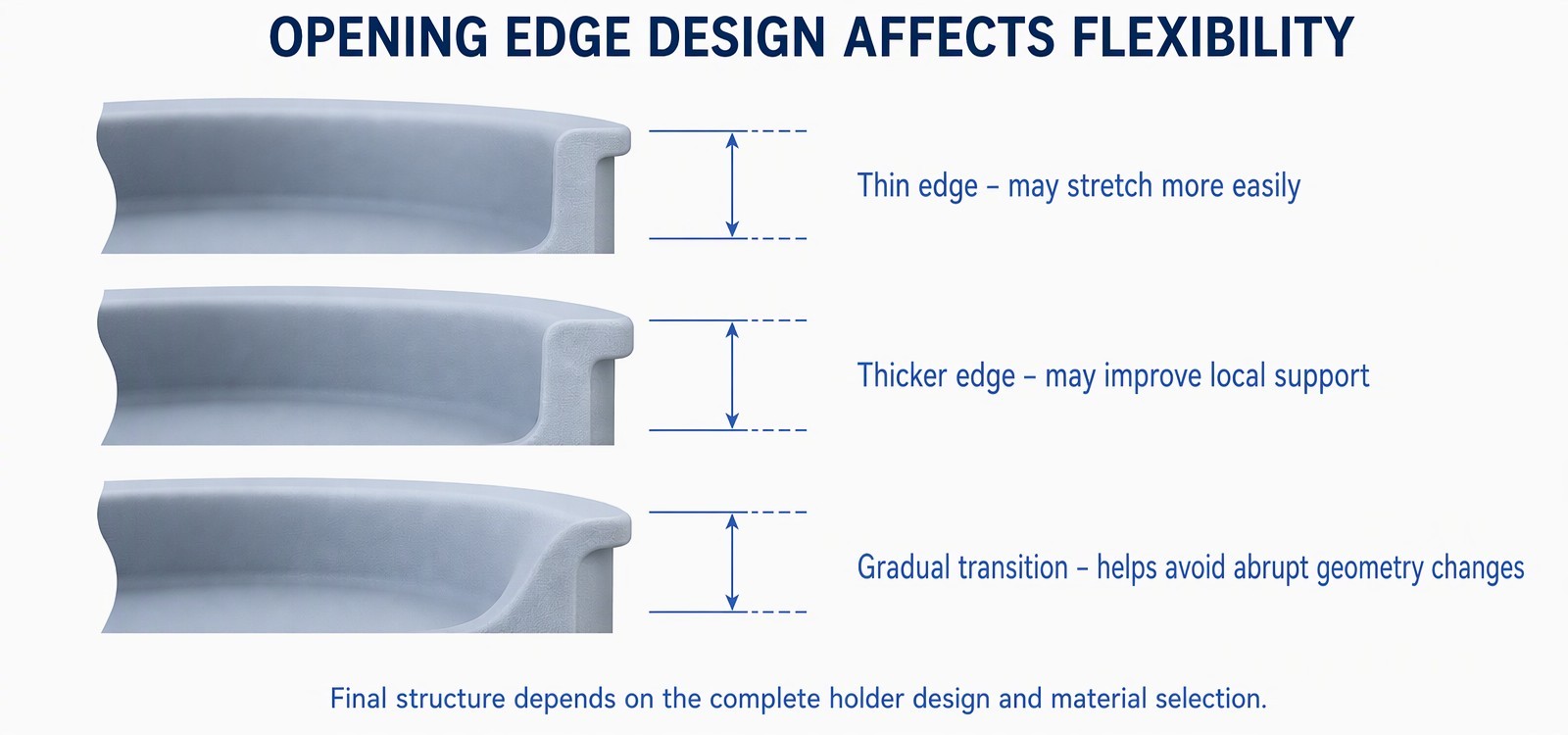
Transitions matter just as much. An opening that meets the wall at a sharp internal corner creates a hinge line; a gradual sweep distributes the deflection over a longer arc, which lowers peak strain and improves recovery.
How Should the Opening Be Designed for Different Brush Handle Sizes?
Design around a range, and choose the range from the brushes the customer will actually own. A holder specified for a single handle diameter will fail for every other brush in the set, and multi-brand sets vary more than brands expect.
We normally ask for the smallest and largest ferrule in the intended set, then set the opening so the largest one passes with light interference and the smallest one is still held. If those two conditions cannot both be met, the answer is a divided opening rather than a compromise on one hole.
Shape is a capacity decision as much as an aesthetic one. Round uses the least perimeter for a given footprint, oval adds usable wall length, and a rounded rectangle adds the most — at the cost of two corners that have to be radiused generously enough not to become the failure point.
None of the three is better in the abstract. Each matches a different brush mix, and the drawing should say which mix it was designed for.
How Do Wall Thickness and Silicone Hardness Affect Opening Performance?
Why Can a Thin Opening Edge Stretch Too Easily?
The rim is a ring in tension, and its stiffness depends on the section it has to work with. A thin rim has very little material to distribute the strain from an inserted ferrule, so the same interference produces a much higher local elongation.
High elongation is not automatically a failure, but it does two things: it reduces the force the rim can apply to hold the brush, and it increases the permanent set after each cycle. Both push the holder toward the "gone slack" complaint.
Can a Thicker Opening Edge Improve Shape Stability?
Yes, up to a point, and then it reverses. A thicker rim holds its circularity and recovers better, but it also resists the interference, which raises insertion force. Past a certain section the user has to push, and pushing is when brushes get damaged and holders get tipped over.
The useful compromise is a rim that is locally thicker than the wall behind it, with a gentle taper into the wall. It buys recovery and keeps insertion force reasonable, and it puts the material where the load actually is. The same principle governs tear behaviour at thin silicone sections in parts that see repeated flexing.
How Does Silicone Hardness Influence Opening Flexibility?
Hardness sets how much force a given deflection requires, and how completely the material returns. A harder compound returns more completely but demands more force; a softer one is easier on the hand and slower to recover.
Because the rim is thin, hardness has less influence here than section does. A 20 Shore A difference in a 2 mm rim is usually less noticeable than a 0.4 mm change in rim thickness. That is why we tune the rim geometry first and use hardness only to fine-tune the feel. The comparison between compounds is covered in our guide to choosing hardness for silicone parts.
How Can the Opening Maintain Its Shape After Repeated Use?
Why Should Shape Recovery Be Considered During Product Development?
Because the opening is the only part of the holder that is loaded every single time the product is used. A wall that is stressed once a day and a rim that is stressed twice a day for a year are not comparable, even in the same material.
Recovery is also the property customers describe most precisely. They will not say "the rim took a set"; they will say "it used to be tight". If recovery is not in the design brief, nobody will test for it, and the complaint will arrive as a quality issue rather than a design one.
How Can Structural Transitions Reduce Localized Stress?
By spreading deflection over a longer path. Three levers do most of the work: a generous radius where the rim meets the wall, a gradual rather than stepped thickness change, and a rim profile that rolls outward rather than presenting a sharp lip.
Each of those lowers peak strain at the contact point. Lower peak strain means less creep per cycle, which is the only thing that actually extends the useful life of the opening.
Which Design Details Should Be Evaluated in Sample Testing?
Opening dimensions in both directions, rim thickness at the thinnest point, hardness, deflection under a representative brush, and recovery after a set number of cycles. The last one is the one that gets skipped and the one that predicts the complaint.
Testing with the real brush set matters more than testing with a mandrel. A steel pin of the right diameter tells you about interference; a real brush tells you about ferrule edges, handle tapers and the way people actually insert things.
What Should Manufacturers Confirm Before Mold Development?
Which Opening Dimensions Should Be Included in the Product Drawing?
Opening width and length or diameter, rim thickness at the thinnest point, corner radius, the transition geometry into the wall, and the height at which the opening sits. That last one is often missing and determines how much wall is available to deflect.
A section through the rim, drawn at the corner rather than on the straight, is the single most useful view on the drawing. Corners carry the highest strain and are the least likely to be dimensioned. Our guide to reading silicone drawings explains the callouts that tend to get lost between design and tooling.
How Should Brands Confirm the Design With Actual Makeup Brushes?
Fill the holder with the intended set, leave it loaded for a few days, then check the rim. A holder that looks correct empty and has ovalised under load is not correct. The loaded check is cheap and it is the only one that reproduces what the customer will see.
Why Is It Important to Evaluate the Complete Holder Instead of the Opening Alone?
Because the opening is supported by everything below it. Height sets the lever arm a leaning brush applies; wall thickness sets how much of that reaches the base; base width sets whether the holder tips. A rim that recovers perfectly on a short, thick-walled holder can fail on a tall one with the same opening.
This is also why a holder cannot be specified from its opening dimensions alone, and why a change of height during development invalidates the opening test that was already passed.
A rim is a spring, not a hole
The parts of a silicone makeup brush holder that determine whether it works are all within a few millimetres of the top: the interference the rim allows, the radius at the corner, and the taper that carries strain into the wall. Design those three against a real brush set and the holder will still be holding brushes in a year.
FromRubber moulds custom silicone parts in Dongguan, with toolmaking and sampling in house. If you are developing a brush holder, send the brush set along with the drawing — the interference check is the first thing we run, and it is the one that saves a tooling revision. WhatsApp or WeChat: +86 18676210913.
Sources and further reading
- Opening support in a soft silicone vessel — FromRubber engineering article on access versus shape retention.
- Why a moulded silicone cup loses its shape — FromRubber failure analysis on repeated loading.
- Tear strength at thin silicone sections — FromRubber engineering article.
- Choosing hardness for silicone parts — FromRubber material selection guide.
- Choosing section thickness for a moulded part — FromRubber design article.
- Reading a silicone product drawing — FromRubber guide to tolerances and symbols.