How to Develop Matching Silicone Face Mask Bowls and Spatulas for Private Label Beauty Kits
- Share
- Issue Time
- Nov 11,2026
Summary
A bowl and spatula set is one product system, not two parts in one box. Because a soft bowl changes shape when it is filled or squeezed, the spatula has to be sized against the working opening rather than the moulded one. The article covers capacity, wall thickness, matching across two compounds and how to sample a set together.
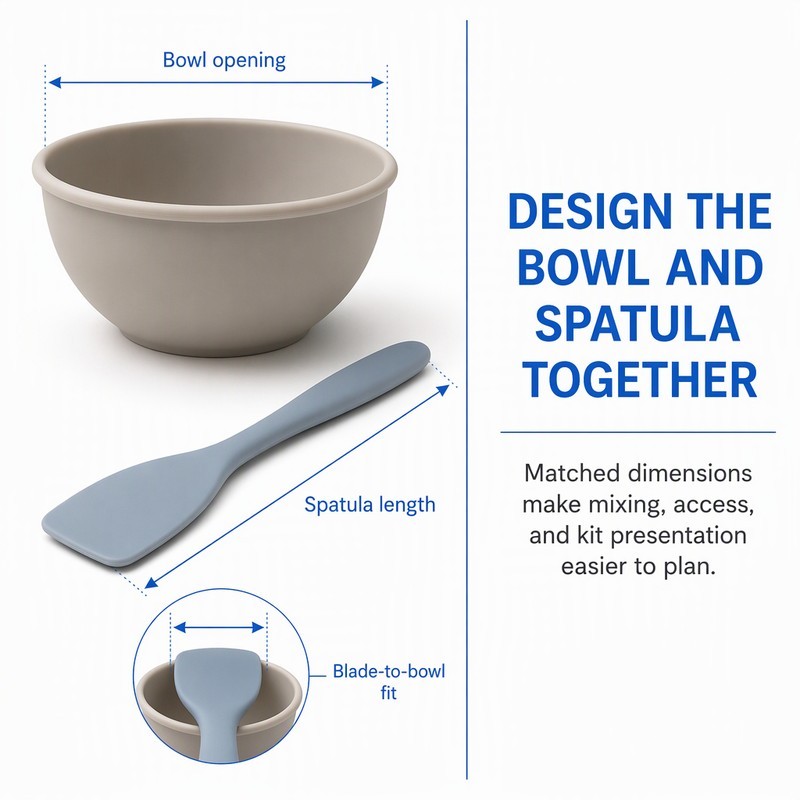
Two silicone parts, one carton, one colour, one logo. It sounds like the easiest development project on a brand's list, and it is the one that most often comes back from the first production run with a mismatch nobody can name: the spatula looks small next to the bowl, the bowl feels flimsy when it is full, and the pair does not sit together in the box the way the render did.
None of that is a colour problem. It is a proportions problem, and it starts because a flexible silicone face mask bowl is not a fixed vessel. Its opening moves when it is filled, squeezed or washed, so a spatula measured against the moulded diameter is measured against a shape that does not exist in use.
Why Should Face Mask Bowls and Spatulas Be Developed as a Matching Set?
How Does Product Compatibility Affect the Overall Kit Design?
A silicone face mask bowl and its spatula are used in contact, so their dimensions are coupled. The spatula has to reach the far sidewall and the bottom fillet while the fingers stay outside the rim; that sets a minimum length that depends on the bowl's opening and depth, not on the spatula alone.
The coupling runs the other way too. If the bowl wall is soft enough to squeeze for dispensing, the rim deflects inward under the thumb and the usable opening narrows by a few millimetres exactly when the user is scraping the last of the product out. A spatula sized to the empty bowl will foul the rim at that moment, and the user will blame the spatula.
The fix is a working envelope rather than a nominal one: specify the opening as a range that includes the loaded and squeezed state, then size the blade against the narrow end. It costs nothing at the drawing stage and removes a whole class of complaint.
Why Is Visual Consistency Important for Private Label Beauty Kits?
A kit is judged as one object before it is judged as two products. What reads as "consistent" is not identical wall thickness or identical hardness; it is a shared visual grammar — the same corner radius on the bowl foot and the spatula handle end, the same surface sheen, the same colour under the same light, the same logo depth.
Surface finish is the detail that breaks most often. A matte bowl and a semi-gloss spatula in the same colour read as two different materials under retail lighting. Because the sheen comes from the mould surface rather than the compound, it has to be specified once and applied to both tools.
Colour matching across two tools is a pigmentation question, and it is worth settling early. The same masterbatch in two different section thicknesses can read slightly differently, because a thin wall transmits more light than a thick one. A spatula blade at one thickness and a bowl wall at another will never look identical in daylight unless the pigment loading is adjusted for each part.
We treat that as a sampling task rather than a theoretical one: press both parts from the same batch, look at them together under daylight and under warm retail light, and adjust if needed. Related reading on silicone palettes used for mixing cream products covers the same surface and cleaning questions from the mixing side.
How Should Brands Determine the Right Bowl Size and Capacity?
How Does Bowl Diameter Affect Mixing and Access?
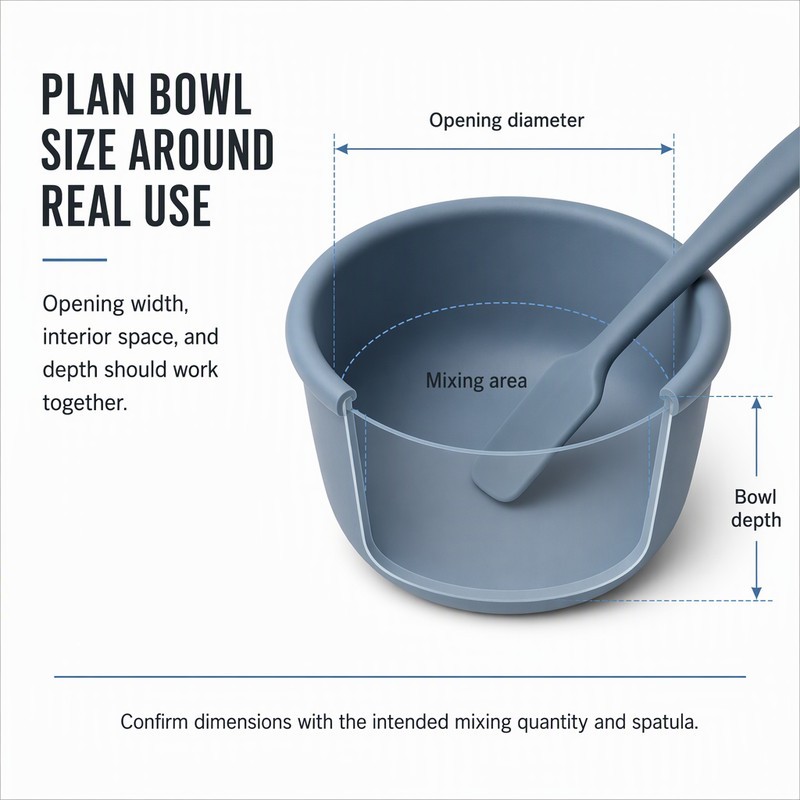
Diameter sets how much room the spatula has to move. A narrow bowl forces a small circular motion, which is fine for a single mask dose and frustrating for anything larger. A wide, shallow bowl gives a long sweep but lets product spread into a thin film that is hard to pick up again.
The useful measure is not the diameter but the clear width at the working depth: how much floor the spatula can cover in one pass with the wrist in a natural position. On a bowl that tapers, that figure is considerably smaller than the rim suggests.
Why Should Bowl Depth Match the Intended Product Use?
Depth is a function of dose and of the tool. A clay mask mixed at the bottom of a deep bowl is hard to reach without putting knuckles into the product. A shallow bowl used with a long spatula tips.
The stable proportion for most mask kits is a depth that lets the spatula rest at roughly thirty to forty degrees without the handle fouling the rim. That is a geometric constraint rather than a styling choice, and it is easier to check with a printed profile than with a render.
How Can Bowl Wall Thickness Affect Stability?
Wall thickness does two jobs: it holds the bowl's shape when filled, and it sets how much the bowl can be squeezed. Those conflict. A thin wall that squeezes easily will also bulge and rock when it is full; a thick wall that stands firmly needs real hand force to deform.
Silicone stiffness rises steeply with thickness, so the difference between a wall that holds and a wall that collapses is smaller than most first drawings assume. Our analysis of the trade-offs of thicker silicone in a moulded vessel sets out where additional thickness stops buying stability and starts buying weight, and the same curve applies to a bowl.
Opening diameter, mixing area and depth are one decision, not three. Change the depth and the mixing area becomes harder to reach; change the diameter and the spatula that matched the old bowl no longer reaches the fillet.
The failure mode to watch for is a bowl that looks generous in plan view and is unusable at the bottom. A printed section through the centre line exposes that in a minute.
How Should the Silicone Spatula Match the Bowl Structure?
How Should Spatula Length and Blade Width Be Matched to Bowl Dimensions?
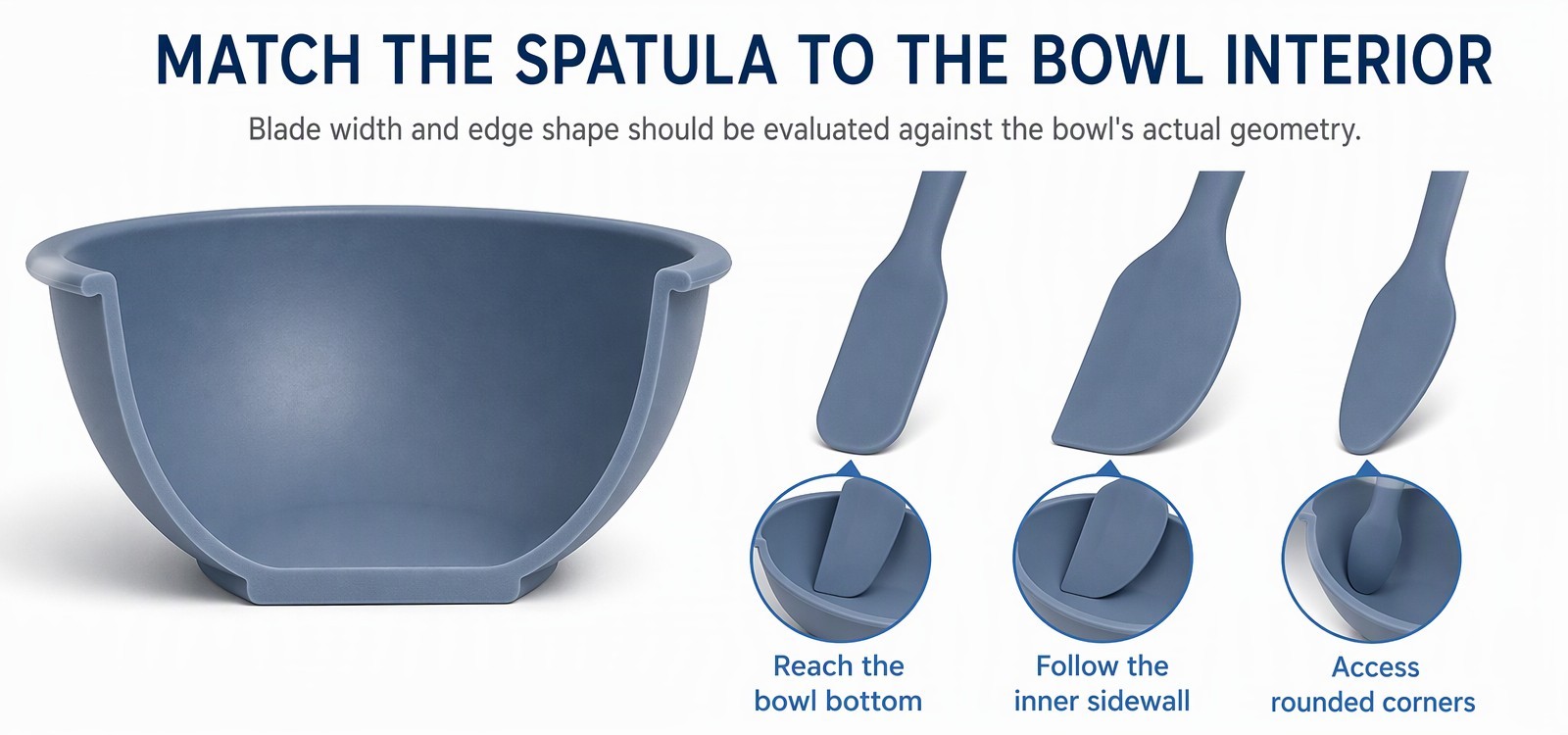
Length should be set so that the blade reaches the opposite fillet with the index finger still on the handle flat — not at the very end of the handle. If the user has to hold the tip of the handle to reach the bottom, the tool is too short for the bowl, whatever the drawings say.
Blade width has a narrower window. Too wide, and the blade cannot turn inside the bowl; too narrow, and the user needs several passes to lift a dose. The practical test is whether the blade can rotate through a full circle at working depth without touching the wall on both sides at once.
Should the Spatula Blade Shape Follow the Bowl's Inner Contour?
Partly. A blade that mirrors the bowl exactly is efficient but unforgiving: any variation in wall thickness across a production run changes the clearance, and a blade that fit the sample bowl may scrape or miss on the next cavity.
A rounded leading corner and a straight trailing edge give most of the benefit with tolerance to spare. The corner reaches into the fillet; the straight edge keeps the film even on the flat of the bottom. If the bowl is deep, a slight curve along the blade length helps; if it is shallow, it hurts.
Which Silicone Material and Structural Details Should Be Coordinated?
Should Both Products Use the Same Silicone Hardness?
Usually not, and insisting on it is a common cause of a set that feels wrong in the hand. The bowl is a large, curved shell that has to resist bulging; the spatula is a thin blade that has to deflect. Identical compound in both sections produces a bowl that is too soft at the rim or a spatula that is too stiff at the tip.
What must match is the colour, the finish and the tactile family — the two parts should feel like they came from the same factory, not from the same batch. Brands that specify one hardness for everything almost always end up changing it after the first sample.
How Can Different Wall Thicknesses Affect the Feel of a Matching Set?
Wall thickness is the main reason a set can look matched and feel mismatched. A bowl wall and a spatula handle at the same nominal thickness will not feel the same, because the bowl is a closed shell in hoop tension and the handle is a free column in bending.
In practice we set the bowl wall from the stability requirement and the handle from the demoulding requirement, then check them together by hand. The two numbers are usually different, and they should be.
How Should Surface Finishes and Colors Be Coordinated?
Settle three things before tooling: the mould surface finish for both cavities, the pigment system, and the logo method. Embossed logos read deeper on a matte surface and shallower on a polished one; a two-tone kit needs a masking step that has to be planned into the process, not added later.
Cleaning behaviour belongs in the same conversation. A very matte finish hides scratches and shows residue; a polished finish wipes clean and shows every scuff. Our note on how a silicone pad is used and cleaned in daily service is a useful reality check on which finish survives real use.
What Should Brands Consider When Customizing a Private Label Beauty Kit?
Where Should Logos Be Placed on the Bowl and Spatula?
Put the bowl logo on the outside wall where the wall is thickest, not on the base, where a raised mark becomes a rocking point. Put the spatula logo on the handle flat where the section is stable, not on the blade, where a mark becomes a place for product to collect.
Depth matters as much as position. A mark deeper than roughly a third of the local wall removes the material that was holding the shape, and thin sections are where moulded silicone fails first.
How Should Products Be Arranged for Packaging?
Nesting the spatula inside the bowl reduces carton volume, which is usually the largest cost lever in the project. It also loads the blade against a hard surface for the whole journey. A moulded rest — a small saddle on the bowl base or a shaped insert — solves it for very little tooling.
Check the packed height, not just the packed length. A spatula lying diagonally across a bowl can add more height than a longer carton would have cost.
What Other Components Can Be Included in a Custom Beauty Kit?
Only what the product concept needs. A lid turns a bowl into a storage container and changes the wall and rim design. A second, smaller spatula for eye products changes the blade width. A measuring mark inside the bowl is a mould engraving rather than a print, which is more durable and more expensive.
Each addition reopens the matching question, so the kit should be locked as a set of dimensions before any single part goes to tooling.
How Can Manufacturers Coordinate Sampling and Mass Production?
Which Specifications Should Be Confirmed Before Mold Development?
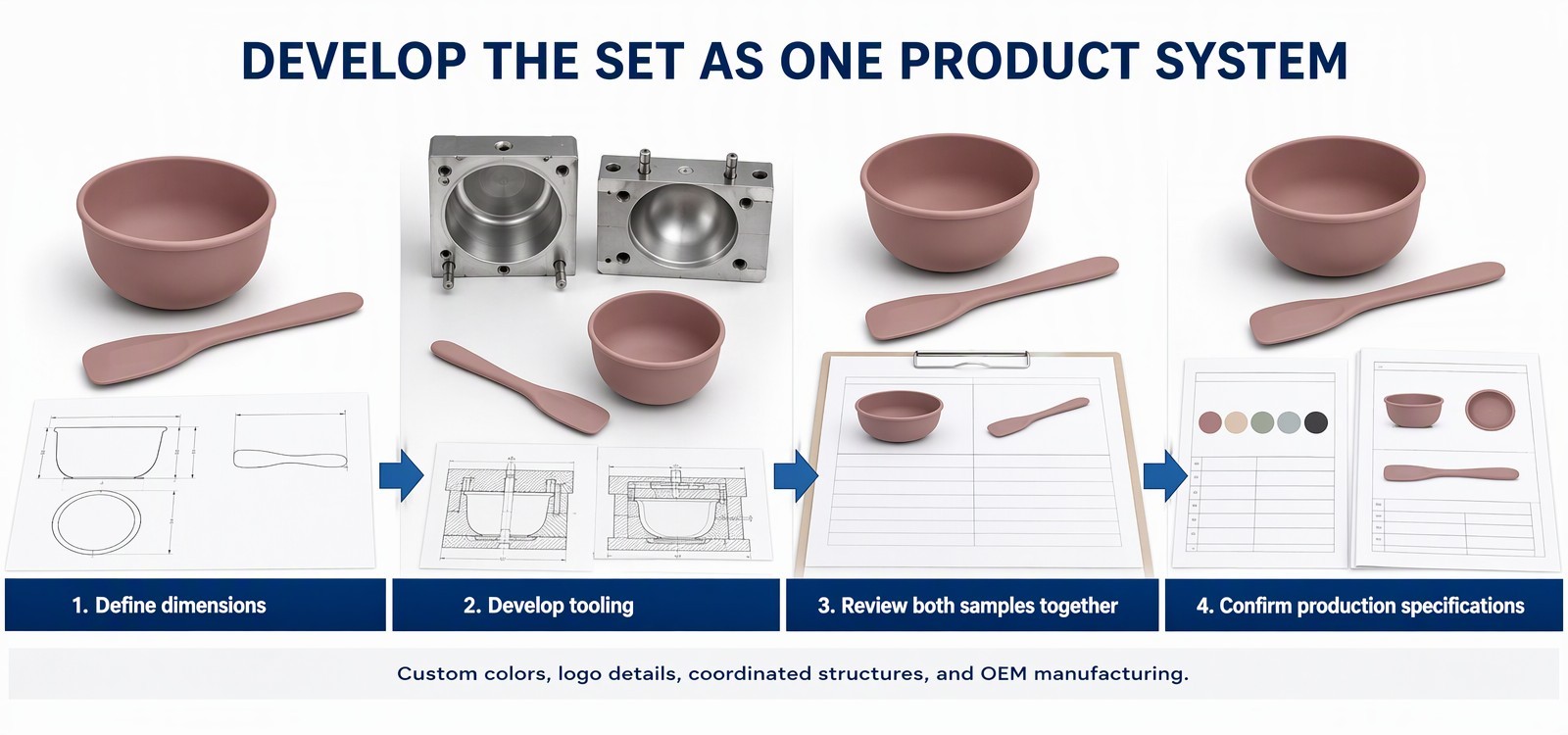
Seven items: bowl working capacity, bowl opening range including the squeezed state, wall thickness at the rim and the base, spatula length and blade width, material hardness for each part, colour and finish for each part, and logo position and depth. Any of those left open will be decided by the toolmaker.
It is also worth agreeing the inspection method at this stage, because a bowl measured across the rim and a bowl measured at the base are different products.
Why Should Both Products Be Evaluated Together During Sampling?
Because each part can pass on its own and the pair can still fail. The spatula may meet its length tolerance and still not reach the fillet because the bowl came in at the low end of its wall tolerance. Approving them separately hides the interaction that customers will notice.
We press both parts from the same batch and evaluate them together, with product in the bowl, before either sample is signed off. The reason is the same one behind most production surprises: the gap between an approved sample and a stable production process opens widest on multi-part projects.
What Should Be Checked Before Approving Bulk Production?
Dimensional consistency across cavities, appearance under the agreed lighting, logo depth and legibility, and the packed assembly. Then a second check that is easy to skip: wash both parts the way the customer will, and confirm that the finish and the fit survive it.
One set, one set of numbers
A private label bowl-and-spatula kit succeeds or fails on proportions that are decided in a week and lived with for years. The three that matter most are the working opening rather than the moulded one, the length that lets the blade reach the fillet with the hand still outside the rim, and a shared finish that survives washing.
FromRubber moulds custom silicone parts in Dongguan, with toolmaking, sampling and production under one roof, which is what makes it practical to evaluate both parts of a set together. If you are developing a mask bowl and spatula kit, bring the two drawings — or a sample of each — and we will check the interaction before either goes to steel. WhatsApp or WeChat: +86 18676210913.
Sources and further reading
- Trade-offs of thicker silicone in a moulded vessel — FromRubber engineering article on wall thickness, stiffness and weight.
- Why a moulded silicone cup loses its shape — FromRubber failure analysis on flexible vessels.
- Silicone palettes for mixing cream and foundation — FromRubber application notes on surface and cleaning.
- How a silicone pad is used and cleaned in service — FromRubber application article.
- Sample versus mass production consistency — FromRubber process control article.
- Prototype mould and production mould — FromRubber technical FAQ.