How to Improve Tactile Feedback in Custom Silicone Keypads for Two-Way Radios?
- Share
- publisher
- FromRubber
- Issue Time
- Nov 13,2026
Summary
Tactile feedback is three signals, not one: resistance before the press, the release at the snap, and the speed of the return. The article links each of them to dome geometry, membrane thickness and assembly stability, with a press-curve test routine for prototypes.
A radio keypad is used in the worst conditions a keypad ever meets. Gloves, rain, noise loud enough to bury any audible click, and a thumb that has to find the push-to-talk key while the other hand holds a light. The operator does not look down. The key either tells the finger it has been pressed, or the message goes out late, cut off, or not at all.
Tactile feedback is usually discussed as a single quality, something a key has more or less of. In practice it is three separate signals: the resistance before the press, the sudden release at the snap, and the speed of the return that tells the finger the key is ready again. A key can be strong in one and weak in another, which is why two keypads described as firm can feel completely different on a cold morning. The place to start is the structure behind the legend: tactile silicone keypads are judged by how they answer a thumb, not by how their symbols look.
What Makes Tactile Feedback Important for Two-Way Radio Keypads?
On a device where the hand is already busy, feedback replaces sight. The operator builds a mental map of the panel and then trusts it. Every key that answers weakly erodes that trust, and the operator compensates by pressing harder, which shortens the life of the membrane and makes the next press even less distinct.
Helping Users Operate Controls Without Looking at the Radio
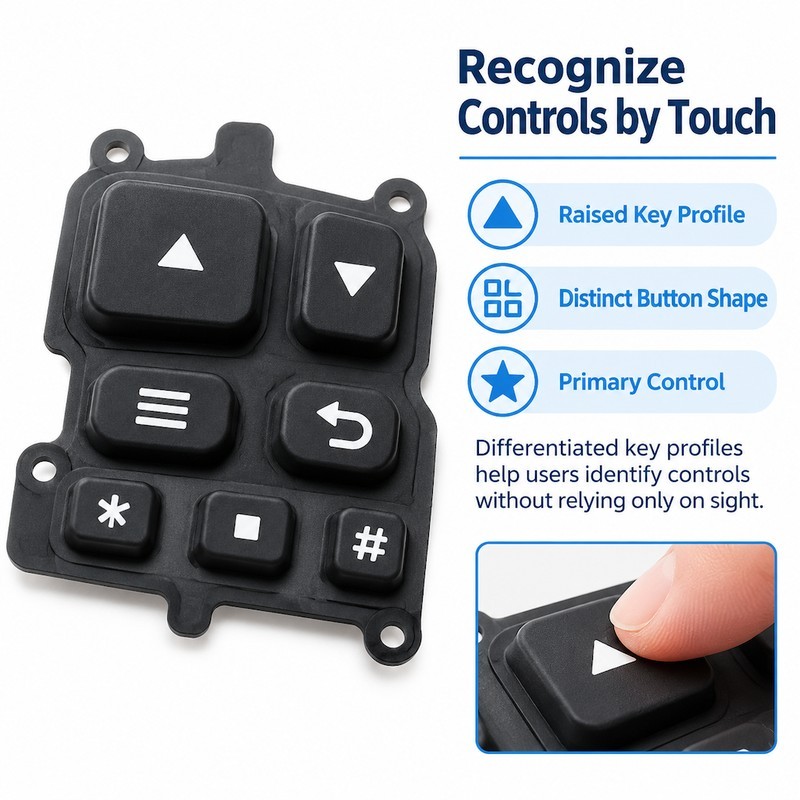
Blind operation depends on being able to tell keys apart by feel alone. That means differences in height, edge shape and surface texture, not only differences in legend. A row of five identical round keys at the same height is a row of five identical targets; the finger has to count from an edge to find the third one.
Radio panels usually solve this with a raised push-to-talk key and a smaller cluster for channel and volume. The raised key works because the finger meets a wall before it meets the keytop, so the target announces itself. The cluster works because its keys can be small, as long as their spacing and travel are consistent enough to be learned.
There is a practical limit to how much shape can carry. If every key has a different profile, the panel becomes a texture puzzle that has to be relearned in gloves. Two or three profile families, consistently applied, give the finger a system: this is the talk key, these are the navigation keys, these are rarely used.
Consistency inside a family matters more than distinctiveness between families. The four arrow keys should feel like four versions of the same press, or the operator will start checking the panel by eye after every press.
Providing Clear Feedback for Frequently Used Controls
Not all keys are pressed the same way, and this is where most panels lose their logic. Push-to-talk is held for several seconds at a time. Channel up is tapped once. Volume is pressed repeatedly in quick succession. Menu keys are pressed rarely and deliberately.
A held key has a different requirement from a tapped key. The finger needs a clear snap at the start, then a comfortable static load for as long as the key is down, then a definite release. If the dome is too aggressive, holding it becomes tiring and the thumb drifts. If it is too soft, the operator cannot tell whether the transmission has started.
Maintaining Consistent Operation With Gloves
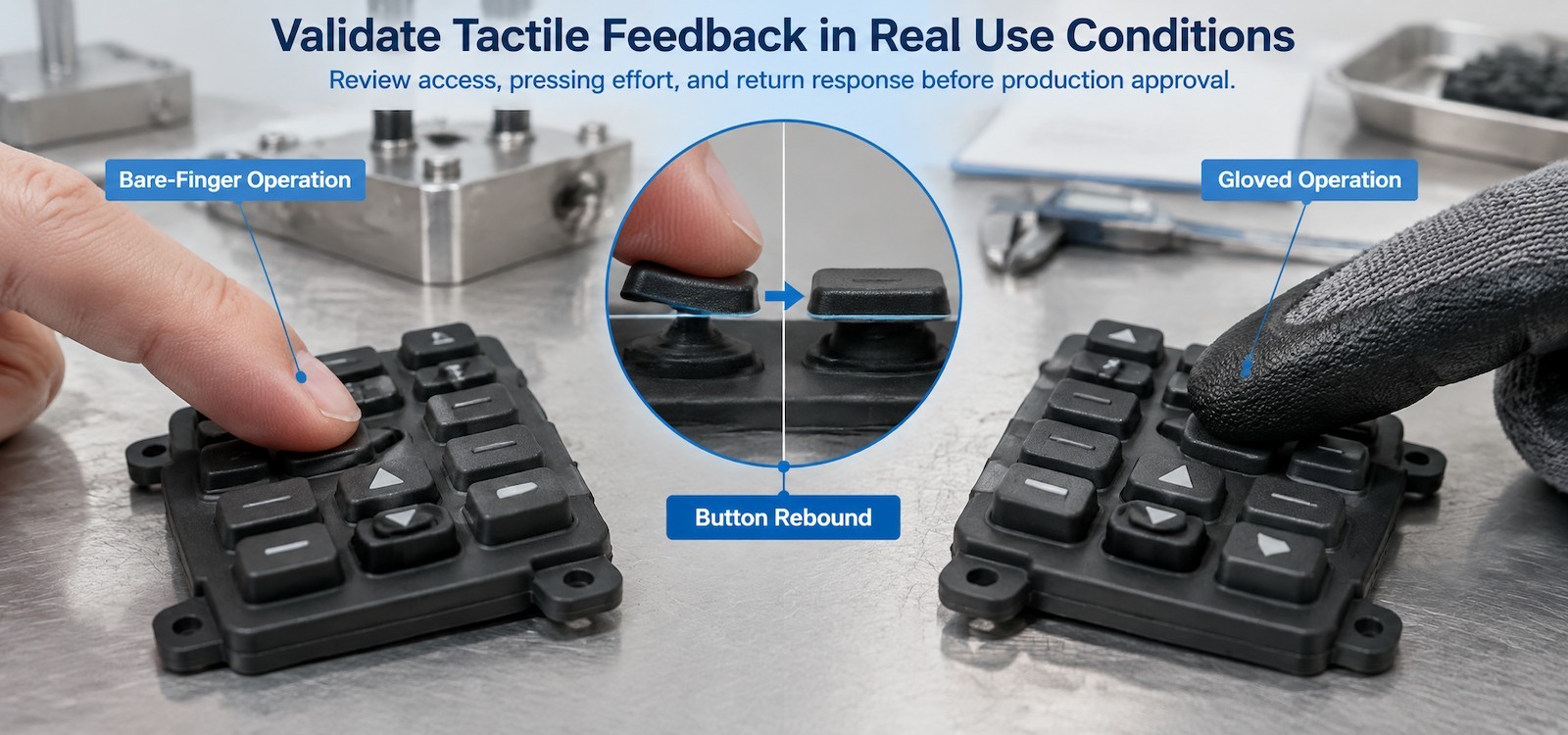
Glove material spreads the load over a wider area and removes the fine sensation that tells a bare fingertip where the key edge is. The panel does not become unusable; it becomes slower. The operator has to press more deliberately, and deliberate pressing on a small key often catches the neighbour.
The countermeasures are geometric rather than electronic: more key height, a wider keytop, a clearer land between keys, and a snap that is strong enough to be felt through leather or nitrile. A keypad tuned for bare fingers often feels dead in gloves, even though nothing about the electronics has changed.
Which Silicone Keypad Structures Influence Tactile Feedback?
| How the key is used | What the finger needs | Structural lever |
|---|---|---|
| Held for seconds, e.g. push-to-talk | Clear start, low holding effort, definite release | Dome height and wall, plus a stable keytop |
| Tapped in sequence, e.g. channel | Fast return, short travel, repeatable snap | Membrane thickness and return force |
| Pressed rarely and deliberately | Resistance that discourages accidental use | Wall thickness and keytop height |
| Operated in gloves | Large target, strong snap, wide land | Keytop diameter and dome geometry |
Membrane Thickness and Button Flexibility
The membrane is the spring that returns the key. Thin membranes deform easily, which lowers the press force but also lowers the return force, so the key comes back slowly and can feel mushy at the top of its travel. Thick membranes return quickly but raise the force needed everywhere, including on the keys that should be light.
Because thickness affects stiffness by roughly its cube, a small change goes a long way. This is why the most successful keypad revisions are usually measured in tenths of a millimetre of wall, not in a change of compound.
Dome Geometry and Snap-Through Response
A moulded silicone dome is a bistable structure. It resists until a certain point, then collapses quickly to the contact, then pushes back as the finger releases. The finger feels the collapse, not the peak force, which is why a key with high peak force can still feel vague if the collapse is slow.
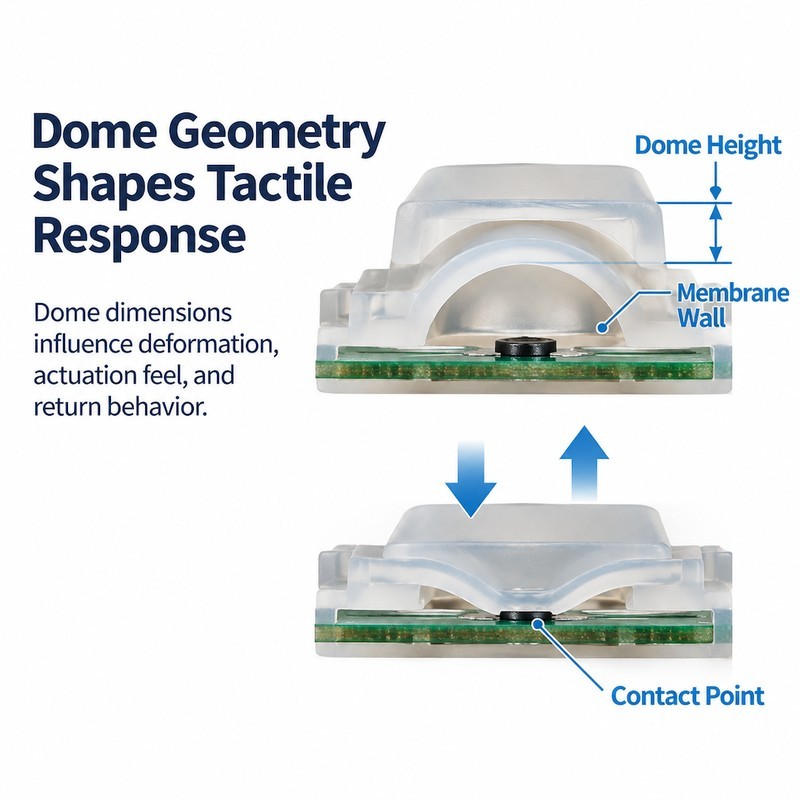
Dome height sets how far the structure can travel before it goes over centre. A tall dome gives a long, soft approach and a late snap; a shallow dome snaps early and sharply. Wall thickness sets the force at which that happens. Diameter sets both, and also determines how much space the dome needs underneath the keytop.
On a radio panel with a thin body, dome height is usually the constraint that cannot be met, and the design compensates with a stiffer wall. That produces a key that snaps late and hard, which feels fine for a tap and unpleasant for a held press.
Button Height and Surface Profile
Raised keys are easier to find and easier to press cleanly, because the finger arrives at a defined edge instead of sliding across a flat surface. Flat keys allow a slimmer panel and a cleaner look, but they demand more precision from the operator. Recessed keys protect against accidental presses and are difficult to operate in gloves.
Surface profile adds a second channel of information. A shallow dish centres the thumb; a raised bar gives a direction; a fine texture confirms contact. These features are moulded into the keytop, so they add no assembly step and no printing that can wear away.
How Does Silicone Hardness Affect Radio Keypad Performance?
Choosing Hardness for the Required Pressing Force
Hardness is quoted on the Shore A scale defined in ASTM D2240, measured on a flat test piece. It tells you how the compound behaves as a material, not how the key behaves as a structure. Two compounds four points apart can produce nearly identical press forces if the wall is adjusted to compensate, and two keys in the same compound can differ widely if their walls differ.
What hardness does control is the shape of the force curve after the snap: a softer compound gives a longer, flatter release and a slower return, while a firmer one returns briskly and feels more definite at the top of travel. Radios generally sit in the middle of the range, because they have to work with a thumb, in gloves, in cold weather.
Balancing Flexibility and Rebound
Easy pressing and quick return pull against each other. Every reduction in force also reduces the energy stored for the return. The compromise is usually found in geometry: keep the wall thin enough for a light press and add a defined hinge or a taller dome to store enough energy for a fast return.
Rebound is the part of the feel that operators describe as "positive" without being able to explain it. A key that returns slowly leaves the finger unsure whether the press registered, and the operator presses again. Repeated double presses on a channel key are usually a rebound problem, not a contact problem.
Considering Temperature and Outdoor Operating Conditions
Silicone stays flexible across a wider temperature range than most elastomers, which is why it ends up on outdoor equipment. Flexibility is not constant across that range, though: a key tuned at room temperature will feel firmer in a cold store and softer in direct sun. The shift is modest, but on a key that was already marginal it is enough to change the operator's perception.
UV exposure, ozone and repeated cleaning also change the surface over time. A matte finish that has been polished by a thousand thumb presses feels different from the sample that was approved, which is one reason surface texture is specified as a moulded feature rather than a coating.
How Can Custom Keypad Design Improve Tactile Feedback?
Separate Primary and Secondary Button Structures
The most effective change on a radio panel is to stop treating all keys as equal. Give the push-to-talk key a taller dome and a wider keytop, and keep the secondary keys shallower and tighter. The operator then learns two presses instead of ten, and the panel becomes usable without looking within a shift.
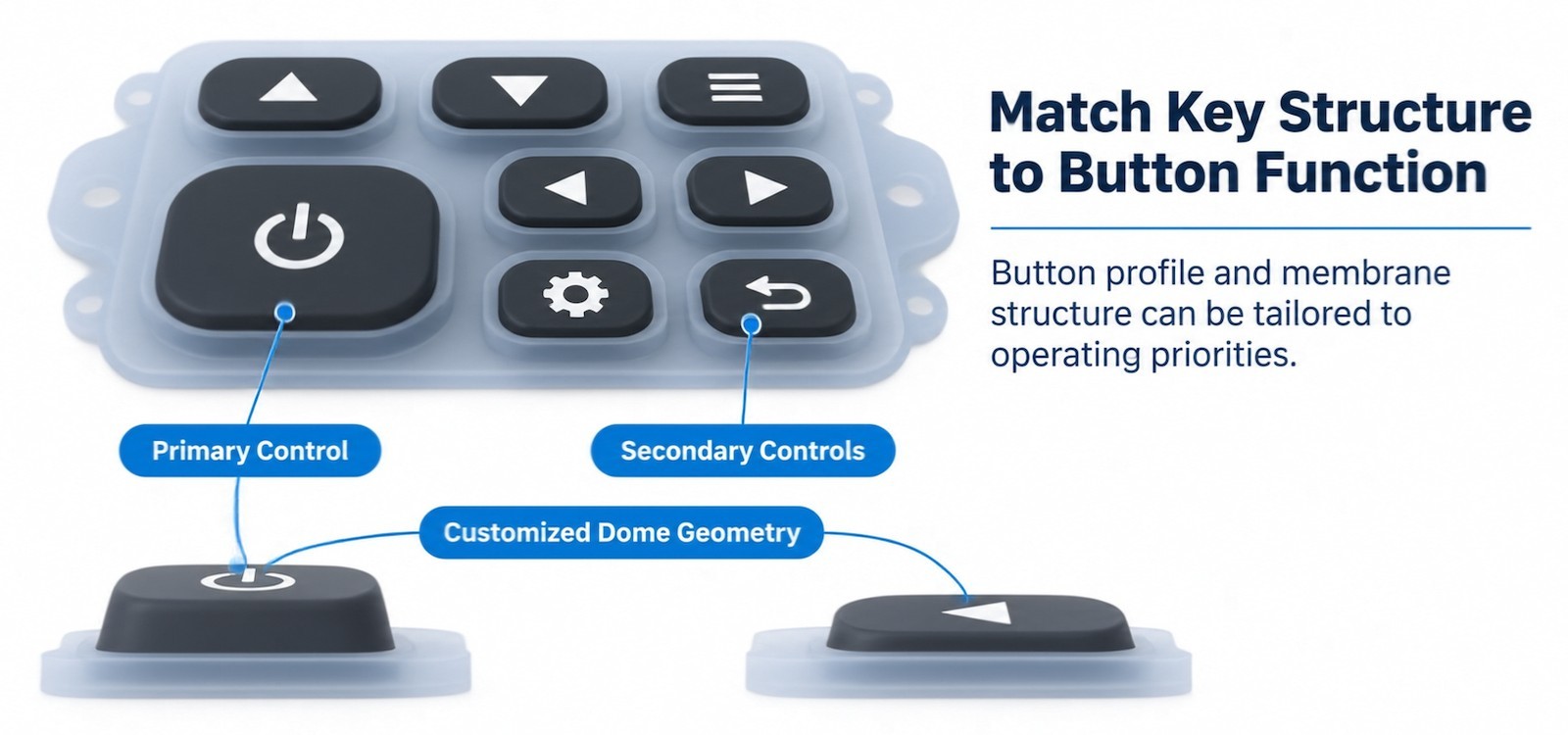
This is also where a custom moulder earns its place in the project. A stock keypad has one dome geometry; a custom one can carry several, and the cost difference sits in the cavity work rather than in the parts.
Optimize Membrane Geometry During Mold Development
Dome diameter, dome height, wall thickness and the width of the surrounding land are the four parameters that set the press. They should be adjusted together, on a section drawing, before the cavity is cut. Adjusting one in isolation usually moves the problem to the neighbouring key.
Two details are worth reviewing at this stage: the radius where the dome meets the membrane, because a sharp transition concentrates stress and shortens life, and the flat area around the dome, because it controls how much the key can rock when pressed off-centre.
Improve Keypad Stability Within the Radio Housing
A keypad that shifts inside its housing changes its own feel. When the sheet is pushed sideways by a gasket or by the battery door, some keys gain travel and others lose it. Locating features and a correctly sized perimeter keep the part where the drawing puts it.
Contact alignment belongs in the same review. If the carbon pill sits off its pad, the key will feel correct and still fail intermittently, which sends the operator back to pressing harder and the whole cycle starts again.
How Should Manufacturers Test Tactile Feedback Before Mass Production?
Measure Pressing Force and Button Travel
Record breakaway force, force at snap, travel at snap and total travel for every key. The four numbers together describe the press curve; any one alone can be matched by a key that feels completely different. Compare keys within the panel first, then against the drawing.
Check Rebound and Repeated Pressing Performance
Press each key two hundred times and note whether the return slows or the snap softens. Silicone keypads are typically rated in the millions of presses, and our published range for custom keypads is one to five million depending on geometry, but the useful information at prototype stage is the trend, not the headline number.
Evaluate Operation With and Without Gloves
Test with the gloves the users actually wear. Leather, nitrile and coated work gloves transmit force differently, and a panel that passes with a bare hand can fail with the third type. Ask the tester to name the key they just pressed without looking, and record errors rather than opinions.
Frequently Asked Questions About Tactile Silicone Keypads
Does harder silicone always provide stronger tactile feedback?
No. Feedback comes from the snap of the dome, which depends on geometry as much as on compound. A harder compound raises the force everywhere but can make the snap shorter and less informative. Matching the wall and dome to the compound matters more than the hardness number.
How can silicone dome geometry improve button response?
A taller dome gives a longer approach before the snap; a shallower one snaps earlier and more sharply. Wall thickness sets the force at which the snap occurs. Adjusting height and wall together is what moves a key from vague to definite without making it heavy.
What makes a radio keypad easier to operate with gloves?
Key height, keytop area and a strong snap, supported by a wide land so that a sliding gloved thumb stops at a boundary. Legends help less than shape, because a glove removes the fine sensation needed to read a printed symbol by touch.
Can different buttons on the same keypad have different pressing forces?
Yes, and on radio panels they usually should. Different dome heights and wall thicknesses can be combined in one cavity so that the push-to-talk key is distinct while the channel keys stay light and fast.
How can manufacturers evaluate tactile feedback before mass production?
Measure the four points of the press curve on every key, repeat presses to check for drift, and test with the gloves users actually wear. Our notes on large keypad buttons that tilt or jam cover the off-centre press, which is the usual reason a key that measures well still feels wrong.
What a Radio Builder Should Hand to the Moulder
Tactile silicone keypads are decided on paper, long before anyone presses a sample. Three things shorten the work: the button functions with their usage frequency, the housing section through the keypad, and the glove types the users wear. With those, dome geometry and key profiles can be set on paper, and the first prototype arrives close to the target instead of starting a series of guesses.
FromRubber is operated by Dongguan Bohao Electronic Technology Co., Ltd. in Dongguan, Guangdong. FromRubber has developed more than 6,500 custom silicone projects and holds over 7,200 molds in Dongguan, which means most keypad geometries have a close relative already in the building. That shortens the loop between a drawing and a sample that can be pressed in a real glove. Phone, WhatsApp or WeChat: +86 18676210913, or send the drawing through the contact page.
Related Reading
Sources and Test Methods Referenced
- ASTM D2240-15(2021), Standard Test Method for Rubber Property, Durometer Hardness. ASTM International.
- ISO 37:2017, Rubber, vulcanized or thermoplastic, determination of tensile stress-strain properties. ISO.
- ISO 23529:2016, Rubber, general procedures for preparing and conditioning test pieces for physical test methods. ISO.
- ASTM D395-18(2025), Standard Test Methods for Rubber Property, Compression Set. ASTM International.
- FromRubber product data for custom silicone rubber keypads: rated press life and key travel as published on the Custom Silicone Rubber Keypad page.
- Editions checked against the ASTM, ISO and IEC publisher listings in November 2026.