How to Plan a Silicone Brush Organizer Range in Several Sizes
- Share
- Issue Time
- Nov 11,2026
Summary
Scaling a drawing is not the same as designing a size range. In a soft organizer, capacity is set by opening perimeter, stability is set by wall curvature, and the base has to be reviewed per size. The article explains why each size needs its own drawing and its own sample approval, and which five features carry the family look.
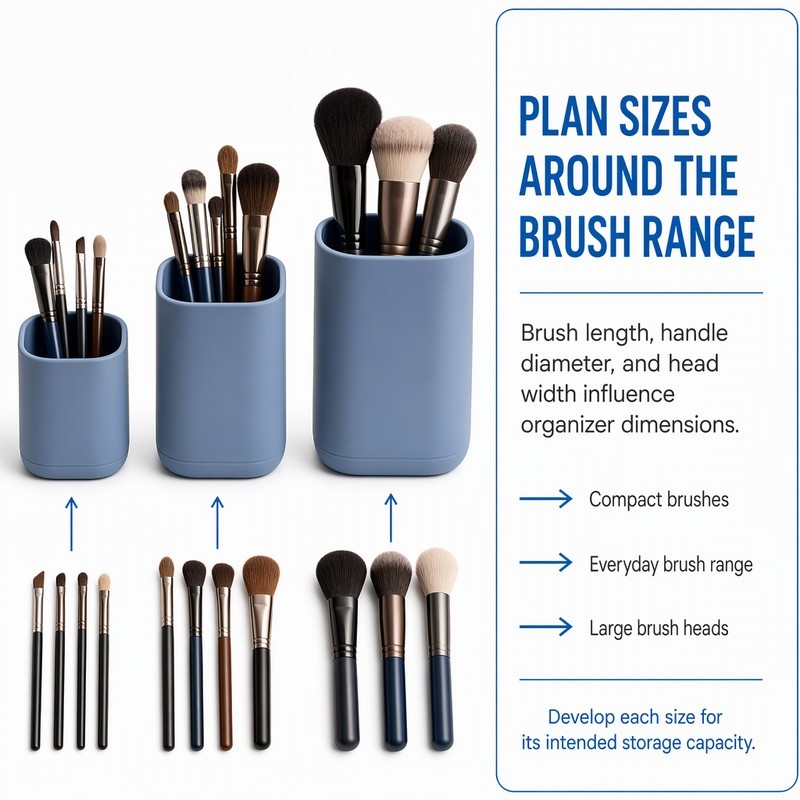
A brand approves one size, it sells, and the next question is a family: small, medium, large, maybe a travel version. The obvious move is to scale the drawing. That is also the move that produces the returns — a large size that leans when it is full, a small size whose walls are thick enough to be a cup rather than a holder, and a medium that holds eleven brushes when the packaging says twelve.
A silicone brush organizer is a container whose job is defined by its opening, not its volume. Change the size and you change four things independently: the perimeter available for brushes, the depth that supports them, the wall section that resists bulging, and the base that keeps the whole thing upright. A single scale factor cannot hold all four in proportion.
Why Do Makeup Brush Organizers Need Different Size Options?
How Do Brush Length and Brush Head Size Affect Organizer Dimensions?
Brush length sets the minimum depth. A holder that is too shallow lets long handles lean outward, which increases the overturning moment on a flexible wall and makes the organizer look unstable even when the base is fine.
Head size sets the opening. A powder brush head is wide, and a tight opening compresses it. Brushes stored under compression keep that shape, which is the reason a user will tell you the holder "ruined" a brush — the splaying is real and it does not recover.
Those two constraints diverge quickly. A set of short liner brushes wants a wide, shallow tray; a set of long foundation brushes wants a narrow, deep cup. One silhouette cannot serve both, which is the honest argument for a range rather than a size run.
Should Brands Develop Separate Sizes for Different Storage Needs?
Only if each size answers a different use. A small size for a handbag, a medium for a vanity, a large for a professional kit: those are three different jobs with three different constraints, and the drawings should reflect that.
A range built purely to fill a price ladder produces sizes that differ in height by twenty millimetres and nothing else. That is a merchandising decision dressed as product development, and buyers notice within one season.
The useful starting point is a brush inventory, not a dimension table. Lay the intended brushes on a bench, group them by head width, measure the longest handle in each group, and let those two figures set the size. The range then has a reason for existing that a buyer can repeat back to you.
Where a brand is developing a category rather than a single product, this inventory approach also reveals whether the range needs three sizes or two. More often than not it is two plus a variant.
How Should Brands Plan the Dimensions of Each Organizer Size?
How Should Organizer Height Match Different Brush Lengths?
Height should follow the longest handle in the intended group, with the brush head clear of the rim and the handle end still visible. If the handle disappears entirely, the user has to tip the holder out to find a brush, and the holder gets treated as a cup rather than a storage system.
There is a second limit at the other end: a holder much taller than its contents looks empty and, in a soft material, needs either a thicker wall or a wider base to stay upright.
How Does Opening Width Affect Brush Capacity?
Capacity is governed by opening perimeter, not by footprint area. Brushes pack around the inside of the opening, so the number that fit is roughly the perimeter divided by handle diameter, minus the space lost to the wall's own thickness at the rim.
That is why a square footprint and a round footprint of the same area do not hold the same number of brushes. The round one loses usable space at the corners it does not have; the square one wastes space where the handles cannot reach into the corner radius.
Why Should Internal Space Be Planned Around Actual Brush Dimensions?
Because a handle is not a point. Every brush occupies a cylinder whose diameter is set by the ferrule, not the handle, and the ferrule is usually the widest part that has to pass the opening. Designs sized from handle diameter pass the drawing check and fail the packing test.
We ask for a sample of the widest brush in the range before quoting a compartment layout. It is a five-minute check that avoids a tooling change.
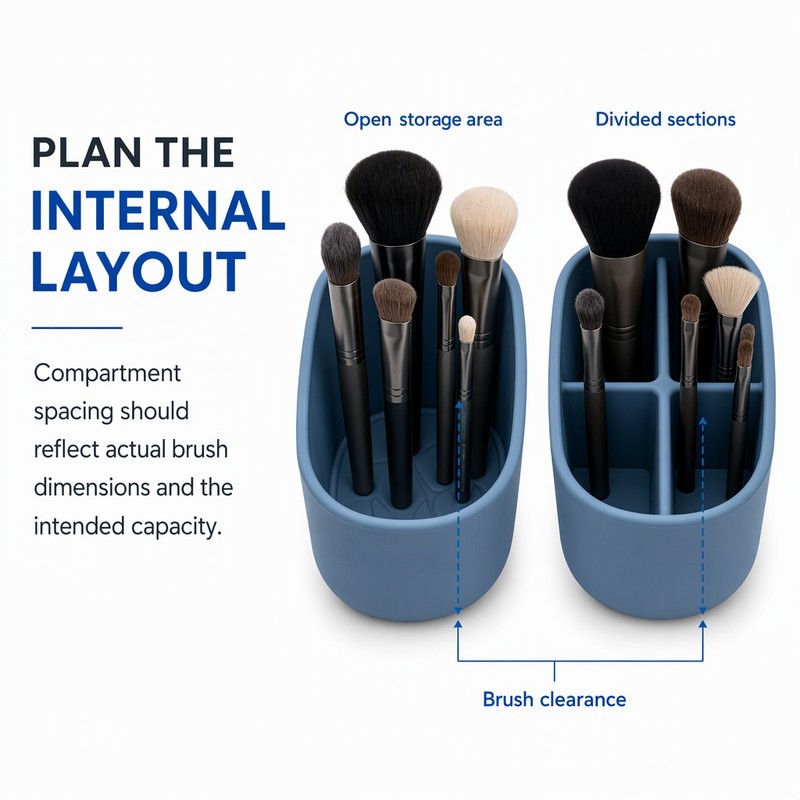
Open storage and divided storage behave differently as the load grows. An open cup lets brushes share one volume and find their own spacing; it also lets them lean into each other. A divided layout fixes spacing and prevents crowding, at the cost of unused volume in every compartment.
For a soft material the practical middle path is usually a shallow dividing rib that guides spacing without fully enclosing each brush — enough structure to stop crowding, not so much that the holder stops being flexible.
How Should Internal Compartments Be Designed for Different Brush Sizes?
Should the Organizer Use One Large Storage Space or Multiple Sections?
One space is easier to mould, easier to clean and more forgiving of a mixed brush set. Multiple sections give a tidier retail appearance and stop heavy brushes from crowding the light ones.
The decision usually comes down to the fixture the organizer sits on. A divided layout reads better on a shelf; an open one reads better in use. If the product will be photographed for a listing, that distinction matters more than either option's technical merits.
How Can Compartment Spacing Prevent Brushes from Becoming Overcrowded?
The rib pitch has to be set from the widest ferrule in the group, plus clearance. If the pitch is set from the average, half the range will not fit, and the user will force the ones that do — which is where split ferrules and crushed brush heads come from.
Clearance also has to allow for the wall's own flex. A soft rib deflects under load, so the effective compartment is smaller than the moulded one when the holder is full.
How Should Internal Structures Change Across Different Product Sizes?
The rib count should stay roughly constant while the rib pitch grows, or the compartment count should fall as the size rises. Scaling the rib pitch and the rib count together is what produces a large size with twenty compartments too small to use.
This is the point where a family of drawings stops being a scale operation and becomes three separate designs. It sounds like more work and it is; it is also the difference between a range that ships and a range that gets revised after the first container.
What Structural Challenges Arise When Scaling a Silicone Organizer?
How Can Thin Walls Affect the Stability of Larger Organizers?
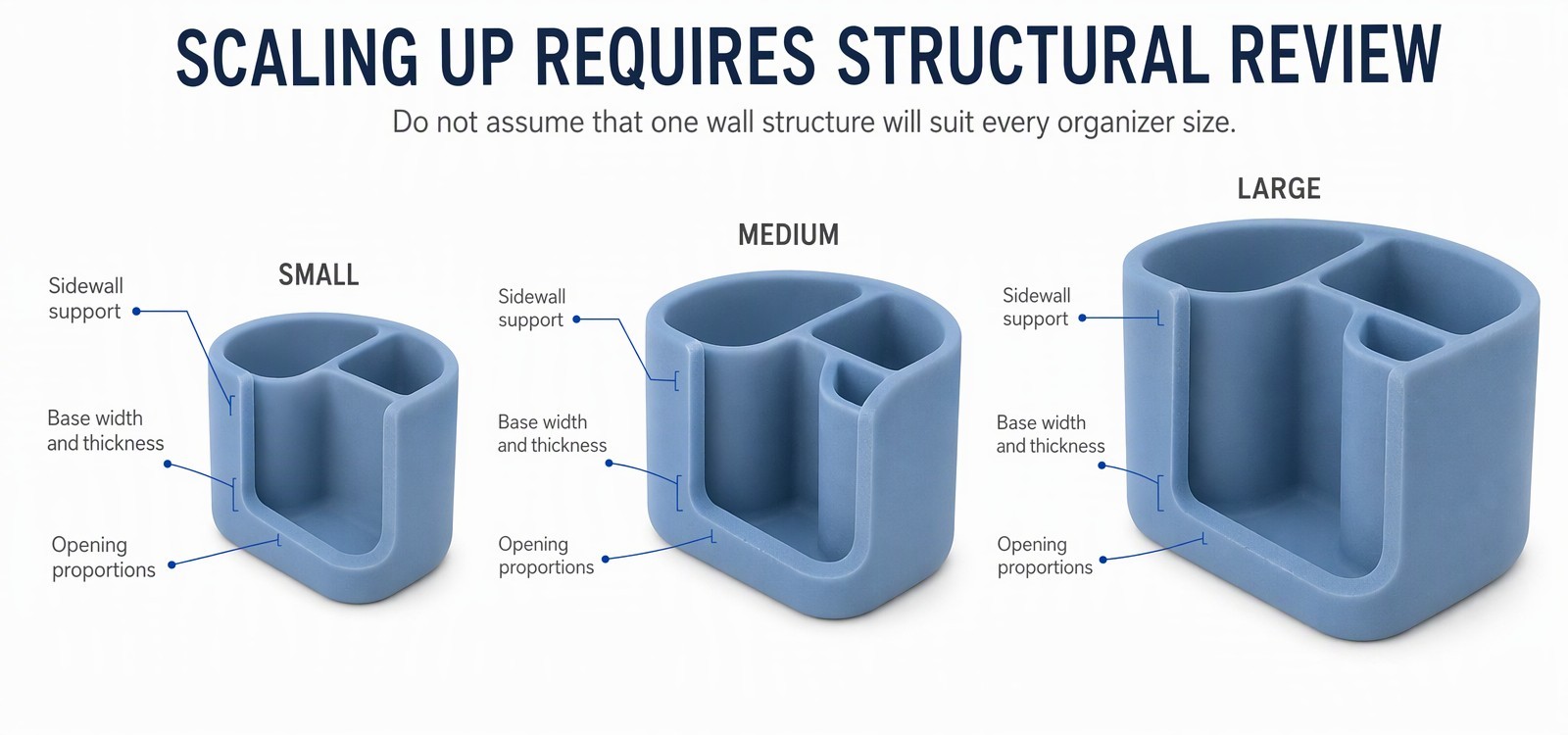
A wall that holds its shape at eighty millimetres across will bulge at a hundred and forty. The reason is that the load on the wall grows with the volume it contains while the wall's resistance grows only with its section and its curvature.
Curvature is the part people forget. A large, gently curved wall is a shallower arch than a small one, so it resists hoop load far less effectively at the same thickness. This is why the wall thickness has to rise with size even when the material and the shape are unchanged — and why a scaled drawing so often produces a large size that feels soft.
Why Should the Base Structure Be Reviewed for Each Size?
The base is the only thing resisting overturning, and overturning moment grows with height times the mass of the contents. A base that is stable at medium is not automatically stable at large, because the taller centre of gravity multiplies the same nudge.
Practical levers are base width, a slightly thicker base pad, and a small outward flare at the foot. All three are cheap in tooling terms and all three are decisions that must be made per size, not copied from the master drawing.
How Can Material Hardness Affect Different Organizer Sizes?
Hardness and thickness are interchangeable up to a point. A large organizer can be made stable either by thickening the wall or by moving to a harder compound; the first adds weight, the second reduces the soft-touch feel the product was specified for.
Because softness is usually the reason the product exists, most ranges end up with two compounds: a softer one for the small sizes and a firmer one for the large. That is a legitimate outcome, but it has to be planned, because two compounds means two material lots and a colour-matching task that a single-compound range would not need.
The stretch behaviour that makes a flexible wall pleasant in the hand has a limit, and it is worth understanding before specifying a very large size in a very soft compound. Our note on how much stretch a moulded silicone part can usefully carry describes where that limit sits in a different product family.
How Can Brands Maintain a Consistent Design Across Multiple Sizes?
Which Design Features Should Remain Consistent Across the Product Range?
Corner radius, rim treatment, surface finish, logo position and colour. Those five carry the family resemblance. Everything else can vary without breaking the range.
The rim is the single strongest cue. A rolled rim on the small size and a flat rim on the large reads as two products from two suppliers, even in the same colour.
Which Dimensions Should Be Adjusted Independently?
Height, opening width, rib pitch, wall thickness and base width. Each answers a different constraint: brush length, brush count, spacing, stability and overturning. Tying any of them to a single scale factor re-couples constraints that should be independent.
Should Different Sizes Use Separate Mold Designs?
Almost always. A cavity can be shared only if the parts differ in a dimension that comes from the same core and cavity geometry, which is rarely the case across a real range.
What can be shared is the tooling approach: the same gating concept, the same parting line strategy, the same surface finish specification. Sharing design intent across four tools is cheaper than sharing one tool across four sizes, and it produces better parts. The tool-life side of that argument is covered in our notes on maintaining silicone moulds across a production programme.
What Should Be Confirmed Before Mass-Producing Multiple Sizes?
How Should Brands Organize Drawings and Product Specifications?
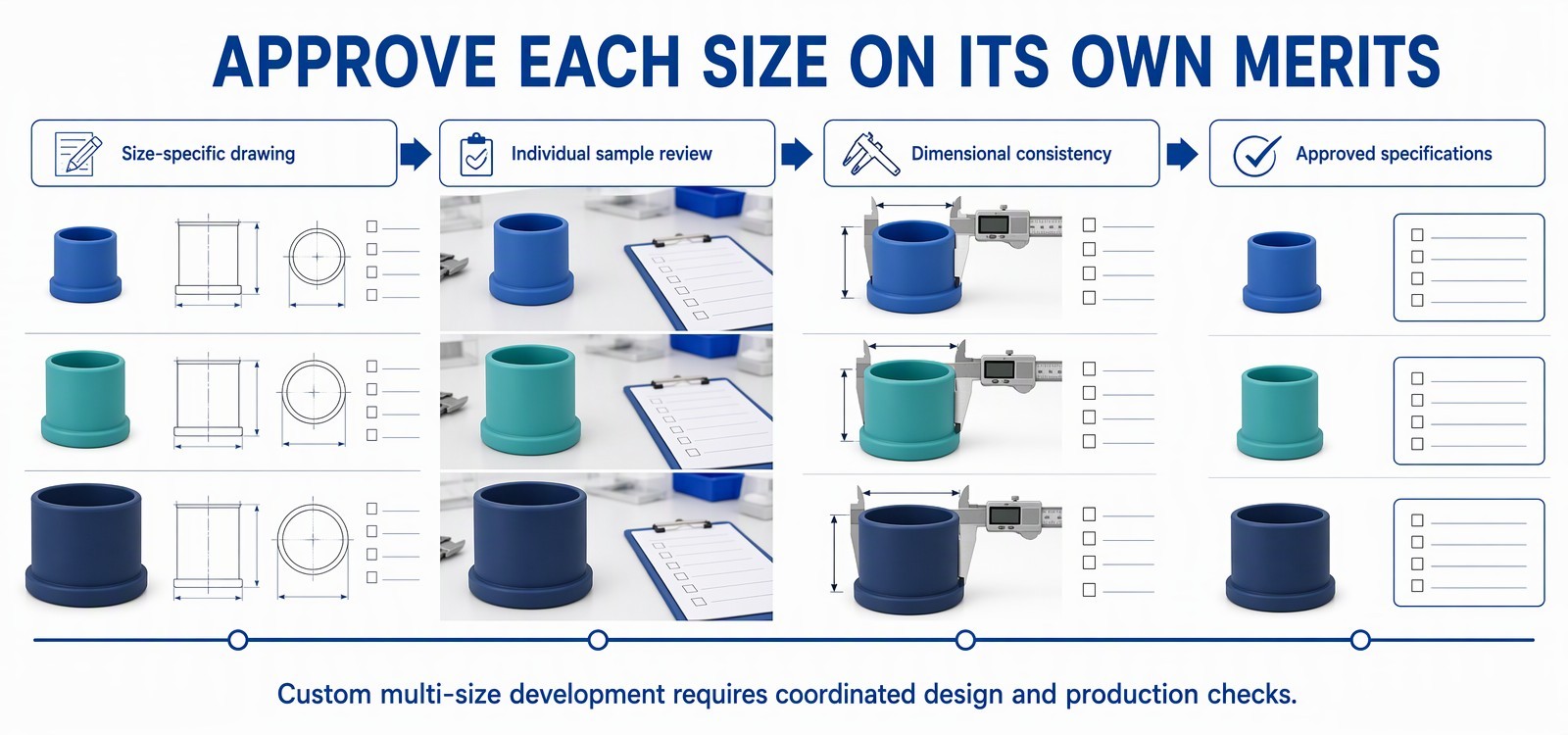
One drawing per size, each dimensioned in full, rather than a master drawing plus a scale note. A scale note is how a toolmaker ends up guessing which features were meant to stay fixed.
Each drawing also needs the material callout, colour reference, finish specification and logo detail repeated in full. Cross-referencing a master document is where version drift starts.
Why Should Each Size Go Through Its Own Sample Evaluation?
Because the structural behaviour is size-dependent. A medium sample proves that the medium design works; it says nothing about the large one's wall or the small one's rim. Yet a size run is where sampling budgets get cut, and it is exactly where a shared sample assumption costs most.
The minimum defensible position is a full dimensional and visual check on every size, plus a filled-load check on the largest and the smallest. Those two are where the failure modes concentrate.
How Can Manufacturers Maintain Consistency Across Different Production Runs?
Agreed specifications, a stored reference sample per size, and dimensional checks at the points that matter rather than across the whole part. Shrinkage is the variable that most often pulls a size run out of alignment, and it behaves differently as section thickness changes — the compensation logic is set out in our guide to silicone shrinkage and mould dimensions.
The range is a design problem, not a scaling problem
A silicone brush organizer family works when each size is designed against a real brush set and checked for its own wall and base behaviour. The three numbers that decide whether the range holds together are the opening perimeter against handle and ferrule diameter, the height against the longest handle, and the wall thickness against the size of the shell it has to support.
FromRubber has been moulding custom silicone parts since 2010, with toolmaking and sampling in house, so a four-size range can be developed as four designs rather than one design copied four times. If you have a brush inventory and a size plan, send it over — a flat drawing and the brush set is enough for us to start. WhatsApp or WeChat: +86 18676210913.
Sources and further reading
- Choosing silicone thickness for a moulded part — FromRubber engineering article on section thickness and stiffness.
- Trade-offs of thicker silicone in a moulded vessel — FromRubber analysis of wall thickness, load and weight.
- How much stretch a moulded silicone part can carry — FromRubber design guide.
- Silicone shrinkage and mould dimensions — FromRubber tooling guide.
- Mould maintenance across a production programme — FromRubber tooling article.
- Reading a silicone product drawing — FromRubber guide to dimensioning and tolerances.