How to Prevent Brush Slots from Being Too Tight or Loose in a Custom Silicone Makeup Brush Organizer?
- Share
- Issue Time
- Nov 9,2026
Summary
Brush slot fit is not a single width. This article explains how opening geometry, wall thickness, silicone hardness and handle diameter act on the same contact band, why a narrower slot is not a stronger hold, and how to test insertion, stability and slot recovery before the mold is approved.
A brand receives the first sample of its silicone makeup brush organizer, loads it with its own brushes, and discovers two problems in the same minute. The thin liner brush slides down until the bristles rest on the base. The thick foundation brush will not go in at all, and forcing it stretches the slot into an oval that stays oval. Both problems come from the same decision, made months earlier, when every slot was given the same width.
Slot fit in a silicone makeup brush organizer is not a width. It is the result of four variables acting together: the opening geometry, the wall thickness behind the opening, the hardness of the silicone, and the actual diameter of the brush handle where it is gripped. Change any one and the other three have to be reviewed again.
Why Brush Slot Fit Matters in a Silicone Makeup Brush Organizer
A slot does two jobs. It lets a brush in without damaging the handle or the slot, and it holds the brush upright when the organizer is carried, tilted, or bumped. Those jobs pull in opposite directions, and the useful range between them is narrower than most drawings assume.
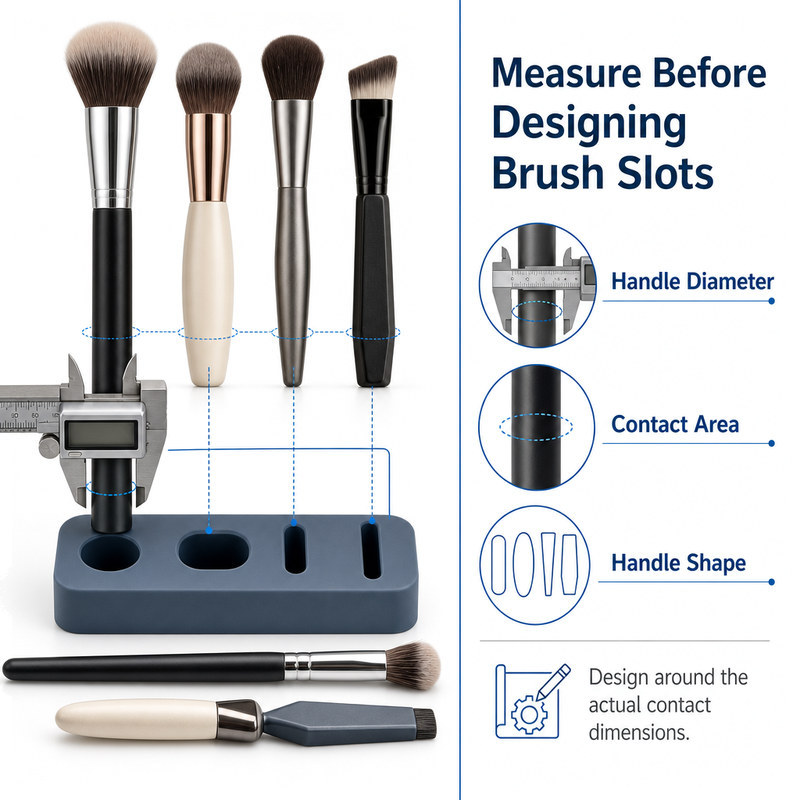
Handle diameter at the contact band, not at the widest point, sets the slot. The slot shapes below show why one opening cannot suit a round, an oval and a tapered handle at once.
A slot that is too tight creates resistance during insertion, stretches the opening, and leaves the lip permanently deformed after a few weeks. Bristles get damaged when the user pushes harder to overcome the resistance. A slot that is too loose lets the brush lean, so a heavy brush sits at an angle and a light one slides down until the ferrule stops it. In both cases the organizer looks fine in a photograph and behaves badly in a bathroom.
The starting point is not aesthetics. It is the handle. A slot dimension estimated from a photo or from a nominal size will be wrong for part of the brush set, because brush handles are not standardized and often vary along their length.
Measure Brush Handles Before Designing the Slots
Check Handle Diameter at the Actual Contact Area
Most handles taper. The diameter near the ferrule is usually larger than the diameter near the base. The slot grips a specific band of the handle, so that band is the only measurement that matters. Measuring the widest point of the handle is a common error, and it produces a slot that is too loose at the point where it actually holds.
Measure several brushes from the same set rather than one. Production handles vary within a batch, and a slot sized to a single sample will be tight for the larger ones.
Consider Different Brush Handle Shapes
Round, oval, tapered, and flat handles contact a slot differently. A round handle touches the slot along a line on each side. An oval handle touches on two narrow bands. A flat handle with rounded edges touches on two edges and leaves a gap in the middle. A tapered handle only contacts where its diameter matches the opening.
That difference changes retention more than slot width does. An oval handle in a round slot has less contact area than the same handle in an oval slot, so it will feel looser even though the nominal width is the same. This is the point at which a single uniform slot design stops working for a mixed brush set.
Account for Brush Handle Size Variations
Define the target range before designing. If the organizer is sold with a brush set, the range is known and the slots can be tuned to it. If it is sold empty as a universal organizer, the range is wider and the design has to accept a compromise: a slot that holds the largest handle comfortably will be loose for the smallest.
One practical approach is a mixed layout: a few larger slots for face brushes and more numerous smaller slots for eye and detail brushes. The organizer then matches how a brush collection is actually distributed instead of treating every brush as identical. A silicone organizer with different slot openings is shown in our page on custom silicone cosmetic holders.
How Slot Width Affects Insertion and Holding Performance
What Happens When Brush Slots Are Too Narrow?
Insertion resistance rises sharply as the opening approaches the handle diameter. The lip stretches, and the silicone around it thins. If the opening is much narrower than the handle, the lip does not return fully, and the slot becomes a permanently open oval that holds nothing.
Narrow slots also concentrate stress at the point where the lip meets the wall. Repeated insertion flexes that point, and on a thin wall it is where a tear begins. A narrow opening is therefore not a stronger grip; it is a higher insertion force with a shorter service life.
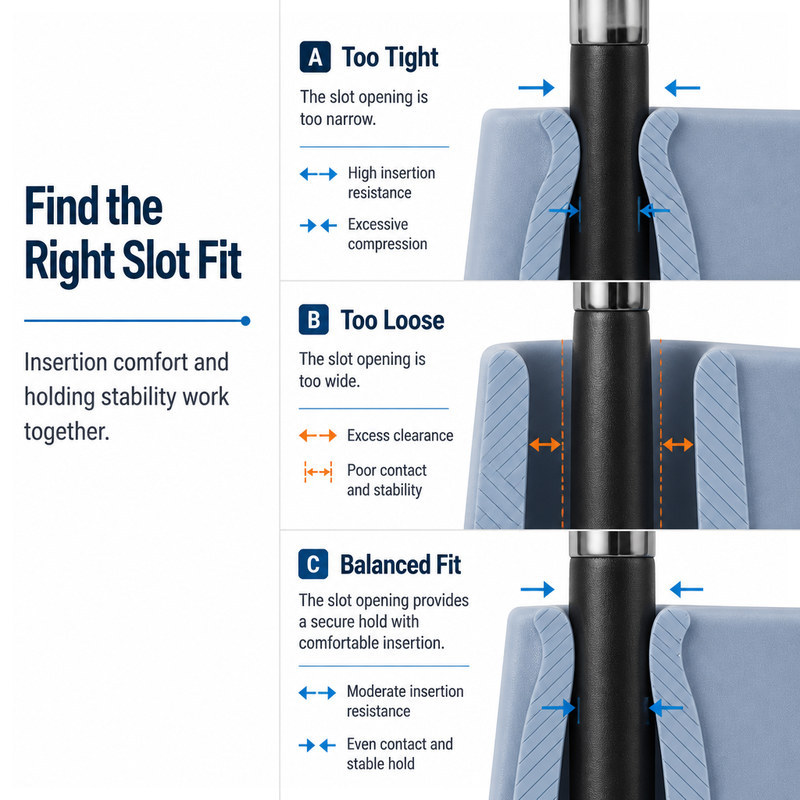
Three fits, three failure modes. The narrow slot stretches the lip, the wide slot loses contact, and the balanced slot keeps contact without forcing the handle.
What Happens When Brush Slots Are Too Wide?
Excessive clearance removes contact, and contact is what generates retention. A brush in an oversized slot stands only if its centre of gravity stays inside the opening, which is unlikely for a tall brush with a heavy handle. The brush leans, the bristles touch the neighbouring brush, and the organizer's footprint becomes unstable when it is carried.
Loose slots are also harder to fix later. A tight slot can sometimes be adjusted by changing the silicone hardness or the wall thickness, but an oversized opening requires new mold geometry.
Use Slot Shape and Opening Geometry to Improve Fit
Round Slots Versus Oval Slots
A round slot gives even contact around a round handle and is simple to mold. An oval slot gives two longer contact bands on an oval handle and resists rotation. Neither is universally better; the correct choice depends on the handle shape and on whether the brush should be free to rotate.
For a mixed set, oval slots in the front row and round slots in the back row is a common arrangement: the visible front brushes are held more firmly, and the back row accepts whatever the brand supplies.
Add Flexible Entry Features Where Necessary
Three entry details are worth considering when insertion force is the problem:
- a tapered entrance that widens towards the top, so the handle is guided into the slot;
- a slit opening that opens like a slot rather than stretching like a ring;
- a reduced wall thickness immediately behind the lip, so the lip can flex without moving the whole wall.
Each of these changes the stress pattern. A slit opening, for example, converts tensile stretch into bending at the slit root, which is usually more forgiving but also more sensitive to a sharp corner. Round the root, or the slit becomes the tear starter.
Silicone Hardness and Wall Thickness Also Affect Slot Performance
How Silicone Hardness Changes the Feel of Brush Slots
Hardness decides how much force the slot applies for a given amount of deformation. A softer compound deforms further at the same insertion force, so it feels more forgiving and holds less firmly. A harder compound resists deformation, which increases retention and increases the effort needed to insert a brush.
Hardness is measured by indentation, and the scale used in the specification has to match the method: ASTM D2240 defines the durometer method, and ISO 48-4 defines the corresponding Shore hardness method. A specification that says "medium" is not a specification. Our longer note on choosing between 40 Shore A and 60 Shore A explains how that range behaves in a molded part, and it applies well beyond keypads.
How Wall Thickness Influences Flexibility
A slot is a hole in a wall, and the wall's thickness decides whether the hole can open. A thick wall around a slot resists deformation, so the slot feels tight even when its width is correct. A thin wall opens easily but may not spring back, especially if the silicone is soft.
The useful arrangement is usually a thin section immediately around the lip, thickening behind it to a structural wall. That gives the lip room to flex and keeps the surrounding body stiff enough to hold the brush upright.
Balance Flexibility and Retention Instead of Relying on One Dimension
Retention comes from contact area multiplied by contact pressure over time. Widening the slot reduces both. Narrowing the slot raises pressure at a smaller contact area and increases wear. Increasing hardness raises pressure without changing geometry, but it also raises insertion force. Thickening the wall raises pressure and reduces the lip's ability to open.
Because the four variables interact, changing one in isolation rarely solves the problem. A slot that is slightly too loose is often better fixed by increasing the contact band length, or by changing the hardness, than by narrowing the opening by a fraction of a millimetre.
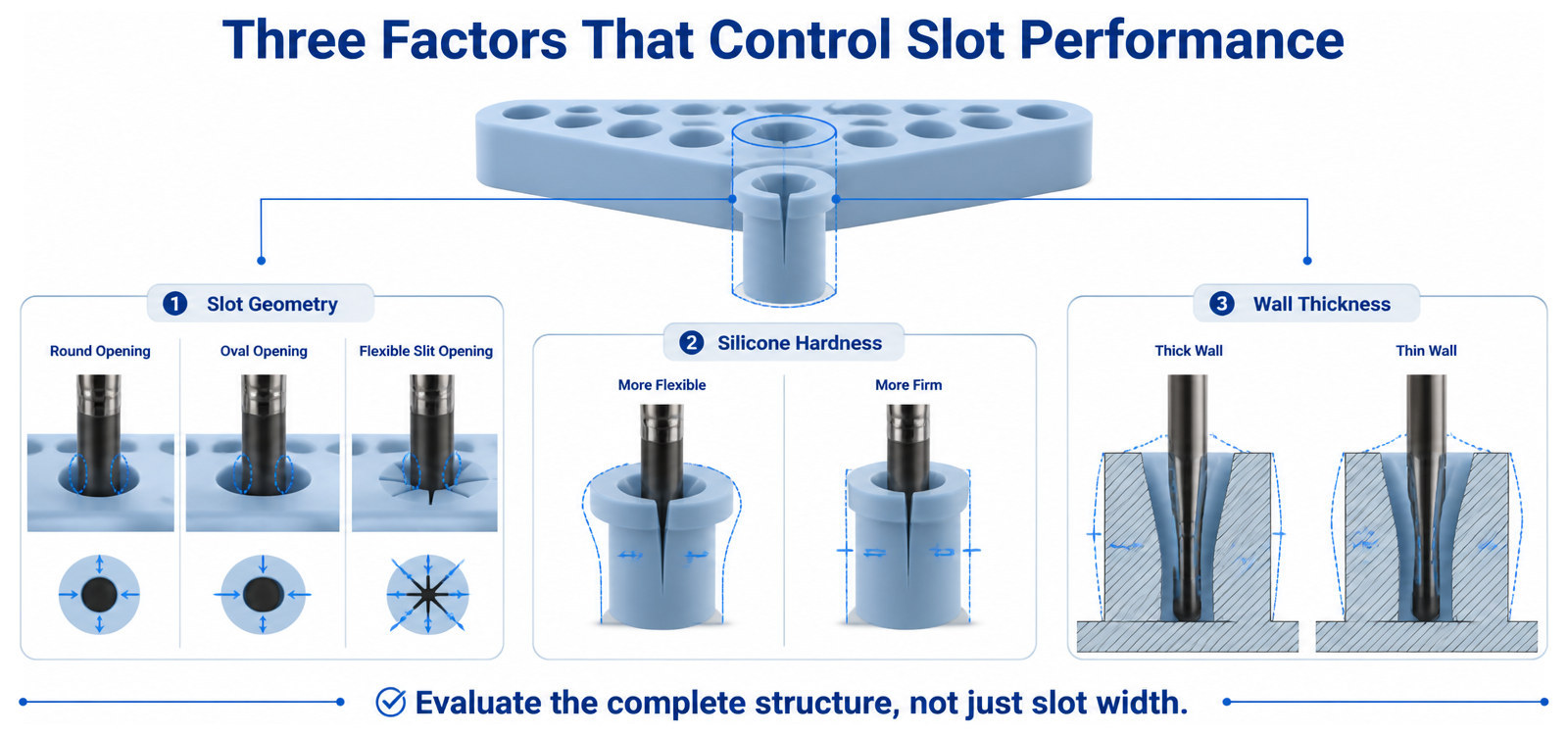
Geometry, hardness and wall thickness act on the same contact band. Changing one without the others moves the problem rather than solving it.
Common Brush Slot Design Mistakes to Avoid
- using one slot width for a brush set with different handle sizes;
- measuring the widest part of the handle instead of the contact band;
- specifying hardness without a scale or a value;
- narrowing the opening without checking how far the lip can stretch;
- leaving excessive clearance and expecting the base to keep the brush upright;
- approving a mold without inserting the actual brushes into the prototype;
- ignoring normal production variation in handle diameter and in the molded slot.
Dimensional variation is the last item for a reason. Even a well-designed slot has a tolerance band, and handles vary too. A design that only works at nominal dimensions will produce complaints from a predictable percentage of users. Tolerance classes for moulded rubber products are defined in ISO 3302-1, and they are worth stating on the drawing so that both sides measure the same way.
How to Test Brush Slot Fit Before Approving the Mold
Test Insertion and Removal Resistance
Insert and remove each representative brush ten times, using a normal grip rather than a deliberate push. Note whether the effort is comfortable, marginal, or requires force. Record it per brush type, because an average hides the two extremes that will generate the complaints.
Check Brush Stability After Placement
Load the organizer with a full set, lift it, tilt it slightly, and set it down. Observe whether any brush leans, rotates, or slides. Then repeat with one oversized brush in each slot position, because users do not respect the intended arrangement.
Test Repeated Use and Slot Recovery
Insert and remove the largest brush twenty to thirty times in the same slot, then leave it in place for a day. Inspect whether the opening returns to its original shape, whether the lip has taken a set, and whether a tear has started at the slit root or at the lip corner. This test finds the failures that a single insertion cannot.
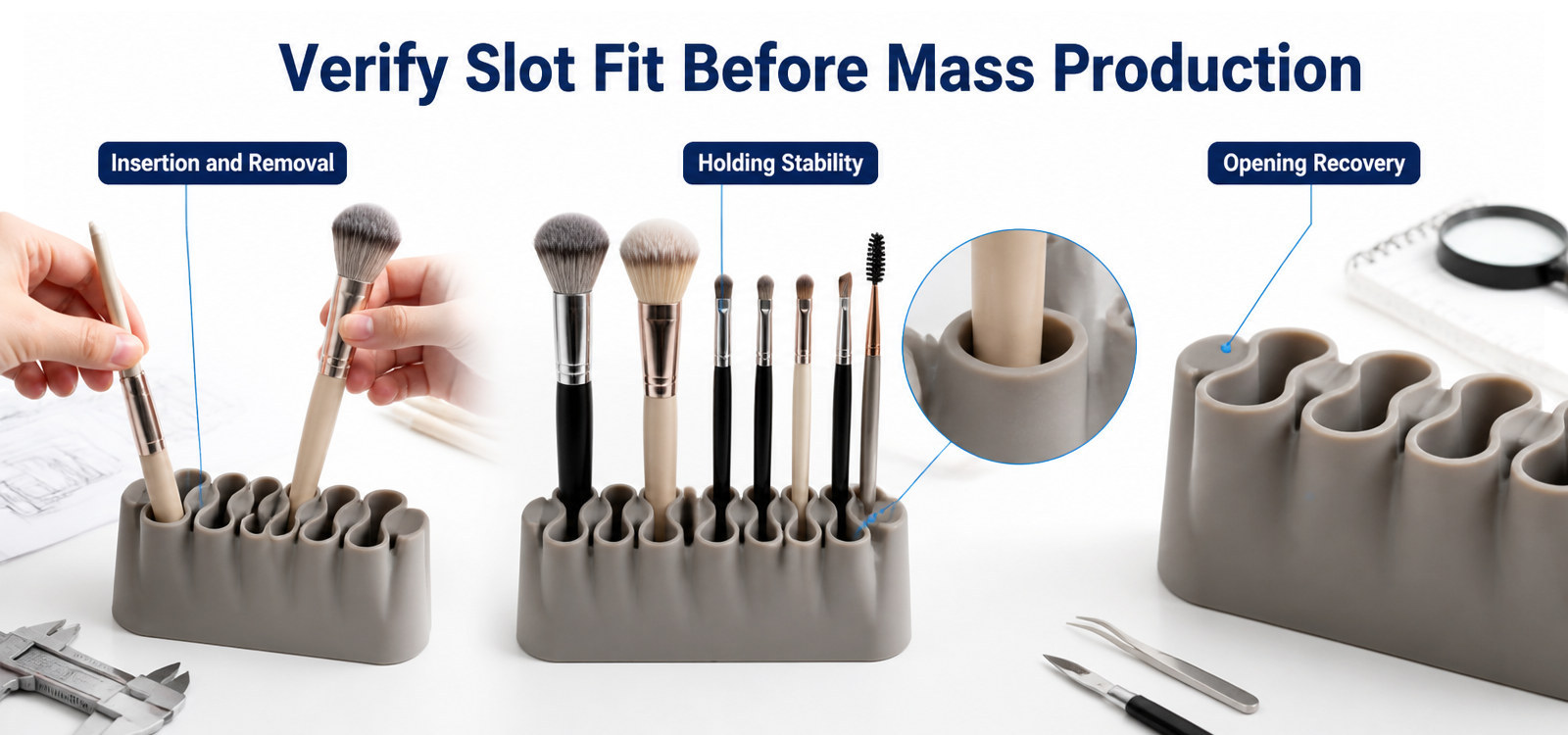
Fit is confirmed by using the organizer, not by measuring the slot. Insertion, stability under load and recovery after repeated use are the three checks that predict field complaints.
What Information Should Buyers Provide for a Custom Brush Organizer Quote?
| Information | Why the supplier needs it |
|---|---|
| Reference photos or physical brush samples | Confirms handle geometry, taper, and weight distribution |
| Handle diameter at the contact band | Sets the slot opening, not the nominal width |
| Number of slots and their arrangement | Determines the mold layout and the wall between slots |
| Overall organizer dimensions | Constrains slot depth, wall thickness, and base size |
| Preferred silicone hardness | Changes both insertion feel and retention |
| Color, finish, and logo method | Affects mold finishing and secondary operations |
| Estimated order quantity | Sets cavity count and unit cost |
Custom Silicone Makeup Brush Organizers for Beauty Brands and OEM Buyers
Slot dimensions, opening shape, wall thickness, and hardness can all be adjusted for a specific brush collection, but they have to be adjusted together. Sending the actual brushes, or a drawing with the contact band marked, turns the conversation from an estimate into a design.
FromRubber produces custom silicone organizers and beauty tool components for brands, wholesalers, and OEM buyers. Our tooling shop runs 10 CNC machines in-house, and production uses 40 compression molding machines, so a slot revision and its sample can be handled by the same team. Send brush samples or drawings through the inquiry form, or talk to us on WhatsApp and WeChat at +86 18676210913. If the organizer is part of a larger set, our note on designing matching silicone beauty sets covers how shared tooling and colour decisions work across several parts.
Frequently asked questions
Is a narrower slot always a stronger hold?
No. A narrower slot raises insertion force and stress at the lip, but retention depends on contact area and pressure over time. Past a point, a narrower opening deforms permanently and holds less.
Should every slot in an organizer have the same size?
Only if every brush has the same handle diameter at the contact band. For a mixed set, two or three slot sizes usually work better than one compromise width.
What silicone hardness is right for brush slots?
It depends on the wall thickness and the handle range, so it should be chosen together with the geometry and confirmed on a sample. A value without a scale is not a usable specification.
Why do the slots loosen after a few months?
Most often because the lip was over-stretched at insertion and took a permanent set. A thinner lip section, a different entry geometry, or a slightly harder compound can reduce that.
Can an existing organizer be adjusted without a new mold?
Sometimes, by changing the compound hardness alone, which shifts both feel and retention. Changes to the opening geometry or the wall thickness require mold work.
Sources and further reading
- ASTM D2240-15(2021), Standard Test Method for Rubber Property, Durometer Hardness. ASTM D2240 standard page (https://store.astm.org/d2240-15r21.html)
- ISO 48-4:2018, Rubber, vulcanized or thermoplastic, Determination of hardness, Part 4: Indentation hardness by durometer method (Shore hardness). ISO 48-4 standard page (https://www.iso.org/standard/74969.html)
- ISO 3302-1:2014, Rubber, Tolerances for products, Part 1: Dimensional tolerances. ISO 3302-1 standard page (https://www.iso.org/standard/62492.html)
- FromRubber technical notes: 40 Shore A versus 60 Shore A, hardness and product feel.