How to Prevent Deformation and Uneven Edges in Silicone Beauty Mixing Bowls?
- Share
- Issue Time
- Nov 11,2026
Summary
A bowl that is flat on the day it is molded can rock six weeks later. This article treats deformation as a shrinkage gradient, separates warpage from flash, and sets out rim geometry, base design, demolding and inspection controls that keep mixing bowls dimensionally stable.
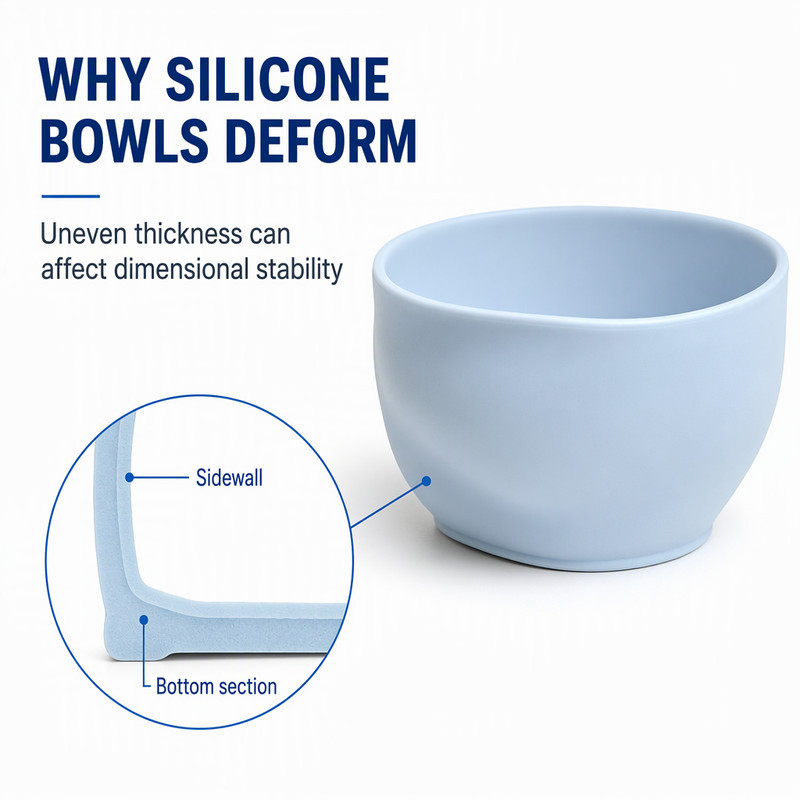
The bowls leave the factory flat. Six weeks later, at the brand's filling line, half a carton rocks on the conveyor: the base touches on two sides and lifts on the other two. Nobody changed the mold. The parts simply finished moving after they were packed.
A silicone beauty mixing bowl is a thin shell, and a shell does not deform because it is soft. It deforms because different parts of it shrink by different amounts at different times.
What Causes Silicone Beauty Mixing Bowls to Deform?
The direct answer: deformation is a shrinkage gradient, not a softness problem. Where a bowl has a thick base and a thin wall, the two sections cure at different rates and contract by different amounts as they cool. The result is a bowl that is round when it leaves the cavity and slightly oval a day later.
Thermal expansion and contraction in polymers is well documented as a source of dimensional change that depends on the material and on the temperature path it experiences. For a molded silicone bowl, the temperature path is set by the mold, the cure and the cooling that follows.
Uneven Wall Thickness Can Cause Different Areas to Shrink or Distort
Silicone shrinks as it cures and continues to change slightly as it cools. A thick section holds heat longer, cures later and contracts more in absolute terms than a thin section beside it. When the two are joined, one of them has to give.
An Insufficiently Supported Bowl Wall May Collapse or Bend
A bowl wall is a shell in compression when the bowl is squeezed and in bending when it is carried. A wall that is thin relative to the bowl diameter deflects under both, and a deflection that is held for long enough becomes permanent.
An Unstable Bottom Structure Can Cause the Bowl to Tilt
Inconsistent Curing and Cooling Conditions Can Affect Dimensional Stability
Two bowls from the same cavity can end up different if one was demolded hot and stacked immediately while the other cooled on a rack. The first cools against a flat surface under its own weight; the second cools in free air.
Why Do Silicone Beauty Mixing Bowls Develop Uneven or Wavy Edges?
A wavy rim is usually diagnosed as warpage and treated by changing material. In most cases it is a rim geometry or mold closing issue, and the warp is a consequence rather than a cause.
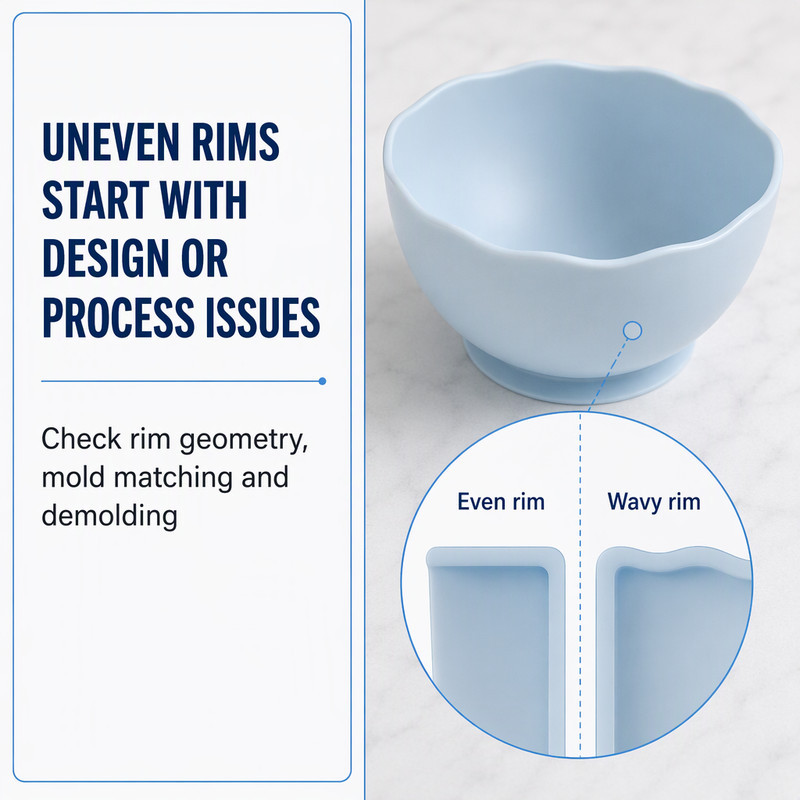
The rim is the thinnest free edge of the part and the last area to be constrained by the mold. It is also the area with the least material behind it, so any difference in closing pressure or in rim thickness shows up there first.
Because the rim is a closed loop, a local error becomes a global wave. A small excess of material in one sector pushes the neighbouring sectors outward, and the wave travels around the circumference rather than staying where it started.
Inaccurate Mold Rim Dimensions Can Produce Uneven Openings
The rim is formed by the meeting of two mold surfaces. If the cavity that forms the outer edge and the core that forms the inner edge are not concentric, the rim thickness varies around the circumference. A rim that is thicker on one side holds more heat and shrinks more, which adds to the geometric error.
Checking concentricity and rim width at several points around the circumference is a five-minute job on a new tool and an expensive discovery on a production tool.
Uneven Mold Closing Can Create Flash Along the Bowl Rim
Flash and warpage are often confused because both make the rim look uneven. Flash is excess material squeezed into the parting line; warpage is a dimensional change of the part. The distinction matters because the fixes are different: flash is a closing or venting issue, warpage is a shrinkage issue.
A simple check separates them: run a fingernail along the rim. Flash has a step or a thin edge that can be felt and often peeled. Warpage feels smooth but the rim is not level.
Uneven Wall Thickness Near the Rim Can Affect Edge Stability
A rim that is thin at its inner edge and thick at its outer edge is a small lever with a large thermal mass at the end. As it cools, the thick outer edge contracts more and pulls the thin inner edge with it, which is how a rim curls rather than waves.
A rim with a more uniform section, or with a small bead placed so that it does not create an isolated thick mass, holds its shape better.
Excessive Pulling During Demolding Can Distort the Bowl Opening
A bowl released by pulling one side of the rim distorts the opening before the part has cooled. The opening is a ring, so the distortion does not stay local: pulling one side makes the opposite side move inward, and the bowl ends up slightly oval with a high and a low point on the rim.
That ovality then persists, because the part cools in the deformed shape.
How Should Manufacturers Design Silicone Mixing Bowls to Maintain Their Shape?
Design decides how much the bowl can move; process decides whether it moves. The four decisions below reduce the amount of movement available.
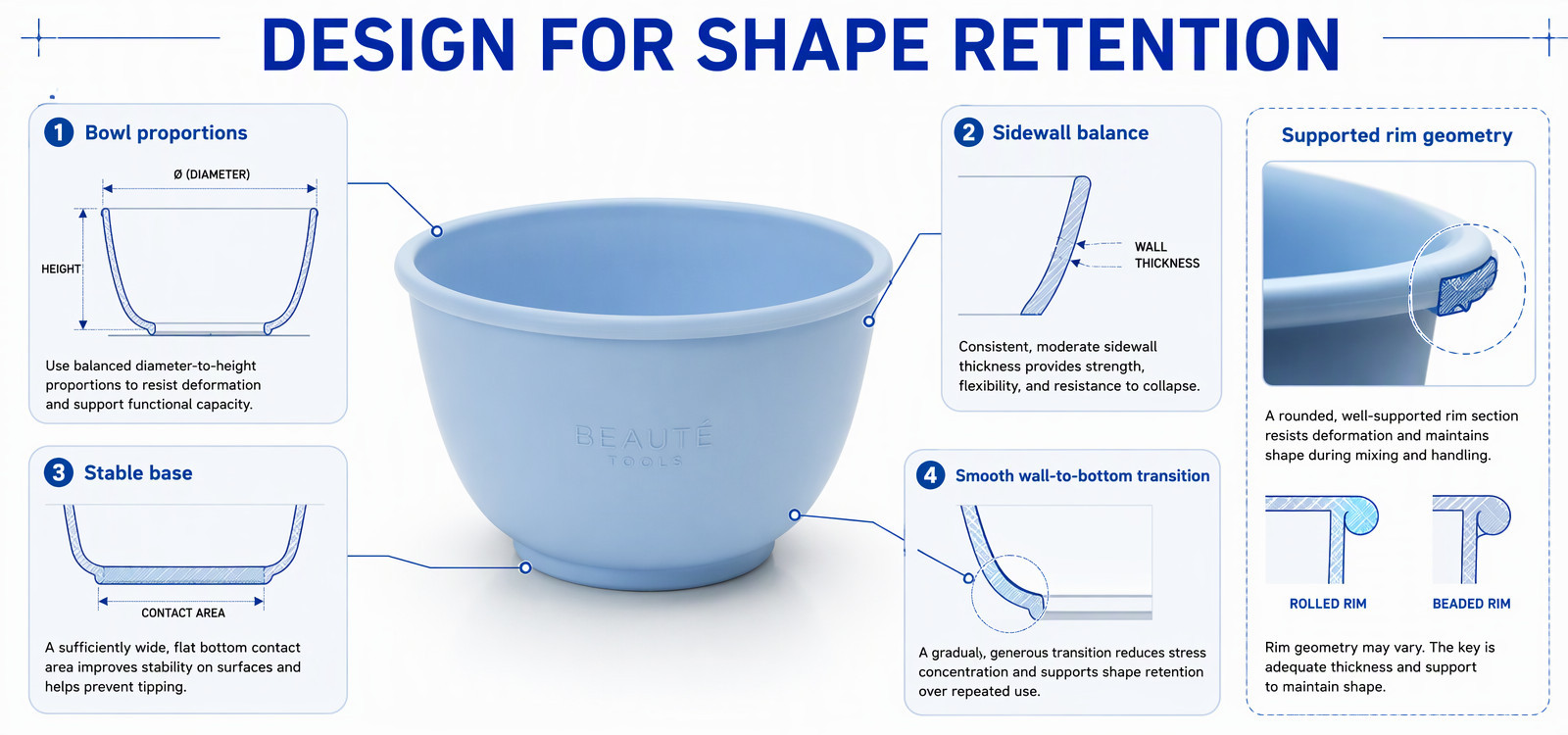
Balance Bowl Diameter, Height, and Sidewall Thickness
A bowl is a proportion, not a set of dimensions. Increasing the diameter without reviewing the wall makes the bowl more flexible; increasing the height without reviewing the base makes it more likely to lean. The three should be adjusted together, and the wall should be set from the stiffness the bowl needs when it is carried full.
A slight taper from rim to base adds stability without adding much material, because the lower part of the wall is where bending is resisted most effectively.
Design the Bottom to Support the Bowl Without Adding Unnecessary Material
The base needs a flat contact area, a radius at the wall junction and enough thickness to resist cupping. It does not need to be uniformly thick across the whole diameter. A base that is thicker at the centre than at the edge creates its own shrinkage gradient and is a common cause of rocking.
Improve Rim Geometry to Reduce Edge Deformation
A rounded rim with a controlled section deforms less than a square rim with a thin inner edge. A small bead or a rolled edge spreads the section without creating an isolated mass, and it also removes the sharp edge that catches during demolding.
Rim geometry should be checked in a trial where the part is demolded by the intended method, because the rim is where a bad release shows first.
Avoid Abrupt Transitions Between the Bowl Wall and Bottom
A sharp internal corner at the wall-to-bottom junction is a stress concentration, a cure hot spot and a place where material accumulates. A generous radius distributes all three.
How Does Silicone Hardness Affect Mixing Bowl Shape Retention?
Hardness changes how much the bowl deflects under a given load, but it does not change the shrinkage behaviour that causes warpage. That distinction is the reason changing compound often fails to fix a wavy rim.
Softer Silicone Offers More Flexibility but May Need More Structural Support
A soft bowl is easy to squeeze and pleasant to handle, but it deflects under its own weight when filled and is more likely to take a set when stored nested. Softer compounds usually need a slightly thicker wall or a more supported rim to compensate.
Firmer Silicone Can Improve Shape Retention but May Change Handling Feel
A firmer bowl holds its shape and resists ovalising, which is why it is often chosen for products that need to sit on a surface. The trade-off is that a firm bowl feels less forgiving when squeezed, and a firm rim can feel sharp against the hand.
Material Hardness Should Be Evaluated Together With Bowl Geometry
Two bowls of the same compound but different diameters will behave differently, because the wall stiffness relative to the bowl size is different. Evaluating hardness on a flat sample, or on a bowl of a different size, gives a result that does not transfer.
Which Manufacturing Checks Help Prevent Deformation and Uneven Edges?
Checks should be placed where the risk is created: the tool, the process, the release and the inspection bench.
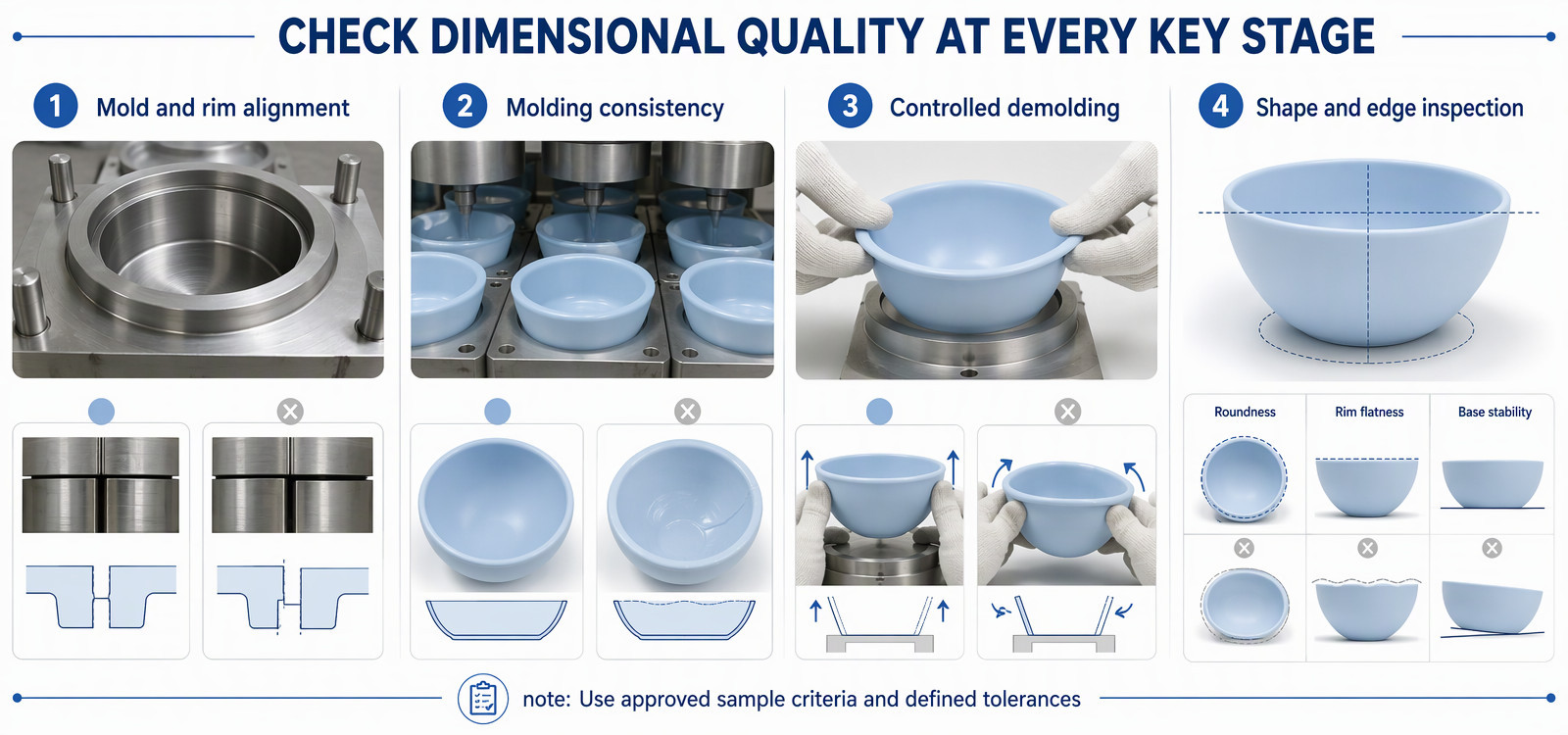
Inspect Mold Dimensions and Rim Alignment Before Production
Measure rim width at several points around the circumference, check that the two rim-forming surfaces are concentric, and confirm the closing condition with a contact check. These measurements are quick on a new tool and expensive to discover later.
Record them. A rim that changes after a repair is a common cause of a defect that appears without any process change.
Monitor Material Preparation and Molding Consistency
Mix ratio, working time and compound temperature all affect how much the part shrinks. A batch that is slightly off-ratio cures differently and moves differently, and the difference may only show as a bowl that will not sit flat.
Cycle time and platen temperature belong on the same record, because a bowl cured at a lower temperature for longer is not the same part as one cured hot and fast, even if both pass a hardness check.
Control Demolding and Post-Molding Handling
Release the bowl by lifting the rim evenly, or with an ejector that pushes the base, rather than by pulling one side. Then let the part cool in its intended shape: on a flat rack, not stacked warm, and not nested inside another bowl.
Inspect Bowl Roundness, Rim Flatness, and Base Stability
Three checks cover the visible consequences. Measure the diameter at two heights and in two directions to detect ovality. Place the bowl on a flat plate and press alternate sides of the rim to detect rocking. Sight along the rim, or stand the bowl on a flat surface and look at the gap under the rim, to detect a wave.
Do these checks after the part has cooled for a defined period, not immediately after demolding, because a bowl that is still warm will pass a test it fails the next day. Rim condition and flash belong on the same inspection sheet; our note on uneven edges and flash on silicone beauty tools explains how to separate the two visually.
What Should Buyers Confirm Before Ordering Custom Silicone Beauty Mixing Bowls?
- Bowl diameter, height and working capacity, measured internally rather than externally.
- Sidewall and base thickness, with the transition between them defined.
- Rim shape: square, rounded, rolled, with or without a pouring lip.
- Silicone hardness with the scale, plus any requirement on squeeze feel.
- Whether the bowl must stand unaided and how stable it must be when full.
- Base flatness and roundness tolerance, and the method used to check them.
- Colour, surface finish and any marking method, including whether marks are molded or printed.
- Storage and packing method, because nesting and stacking change the shape over time.
- The cooling or settling time allowed before packing, and whether parts are inspected before or after it.
Frequently Asked Questions About Silicone Beauty Mixing Bowl Manufacturing
Why does my silicone beauty mixing bowl become warped?
Most often because the wall and base have different thicknesses and therefore cure and shrink differently. The bowl is dimensionally correct when it leaves the cavity and moves during cooling. Storage under load, such as nesting, makes it worse.
How can manufacturers prevent uneven edges on silicone mixing bowls?
By controlling rim geometry and mold closing. A rim with a uniform section, a concentric cavity and core, and an even closing condition produces a level edge. Trimming a wavy rim by hand treats the symptom rather than the distribution of material that caused it.
Does silicone hardness affect bowl deformation?
It affects deflection under load, which is what users feel, but it has little effect on the shrinkage gradient that causes warpage. A harder compound will resist ovalising more, but it will not correct a wall-to-base thickness difference.
Why does a silicone mixing bowl have a wavy rim after demolding?
Usually because the rim was pulled or twisted during release, or because the rim section is uneven around the circumference. Because the rim is a closed loop, a local error becomes a wave that travels around the whole edge.
How can wall thickness affect silicone bowl stability?
A wall that is thin relative to the bowl diameter deflects under load and can take a permanent set. A wall that is thick at the base and thin at the rim creates a shrinkage gradient that pulls the rim out of shape. Uniform, gradual transitions are more stable than either extreme.
Can manufacturers customize the rim and bottom structure of silicone beauty mixing bowls?
Yes, both are tooling features. A pouring lip, a rolled rim, a flat base or a recessed base can each be built into the mold, but each changes how the part fills, cures and releases, so the structure should be reviewed against the bowl proportions before the tool is cut.
Preventing Mixing Bowl Deformation Starts With Structural Balance and Mold Accuracy
A bowl holds its shape when its sections are balanced, its rim is supported, its base is stable and its release is even. Warpage is the visible result of a shrinkage gradient, and the gradient comes from geometry far more often than from the compound.
FromRubber molds custom silicone beauty mixing bowls and matching spatulas for cosmetic brands and OEM buyers, including sets where bowl, spatula and lid have to work together. Our note on designing mixing bowls and spatulas as a matching set covers the shared-tooling side of that work. Send drawings, dimensions or a sample through the inquiry form for a structural review, or reach us on WeChat and WhatsApp at +86 18676210913.
Sources and further reading
- Coefficient of Linear Thermal Expansion of Polymers and Polymer Composites: A Comprehensive Review (2025). Thermal contraction depends on material, direction and temperature path, and is a documented source of dimensional change in molded polymer parts. pmc.ncbi.nlm.nih.gov
- FromRubber technical notes: mixing bowl and spatula set design, flash and uneven edges after molding.