It Is Time To Replace Your Rubber Keypad!
- Share
- publisher
- Suey
- Issue Time
- Nov 7,2025
Summary
How to decide whether to replace your rubber keypad using four measurements instead of appearance: contact resistance, force drift, return time and insulation resistance, the four wear modes that end a keypad's life, and when the correct fix is a specification change rather than a new part.

The panel looks fine. The machine is eight years old. Operators have started pressing one key twice, then leaning on it. Somewhere between "the keypad is worn out" and "we need a new machine" there is a decision, and it is usually made on opinion because nobody measured anything.
Here is how to decide whether to replace your rubber keypad using four measurements, and how to tell the difference between a worn keypad and a badly specified one.
How Do You Know It Is Time to Replace Your Rubber Keypad?
The direct answer: replace when the contact resistance has risen beyond the input threshold of your controller, or when the force curve has drifted far enough that operators compensate. Both are measurable, and neither requires guessing from appearance.
The visual cues people rely on, a shiny legend or a flattened key, lag the electrical failure by months. A key can look worn and still switch cleanly; a key can look new and fail because the carbon pill has glazed. Measure first, then decide.
- Contact resistance above roughly 100 to 200 ohms on a carbon pill switch usually means the pill surface has worn or contaminated, and the controller is starting to see a slow or missed press.
- Actuation force drifted by more than about 20% from the original sample is the point where operators begin to notice, and where double presses appear.
- Visible carbon migration, a dark ring on the PCB or the pill, means the switch has been arcing and the surface is no longer flat.
The Four Wear Modes That Actually End a Keypad's Life
Rubber keypads rarely fail from a single cause. They fail by one of four mechanisms, and each points to a different remedy, which is why identifying the mode matters more than replacing the part.
Only the first two are genuinely age-related. The other two will repeat on the replacement part unless the specification or the assembly method changes.
| Wear mode | What you see | What it means |
|---|---|---|
| Carbon pill wear | Rising resistance, dark residue on the PCB | End of life; replacement is the fix |
| Dome fatigue | Soft feel, slow return, no click | Silicone has taken a compression set; replacement |
| Web tearing | Cracks at the key root, key feels loose | Often a design or assembly issue, not age |
| Chemical attack | Sticky surface, swollen keys, legend loss | The grade is wrong for the cleaning agent; re-specify |
What to Measure Before You Replace Your Rubber Keypad
Four measurements, done on five keys spread across the panel, are enough to make the decision defensible. Record them against a known-good baseline, which in most plants means the first article from the original build.
- Contact resistance at the controller input, with the key held closed, measured on a meter rather than inferred from machine behaviour.
- Actuation force and travel on a press rig, plotted rather than read as a single peak.
- Return time, measured by releasing the key and recording how long the contact stays closed.
- Insulation resistance between adjacent keys, which catches moisture ingress and internal contamination that a single-key test misses.
If the numbers are inside specification and the complaint is still real, the problem is elsewhere: a worn connector, a contaminated PCB pad, or a controller input that has drifted. Replacing the keypad in that situation removes the evidence and leaves the fault.
How to Order a Replacement Without Repeating the Whole Qualification
A replacement part does not automatically need a full programme. If the drawing, material, legend method and dimension set are unchanged, the requalification can usually be limited to a dimensional report and a functional test on the first lot. What does need to be explicit is the material grade and the cure, because those are the two variables that a new tool or a new press will change silently.
Send the worn sample with a note of the failure mode, the original purchase date if known, and the environment the panel works in. Those three inputs let a molder choose a grade that addresses the actual failure instead of copying the label on the old part.
Understanding Rubber Keypad Deterioration
Rubber keypads are engineered for durability and resilience, but like all components, they have a finite lifespan. The gradual deterioration of these essential interface elements can compromise your equipment's functionality in ways that aren't always immediately apparent.
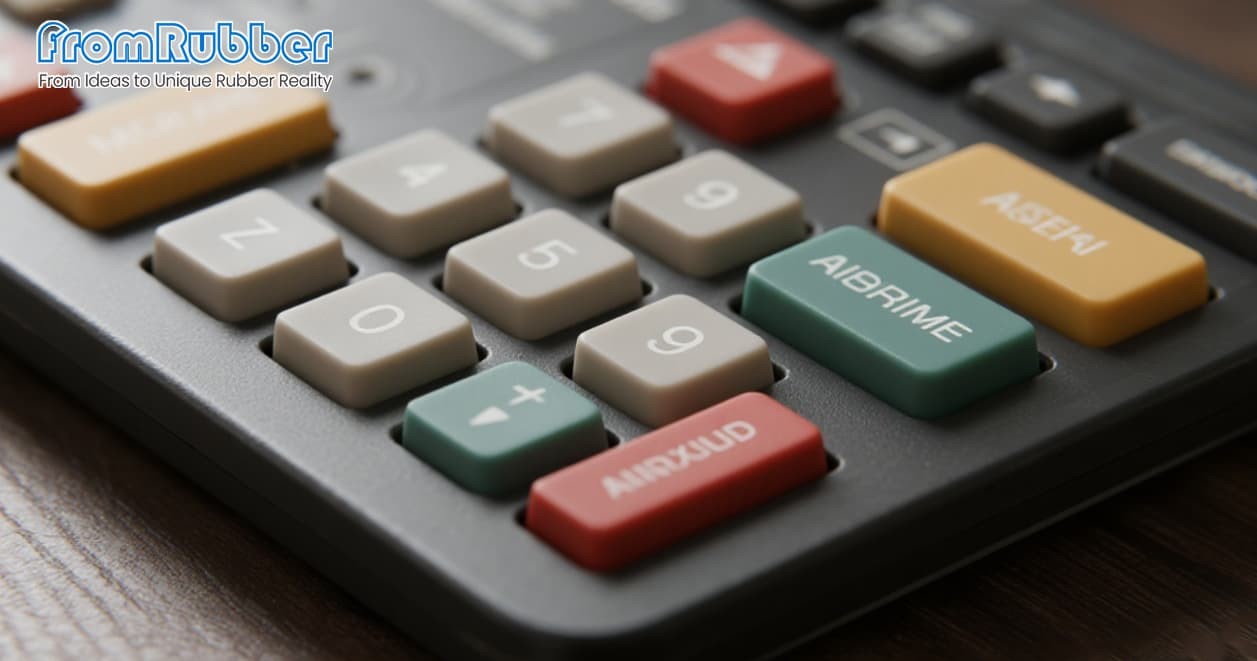
Visual comparison showing the difference between a new rubber keypad and one that needs replacementThe Science Behind Rubber Keypad Wear
Modern rubber keypads are typically manufactured from silicone rubber or thermoplastic elastomers (TPE), materials chosen for their excellent tactile response, environmental resistance, and longevity. However, several factors contribute to their eventual degradation:
Material Fatigue
Each press of a rubber key causes microscopic stress to the material. Over thousands or millions of cycles, this stress leads to material fatigue, changing the keypad's mechanical properties and reducing its responsiveness.
Environmental Factors
Exposure to UV light, ozone, extreme temperatures, and chemicals can accelerate the aging process of elastomeric materials, causing them to become brittle, discolored, or less flexible.
Surface Abrasion
Constant finger contact, cleaning procedures, and incidental abrasion gradually wear away the keypad's surface texture and legends, potentially leading to illegibility and reduced tactile feedback.
Signs Your Rubber Keypad Needs Replacement
Recognizing the early warning signs of keypad deterioration can prevent more serious equipment issues down the line. Here are the most common indicators that replacement is necessary:
Reduced Tactile Response
Keys feel mushy or require significantly more pressure to register. The satisfying "click" feeling diminishes, leading to user uncertainty about whether a press has registered.
Sticking or Non-Returning Keys
Keys fail to return to their original position after being pressed, potentially causing repeated entries or equipment malfunctions.
Fading or Worn Legends
The printed characters, symbols, or graphics on the keypad surface become difficult to read due to wear, fading, or complete removal.
Cracking or Hardening
The rubber material shows visible cracks, has become brittle, or has lost its original flexibility, increasing the risk of complete failure.
Inconsistent Activation
Some keys work intermittently or require pressing at specific angles, indicating wear in the conductive contacts or dome switches beneath the surface.
Discoloration or Staining
The keypad has changed color significantly, potentially indicating material degradation or chemical damage that could affect performance.
Important Note
Continuing to use a deteriorated rubber keypad can lead to more than just user frustration. It may cause damage to the underlying electronic components, create safety hazards in critical applications, and significantly reduce the overall lifespan of your equipment.
The Replacement Process: What to Expect
Replacing a rubber keypad might seem straightforward, but proper execution requires attention to detail and understanding of the specific requirements for your equipment.
1Identification and Sourcing
The first step is accurately identifying your current keypad model and specifications. This includes dimensions, button layout, connector type, and mounting method. As manufacturers, we maintain extensive databases of keypad specifications and can often match or recreate keypads even for discontinued equipment.
2Preparation and Safety
Before beginning the replacement process, ensure the equipment is powered off and disconnected from any power sources. Gather the necessary tools, which typically include precision screwdrivers, plastic opening tools to prevent damage to housings, and appropriate cleaning supplies.
3Removal of the Old Keypad
Carefully remove the old keypad, paying attention to how it's secured (adhesive, mechanical fasteners, or integrated into the housing). Document the disassembly process if necessary for reassembly. Take this opportunity to clean the contact surface thoroughly.
4Installation of the New Keypad
Position the new keypad carefully, ensuring proper alignment with the underlying contacts and any display elements. Follow the specific mounting instructions for your keypad type, whether it involves applying even pressure for adhesive models or securing mechanical fasteners.
5Testing and Verification
After installation, thoroughly test each key for proper activation and tactile response. Verify that all functions work as expected before returning the equipment to service. Document the replacement for maintenance records.
Choosing the Right Replacement Keypad
Not all replacement rubber keypads are created equal. Selecting the appropriate replacement involves several critical considerations:
| Feature | Standard Replacement | Premium Replacement | Custom Solution |
|---|---|---|---|
| Material Quality | Standard silicone | Medical/food-grade silicone | Specially formulated compounds |
| Durability | 1-3 million cycles | 5+ million cycles | Custom engineered lifespan |
| Environmental Resistance | Basic protection | IP67 rated options | Tailored to specific conditions |
| Tactile Response | Standard | Enhanced with precise actuation force | Customized to application |
| Lead Time | Immediate | 1-2 weeks | 4-6 weeks |
| Cost | Economical | Moderate | Higher initial investment |
Material Considerations
The base material of your replacement keypad significantly impacts its performance and longevity. Silicone rubber remains the industry standard for most applications due to its excellent balance of properties:
Silicone Rubber
Offers excellent temperature resistance (-60°C to 230°C), good tear strength, and maintains flexibility across a wide temperature range. Ideal for most industrial, medical, and consumer applications.
Thermoplastic Elastomers (TPE)
Provides good flexibility and can be more cost-effective for high-volume production. May have limitations in extreme temperature applications compared to silicone.
Specialty Compounds
For demanding environments, conductive-filled silicones, fluorosilicones for chemical resistance, or custom-colored compounds for branding purposes may be appropriate.
The Manufacturing Advantage
As direct manufacturers, we offer significant advantages over third-party suppliers when it comes to rubber keypad replacement:
Illustration showing the precision manufacturing process of custom rubber keypadsPrecision Engineering
Our manufacturing capabilities allow for precise control over every aspect of keypad production, from material selection and compounding to molding and finishing. This results in replacement keypads that not only fit perfectly but also match or exceed the performance of the original components.
Quality Assurance
Every keypad undergoes rigorous testing for dimensional accuracy, tactile response, electrical functionality (for conductive rubber keypads), and environmental resistance. Our quality control processes ensure consistent performance across all production runs.
Customization Options
Beyond direct replacements, we offer customization services to improve upon original designs. This includes enhanced tactile feedback, modified layouts for improved usability, upgraded materials for extended service life, and custom colors or graphics for branding purposes.
Cost-Benefit Analysis of Timely Replacement
While replacing a rubber keypad represents an expense, the cost of postponing replacement can be significantly higher. Consider these factors in your decision-making process:
Replace, Re-Specify or Re-Design?
The measurement decides the route. Rising resistance with a stable force curve means wear, and a like-for-like replacement is correct. Stable resistance with a soft, slow-returning key means the compound has taken a compression set, which is a material or temperature problem; the replacement needs a harder durometer or a different grade, otherwise the new part will do the same thing.
Torn webs and cracked key roots point at design or assembly. A replacement will fail in the same place unless the web thickness, the panel support behind the key, or the mounting torque changes. This is the case where a new drawing is cheaper than a second replacement cycle.
Getting the Reference Part Right
When the original drawing is unavailable, the worn sample is still usable as a reference, provided you record the dimensions before it distorts further and note which surfaces were originally flat. Our article on custom silicone keypads for legacy equipment covers that workflow, and the Verifone Vx520 keypad page shows what an established replacement pattern looks like.
Downtime Costs
Equipment failure due to keypad issues can halt operations, resulting in lost productivity and revenue that far exceeds the cost of proactive replacement.
Secondary Damage
A malfunctioning keypad can lead to incorrect inputs, potentially causing damage to more expensive components within the equipment.
User Experience
Poorly functioning interfaces frustrate users, reduce efficiency, and can impact perception of your product quality if the equipment is customer-facing.
Safety Implications
In critical applications, keypad failure can have safety consequences, making timely replacement not just an economic decision but a safety imperative.
Ready to Replace Your Rubber Keypad?
Don't wait until keypad failure disrupts your operations. Our team of experts is ready to help you identify the perfect replacement solution for your specific needs. With our manufacturing capabilities and extensive experience, we can provide keypads that restore—and often enhance—your equipment's interface performance.
Quick response • Exact replacements • Custom solutions • Bulk pricing available
Frequently Asked Questions
How long should a silicone rubber keypad last?
Life is dominated by actuation count and environment rather than calendar age. Panels in clean indoor equipment commonly run for several million actuations; panels exposed to solvent cleaning, UV or repeated temperature cycling reach the same resistance limit far sooner.
Can a worn keypad be repaired instead of replaced?
Occasionally. Cleaning the PCB pad and the carbon pill restores contact for a short period when the failure is contamination. If the wear ring is already visible on the pill, cleaning buys weeks rather than months.
Why did the replacement keypad feel different from the original?
Usually because the durometer or the web thickness was copied approximately rather than measured. Ask for the force curve of the new part and compare it with the original baseline before accepting the lot.