Light Transmittance Decay in Smart Lock Silicone Keypads: Yellowing of Translucent Silicone Under UV and Its Effect on Backlight Uniformity
- Share
- publisher
- FromRubber
- Issue Time
- Oct 5,2026
Summary
A backlit keypad can stay mechanically perfect while it visually degrades: yellowing, transmission loss and uneven illumination. This article treats optical performance as a design property, covering formulation stability, siloxane migration, thickness consistency, the LED interface, and an incremental UV test that separates steady drift from localised ageing.
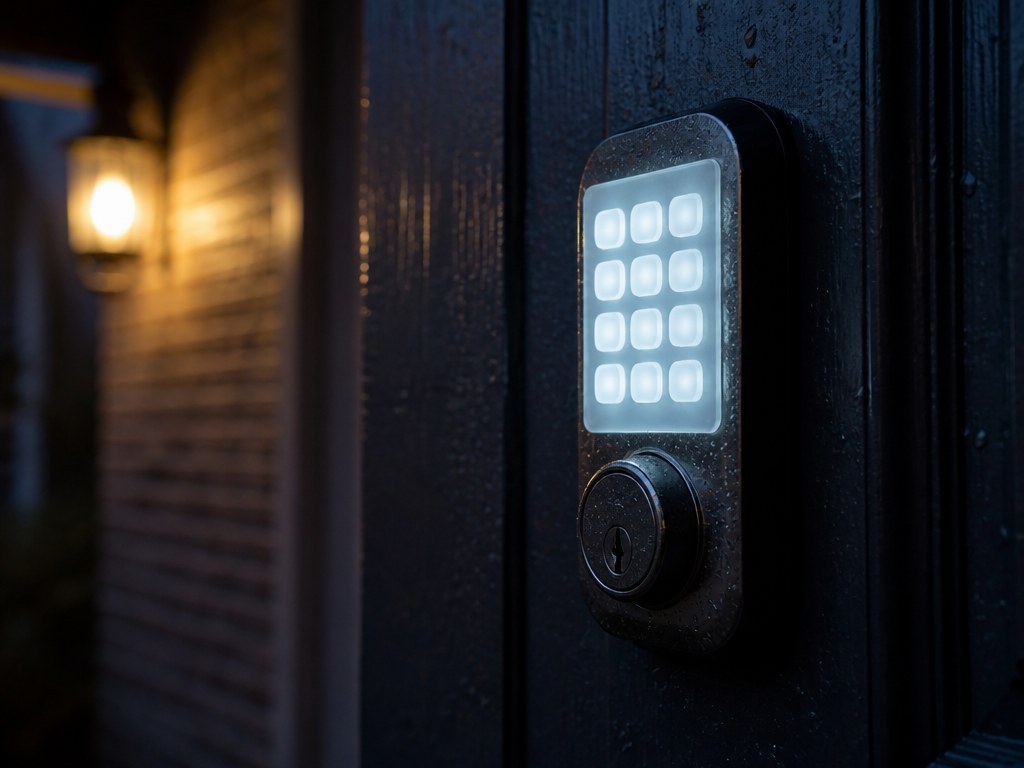
A smart lock keypad is one of the few silicone parts that is judged by the eye rather than by the thumb. The keys still actuate perfectly, the contacts still close, the IP rating still holds — and yet the product reads as degraded, because the backlit numerals have turned from crisp white to a muddy amber and one corner of the panel is visibly brighter than the rest. Optical ageing is the failure mode that mechanical testing never sees, and on an entry door it is the one the customer notices every single day.
Two different things are being asked of the same material
A backlit keypad has to do two jobs that pull against each other. Mechanically it is a spring, so it wants a compound with consistent elastic behaviour. Optically it is a light pipe, so it wants a material that transmits and diffuses LED light evenly, keeps that transmission stable for years, and does not drift in colour. Adding fillers and pigments to tune the mechanical side changes how light travels; tuning the optical side changes the cure behaviour and the mechanical response. The interesting engineering is in the middle, not at either end.
Why translucent silicone drifts under UV
UV ageing is not the same as mechanical failure
The most common confusion in an optical investigation is treating discolouration and degradation as one phenomenon. They are not. UV exposure can initiate photochemical reactions in the organic components of a silicone system — residual species, additives, pigments and surface treatments — well before the silicone network itself loses meaningful mechanical strength. Research on silicone degradation under ultraviolet irradiation has shown that different UV bands act on the material in different ways, with shorter-wavelength exposure able to drive bond rupture while longer-wavelength exposure has been observed to push the material in a different direction altogether, including a post-cure effect rather than simple breakdown. That is why a part can pass a mechanical check after ageing and still fail a visual requirement.
Formulation and optical stability
Optical behaviour belongs to the whole compound, not to the word “translucent”. Two compounds sold under the same description can age at completely different rates, because what actually absorbs UV and what actually generates colour centres are usually the minor constituents — the catalyst residue, the additive package, the pigment carrier. Silicone materials do not all yellow at the same rate, and a supplier who claims otherwise is describing a sample rather than a system.
There is also a migration effect that rarely gets discussed in keypad design. Low-molecular-weight siloxane species in a silicone compound are mobile, and they are known to migrate to the surface over time; work on the migration behaviour of silicone rubber has characterised this process in detail. On a translucent part, that surface layer is a change in the optical path. Even if the bulk material is unchanged, a migrating film can scatter light differently and shift apparent colour.
Pigments, additives and surface layers
Once a keypad has a coloured body layer, a translucent window layer, a diffusing film and a printed legend, the optical result is a stack. Each layer can age. A pigment that is perfectly stable in the bulk can still contribute to surface colour change if it migrates; a clear top coat can haze; a printed legend can yellow while the window behind it stays clean. Diagnosing the failure is therefore a layer-by-layer exercise, and it should be planned that way before tooling rather than after the first complaint.
How that shows up as uneven backlight
Reduced transmission
Transmission loss is the simplest symptom: the whole panel gets dimmer for the same LED drive current. On an entry lock where the illuminated keypad is what the user finds in the dark, a gradual drop in transmitted light reads as a product that has become unreliable. Because the change is gradual, it is usually reported as “the light is weak now” rather than as a failure.
Uneven brightness
Non-uniformity is more damaging to perceived quality than simple dimming. If two keys of the same nominal design have different material thickness, or different local ageing, or sit at different distances from the LED, they will not match. A keypad that was acceptably uniform when new can develop visible differences as one region ages faster than another — for example the keys closest to a heat source or exposed to sunlight for part of each day.
Halos, hot spots and dark areas
These are the symptoms users describe without knowing the cause. A hot spot is where light passes through with too little diffusion. A dark area is where it is over-absorbed or blocked. A halo is where edge geometry concentrates light. All three are the combined result of diffusion design, wall thickness and LED placement, and all three get worse as transmission drops.
Legend visibility
Illuminated characters depend on contrast between a diffusing window and an opaque mask layer. If the window yellows and the mask stays stable, the contrast shifts toward the yellow, and at low ambient light the numerals lose definition. This is the point at which an optical problem becomes a legibility problem, and legibility on an entry device is a usability and accessibility matter rather than a cosmetic one.
Design factors inside the keypad and LED interface
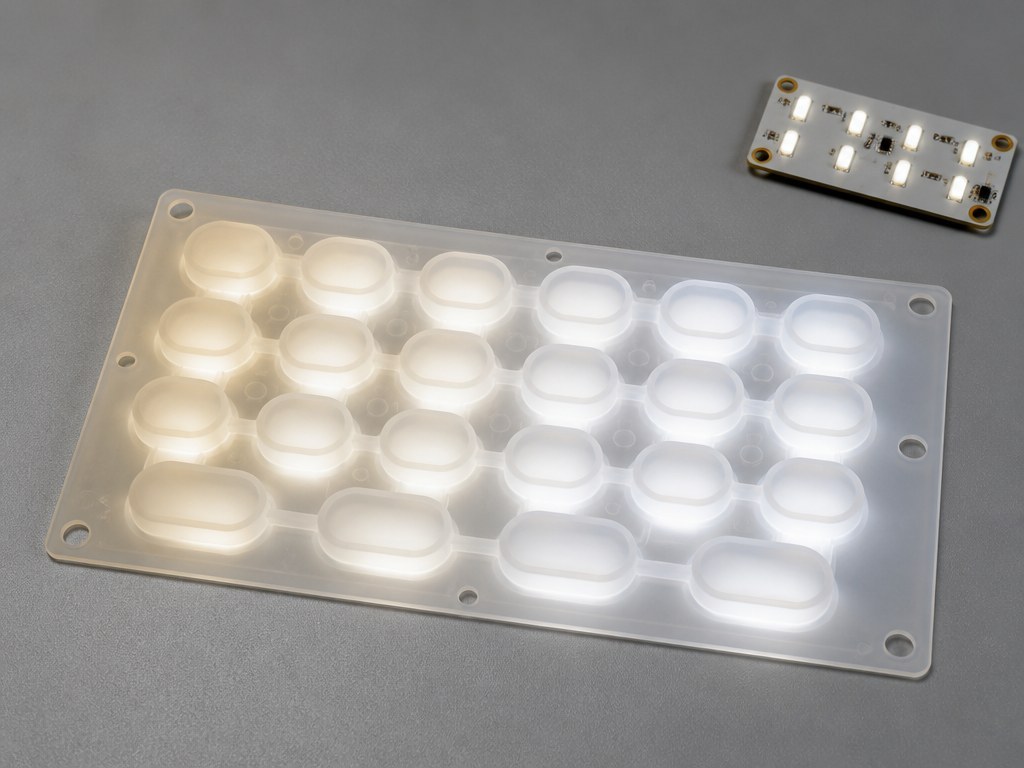
Thickness. Light transmission falls roughly exponentially with path length, so a small difference in wall thickness produces a visible difference in brightness. Thickness has to be controlled as a moulded feature across the whole panel, not only at the nominal point on the drawing.
Translucent versus transparent. A truly transparent silicone gives the highest transmission but also the worst uniformity, because it does not scatter. Practical keypads use translucent material specifically because the scattering is the feature. Choosing between them is a decision about uniformity, not about brightness.
Diffusing regions. Local surface texture, internal light-guide features and the distribution of the mask layer all shape the result. These are moulded features, so they have to be decided before the tool is cut.
LED position. Uneven backlighting is not automatically the silicone’s fault. LED spacing, distance from the panel, and the angle at which light enters the material often dominate the result. Keeping the investigation inside the keypad-to-LED interface — rather than replacing the silicone first — is usually the faster route to the real cause.
Testing UV ageing on a translucent keypad
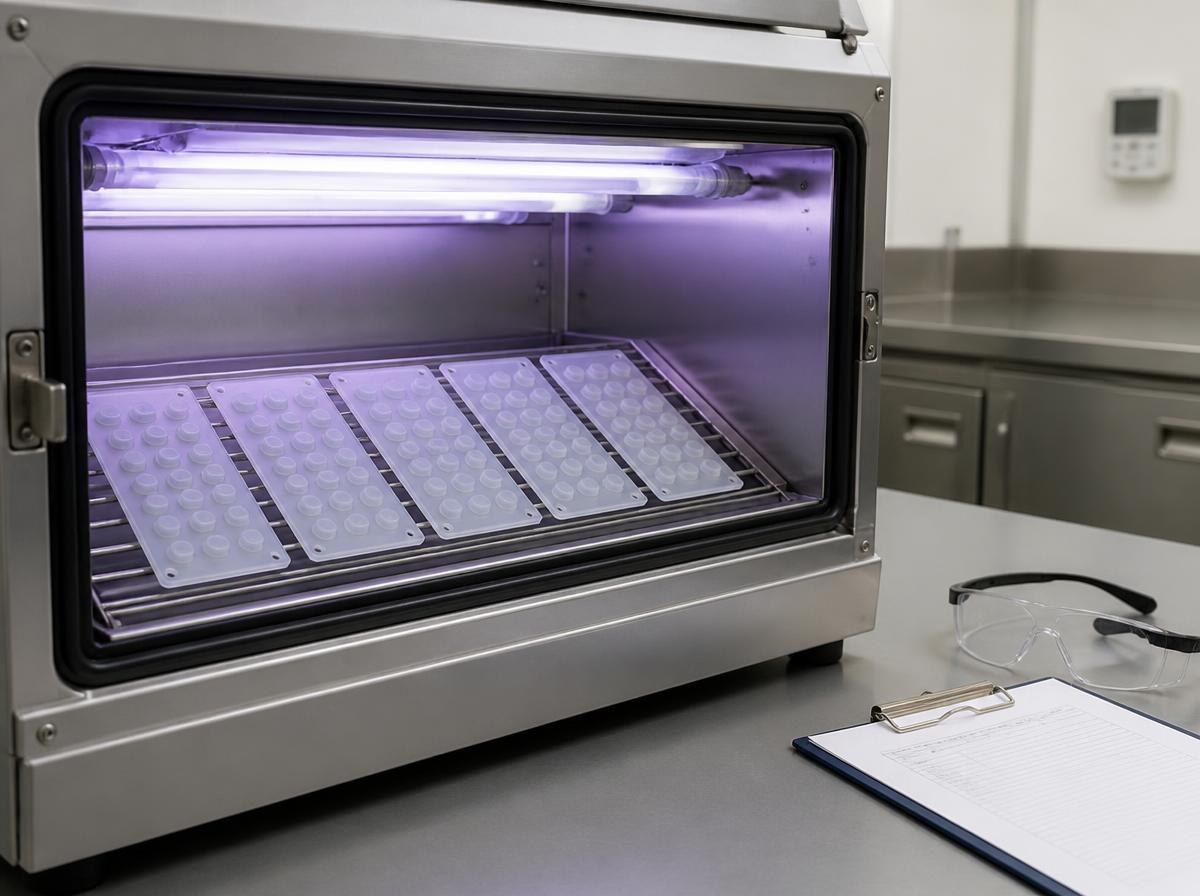
ISO 4892-3:2024 describes methods for exposing plastic specimens to fluorescent UV lamp radiation, heat and water in apparatus designed to simulate weathering, and it is the usual framework for this kind of accelerated optical ageing. What matters more than the chamber is the measurement schedule:
- Measure initial colour on a defined area of each sample and record the instrument settings.
- Measure initial light transmittance through the window region, at the same points you will re-measure later.
- Photograph the panel backlit, at fixed exposure, so that uniformity can be compared visually later.
- Run the UV exposure in defined increments rather than one long block.
- Inspect at each increment — do not rely on the final state alone, because the shape of the curve matters as much as the end point.
- Re-measure colour and transmittance at the same points.
- Re-photograph backlit under the same exposure and compare uniformity, not just average brightness.
- Note where the change is concentrated: uniform shift suggests the compound, localised shift suggests geometry, heat or LED-driven effects.
A useful discipline is to keep an unexposed reference panel from the same moulding batch in a dark drawer for the duration. Every measurement is then a comparison rather than an absolute value, which removes most of the instrument and operator noise.
What to compare when selecting a translucent compound
| Property | Question to answer before tooling |
|---|---|
| Transparency / translucency level | How much scattering do you need for uniformity at your LED spacing? |
| Light transmittance | What is the minimum acceptable transmitted level after ageing, and at what thickness? |
| Colour stability | What total colour shift is acceptable over the exposure the product will actually see? |
| UV resistance | Which UV band does the end product actually encounter — direct sun, window-filtered, or mostly indoor? |
| Hardness and rebound | Does the optical grade still meet the force and return requirements of the key design? |
| Surface finish | Does the finish you need for diffusion cause a moulding or demoulding problem? |
| Thickness consistency | Can the mould hold thickness tolerance across the whole light window? |
| Legend compatibility | Do the mask and legend materials age at the same rate as the window? |
Troubleshooting by symptom
- The whole panel has become darker. Investigate material transmission and ageing first, then LED drive and ageing of the LED itself. A uniform shift points at the light path rather than the geometry.
- One key is brighter than another. Measure thickness across the panel, then check LED alignment and local geometry. A single brighter key is almost never a compound problem.
- Yellowing appears mostly around the illuminated areas. Look at localised heat and light exposure rather than bulk ageing. Concentration near the light source is a strong hint.
- The legends are hard to read but the panel is not obviously yellow. Check the contrast between window and mask layers. The mask may have moved while the window stayed stable.
- The panel looked fine when new and failed within one summer. Check whether the acceptance criteria included an exposure the product actually sees. A short qualification against a mild condition will pass almost anything.
Working on this at FromRubber
Optical requirements are easiest to satisfy when they arrive together with the mechanical ones. On backlit keypad and light-window projects at FromRubber the useful habit has been to define the transmittance floor and the acceptable colour shift before the tool is cut, then mould a test panel early enough that the diffusing features and the wall thickness can still be changed without re-cutting the whole tool.
FromRubber moulds custom silicone rubber parts — keypads, seals, gaskets and technical mouldings. We do not manufacture the smart locks, meters or control panels our parts are fitted to. What we can do is mould translucent and backlit silicone to a stated optical requirement and measure the finished panel rather than a flat sample.
What to take away
On a translucent silicone keypad, optical performance is a design property with the same status as actuation force. It depends on the compound, the thickness distribution, the diffusing geometry, the legend stack and the LED interface at the same time, and it degrades on its own schedule — often long before anything mechanical changes. Specify the transmittance floor and the permitted colour shift before tooling, test in increments with an unexposed reference, and treat a visible brightness difference between two keys as a geometry question before reaching for a different compound.
References
- ISO 4892-3:2024, Plastics — Methods of exposure to laboratory light sources — Part 3: Fluorescent UV lamps — https://www.iso.org/standard/83802.html
- New Aspects of Degradation in Silicone Rubber under UV, PubMed record — https://pubmed.ncbi.nlm.nih.gov/34279359/
- Characteristics of Small-Molecule Migration of Silicone Rubber, Polymers 2022, 14(13):2519 — https://pmc.ncbi.nlm.nih.gov/articles/PMC9268812/
Related reading on this site: dome height tolerance and inconsistent button response, sealing challenges for dust and moisture protection, and the custom silicone rubber keypad range. If you need a backlit or translucent silicone part built to an optical requirement, send the light-path drawing to nani@fromrubber.com or karl@fromrubber.com, or reach us on WeChat / WhatsApp at +86 18676210913. FromRubber — custom silicone rubber parts, Dongguan, China.