Rubber Grommet for Thin Sheet Metal: Common Fit Problems and Solutions
- Share
- publisher
- Suey
- Issue Time
- Sep 21,2026
Summary
Fit problems with rubber grommets in thin sheet metal: limited groove engagement, hole deformation, sharp stamped edges and retention loss. Includes a troubleshooting table, groove geometry guidance, hardness trade-offs and a panel checklist.
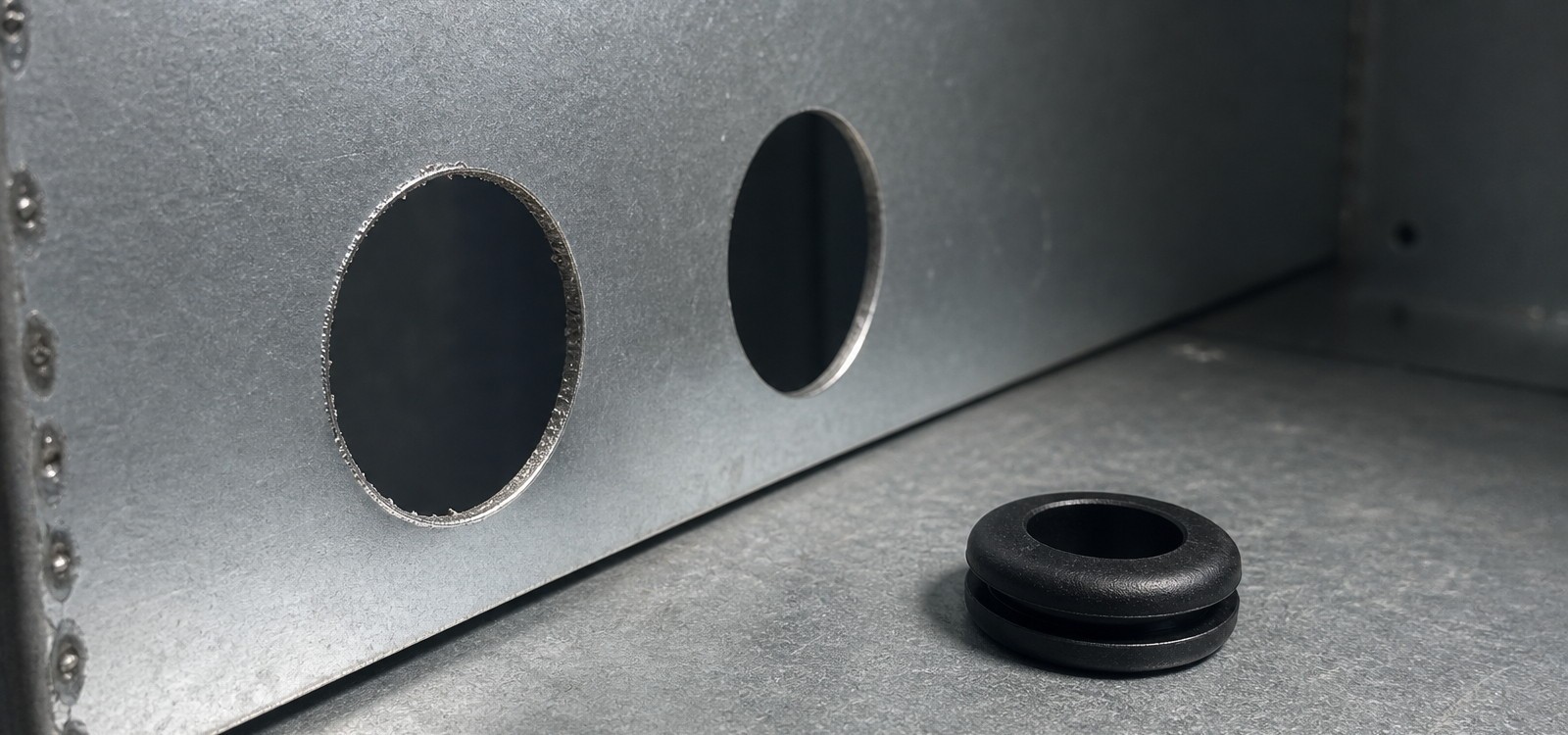
Thin sheet metal takes away the one thing a Rubber Grommet relies on most: material to grip. On 3 mm plate the groove has real depth to work with. On 0.8 mm sheet it has almost nothing, and every small variation in the hole, the panel and the way the part was fitted suddenly matters. The parts that fail here are rarely badly made. They were specified as though the sheet were thicker than it is.
Why Thin Sheet Metal Creates Special Rubber Grommet Fit Problems
The problem is not that thin sheet is weak. It is that thin sheet removes the depth dimension from the retention system and leaves the part depending on preload and bearing area alone.
- Small panel thickness — the groove engages a very short length of material, so there is little area carrying the load
- Limited groove engagement — a groove wide enough to accept the sheet may develop almost no deflection, and therefore almost no grip
- Greater dimensional sensitivity — because less material is in contact, hole variation is not averaged out and shows up directly as fit variation
- Hole deformation — thin sheet distorts around a pierced or punched opening, so the hole is not the clean circle the drawing shows
- Sharp stamped edges — a burr that would be buried in thick plate is fully exposed on thin sheet and sits directly against the groove wall
- Lower mechanical support — the panel itself can bow under installation force, which changes the effective thickness right when the part is being seated
Common Rubber Grommet Problems in Thin Sheet Metal
Problem 1: The grommet does not lock properly
The groove closes around the sheet but does not develop enough deflection to hold, because there is so little material to deflect against. The part looks correctly installed. Under vibration or a light sideways pull on the cable it rotates, then walks.
Possible causes: groove too wide for the sheet, insufficient flange engagement to provide bearing pressure, hole variation across the batch.
Problem 2: The grommet is difficult to install
Because the sheet is thin, it is tempting to compensate with a tighter hole and a narrower groove. The result is a part that will not seat without tooling, and the tooling damages the flange root before the part ever gets into service.
Possible causes: groove too narrow, hole undersized, excessive rubber interference at the flange, panel bowing under hand pressure.
Problem 3: The grommet pops out
On thin sheet there is very little flange bearing surface relative to the load, so the same cable side load that a thick panel would shrug off pushes the part straight out. This is the most common complaint we see on thin enclosure walls.
Possible causes: oversized hole, incorrect groove geometry for the actual thickness, cable side load, insufficient retention for the load case.
Problem 4: The rubber gets cut by the metal edge
A stamped opening on thin gauge material has a burr on one side and a rolled-over edge on the other. Both sit hard against the groove wall and both can initiate a cut, particularly when the grommet is installed with any twisting motion.
Possible causes: burrs and sharp edges, stamping defects, incorrect installation technique, material with limited tear resistance for the edge condition.
The edge is often the real problem
Whenever a thin-sheet grommet fails early, look at the hole edge before changing anything else. Debris-free, deburred edges remove a large share of these failures without touching the part specification.
On thin gauge a light deburr also removes the raised lip that stops the groove closing evenly, which quietly improves retention as well as service life.
How Groove Geometry Affects Thin Sheet Metal Grommet Fit
On thin sheet the groove has to be designed differently rather than simply scaled down, and a cross-section makes the reason clear.
- Groove width — set against the actual sheet thickness plus the deformation the panel takes during installation, not against nominal gauge
- Groove depth — becomes disproportionately important here, because it is the only feature resisting rotation when there is little thickness to grip
- Flange thickness — has to carry the reaction load without rolling over, so a slightly thicker flange usually outperforms a softer one
- Flange diameter — needs to be generous relative to the hole, because bearing area is doing more of the work than it would on thick plate
- Rubber deformation — with little sheet to press against, the rubber displaces outward instead of compressing, which is why flange support matters so much
In section, a thin-sheet grommet works like a shallow clamp rather than a deep one. The load path runs from the cable, into the groove, through a very short band of sheet, and out through the flange. Shortening one link means the others have to be stronger to compensate.
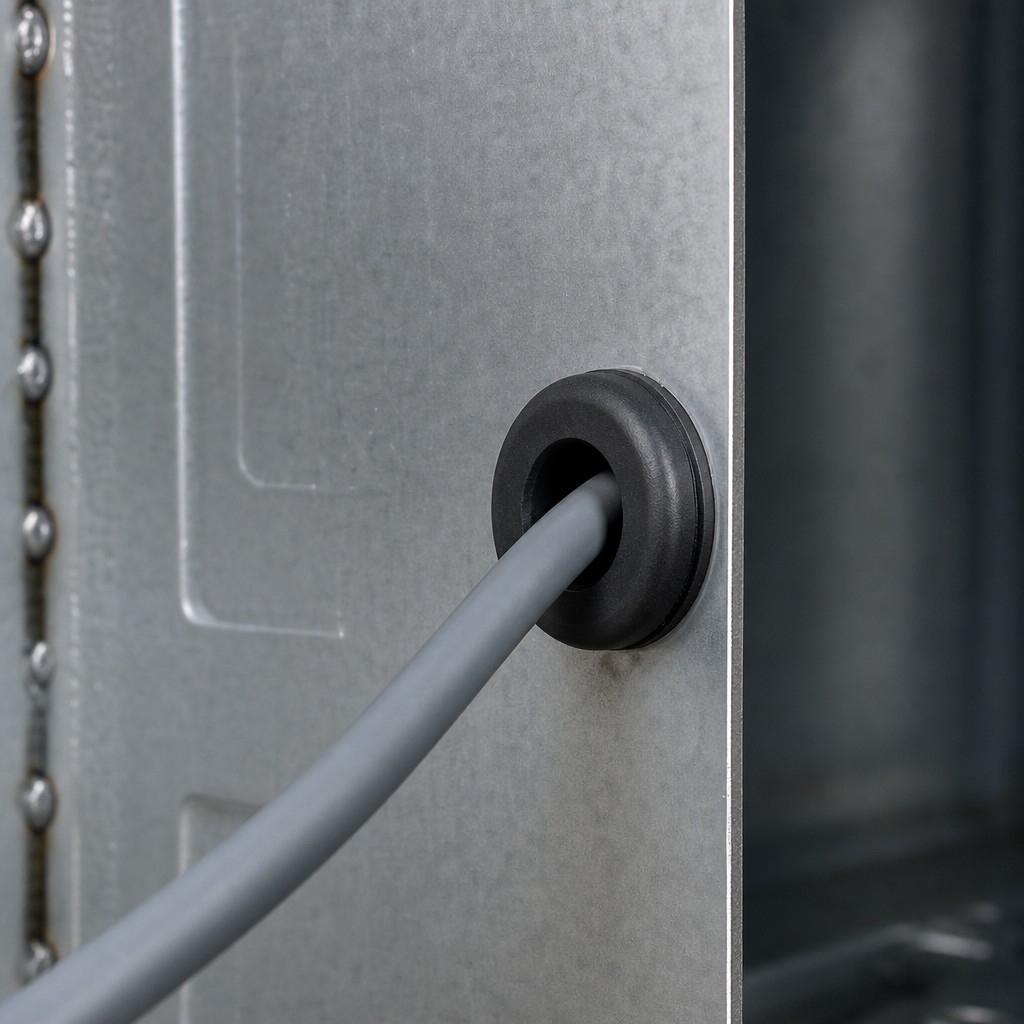
What a properly seated part looks like on thin sheet. The flange sits flat with no gap under the rim, the sheet does not bow around the opening, and the groove is closed over the cut edge with no bright metal visible between the flange and the panel. If you can see the edge of the hole between the flange and the sheet, the groove is not engaged.
How to Check the Panel Before Selecting a Rubber Grommet
- Measure the actual sheet thickness at the hole edge, on several parts, and note the range rather than the average
- Measure the hole diameter at four points and take the smallest value, so an oval opening shows up
- Inspect for burrs on both faces and confirm whether the panel is deburred in production
- Check hole roundness and whether the opening has been distorted by forming nearby
- Establish the production tolerance and how the punching tool wears over its life
- Confirm the finished cable diameter, including any sleeve or conduit
Should the Rubber Grommet Be Softer for Thin Sheet Metal?
The instinct is reasonable: softer rubber conforms to an uneven edge, installs with less force, and tolerates a slightly irregular hole. All of that is true. What is also true is that a softer compound deflects further under the same load and stores less elastic energy for retention, which is precisely the resource thin sheet is short of.
The trade-off shows up in four places:
- Installation force — softer compounds seat with less effort, which reduces the risk of tearing the flange root during fitting
- Deformation — softer compounds deform more for the same interference, so retention depends more on flange support
- Retention — firmer compounds generate more grip from the same groove deflection and hold up better under vibration
- Edge sealing — softer compounds conform better to a rough stamped edge, where firmer compounds can bridge over it and leave a gap
For thin sheet the usual direction is to keep the compound at a moderate hardness and invest the improvement in geometry — a deeper groove, a stronger flange and a properly deburred edge — rather than reaching for the softest available material. Where installation access is genuinely poor, a softer compound can still be the right answer, but it should be a deliberate choice tied to the assembly method rather than a default.
Thin Sheet Metal Rubber Grommet Design Considerations
- Flange geometry — sized for bearing area against a panel that will not support much force
- Groove geometry — depth prioritised over a marginal increase in width matching
- Inner diameter — set so the cable is held without stretching the bore, since bore stretch also pulls the groove
- Material selection — chosen for temperature, fluid exposure and required service life before hardness is fixed
- Hardness — treated as a design variable tied to installation method, not as a quality indicator
- Tear resistance — relevant wherever the part will be fitted over a stamped edge
- Temperature requirements — a part that softens in service loses retention, which matters more here than on thick plate
Troubleshooting Table for Thin Sheet Metal
| Problem | Likely Cause | Dimension to Check |
|---|---|---|
| Grommet falls out under vibration | Poor retention from low groove deflection | Groove width against actual sheet thickness, and hole diameter range |
| Difficult installation, flange damage | Excessive interference at the hole | Hole diameter and groove diameter, plus panel bowing during fitting |
| Edge cuts the rubber | Burrs or a sharp stamped edge | Panel edge condition on both faces of the sheet |
| Grommet deforms or rolls out of shape | Material and design mismatch | Durometer and flange thickness against the load case |
| Cable rubs on the opening | Incorrect inner diameter | Bore against the finished cable outer diameter |
| Flange lifts on one side only | Out-of-round hole or uneven sheet thickness | Hole roundness and thickness at four points around the opening |
When a Standard Grommet Is Not Suitable
Standard parts are built around common hole and thickness combinations. Thin sheet pushes against that assumption, and there are cases where no standard groove will do the job.
- Extremely thin panels, where any standard groove width leaves the part without deflection
- Unusual hole dimensions that fall between standard steps
- Tight cable routing that needs a reduced overall height or an asymmetric flange
- High vibration, where retention has to come from geometry rather than preload alone
- Frequent assembly and disassembly, where the part has to survive repeated fitting without losing grip
When the opening is not circular either
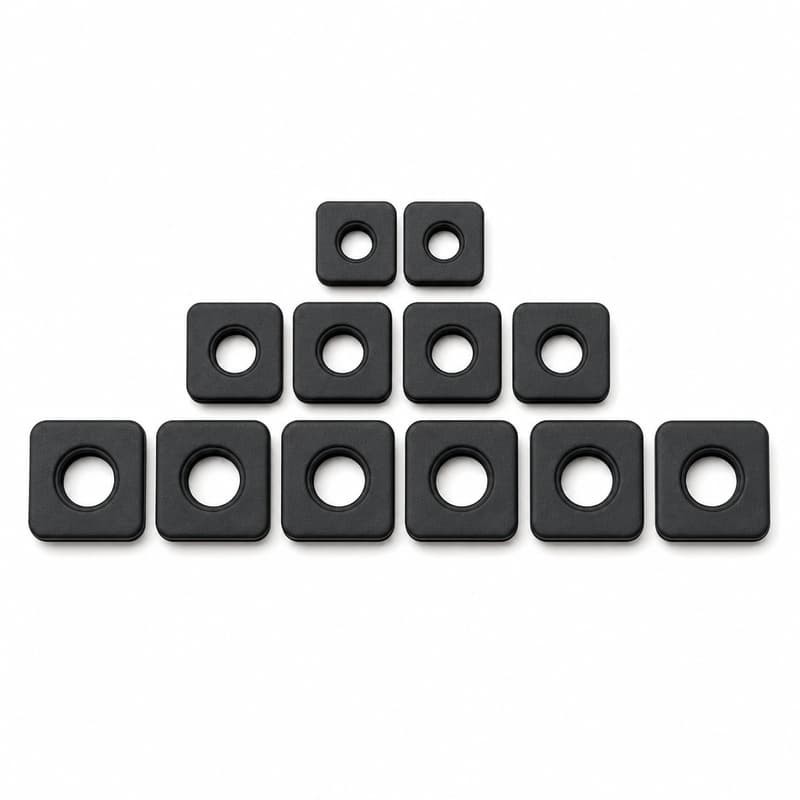
Thin sheet is frequently used for square and rectangular openings, because a pressed or laser-cut aperture is easy to produce and the panel is not stiff enough to need a round hole. A square or rectangular profile grommet with a flange that follows the aperture gives a longer grip line and better bearing than a round part fitted into the corner of a square hole.
Where the opening is a rounded rectangle, the corner radius becomes part of the specification, since it sets how evenly the groove can close.
What to Send to a Manufacturer for Thin Sheet Metal Grommet Development
- Panel thickness with the production range
- Hole diameter with tolerance and the method used to produce it
- Sheet material and finish, since both affect how the edge behaves and how the panel deforms
- Cable outer diameter, including sleeves and conduits
- A drawing or dimensioned sketch, or a sample panel if no drawing exists
- Application environment, including temperature range and fluid exposure
- Installation method and access, so the flange and profile suit the assembly sequence
- Required quantity, with annual volume if known
Frequently Asked Questions
What Rubber Grommet works with thin sheet metal?
One with a groove designed for the actual measured thickness and a flange large enough to give real bearing area. There is no universal part number for thin sheet, because 0.5 mm, 0.8 mm and 1.2 mm gauge each need a different groove. The useful approach is to size the groove against the measured range and then confirm it on the actual panel.
Why does a grommet fall out of thin metal?
Because there is very little sheet for the groove to engage, so retention depends almost entirely on groove preload and flange bearing. Any hole oversize, any cable side load, and any vibration that reduces friction at the interface will start the part moving. Thin sheet removes the margin that thick plate would provide.
How does sheet thickness affect grommet retention?
A thicker sheet gives the groove more material to close around, which increases contact area and makes retention less sensitive to hole variation. A thinner sheet reduces both, so the same groove geometry holds better on the thicker panel. This is why one grommet cannot be expected to perform identically across a range of gauges.
Can rubber grommets be made for very thin panels?
Yes, but the design changes rather than the gauge. A deeper groove, a stronger flange and a material with good tear resistance are the usual combination. Where the sheet is exceptionally thin, an extended or backed flange can also be used to spread the bearing load over a larger area of panel.
Should I change the hole or the grommet?
If the hole can still be corrected at the stamping stage, correcting the hole is usually cheaper and gives a better result. If the tooling is already committed, or the opening is not a simple round hole, changing the grommet is the practical route. In both cases check the edge condition first, because a deburring step often removes the failure without either change.
Sources
- ISO 2768-1:1989, General tolerances — Part 1: Tolerances for linear and angular dimensions without individual tolerance indications. https://www.iso.org/standard/7748.html
- ISO 3302-1:2014, Rubber — Tolerances for products — Part 1: Dimensional tolerances. https://www.iso.org/standard/62492.html
- NEMA Enclosure Types, National Electrical Manufacturers Association, publication 250 summary. https://www.nema.org/docs/default-source/products-document-library/nema-enclosure-types.pdf
- IEC 62444:2010, Cable glands for electrical installations. https://webstore.iec.ch/en/publication/7034
About this guide
FromRubber is the export brand of Dongguan Bohao Electronic Technology Co., Ltd., a manufacturer of custom moulded silicone and rubber components. Thin-gauge enclosure work is a recurring part of our custom grommet projects, and it is usually resolved by combining a groove designed against measured thickness with material and durometer selection that matches the installation method — followed by prototype parts that can be fitted to the real panel before tooling is committed.