Rush Order Finally Delivered, But White Marks Appear on the Instrument Silicone Keypads – Supplier Says It's "Normal." Do You Buy That?
- Share
- publisher
- FromRubber
- Issue Time
- Sep 9,2026
Summary
White marks on dark silicone keypads are three different defects with three different fixes: blooming from migrating additives, stress whitening from over-stretching, or finish damage. Ten minutes of classification settles whether 'normal' is true.
The rush order finally shipped, and when your customer unboxes the industrial instrument, the dark silicone keypads show white marks. The supplier calls it "normal." Sometimes it is; often it is not. The word "normal" covers at least three completely different defects with three completely different causes and three completely different fixes — and telling them apart takes about ten minutes, not a debate.
"White marks" is not one defect
When we receive keypads with white marks, the first step is classification, because the remedy depends entirely on which of these it is:
- Blooming — migrated additives. White, gray or oily residue on the surface caused by compounding ingredients migrating out of the rubber: excess mold release, uncured byproducts, or low-molecular-weight fractions. It appears on dark keys because the white powder contrasts against black. It can often be wiped off, may return, and its composition can be confirmed with infrared analysis.
- Stress whitening — stretched rubber. Localized whitening where the silicone was over-stretched during demolding or assembly — for example, a key skirt pulled past its limit while being popped out of the cavity or forced through a tight bezel. This is micro-tearing or surface crazing in the material itself. Wiping does nothing; it is permanent.
- Coating or finish damage. Many keypads carry a matte or textured finish. Scraping, solvent attack or rubbing against packaging can abrade or cloud the finish locally, leaving white or hazy patches that look like a material defect but are actually surface treatment damage.
Supplier saying "normal" about all three at once is not a diagnosis — it is a way of ending a conversation that should have started with a wipe test and a magnifier.
Ten minutes to classify a white mark
Three quick checks separate the causes without sending parts to a lab:
- Wipe test. A dry cloth over the mark. Blooming smears, wipes away or transfers; stress whitening stays put; coating damage may polish into a glossier patch.
- Magnified look. At 20-40x, blooming looks like a powdery or waxy film following the surface; stress whitening looks like a dense cluster of fine cracks, usually along a stretched zone or a sharp edge; coating damage looks like scratches or an uneven sheen.
- Location logic. Marks on the skirt underside or around a demolding edge point to stretch; marks spread evenly across the whole face point to migration; marks in contact areas with packaging or fixtures point to abrasion.
Why blooming happens, and why it shows up on dark keypads
Blooming is a solubility problem with a temperature story. Every compounding ingredient — peroxide curing byproducts, mold release, plasticizers or softeners, and other additives — has a finite solubility in the rubber network. That solubility rises with temperature. At the hot molding temperature, the ingredients dissolve fully; as the part cools, the network can no longer hold the excess, and the surplus migrates to the surface and crystallizes or films out over days or weeks. This is why the "normal" white marks often appear not at the factory gate but in the warehouse or at the customer's site weeks later. Incomplete vulcanization and a missing or too-short post-cure make it worse, because the unreacted low-molecular-weight material is exactly what has nowhere to go but out. Third-party failure analysis of silicone seals commonly lists the same root causes: poorly compatible additives, peroxide decomposition byproducts, uneven mixing, incomplete cure and missing post-cure.
Dark keypads expose the problem the way a black car shows dust: the same thin film that is invisible on a light-gray pad reads as a bright white haze on deep black silicone. So the same batch of keypads can look "fine" in one color and "defective" in another. If your supplier only ever sees white marks on black parts and calls it normal, ask how many light-colored parts with the same residue they rejected — the answer is usually zero, because nobody looked.
What "post-cure" has to do with it: post-curing (a second bake after demolding) drives volatile byproducts out of the part and completes the crosslinking network. A keypad that is fully cured and post-cured has far less mobile material available to bloom. When white marks appear on a batch that skipped or shortened post-cure, the fix is process, not customer tolerance.
Stress whitening is a different conversation
Stress whitening has nothing to do with chemistry and everything to do with how far the rubber was stretched. Silicone is highly extensible, but stretching it past a point produces localized damage — a whitening that is the rubber's own structure tearing on a micro scale. On keypads it appears around demolding edges, on the underside of key skirts, or where the pad was forced through a housing opening during assembly. The fix is not a different compound; it is demolding technique, cavity design with proper draft, or an assembly method that does not pull the rubber. If a supplier responds to stress whitening with "normal," push on whether the part was designed and handled for demolding, because this one is preventable at the tool and process level.
Finish damage: the third and most avoidable one
Matte-finish keypads are vulnerable in a way glossy ones are not: the matte texture is a micro-roughness that scatters light, and any small area that gets smoothed — by abrasion, solvent, adhesive residue or repeated rubbing in packaging — stops scattering and looks different. A white or hazy patch on a matte key is often just a damaged finish. The fix is handling and packaging discipline: soft separators between pads, no solvent contact, no tight shrink-wrap pressure against the face. This defect also proves the value of specifying the finish and testing it with the actual cleaners and packaging the product will meet.
One case: white patches on a rushed UAV ground-station batch
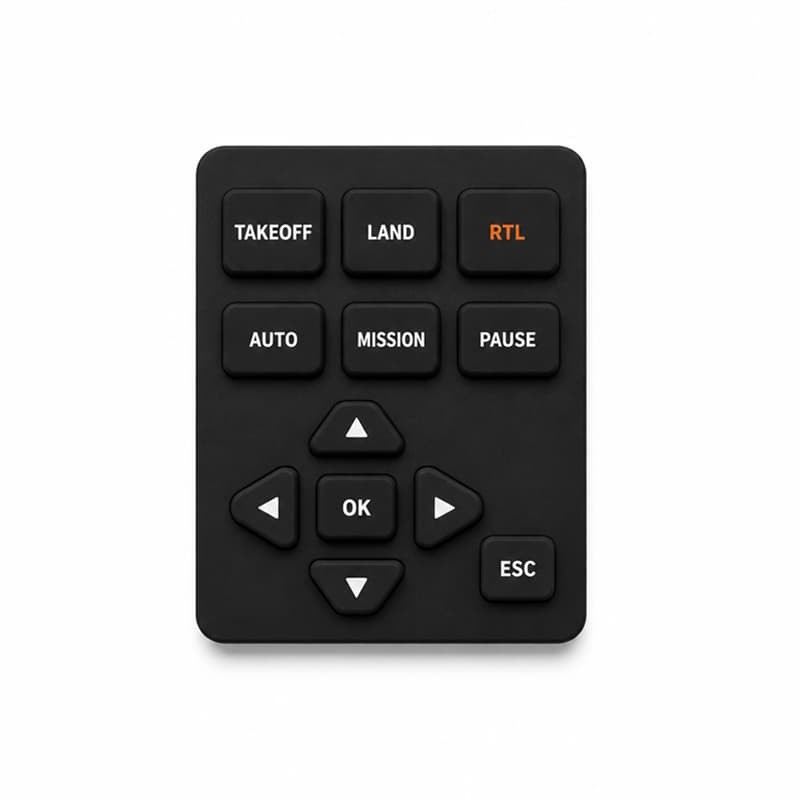
A rush order of dark UAV ground-station keypads reached the customer with white patches on the faces. The supplier's first response was "normal for black silicone." The customer brought the pads to us for a second opinion. The wipe test was decisive: the marks smeared and came off on the cloth, and under magnification the surface showed a powdery film, not cracks — blooming. We had the film analyzed at a third-party laboratory; the infrared spectrum pointed to mold release residue plus uncured low-molecular-weight material, the signature of a rush job that skipped the full post-cure cycle to make the shipment date. The rework was straightforward: a proper post-cure bake on the affected batch, and a change to a cleaner release agent and a documented post-cure step for all dark keypads. The replacement batch arrived with no marks. "Normal" had been a schedule problem in disguise.
What to put in your next specification
White marks are preventable at the specification stage. Add three lines to your keypad agreement: surface appearance acceptance under magnified inspection for dark colors; a mandatory post-cure step with time and temperature documented; and a storage and packaging rule that keeps pads separated and free of solvent contact. Then decide in writing which of the three defects is unacceptable — in practice, all three should be, because each has a known cause and a known fix.
The 60-second supplier screen
Before you accept "normal" from any keypad supplier, ask: has the part been post-cured, and what were the time and temperature? Is the mold release agent water-based or solvent-based, and is it documented? Can they show you a magnified image of the mark in question? Suppliers who can answer all three are rare, and they are exactly the ones who do not need the word "normal" to explain a defect.
Related reading
In short
White marks on silicone keypads are three different defects wearing the same name. Blooming is chemistry and process — wipe it, analyze it, fix cure and release. Stress whitening is mechanical — look at demolding and assembly. Finish damage is handling — look at packaging and solvents. Ten minutes of classification tells you which one you have, and the answer decides whether "normal" is an explanation or an excuse.
This article was written by the molding engineering team at FromRubber, a custom silicone keypad manufacturer in Dongguan, China. We classify surface defects on molded keypads and rework the process — cure, release, demolding — rather than relabeling them as normal.
Sources
- Rubber seal surface blooming: peroxide curing byproducts and lubricant migration as white or gray residue. https://m.huangye88.com/wujin/8135c6cage77aa.html
- Third-party FTIR analysis of silicone seal blooming: additive compatibility, peroxide byproducts, incomplete cure, missing post-cure. https://m.11467.com/product/d55197423.htm
- Blooming definition and mechanism (migration of compounding ingredients to the surface). https://m.baike.com/wiki/%E5%96%B7%E9%9C%9C/1661785
- White frost on dark molded parts and the contrast effect of colorless residue on dark surfaces. https://www.linngd.com/10252.html
- Incomplete cure and missing post-cure causing white spots and later yellowing in silicone products. http://m.toutiao.com/group/7677436050323325449/
- Curing agent selection and blooming-related scrap in silicone production (reported factory losses above 15%). https://m.sohu.com/a/1070742349_122988778/