Serving Salad Like a Pro: The Gentle Touch of Silicone Food Tongs for Leafy Greens
- Share
- publisher
- Suey
- Issue Time
- Apr 14,2026
Summary
Leafy greens bruise at contact pressures a metal tong reaches instantly, which is why silicone food tongs belong on a salad station. This note covers bruising mechanics, dressing grip, hygiene at the hinge and the workflow details that decide whether a service station runs faster or slower with a soft tool.

Food-service note
A bruised leaf is a cell rupture, and it happens at a pressure threshold a metal tong crosses the moment it closes on a stem. Silicone food tongs avoid that because the pad conforms and spreads load, but the tool only earns its place on a station if it also grips a wet leaf and cleans between services. Bruising, grip and hygiene are one design problem.
- Conforming pads distribute load; the leaf stops bruising at the stem, which is where metal tongs concentrate force.
- Wet leaves are slippery: a lightly textured pad holds a dressed leaf better than a smooth one.
- A hinge is a hygiene feature, not just a mechanism; any gap that holds dressing becomes a cleaning problem.
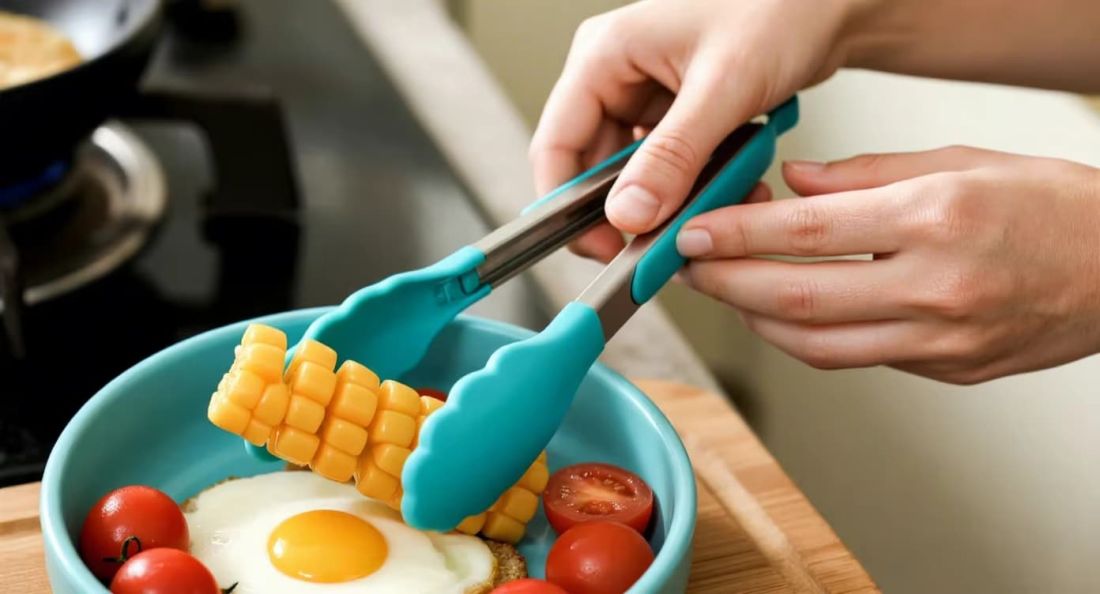
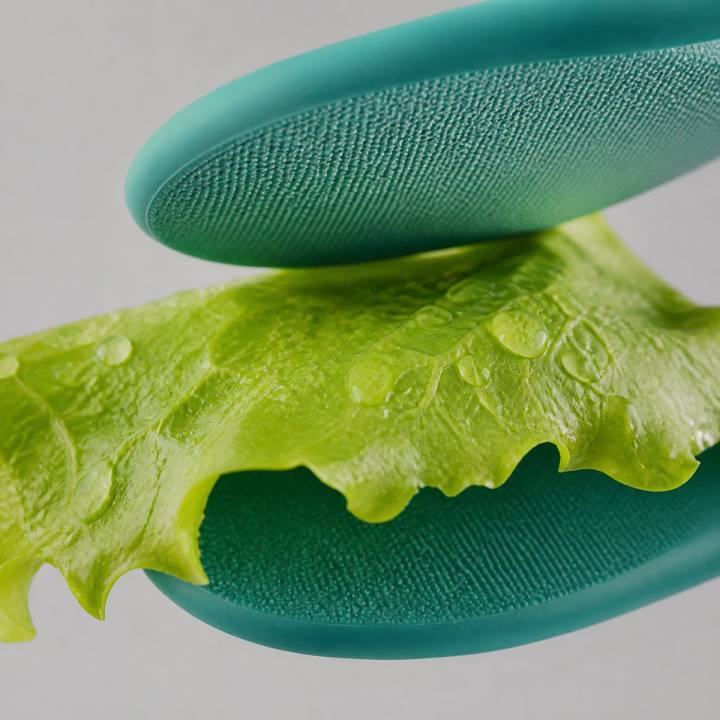
Why silicone food tongs protect a leaf better than metal
Leaf tissue is mostly water in thin-walled cells. Above a local pressure of a few kilopascals the walls rupture and the leaf darkens within hours, which is why a salad bar looks tired by mid-afternoon. Metal tongs reach that pressure on a narrow edge; soft pads spread the same hand force over ten times the area and stay below the threshold.
The geometry that matters is the pad's radius, not its colour. A jaw with a 6 to 10 millimetre radius and a shallow concave face cradles a leaf without a pinch point. Serrated or toothed tips, common on grilling tongs, concentrate force on a few square millimetres and will bruise even in silicone.
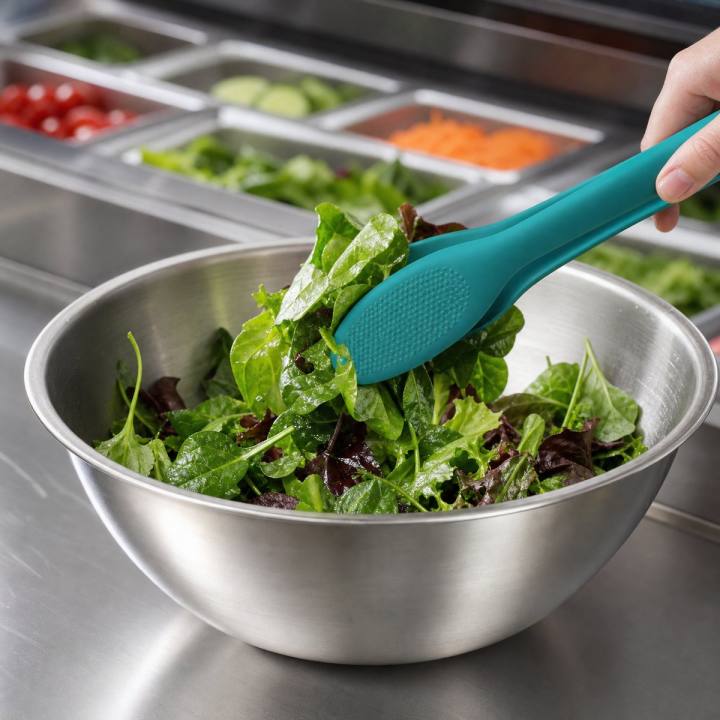
Grip on a wet, dressed leaf
Dressing lowers the friction between leaf and pad, and a smooth silicone pad on a wet leaf is close to a lubricated contact. A fine moulded texture, on the order of 0.2 to 0.4 millimetres deep, breaks the film and gives the pad something to hold without damaging tissue. Too coarse a texture does the opposite: it acts like a grater on a soft leaf.
The second grip factor is the closing force. A dressing-heavy leaf needs a little more force than a dry one, and a light spring lets the server add it with two fingers rather than fighting the tool. Specify a closing force range and test it with a wet leaf, because a tong that works on a dry sample can drop a Caesar salad on the floor.
- Pad texture — fine, 0.2 to 0.4 mm, on the contact face only.
- Closing force — light enough to modulate, measured at the tip.
- Jaw radius — 6 to 10 mm, with no serrations on the food side.
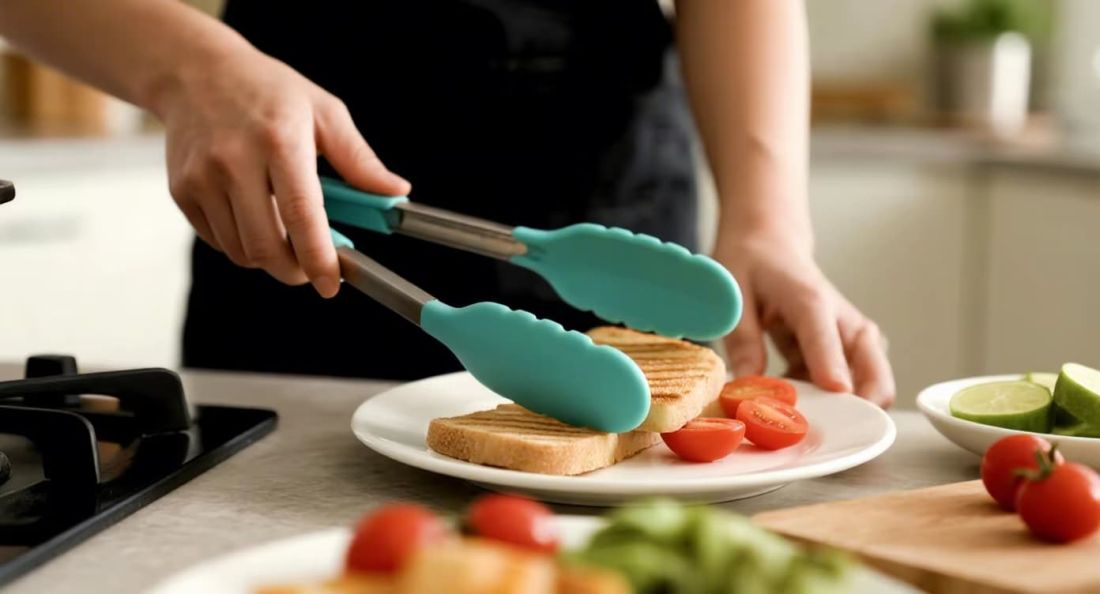
Design values for a salad-station tong
| Parameter | Target | Why |
|---|---|---|
| Pad hardness | 40 to 50 Shore A | Conforms to a stem without collapsing |
| Contact width | 18 to 25 mm | Keeps pressure below the bruising threshold |
| Tip profile | Shallow concave | Locates the leaf; avoids a pinch point |
| Closing force | 2 to 4 N at the tip | Moderate with two fingers, holds a dressed leaf |
| Heat resistance | 120 °C continuous | Hot pasta and warm garnishes |
| Cleaning | One-piece, no closed crevice | Commercial dishwasher, several times a day |
Hygiene and workflow at the station
A salad station is a wet environment, and every gap in a tool becomes a reservoir. A moulded living hinge with an open geometry drains and dries; a coil spring tucked into a sleeve does not. If a spring is necessary, specify a removable one and a sleeve that can be cleaned, or the tong will be replaced for appearance reasons long before it fails mechanically.
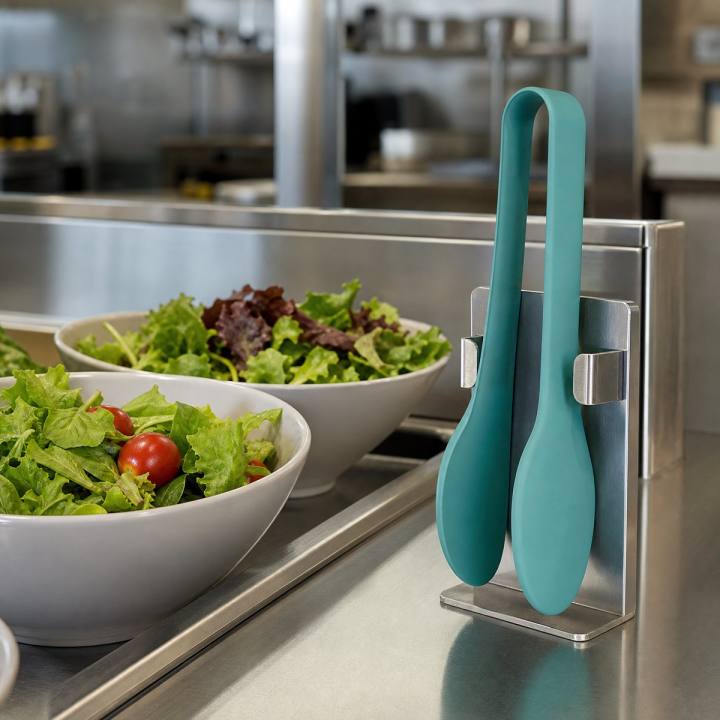
Workflow decides the rest. A tong that rests on the counter contaminates the counter and the tool; a tong with a heel that keeps the pads off the surface, or a station clip, solves it in one moulding detail. Handle length matters too: a short handle forces the server's hand over the bowl, which is slower and less hygienic than a longer one that keeps the wrist above the rim.
How a custom food-service tool programme is quoted and run
Food-service buyers usually want a colour that matches a brand and a tool that survives a commercial dishwasher.
Inputs
Dishes served, leaf types, dressing style, washing method and the brand colour reference.
Geometry
Pad width, radius and texture, closing force and handle length, agreed on a drawing with a sample.
Validation
Hardness, colour and dishwasher cycle testing on production parts, plus a trial in a live station.
Volume and packing
Cavity count, colour coding by station, and packaging that keeps pads from deforming in transit.
What a salad bar should measure before buying tongs
Two numbers settle the purchase faster than a sample. The first is the weight of the heaviest portion served: a tong rated for a 200 gram garnish behaves differently when a server lifts 400 grams of dressed leaves, and the jaw opens under load. The second is the wash cycle count per shift, because a tool washed six times a day ages on a different curve than one washed once.
Then watch the station for ten minutes. If servers use one hand, the tool needs a heel that lets them set it down without touching the bowl rim; if they use two, handle length decides whether their wrist stays above the rim. A design that ignores either detail gets replaced by a cheaper tool that happens to be easier to use, which is a purchasing decision made by staff rather than by the buyer.
Questions from restaurant groups and brands
Do silicone tongs really bruise less than metal?
Yes, because they spread load over a conforming pad instead of a hard edge. They still bruise if the pad is narrow or serrated, so geometry decides the result as much as material.
Will they hold a dressed salad?
With a fine texture and a moderate closing force, yes. Test with the actual dressing, because a vinaigrette lubricates more than a thick dressing.
Are they dishwasher safe?
Food-grade silicone tolerates commercial dishwashing. The risk is trapped water in a hinge or sleeve, which is why one-piece designs are preferred for service use.
Can we colour-match a brand?
To a physical master and a measured tolerance. Colour coding by station is also useful: it stops tongs migrating between salad and dessert service.
Send the menu and the washing routine
FromRubber moulds food-service silicone tongs, servers and kitchen tools in Dongguan, with pad geometry and texture tuned to what the station actually serves. Send the dishes, the dressing style and the dishwasher cycle; we will propose a pad design and a compound, then mould samples for a live trial.
Request a food-service tool reviewRelated reading: handling delicate bakes with silicone tongs and food-contact silicone storage bags.