Silicone Dog Lick Mat Suction Cups: Why They Let Go
- Share
- Issue Time
- Oct 23,2026
Summary
A suction cup is a seal, not a fastener. This article explains why the same silicone dog lick mat can hold on one counter and let go on another, and how to build a surface list and a repeatable test before the mold is cut.
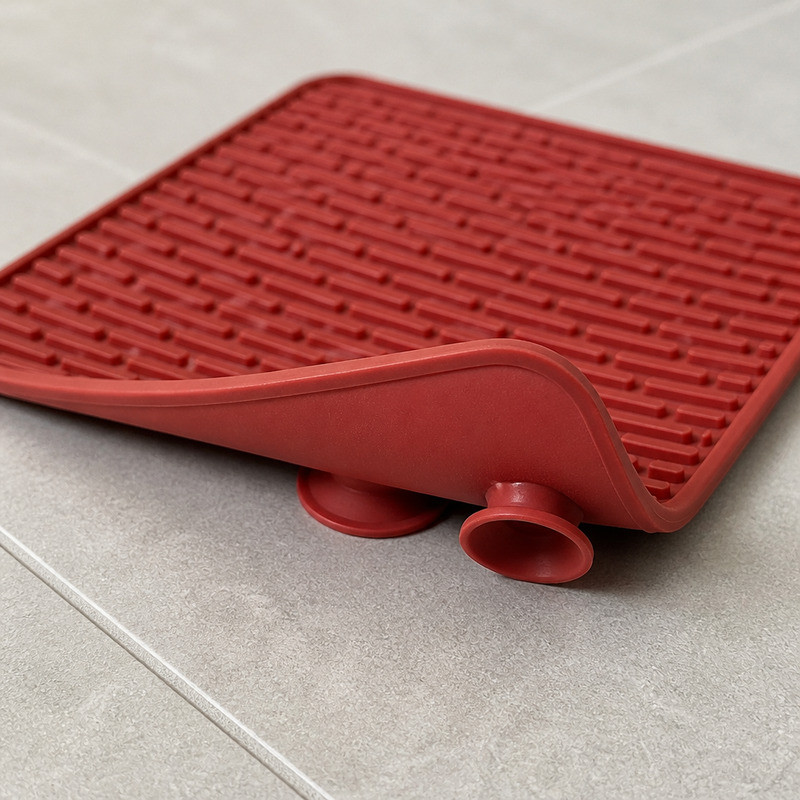
The mat that held in the photo and let go on the counter
A buyer takes a suction mat home from a trade show, presses it onto the kitchen counter, and it holds. The same mat, same buyer, same motion, slides off the tile floor in the utility room ten minutes later. Nothing changed except the surface — and that is the whole problem with judging silicone dog lick mat suction cups from a single successful demonstration.
A suction cup is not a fastener. It is a seal that has to survive the loads a pet applies to it: a tongue pushing sideways, a paw pressing down, an owner peeling one corner up to rinse the mat. The seal exists only while the pressure inside the cup stays below the pressure outside it. Anything that lets air back in ends the grip, no matter how much silicone surrounds the cup.
That framing changes what a brand should specify. Instead of asking for "strong suction", the useful brief names the surfaces the product will meet, the loads it will see, and the cleaning routine it will go through.
What actually holds a mat down
Three conditions have to be true at once. The cup has to be pressed flat enough to push the air out. The lip has to stay in contact with the surface around its full circumference. And the material has to keep pulling the cup back toward its original shape, so the slight vacuum keeps rebuilding itself as the mat is disturbed.
If any one of those fails, holding time collapses. A lip that lifts on one side creates a leak path a fraction of a millimetre wide, and a leak path is enough. This is why failures of silicone dog lick mat suction cups look so binary in the field: the mat either stays put or it does not, and the difference is usually a single discontinuity in the contact band rather than a gradual loss of strength.
The size of the cup sets the potential holding force, since force is pressure difference multiplied by the enclosed area. The lip geometry sets whether that potential is ever reached. In practice, the lip does more of the work than the diameter.
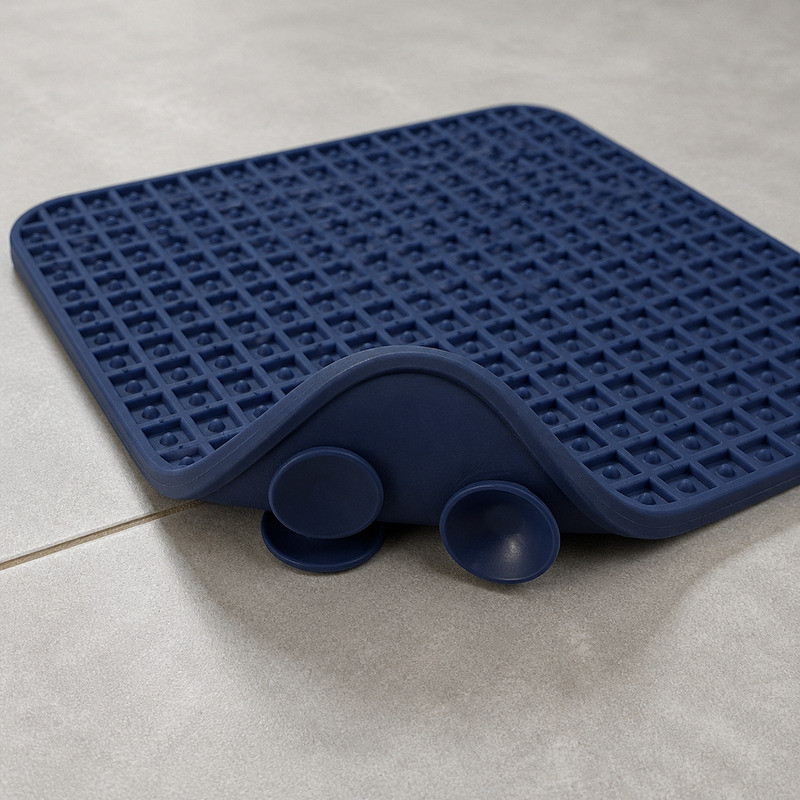
Why silicone dog lick mat suction cups behave differently on different counters
Smooth, non-porous surfaces give the seal a chance
Glazed tile, glass, polished stone and sealed countertops present a continuous surface, which is the condition a cup is designed for. Even here, finish matters. A honed stone with a slightly open grain behaves differently from a polished one, and a surface that has been wiped with an oily cloth is a different test again.
Texture interrupts the contact band
On a textured worktop, a brushed metal bench or a floor tile with a moulded pattern, the lip sits on the high points and bridges the low ones. Air enters through those bridges. The cup may feel attached when pressed and still release within seconds. This is the most common reason a mat is returned as "not sticking" when nothing is wrong with the moulding.
Work on biological suction discs makes the same point from the other direction: on irregular surfaces, the cup that survives is the one that develops friction at the rim, because friction delays the sideways slip that starts a leak (Wainwright et al., Biology Letters, 2013). A silicone mat on a rough counter has no such advantage unless the lip is soft enough to bite into the texture.
Curvature and joints prevent full contact
A cup designed for a flat surface cannot seat evenly on a curved bowl wall or across a grout line. The lip touches on two sides and floats in the middle. Where the target is a bowl, the geometry has to be designed for that bowl, or the product should not promise it.
Films and residue change the surface
Detergent residue, cooking oil, silicone spray and dried food all act as a release layer. Household cleaning habits vary more than most product teams expect: in a survey of 537 dog and cat caregivers, reported bowl-cleaning frequency ranged from after every meal to never (Raspa et al., 2023). A mat that only holds on a freshly degreased surface is a mat that will be reported as faulty.
Cup geometry is only half the story
Cup diameter and cup height are the numbers that appear on a drawing. The behaviours that decide performance usually are not on the drawing at all.
The lip needs a consistent contact band
A thin, flexible lip conforms to minor imperfections and seals more easily. A thick, stiff lip resists rolling but demands a flatter surface. There is no universally better choice: the right lip follows from the surface list and from how much force the owner is willing to apply when pressing the mat down.
Cup size has to match the mat it sits on
A large cup on a thin mat can distort the mat around it when pressed, lifting a neighbouring cup. A small cup on a stiff mat may never develop enough vacuum to hold. Diameter, height and the local stiffness of the surrounding film are one design problem, not three.
The film between the cups carries the load
When a pet pulls at the mat, the load travels through the base into the cups. If the base is too stiff, the load concentrates at one cup and peels it. If it is too soft, the mat walks across the floor as a whole. The useful review looks at the underside and the feeding surface together, in section, rather than treating the cups as an accessory added at the end.
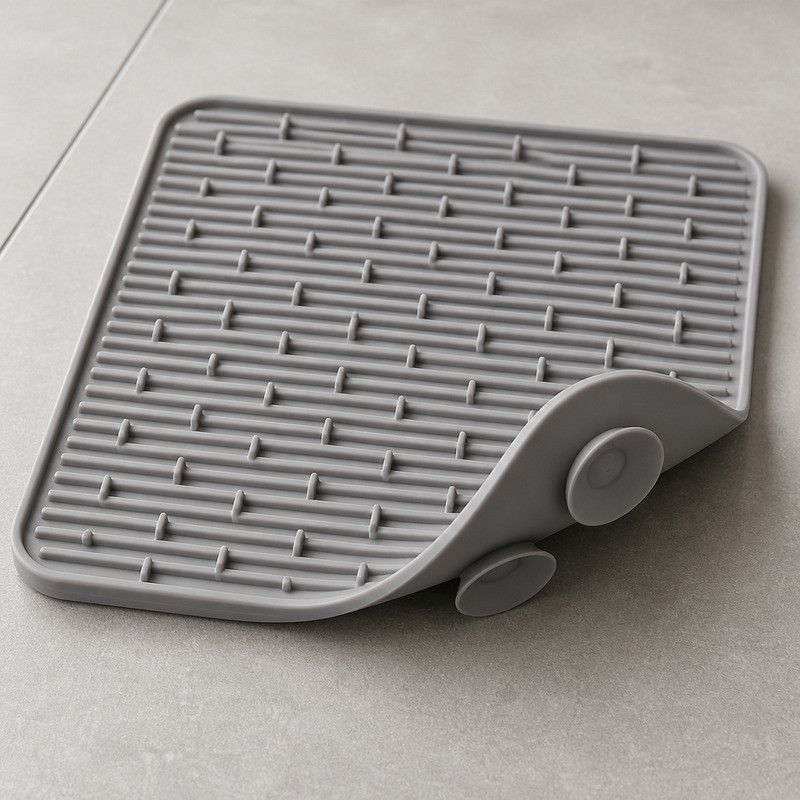
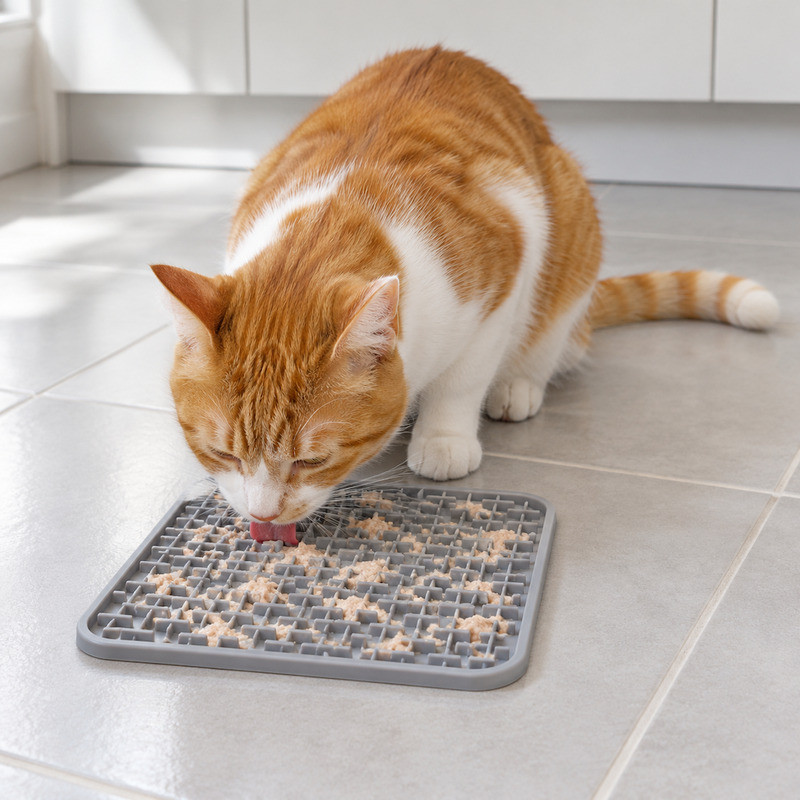
Why a mat holds at first and lets go later
Attaching and holding are two different tests
Pressing a cup down proves that air can be expelled. It does not prove the seal survives movement. A tongue dragging across the feeding surface applies a sideways load that peels the lip progressively; a paw pressing near the edge applies a local peel. If the sample is only tested by pressing it down and lifting the mat, the harder half of the performance question has not been asked.
Silicone creeps under sustained load
Elastomers deform over time. A lip held under compression for hours in a warm kitchen takes a slightly different shape than a lip pressed for ten seconds in a showroom. That is normal behaviour, not a material fault, but it does mean that a design which relies on a very thin lip in permanent tension will age differently from one that relies on a thicker band.
Washing changes the surface on both sides
Dishwasher cycles, abrasive sponges and hard water all alter the cup face. The relevant question is not whether washing damages the silicone, but whether the cup still seals after twenty cycles of the cleaning method the product will actually meet. That is testable, and it belongs in the approval criteria rather than in the after-sales conversation.
How to test suction before the tool is approved
Start with the surfaces customers actually use
Write the list down and treat each entry as a separate condition: glazed floor tile, sealed countertop, stainless steel sink base, glass table, textured worktop, curved bowl, painted wood. Group them by finish rather than by room. Record the surface, its condition, and how it was cleaned before the test.
Separate first contact from sustained holding
Attach the mat, then apply a repeatable disturbance: drag a loaded spatula across the surface, press down near one corner, lift one edge. Note how many cycles pass before a cup releases, and which cup releases first. The pattern of failure is more informative than a single pass-or-fail result.
Retest after cleaning and after use
Run the same test after a wash with the intended detergent, after air drying, and after a smear of the food the product is designed for. Contact performance after realistic use is the number that matters, not the number from a clean lab bench.
Record the conditions behind every result
Cup diameter, lip thickness, cup height, material hardness, base thickness, surface type and test procedure should travel with the result. Without them, two samples cannot be compared, and the next design change is a guess.
What to put in the brief
Most suction problems are decided before a tool exists, in a brief that named a mat but not a surface. The following items are enough for a manufacturer to review the design seriously.
| Brief item | Why it changes the suction result |
|---|---|
| Target surfaces, described by finish rather than by product name | Gloss, texture and porosity decide whether a continuous seal is possible at all. |
| Whether curved surfaces are in scope, and which curvature | Cup diameter has to be small relative to the curve to keep the lip in contact. |
| Cup diameter, height and lip geometry, if already fixed | These set contact area and how much force the owner must apply to seat the cup. |
| Base thickness and the flexibility of the whole mat | The film between cups carries the peel load; too stiff concentrates it on one cup. |
| Cleaning method, temperature and detergent | Residue and heat both change the cup face and the surface it seals against. |
| Expected load: pet size, feeding style, floor or bowl | A floor mat sees lateral drag; a bowl insert sees lift and rotation. |
| Retail-market requirement for the compound | Documentation is separate from geometry but decides whether the product can ship. |
Supplying the list changes the conversation. Instead of a supplier promising that the cups will hold, the review can say which surfaces the current geometry is likely to suit and which it will not.
How FromRubber approaches suction features
Suction questions tend to arrive after a sample has already been rejected on someone's worktop, which makes the first useful step a review of the surface list rather than the cup. FromRubber, the trading name of Dongguan Bohao Electronic Technology Co., Ltd., produces moulded pet products in Dongguan, Guangdong, China — lick mats, feeding mats and lids among them — and reviews suction as part of the mould rather than as a separate component. Cup diameter, lip section, cup height, spacing and the base thickness between cups are read together, because a change to any one of them moves the others.
The review also asks what the cups are for. A cup that keeps a mat from sliding on a tiled floor has a different requirement from a cup that is expected to anchor the product inside a bowl while a dog works at it. Once that is clear, sampling can be planned around the surfaces in the buyer's list instead of around a single press-and-pull demonstration. Mould development and sampling follow the routes described under mould making and silicone moulding, and the wider pet range is listed under pet supplies.
Where the geometry cannot meet the surface requirement, the honest answer is a narrower claim on the packaging, or a different attachment method, rather than a stronger promise about adhesion.
For readers comparing suppliers rather than surfaces, two existing round-ups cover adjacent ground: lick mat manufacturers assessed for pet brands and silicone pet feeding manufacturers. Both apply a stated rubric, which is the only way a list of this kind is worth reading.
Suction questions that come up in every project
Why does the mat stick to glass but not to a textured worktop?
Glass gives the lip a continuous, non-porous surface to seal against. A textured worktop gives it a series of ridges, so the contact band is broken by air paths. The cup is doing the same thing in both cases; only the surface is different.
Can silicone suction cups hold on a curved dog bowl?
Sometimes, but the result depends on the curvature, the cup diameter and how much of the lip can touch. A cup much smaller than the bowl radius conforms better than a large flat cup. Testing on the actual bowl is the only way to know whether the contact is continuous enough to hold.
Are larger cups always stronger?
Larger cups enclose more area, which raises the potential holding force, but they also demand a flatter surface and a stiffer base to avoid distorting the surrounding mat. On a flexible mat, a smaller number of well-sealed cups often performs more predictably than a large cup that cannot maintain contact.
How should a manufacturer evaluate suction performance?
With a written surface list, a repeatable attachment procedure, a defined disturbance, and a documented cleaning cycle. Results should be recorded per surface, because a single average figure hides exactly the information the buyer needs.
Sources and further reading
- Wainwright D.K. et al., "Stick tight: suction adhesion on irregular surfaces in the northern clingfish", Biology Letters. Read the paper
- Raspa F. et al., "Pet feeding habits and the microbiological contamination of dog food bowls", BMC Veterinary Research 19:261, 2023. Read the study
- U.S. Code of Federal Regulations, Title 21, Section 177.2600, "Rubber articles intended for repeated use". View the regulation
The mechanics described here are general principles of suction contact. They are not a substitute for testing a specific cup geometry on the specific surfaces named in a product brief.
Tell us the surface, not just the shape
If your lick mat design includes cups, the surface list is the most useful thing you can send — more useful than a target diameter. Send it together with the drawing, the base thickness and the cleaning method.
Email: nani@fromrubber.com or karl@fromrubber.com · WeChat and WhatsApp: +86 18676210913
View custom pet silicone products