Silicone GPS Tracker Cover Design for Different Dog Collar Widths and Tracker Sizes
- Share
- publisher
- FromRubber
- Issue Time
- Oct 19,2026
Summary
A practical design guide for pet brands sourcing custom silicone GPS tracker covers: how to measure collars and tracker housings, match holder geometry to collar widths, choose a retention structure, and validate a prototype before tooling.
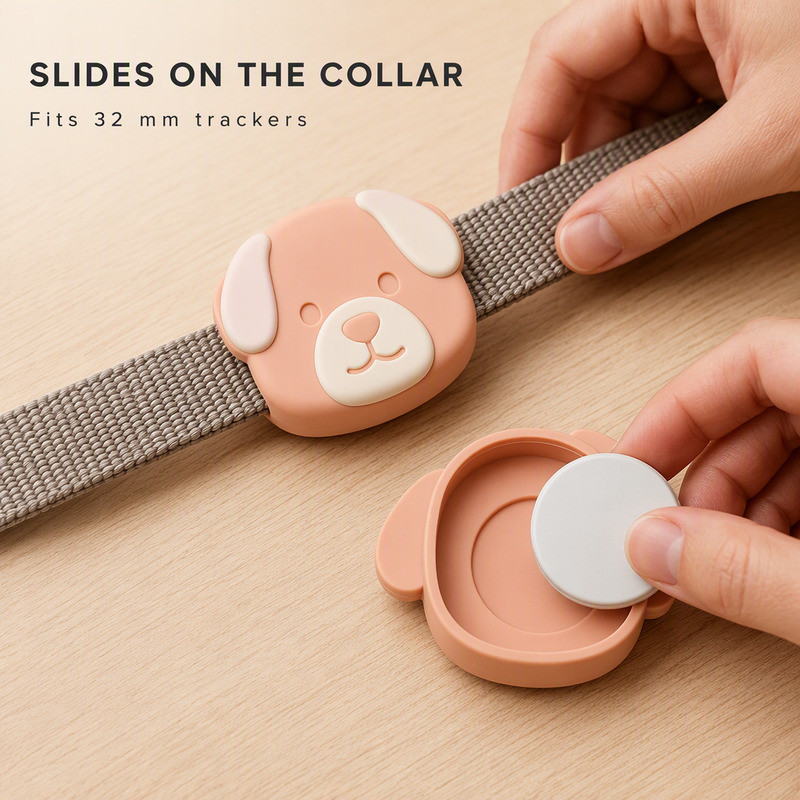
A silicone GPS tracker cover that “fits most collars” usually fits exactly one collar well. The rest of the range either lets the tracker rotate, pinches the webbing, or refuses to close over a bound edge. When that happens, the tracker is rarely the problem. The collar is, and nobody measured it.
The pattern in failed tracker-holder drawings repeats: the cavity is drawn around a device, the channel is drawn around a catalog width, and the two are assumed to be compatible. A collar is not a flat strip of a stated size. It is a folded, stitched, sometimes padded assembly that compresses under load and bends around a neck. A holder designed against a number rather than a sample will pass CAD review and fail the first fitting on a real dog collar.
Two interfaces, only one of which is usually specified
A tracker cover is a clamp with two jobs. The cavity has to hold a device; the channel has to hold a collar. Both jobs have their own tolerance chain, and improving one tells you nothing about the other. A holder can grip a tracker so firmly that removal needs a tool, and still slide along the collar like a bead on a wire. It can also sit perfectly still on the collar while the tracker rattles inside it.
Before any dimensions are fixed, decide which of the three common architectures you are actually building, because each one fails differently.
| Architecture | What retains the tracker | What retains the collar | Typical failure |
|---|---|---|---|
| Sleeve that encloses the device | Full wrap plus an end opening | Friction along a long contact length | Stretches over time; the opening relaxes and the tracker creeps out |
| Holder threaded onto the collar | Molded lips over the device face | A closed channel the webbing passes through | Channel sized to nominal width; binds on thick or bound edges, rotates on thin webbing |
| Snap-in mount | Interlock or a rigid insert | Separate loop or clamp | Harder to assemble; interlock wear shows up as looseness rather than visible damage |
Measure the collar as the holder will see it
The number printed on a dog collar is a nominal webbing width, and it is often the least useful dimension in the project. A 25 mm collar with a folded and stitched edge can present 26.5 mm at the point where the holder sits, and a padded collar can present far more. If the channel is cut to the nominal figure, the holder will either fight the collar during installation or sit slightly open, which is the beginning of rotation.
Four measurements matter more than the label:
- Width at the mounting position. Not at the buckle, not at the D-ring. Mark where the holder will sit on a worn collar and measure there.
- Thickness under slight compression. Webbing is not rigid. Calipers closed on a loose strap read low; the holder feels the compressed figure, not the free one.
- Edge profile. Cut-and-seal, folded and stitched, and rolled edges all behave differently inside a channel. A bound edge adds thickness on two sides only, which tilts the holder.
- Stiffness and curvature. A stiff collar holds a long channel straight; a soft one wraps and pulls the channel into a curve. The same holder feels tight on one and loose on the other.
Also check the hardware. Buckles, adjusters, D-rings and stitching all take up space, and a holder that is dimensionally correct can still be unusable because it cannot slide past a stitch line without being forced. The practical test is a five-minute one: slide the intended holder body along a real collar by hand, from the buckle to the intended position, and watch where it catches.
The collar is not only a mounting rail. It sits on a neck. A 2025 review of walking equipment in Animals notes that flat collars produce the least body restriction and suit dogs that walk without pulling, while tightening designs concentrate load [3]. That does not settle holder geometry, but it does mean the cover should add as little bulk and edge height as the function allows, especially at the front of the throat.
Measure the housing, not the product page
Tracker listings quote length, width and thickness, and those three numbers are not enough to cut a cavity. The corners are where a cavity either works or creates a stress riser. A housing with a 3 mm corner radius dropped into a cavity with a 6 mm radius leaves four unsupported arcs; the device shifts until a corner finds the wall, and every shift works the retaining lip.
What a mold maker actually needs:
- Overall length, width and thickness, measured on a physical unit rather than read from a specification.
- Corner radii and any curvature across the back or face. A domed back needs a matching cavity floor, or the device rocks.
- Raised buttons, ports, charging contacts and indicator windows, with their positions relative to the cavity edges.
- Seams and parting lines on the housing, since these are often the highest points and the first places to wear.
- Any groove, hook or locking feature the cover is expected to engage.
- Access requirements: charging cable clearance, button travel, and whether the device is removed weekly or left in place for a season.
A photograph is a starting point, never a specification. Perspective hides thickness, and a rendering hides draft. Send one physical unit or a CAD file exported at true scale, and say which revision it is. Housing revisions are the quiet cause of “the same cover suddenly fits badly”.
Matching geometry to collar width and tracker size
There is no universal collar-width category worth designing to. There are, however, geometric consequences that repeat across the range.
Narrow collars
A narrow webbing gives a short contact length, so resistance to rotation comes mostly from how well the channel matches the edge. Widening the holder footprint for stability adds a lever arm on a small neck. Keep the body compact and the channel snug.
Medium widths
A modest channel length with slight interference on the edge usually balances well. The question is not the width but the ratio of channel length to clearance. A long channel with generous clearance behaves worse than a short one with a close fit.
Wide collars
Wide webbing tolerates a longer channel, but a long rigid channel resists the collar’s curve. If the collar bends and the holder does not, the holder lifts at the ends and the contact patch shrinks to a line. Shorten the channel or thin the walls that bridge the bend.
Padded and thick collars
Padding changes the profile, not just the number. A padded collar compresses under the holder and recovers elsewhere, so a channel that measures correctly on the bench can feel tight under load and loose at rest. Design against the compressed thickness and check a collar that has been worn.
Different tracker sizes
Stretching one cavity across two device sizes is a false economy. It either fits the larger device and leaves the smaller one loose, or fits the smaller one and cannot accept the larger without local overstretch. If the devices differ by more than a millimeter in any dimension, treat them as separate parts.
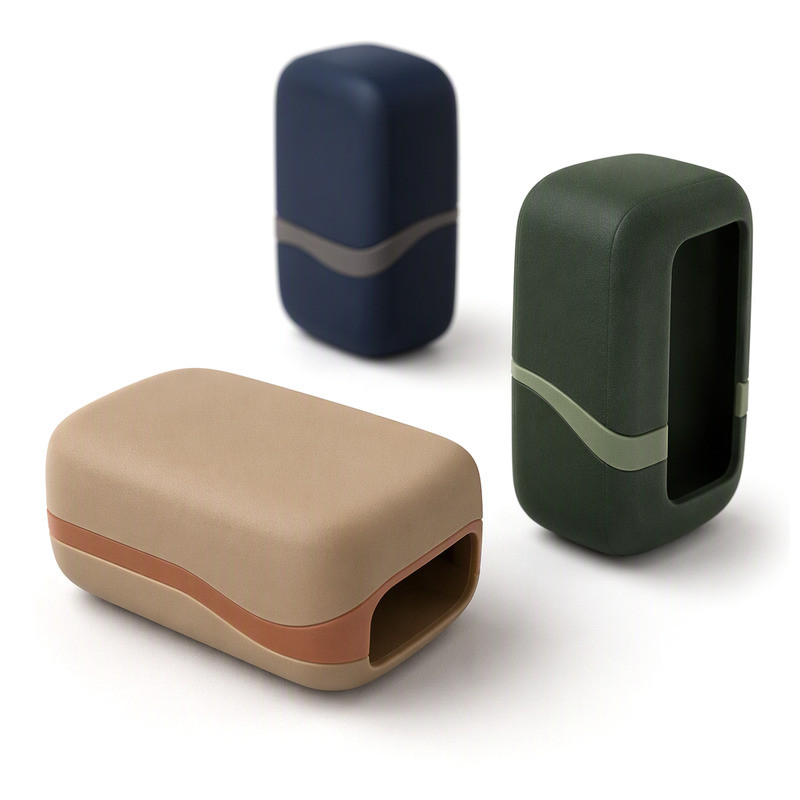
The three sleeve-style covers above show the point. They are all closed-end sleeves with an open collar channel, and the only thing that changes between them is proportion: cavity depth, wall thickness and the length of the channel floor. Those proportions are what make one suitable for a compact tracker on narrow webbing and another suitable for a thicker device on a wider strap. Color is the least important variable on the drawing, even though it is the one buyers ask about first.
Retention structures and what each one costs
Once the two interfaces are dimensioned, the retention method decides how the product behaves in daily use. Molded lips give the most direct hold on the device, but a lip that is too tall is difficult to release and a lip that is too thin tears at the root. A closed channel is the most direct way to keep a holder on a collar, but it cannot be added or removed without threading the entire strap. If that trade-off feels familiar, it is the same argument about preload and contact that decides whether a rubber grommet stays in a panel, applied to a different part. Elasticated sleeves are forgiving across collar variation, and forgettable across time: the elastic relaxes, and the fit that was acceptable in month one is loose in month six.
Snap-in and interlocking designs solve the removal problem for the device and create a new one at the interlock. Every engagement cycle wears the mating surfaces slightly, and the wear appears as a small rattle rather than a visible crack. If the product is intended for daily removal, design the interlock with a defined engagement depth and inspect that depth on production samples, not only on the prototype.
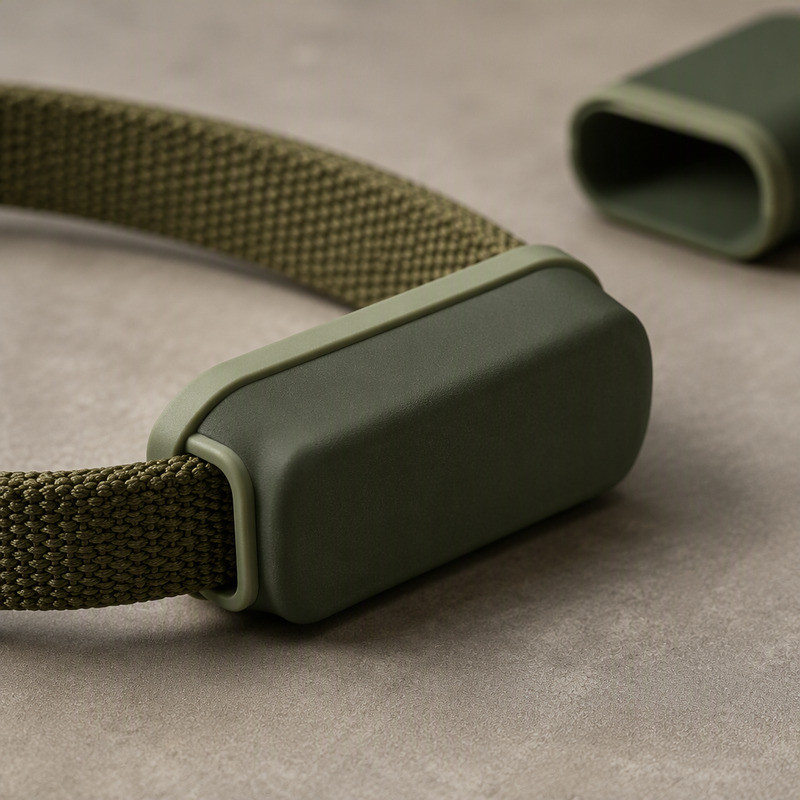
Look closely at the open end of a threaded holder and you can see the whole design problem in one place. The rim has to be thick enough to survive repeated insertion, thin enough to flex over the device, and short enough that a thumb can find the edge. Those three requirements pull in different directions, which is why the rim is usually the first feature to be revised after sampling.
Silicone does not solve this by being soft. A softer compound reduces insertion force and increases the chance of the rim rolling instead of seating. A harder compound seats more decisively and transmits more force into the cavity corners. The right answer is a combination of rim geometry and hardness, and it can only be confirmed on a molded part.
Why the fit changes after molding
Silicone shrinks. The amount depends on compound, cure and wall sections, and it is never uniform across a part with thick and thin regions. A cavity drawn at 32.0 mm may measure 31.6 mm after cure, which is the difference between a device that drops in and one that must be pressed. ISO 3302-1 exists because molded rubber dimensions carry tolerance classes rather than single values [1]. Ask which class the drawing assumes, and check the critical fit dimensions against it.
Elastic recovery matters as much as hardness. Two compounds can read the same durometer and recover differently after stretching, because hardness measures indentation resistance, not spring-back [2]. One holder grips for a year; the other stays slightly open after the first installation. Where repeated stretching is expected, compare elongation and tensile behavior as well [4].
Wall thickness is the third variable. A 2 mm wall around a cavity flexes; a 4 mm wall resists. Neither is wrong, but the pair must match the removal frequency. Thick walls on a device charged every night turn a routine task into a struggle; thin walls on a device left installed for months may creep and lose preload.
Validate on the extremes, not the average
Prototype approval usually happens on the middle of the range, which is the one sample least likely to reveal a problem. Test the smallest and largest collar in the intended range, and test them with the holder in the position it will actually occupy. Then run the checks that a bench fit cannot answer: twenty installation and removal cycles on the device, a collar bent around a form roughly the size of a neck, and a visual inspection of the rim root for whitening or tearing.
Keep this separate from formal durability or safety testing. A fit trial tells you whether the geometry works. It does not tell you whether the material survives two years of UV, salt water and skin oils, and it should not be presented as if it does.
What to send before a mold is quoted
- One tracker unit, or a CAD file at true scale, with the housing revision identified.
- Collar samples at both ends of the range, plus the width and compressed thickness measured at the mounting position.
- Photos of the collar edge profile and of the hardware the holder must pass.
- The intended architecture, or a clear statement of how the device will be removed.
- Target hardness and color if already fixed, and the surface finish expected.
- Where the holder will sit on the neck, since that decides how much bulk is acceptable.
- Expected order quantity and whether the tooling is expected to cover more than one device size.
With those inputs, a mold maker can flag the risks that are cheap to fix on paper: a channel that will bind on a bound edge, a cavity corner that will overstretch, a rim that is too thin for the removal frequency. Without them, the first sample becomes the design review, and revisions are paid for twice.
Questions we get at the drawing stage
Can one holder fit several collar widths?
Within a narrow band, yes, if the channel is designed around the thickest collar in that band and the retention comes from edge contact rather than from clamping the full width. Across a wide range, no. The compromise shows up as rotation on the thin end and installation force on the thick end.
Is a tracker sample really necessary?
It is the fastest way to avoid a second tool. A sample reveals draft, corner radii, seam height and button travel that a drawing often omits. If a sample cannot be shipped, a CAD file plus photographs of the corners and ports is workable, but the risk of a revision rises.
How does collar thickness change the design?
It sets the channel height and the amount of interference. Too little height and the holder sits proud and rotates; too much and the holder compresses the webbing, which looks secure until the collar relaxes and the holder starts to move.
Can the same cover fit a different tracker model?
Only if the cavity, corner radii and port access all still work. In practice, a different housing revision means a different cavity. Treat it as a new part unless the two devices share a mechanical envelope.
Close both interfaces before you cut steel
The expensive mistakes in this product category are not material mistakes. They are dimensional ones: a channel cut to a catalog width, a cavity drawn from a photograph, a rim sized by eye. Each is cheap to correct on a drawing and costly to correct in a mold.
One boundary worth stating plainly: a silicone cover is a holder and a scuff barrier. It is not a waterproof housing, and it cannot guarantee retention on a collar outside the range it was designed for.
FromRubber, the export brand of Dongguan Bohao Electronic Technology Co., Ltd., molds custom silicone parts for pet product brands in Dongguan, Guangdong, including tracker covers and holders, and reviews drawings and reference samples before tooling rather than after the first sample fails. If you are at that stage, send the tracker sample, the collar measurements and the intended mounting position to nani@fromrubber.com or karl@fromrubber.com. We can also be reached on WeChat or WhatsApp at +86 186 7621 0913. More on our custom silicone rubber parts capability is on the site, and related application notes sit under silicone product applications.
Sources
- ISO 3302-1:2014 — Rubber: Tolerances for products, Part 1: Dimensional tolerances, ISO.
- ASTM D2240-15(2021) — Standard Test Method for Rubber Property: Durometer Hardness, ASTM International.
- Cavalli, C. and Protopopova, A. — Review of Collars, Harnesses, and Head Collars for Walking Dogs, Animals 2025, 15(15), 2162.
- ISO 37:2024 — Rubber, vulcanized or thermoplastic: Determination of tensile stress-strain properties, ISO.