Silicone Gasket Dimensions for Water Pumps: How to Specify Inner Diameter, Outer Diameter and Thickness
- Share
- Issue Time
- Nov 5,2026
Summary
Pump gaskets are usually sized from a used part, which has already swollen and taken a set. This article sets out how to read the sealing land, bolt circle and closed gap, and why gasket thickness belongs to the axial stack.
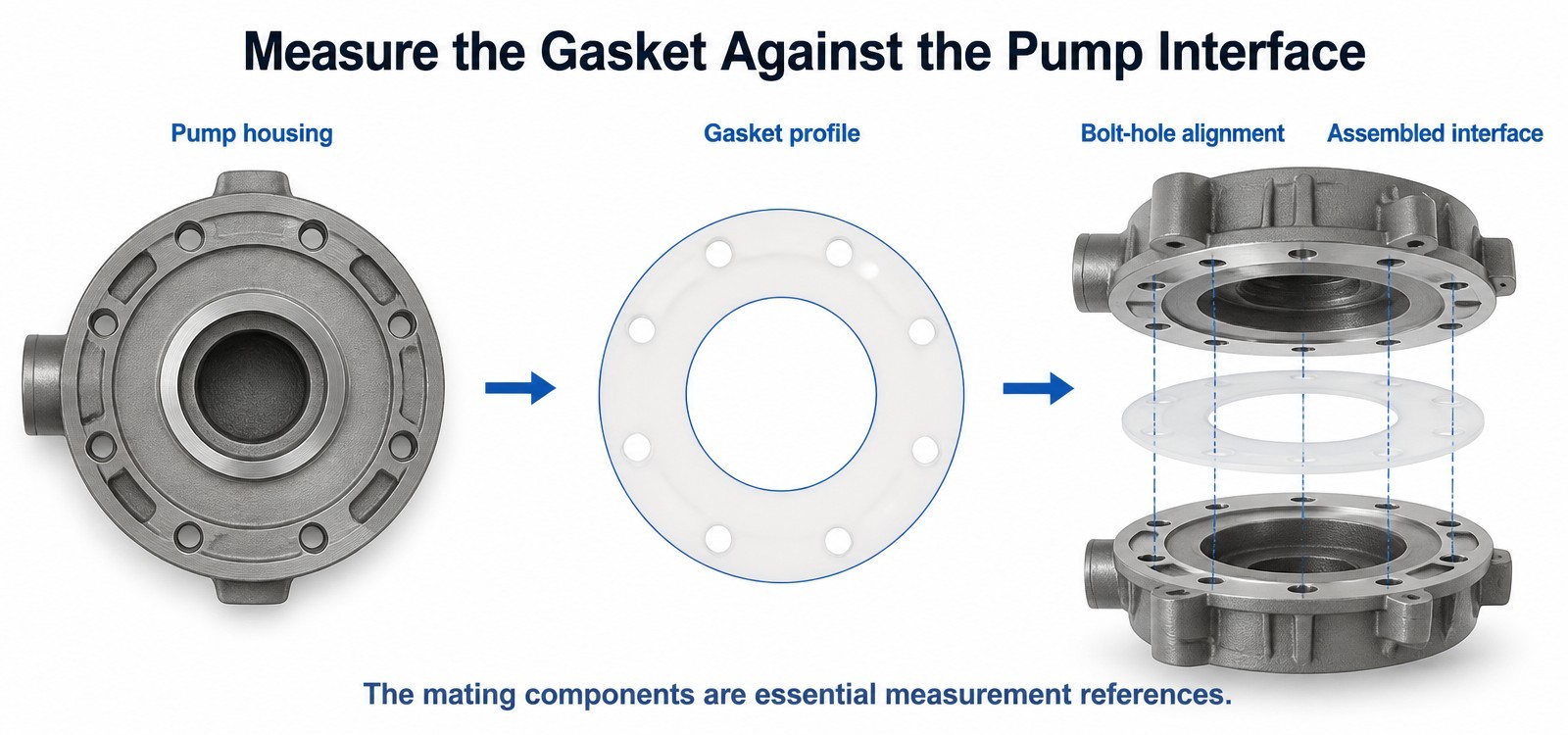
The pump gasket arrives, measures exactly what the drawing says, and still weeps at the flange after two weeks. The dimensions were not wrong. They were answering the wrong question.
Most pump gasket failures that get blamed on the part are actually specification failures: the gasket was sized from the old part, or from the housing's outside shape, rather than from the surface it has to seal. A used gasket is a record of where it has been, not of what it should be — and a pump gasket that has spent a season in water has usually swollen, compressed and heat-set into a shape that never existed at the drawing stage.
This article treats dimensions as a description of the sealing interface. Three of them decide whether the joint works; the rest decide whether it assembles.
Which Dimensions Matter When Specifying a Water Pump Silicone Gasket?
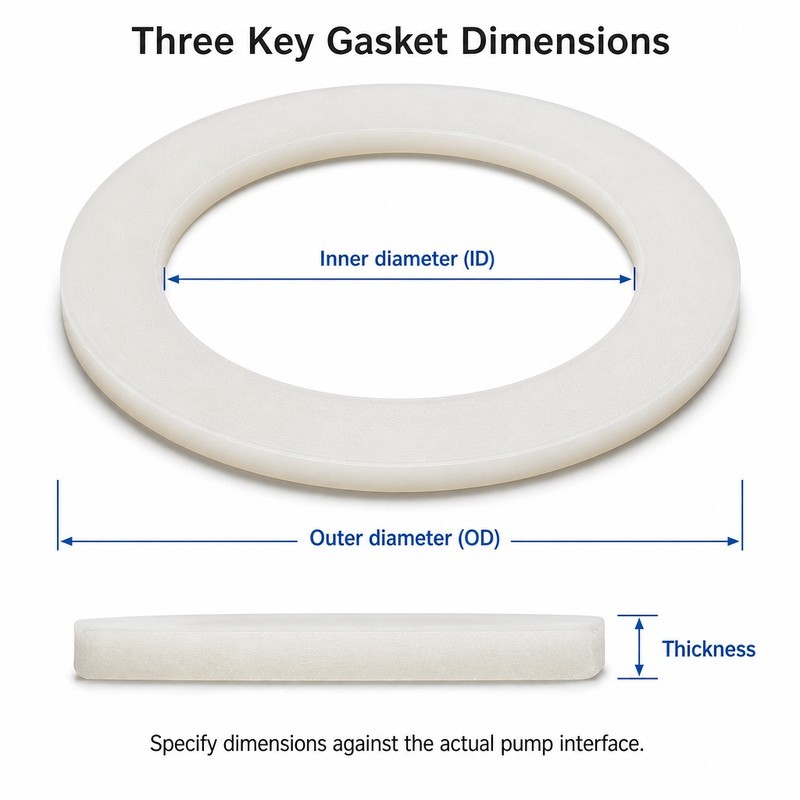
Inner Diameter: Matching the Fluid Passage or Central Opening
The inner diameter defines a boundary between two things at once: the flow passage and the sealing land. Too small, and the gasket intrudes into the passage — it becomes a step that collects debris, creates a dead zone where air can gather, and in some casings sits proud enough to disturb the flow at the joint.
Too large, and the gasket leaves part of the machined land uncovered. The uncovered ring looks like margin on a drawing. In service it is an unprotected surface where water sits against the joint face, and where corrosion or scale can start under the gasket edge.
Outer Diameter: Covering the Required Sealing Area
The outer diameter is usually set by the housing, not by the flow. It has to reach past the bolt holes without covering them, sit inside the casing's outer wall, and leave enough material around each hole that the gasket does not tear when the bolt is tightened.
The common error is to make the outer diameter match the housing's outside profile. On a round pump casing that appears to work; on a casing with a machined step, the gasket ends up bridging the step, and the bridge is where it leaks.
Thickness: Matching the Available Assembly Gap
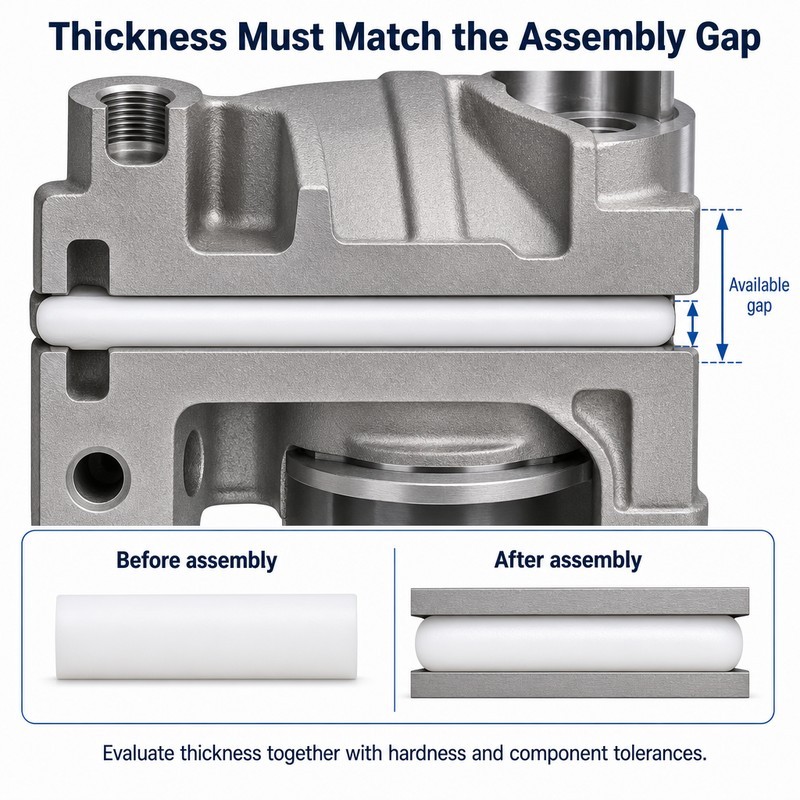
Thickness is the only dimension that changes the assembled geometry of the pump. On designs where the gasket sits between the casing and the cover, its thickness is part of the axial stack: change it and the cover sits at a different height. On pumps where that position influences the running clearance between impeller and casing, a gasket thickness tolerance is quietly an impeller clearance tolerance.
That is worth stating plainly to anyone who signs off a gasket drawing: on these designs the gasket is a shim as well as a seal, and it should be toleranced like one.
Additional Dimensions That May Affect Installation
Bolt hole diameters and their positions on the bolt circle, slot shapes for slotted casings, locating tabs, drain notches and any non-circular outline all have to appear on the drawing if they are functional. A hole pattern that exists to clear fasteners is not critical; a hole pattern that positions the gasket relative to the passage is.
| Dimension | What it controls | Most common error |
|---|---|---|
| Inner diameter | The boundary between the flow passage and the sealing land | Copied from a used gasket that has swollen and taken a set |
| Outer diameter | How much of the machined land is actually covered | Matched to the housing silhouette instead of the land |
| Thickness | Compression, and on some pumps the axial position of the cover | Chosen from the nominal gap only, ignoring tolerances |
How to Measure Inner and Outer Diameters Correctly
Measuring the Actual Pump Housing Interface
Measure the housing, not the old gasket. Specifically: the diameter of the machined sealing land at its inner edge, the diameter at its outer edge, the depth of any recess the gasket sits in, and the surface finish of the land. Those four readings define the space the gasket must occupy.
Take the inner and outer readings at two positions at right angles. A casing that has been machined in one setup will be round; one that has been finished by hand may not be, and an oval land needs a gasket that can accommodate the difference rather than a nominal diameter that averages it away.
Checking the Distance Between Bolt Holes and the Central Opening
Bolt holes matter twice: as clearance and as positions. Measure the bolt circle diameter, and measure from the centre of the passage to the centre of one hole, then check the angular spacing. Gaskets with holes slightly off the true positions will still fit on the bench and will distort when the bolts are tightened, because each bolt pulls its hole into line.
Measuring Irregular or Non-Circular Gasket Profiles
For anything that is not a plain ring, hand measurements are not enough. Photograph the interface with a scale in frame, or better, supply a dimensioned drawing or a 3D file with the sealing land and the bolt pattern. An outline traced onto paper is a last resort — it captures the shape but not the datum, and without a datum the shape cannot be reproduced.
How Should Silicone Gasket Thickness Be Selected for a Water Pump?
Understand the Gap Between the Mating Surfaces
The gap is what the closed pump leaves for the gasket. It is not the gasket's free thickness, and it is not a nominal number on a casing drawing: it is the difference between two machined faces, each with its own tolerance, plus whatever the fasteners pull out of the joint when tightened.
Work out the gap at its widest and at its narrowest, then choose a thickness that still compresses the gasket at the widest point and does not over-compress it at the narrowest. A gasket selected from the nominal gap alone will be too thin on some units and crushed on others.
Avoid Choosing Thickness Based Only on an Existing Gasket
A gasket that has been in a water pump has absorbed water, been compressed, and been held at operating temperature. Silicone absorbs relatively little water compared with some elastomers, but it still swells slightly, and compression set reduces its thickness permanently. Measuring it gives you the thickness of a used, set, possibly swollen part.
The error can go either way, and it is invisible because the measurement is precise. Use the old part for the outline if nothing else exists, and use the housing for the thickness.
Consider Compression and Material Hardness Together
Thickness and hardness are two halves of one decision. A thick soft gasket and a thin firm gasket can generate the same contact pressure at the same bolt load, but they behave differently when the joint moves: the thick soft one follows movement and takes a set, the thin firm one holds its section and loses contact.
For a cast casing with a machined land and steel fasteners, a moderate thickness with a mid-range hardness is usually the stable combination. For a pressed sheet-metal cover on a small circulator, a softer compound at a similar thickness is often the only way to seal a land that is not perfectly flat.
What Can Cause a Correctly Sized Pump Gasket to Leak?
Incorrect Alignment Between the Gasket and Pump Housing
If the gasket's bore is concentric with the passage but the bolt holes are not quite on the bolt circle, tightening the bolts shifts the gasket sideways. The bore is then eccentric to the passage, the sealing band is uneven, and the thin side is where it leaks. The part was in tolerance; the pattern was not.
Insufficient Sealing Width Around the Fluid Passage
Sealing width is (outer diameter − inner diameter) ÷ 2, minus whatever the bolt holes remove. On a casing with a narrow land, that number can be smaller than it looks on the drawing, because the land's inner edge is chamfered and the chamfer does not seal. Measure the flat part of the land, not the full machined face.
Uneven Contact Pressure Across the Gasket
A cast cover deflects between bolts. On a four-bolt round cover the highest pressure is at the bolts and the lowest is midway between them, which is why pump leaks so often appear as a crescent between two fasteners rather than at a bolt. More torque makes the deflection worse, not better, once the cover starts to bow.
Material Incompatibility With the Pump Operating Environment
Silicone is a good general choice for water at moderate temperatures, and a poor choice for many oils, fuels and some glycol mixtures at temperature. It is also sensitive to certain additives and to steam over long periods. The material has to be chosen against the actual fluid, temperature and concentration — not against the word "water".
The four readings that prevent most pump gasket rework
- Land inner diameter and land outer diameter, measured on the flat machined face.
- Recess depth, if the gasket sits in a groove rather than on a flat land.
- Bolt circle diameter and angular spacing, checked against the cover as well as the casing.
- Closed gap at its widest, calculated from both faces with tolerances.
How to Prepare a Technical Drawing for Custom Water Pump Gaskets
Mark the three functional dimensions — inner diameter, outer diameter, thickness — and give each one a tolerance that reflects what it actually does. Then show the bolt pattern with a position tolerance, the outline with a profile tolerance, and a datum that corresponds to something real on the pump, such as the passage bore or the bolt circle.
Resist the temptation to tolerance everything tightly. A gasket drawing where every dimension is equally critical tells a toolmaker nothing about where to spend effort, and it usually produces a part that is expensive and no more reliable. The outline of a gasket that sits in a recess does not need the same control as the bore that defines the flow passage.
Finally, state the material, the hardness, the operating temperature range and the fluid. Those four items decide the compound, and the compound decides how much the finished part will shrink and how much compression set it will take.
How Should Custom Pump Gasket Samples Be Evaluated?
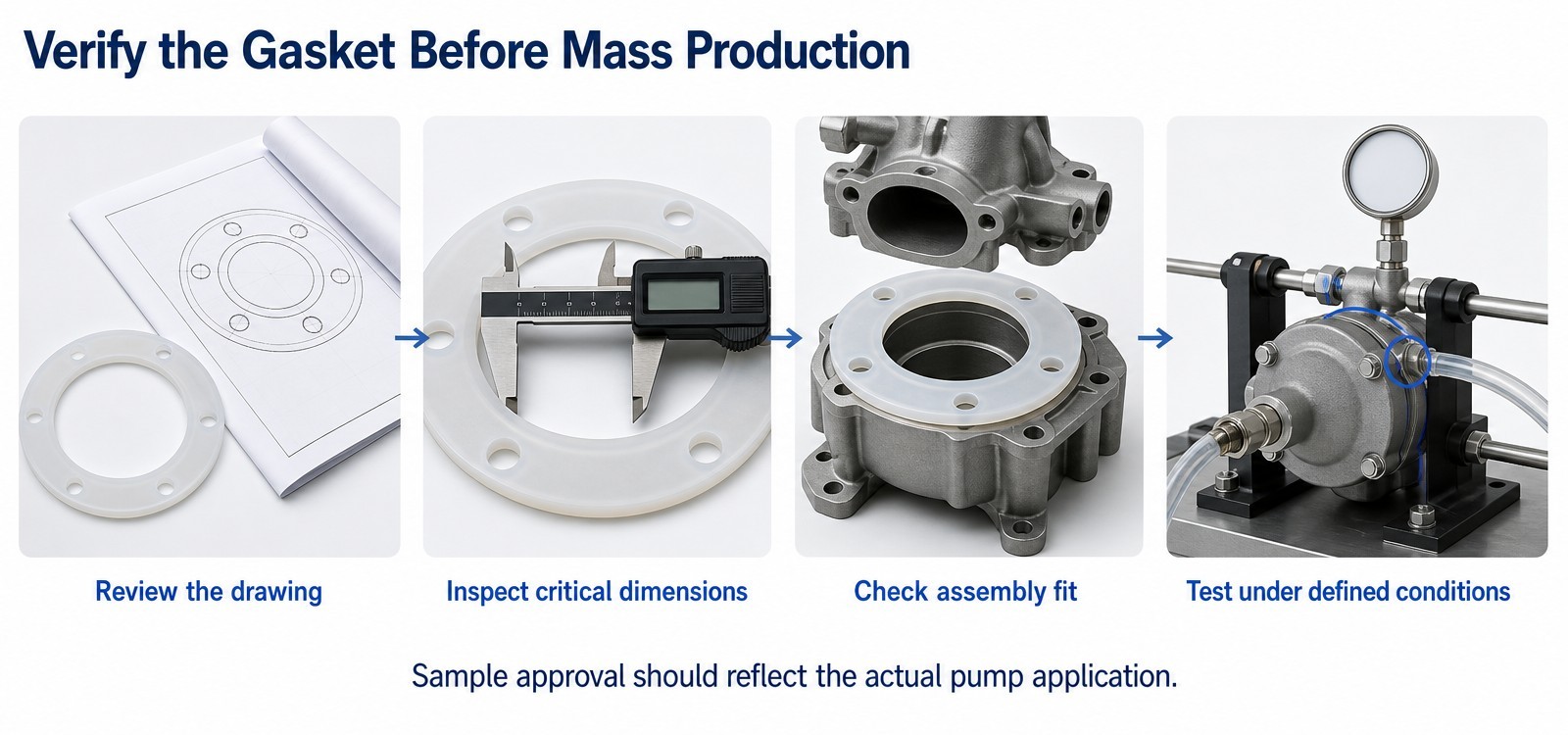
Check Dimensional Accuracy Against the Approved Drawing
Measure the functional dimensions first and the outline second. Record the readings rather than a pass or fail, because a trend across a sample batch tells you whether the tool is stable or still settling.
Confirm Alignment With the Pump Housing and Cover
Fit the sample onto the casing dry, without fasteners, and look at the bore relative to the passage and the holes relative to the bosses. Any eccentricity visible at this stage will be worse when the bolts pull it into line.
Evaluate Compression and Assembly Fit
Assemble the joint and check that the cover seats fully, that the fasteners reach their specified condition without bottoming, and that the gasket has not extruded into the passage. A gasket that squeezes into the flow path is a correctly sized part doing the wrong job.
Conduct Leakage Testing Under Defined Operating Conditions
Test at the pressure, temperature and fluid the pump will actually see, and hold the test long enough to expose compression set rather than only assembly leaks. A short cold test proves the joint closes. It does not prove the gasket will still be sealing after a week at operating temperature.
Custom Silicone Water Pump Gasket Manufacturing at FromRubber
FromRubber has been moulding custom silicone parts in Dongguan since 2010, across two plants running 32 compression moulding machines (30 vacuum-assisted, 2 plate presses) and a seven-machine CNC tool shop. Pump gaskets usually fall into the category of flat or lightly profiled rings with a bolt pattern, which is straightforward to mould and easy to get subtly wrong if the interface was not read carefully.
Drawing review here focuses on three questions: does the bore match the passage rather than the old part, does the outer diameter stay on the machined land, and does the thickness tolerance account for the axial stack. Where a customer has a casing but no drawing, the land can be measured and the profile rebuilt from the housing.
We do not quote performance figures for a pump we have not seen. Pressure, temperature and fluid belong to the application, and the gasket's job is to survive them, not to be rated for them in isolation.
Frequently Asked Questions About Water Pump Silicone Gasket Dimensions
How do I measure the inner diameter of a water pump gasket?
Measure the machined land's inner edge on the housing, not the old gasket's bore. Take two readings at right angles and note whether the land ends in a chamfer, since the chamfer does not seal.
How thick should a silicone water pump gasket be?
Thick enough to compress across the widest closed gap the tolerances allow, and thin enough that the cover still seats at the narrowest. On pumps where the gasket sets the cover height, its tolerance also sets the impeller clearance.
Should a pump gasket have the same outer diameter as the housing?
Not necessarily. The outer diameter should follow the machined land and stop before any step, radius or passage. Matching the housing's outside profile often puts the gasket on a surface that was never machined to seal.
Can silicone gaskets be customised for non-standard water pumps?
Yes. Non-circular outlines, offset passages, slotted holes and multiple ports are all mouldable or cuttable. The practical limit is the width of the sealing land: below a certain width the seal becomes sensitive to surface finish rather than to geometry.
What information is needed to request a custom pump gasket quote?
The housing drawing or a measured sketch of the sealing land, the bolt pattern, the operating temperature and fluid, the required material documentation, and the annual quantity. A sample of the old gasket helps with the outline but should not be used for thickness.
Measure the Pump, Then Draw the Gasket
A pump gasket is a description of a gap. Get the land, the bolt pattern and the closed gap right, and the material choice becomes a short conversation instead of a long experiment.
Send the casing drawing, or a measured sketch with two photographs, and we will tell you which dimensions are driving the seal. WeChat and WhatsApp: +86 18676210913.
Sources
- Elastic recovery after compression in HNBR at low and moderate temperatures, Polymer Testing 61 (2017), SINTEF — compression set behaviour of elastomer seals in flange joints.
- Hydraulic Institute — standards body for the North American pump industry, publisher of pump test and application standards.