Silicone Gaskets for Food Containers: How to Achieve a Reliable Lid Seal
- Share
- Issue Time
- Nov 5,2026
Summary
A lid can close properly and still leak. This article traces the failure to three causes - uneven contact, missing compression and gasket migration - then works through gasket geometry, hardness, food-contact material choice and sample approval for custom food container gaskets.
The lid clicks shut, the latch feels right, and the container still leaves a wet ring on the desk. Nine times out of ten the gasket is not torn, not missing, and not obviously the wrong size. That is exactly why the problem is hard to chase.
When a food container weeps, the first instinct is to ask the compound supplier for something softer, or the moulder for something thicker. Both requests are cheap and both usually fail, because a lid gasket does not seal by being soft. It seals by being squeezed a predictable amount, in a defined place, for the whole life of the container.
A lid and its gasket behave like a spring and its seat. The gasket stores elastic energy, the lid applies the load, the container rim reacts against it, and the latch decides how much of that load survives. Change any one of the four and the seal changes. This article works through that chain in the order failures actually appear on a production line.
Why Does a Food Container Lid Leak Even When the Gasket Is Installed?
A gasket that sits in its groove and looks correct can still leak in three structurally different ways. They are worth separating, because each one has a different fix and a different cost.
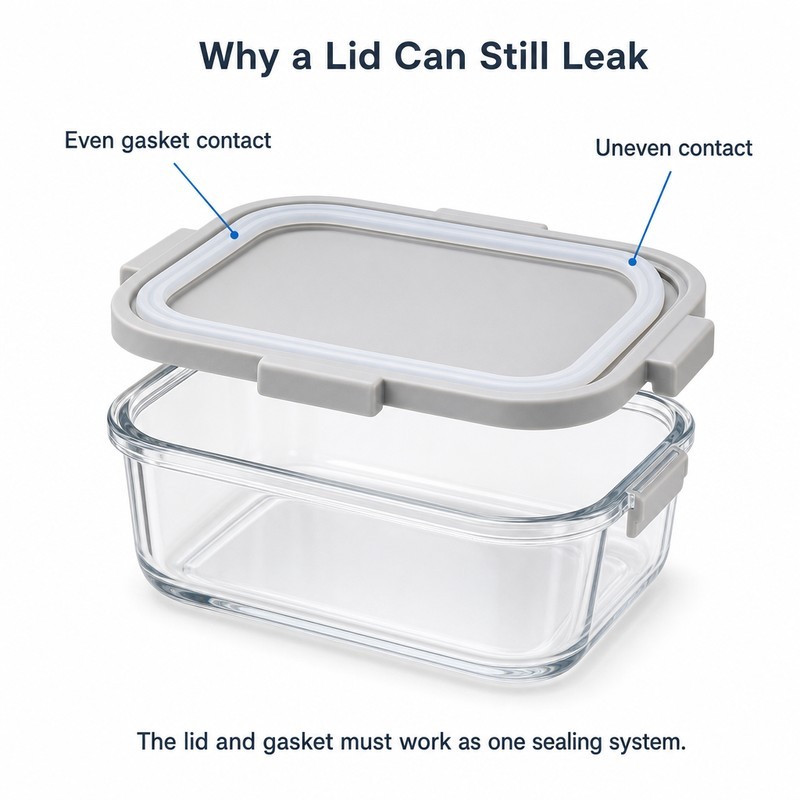
Uneven Contact Between the Gasket and Lid
Contact is rarely uniform around a rectangular lid, and the reason is structural rather than cosmetic. A lid is a plate. When two latches pull on opposite long sides, the plate bows, and the middle of each short side lifts slightly. The gasket in that region is not compressed; it is merely touched.
Corners make it worse. A moulded gasket that turns a sharp radius is thicker on the inside of the bend than on the outside, so the same nominal section presses harder at the corner than along the straight. If the groove is a constant width, the corner is where the gasket is most likely to ride up out of its seat.
Insufficient Compression Between the Lid and Container
A gasket needs a defined amount of squeeze to close the micro-gaps on both mating faces. That squeeze comes from the difference between the gasket's free thickness and the gap the closed lid leaves for it. If the gap was set by copying a competitor's lid, or by adding up nominal wall thicknesses without tolerances, the squeeze may be near zero at the low end of the tolerance stack.
The symptom is characteristic: the container holds liquid when it is still, and leaks when it is tilted or carried. A seal with no stored compression can resist a static head but cannot follow the small relative movement between lid and body during handling.
Gasket Movement During Repeated Opening and Closing
This is the failure that appears after two weeks of use rather than at first assembly. Every open-close cycle drags the gasket slightly against the rim. If the groove is shallower than the gasket section, or has no inner retaining wall, the gasket walks. Once a section of gasket has crept outward, that section stops being compressed and the loop is broken at one point.
Repeated washing accelerates it. Warm water softens the silicone, detergent acts as a lubricant, and the gasket slides more easily in its groove than it did when dry.
Read the leak before you change the part
- Leak along a long side, near the middle: the lid is bowing between latches. Look at latch position and lid stiffness, not at the compound.
- Leak at one corner only: the corner radius is too tight for the section, or the gasket has climbed out of the groove at the bend.
- Leak at the latch side: clamping is asymmetric. One latch is carrying the load and the opposite side is unloaded.
- Leak that starts after a month: compression set or gasket migration. Check groove depth, retaining geometry and wash temperature.
How Should Silicone Gasket Geometry Be Designed for Food Containers?
Geometry decides how the load travels from the latch to the sealing line. There are only a few decisions that matter, but they are usually made in the wrong order: section first, then width, then corners. Doing corners last is what produces a gasket that fits the drawing and leaks in the dishwasher.
Choosing Between Round, Flat and Custom-Profile Gaskets
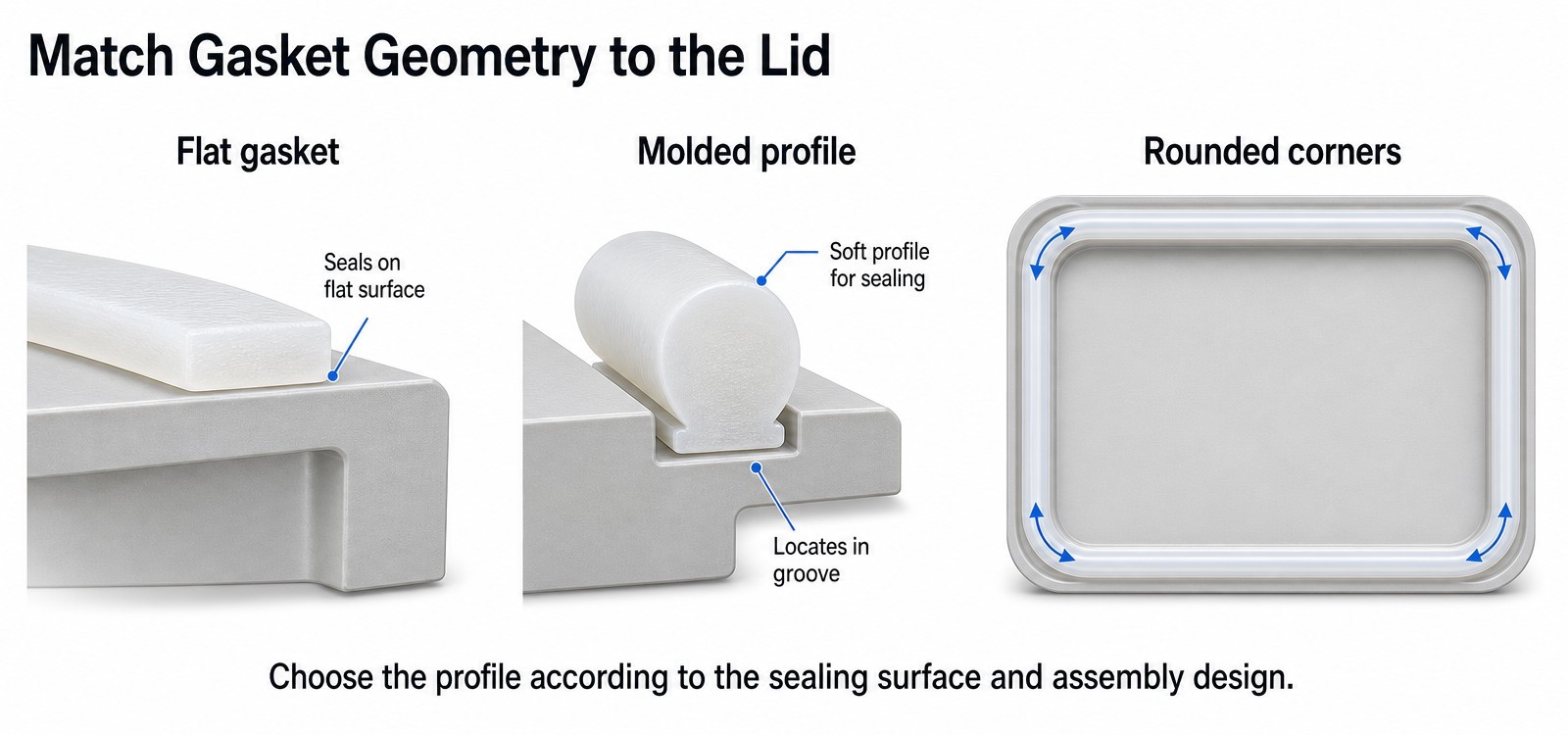
A flat gasket is a strip of constant thickness. It works when the lid has a machined flat land of adequate width and the latch provides a consistent, mostly vertical load. Its weakness is that it has nowhere to go when it is compressed. The material has to bulge sideways, and if the groove is a close fit, that bulge becomes a hydraulic lock that resists closing.
A round or D-section cord behaves differently. It contacts the mating face on a narrow band, so the same latch force produces much higher local pressure, and the surplus material rolls into the free space on either side. That is why a round section often seals a slightly warped lid that a flat gasket cannot.
A custom profile sits between the two. A moulded lip, a small locating foot, or a stepped section lets the designer place the contact band exactly where the lid land is, and put the compliance somewhere else. The cost is tooling: a profile has to be moulded, while a flat gasket can be cut from sheet.
Designing the Gasket Width to Match the Sealing Surface
Width is often chosen by eye — wide enough to look substantial. The useful rule is different. The contact band should be narrower than the flat land on both sides, so that the entire contact band lands on machined surface, with a margin left for assembly tolerance.
Too narrow and the seal becomes sensitive to any scratch, sink mark or food particle on the rim. Too wide and the gasket starts to overlap the container's inner radius, where the surface turns away and contact pressure drops to zero. The overlap looks like extra sealing area on a drawing and behaves like a leak path in reality.
Adjusting Corner Radii for Rectangular Food Containers
A corner is where a constant-section gasket is asked to do something it cannot do: turn without changing length. On the outside of the bend the material is in tension; on the inside it is in compression. If the corner radius is small relative to the section height, the inner face buckles and the outer face thins.
Two practical answers exist. Increase the corner radius until the section can turn without local collapse, or design the corner as a moulded feature with its own geometry — often slightly reduced section height, so that compression at the corner matches compression along the straight. The second is more work at the tooling stage and far less work at the customer-complaint stage.
| Gasket structure | Works best when | Main limitation |
|---|---|---|
| Flat gasket | The lid land is wide and flat, the lid is stiff, and the latch load is mostly vertical | Little room to displace material, so it needs a generous groove |
| Round or D-section cord | The lid bows between latches or the land is narrow | Higher local pressure can over-compress a thin lid |
| Moulded profile | The land is stepped or narrow, or a corner cannot be turned by a constant section | Needs a tool, and the part must be oriented at assembly |
How Do Silicone Hardness and Material Selection Affect Lid Sealing?
Why Silicone Hardness Should Match the Lid Structure
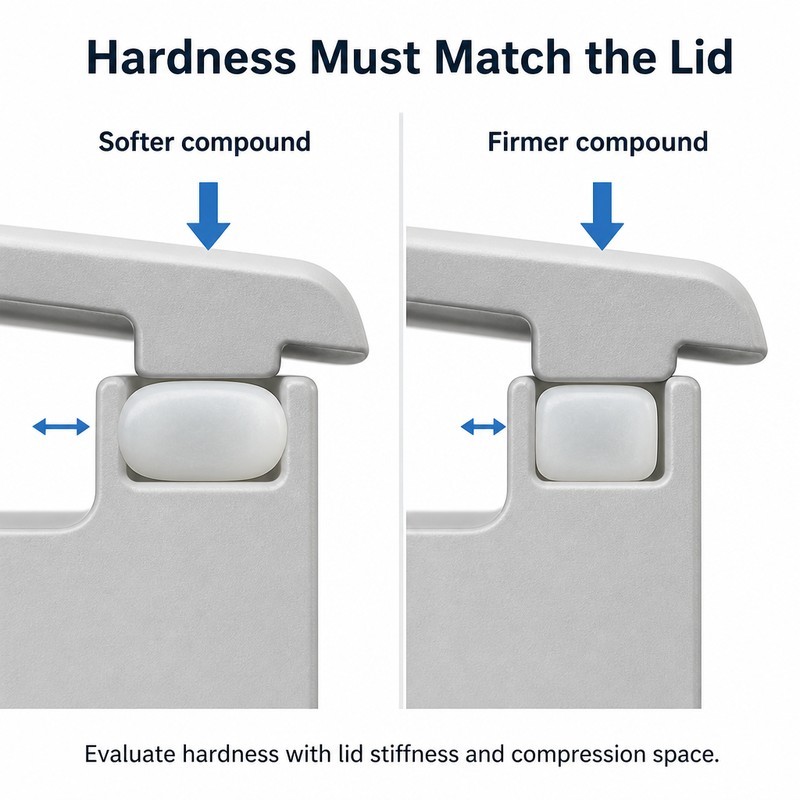
Hardness sets how much pressure the gasket generates for a given squeeze, and how much it fights back against a flexible lid. A soft compound conforms to a warped land and seals it, but it also pushes outward against the groove walls and can be displaced by the latch. A firmer compound stays put and resists creep, but it cannot follow a lid that deflects between latches.
The right question is not "what hardness seals best" but "how much does this lid move, and how much squeeze can I guarantee at the worst point". A stiff, heavily ribbed lid with four latches tolerates a firmer gasket. A thin polypropylene lid with two latches usually does not.
Choosing a Suitable Silicone Compound for Food Contact
Food contact is a compliance question, not a hardness question, and it should be settled before the tooling is cut. In the United States, rubber articles intended for repeated food contact fall under 21 CFR 177.2600, which lists permitted elastomers, vulcanising agents, fillers and limits on extractables. In the European Union, Regulation (EC) No 1935/2004 sets the general framework: materials must not transfer constituents in quantities that endanger health, change food composition unacceptably, or degrade organoleptic properties. National lists and specific measures sit underneath that framework and differ by member state.
Two practical consequences follow. First, "food grade silicone" is not a single certificate that covers every market; it is a claim that has to be supported by the right test package for the destination. Second, the same base polymer can be compliant or non-compliant depending on cure system, pigment and post-cure. Ask for the specific documentation for the specific colour, not for the material family. The U.S. Food and Drug Administration's packaging and food contact substances pages are a reasonable starting point for understanding how the American route is structured.
Considering Temperature Changes and Repeated Use
Silicone keeps its elasticity over a wide temperature range, which is why it is chosen for containers that go from freezer to microwave. What it does not do is recover perfectly. Hold a gasket compressed at an elevated temperature for long enough and it takes a permanent set — the section stays thinner after the load is removed.
Research on elastomer seals shows how strongly this depends on temperature relative to the material's glass transition: compression set rises steeply as the material is cooled toward that region, and continues to evolve with time after the load is released. Silicone's transition sits far below normal food-storage temperatures, which is why it performs well in a freezer. The relevant stress for a container gasket is the other end — repeated dishwasher cycles at elevated temperature, where set accumulates slowly and silently.
The design response is not a different compound. It is spare compression: build in enough squeeze that the seal still works after the gasket has lost some of its thickness, and keep the groove deep enough that a set gasket is still retained.
How to Prevent Gasket Installation and Assembly Problems?
Designing a Suitable Gasket Groove
A groove has three jobs: hold the gasket in place, leave room for the material it displaces, and define the compression. Depth controls compression; width controls where the displaced material goes. A groove that is both shallow and narrow leaves the gasket nowhere to move, so the lid either will not latch or latches onto the gasket instead of onto the rim.
A useful check at the drawing stage is to sketch the gasket section at its free size and again at its compressed size, then confirm that the compressed outline still fits inside the groove with clearance at the walls. If it does not, the lid is being held open by its own seal.
Avoiding Gasket Twisting and Stretching During Installation
An O-section cord that is stretched to fit a groove stays stretched. Its section reduces, its length remains longer than the groove, and it sits in waves that create local leak paths. The same applies to a moulded ring that is forced over a lip during assembly: the memory of that stretch shows up as a loose section weeks later.
Continuous moulded rings with correctly sized corners avoid the problem by design. Where a gasket must be assembled by hand, a locating feature — a small tab, a moulded foot, or a groove deeper on one wall — removes the judgement call from the operator.
Checking Lid Closure Force and Gasket Compression
Testing that the lid closes is not the same as testing that it seals. A lid can close on a gasket that is barely touching, and it can close with a force high enough to distort the rim. Both pass a simple open-close check.
A more informative check is to close the lid on a thin strip of pressure-sensitive film or a soft shim, then open it and read where contact occurred. Anywhere the film is unmarked is a place where the gasket is not working, regardless of what the latch feels like.
What Should Buyers Confirm Before Ordering Custom Silicone Food Container Gaskets?
Provide the Container Lid and Sealing Interface Dimensions
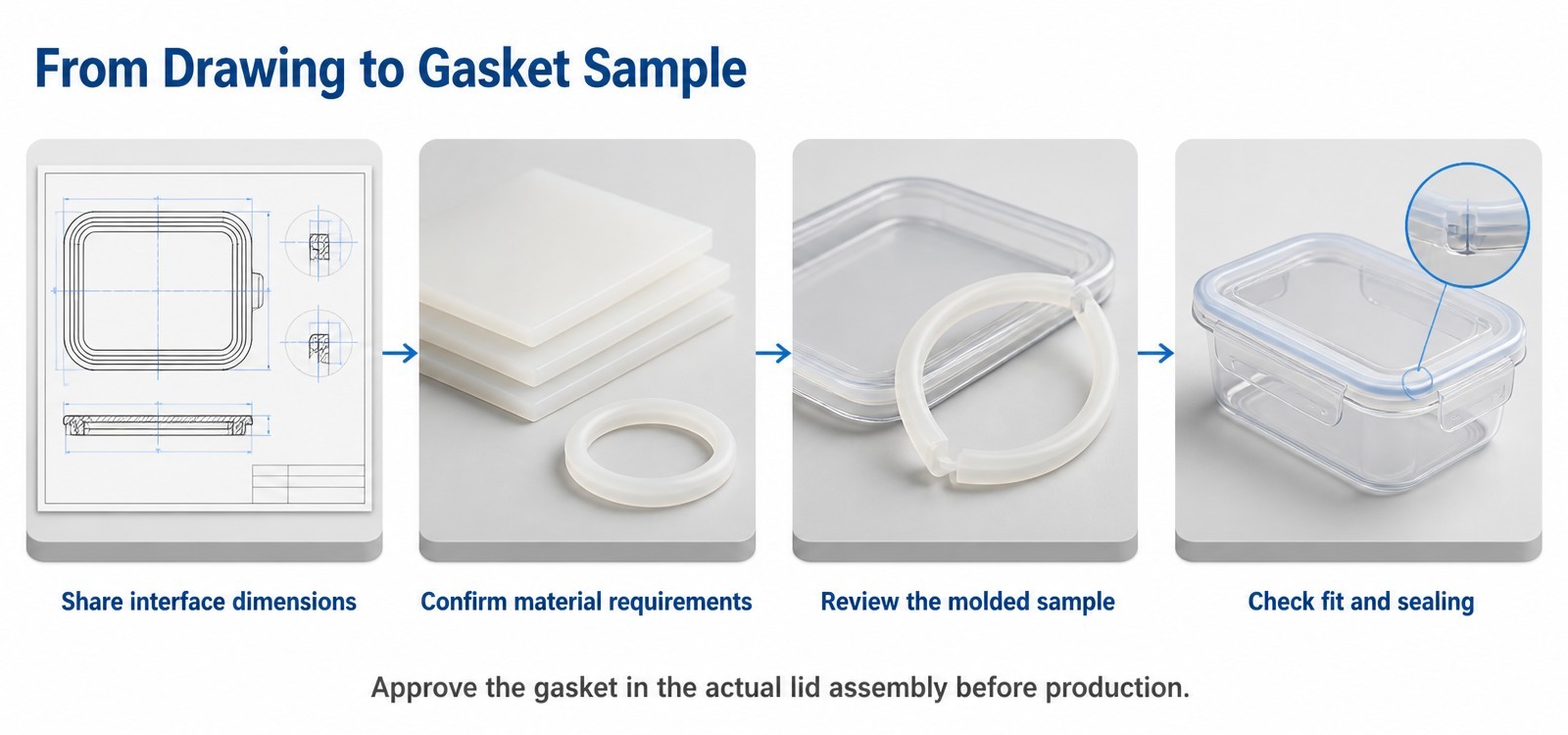
Send the lid drawing, the groove dimensions and the container's mating surface — not only a drawing of the existing gasket. A gasket drawing describes a part; the lid and groove drawings describe the job. When only the gasket is supplied, the moulder can reproduce a shape but cannot tell whether that shape was ever correct.
Confirm Material, Hardness and Application Requirements
State the food-contact markets, the temperature range in use and in cleaning, the cleaning chemicals, and the expected service life. These four answers narrow the compound, the cure system and the post-cure more than any hardness figure does.
Evaluate Samples Before Mass Production
Approve the sample in the real assembly, with the real lid, after the real wash cycle. A gasket measured on a granite table tells you whether the tool is accurate. It does not tell you whether the container leaks.
How FromRubber Supports Custom Silicone Gasket Manufacturing
FromRubber has been moulding custom silicone parts in Dongguan since 2010, across two plants running 32 compression moulding machines (30 vacuum-assisted, 2 plate presses) and a seven-machine CNC tool shop, with post-cure and inspection in-house. Food-container gaskets sit in the part of that range where geometry and material have to be decided together, so drawing review starts with the lid and the groove rather than with the gasket outline.
In practice that means reviewing the groove section against the proposed gasket profile, flagging corners where a constant section will not turn cleanly, and confirming which food-contact documentation the destination market requires before the compound is fixed. Where a customer has a physical sample but no drawing, the interface can be measured and rebuilt — which is often faster than waiting for a CAD file that does not exist.
What we will not do is promise that a given profile seals every container. A gasket is one part of a clamped assembly; the lid, the latch and the rim have as much to do with the result as the silicone does.
Frequently Asked Questions About Silicone Food Container Gaskets
What type of silicone gasket is best for food containers?
There is no universal best. Flat gaskets suit wide, flat lands with strong latches; round or D-section cord suits lids that bow or latch unevenly; moulded profiles suit narrow lands and corners that a constant section cannot follow. The deciding factor is the lid's stiffness and the contact band available, not the material.
How thick should a silicone food container gasket be?
Thick enough that the closed lid still compresses it at the loosest point of the tolerance stack, and thin enough that the latch closes without forcing. The number comes from the groove depth and the lid's closed position, which is why a thickness quoted without those two dimensions is only a guess.
Why does my silicone container gasket keep coming out of the lid?
Usually the groove is shallower than the gasket section, or it has no inner retaining wall, so the gasket has somewhere to go when the lid is opened. Warm washing makes it worse by softening the silicone and lubricating the groove. A deeper groove, a retaining lip or a moulded locating feature solves it more reliably than a firmer compound.
Can silicone gaskets be customised for different container shapes?
Yes. Circular, rectangular, oval and irregular outlines are all mouldable; the constraint is not the outline but the corner geometry and whether the section can turn the radius without collapsing. Very large thin rings may be better cut from sheet than moulded.
How can I test whether a food container gasket seals properly?
Fill the container with water, close it, and invert it over a dry surface for a defined period at room temperature; then repeat after a dishwasher cycle. A seal that passes cold and fails warm is telling you about compression set, not about the gasket's dimensions. For a production check, a pressure-decay test on a sample of lids is more repeatable than a visual inspection.
What This Means for Your Next Container Project
A leaking lid is a system problem with a locatable cause. Read where the leak appears, check whether the gasket is compressed or merely touched at that point, and confirm that the groove has room for the material it displaces. Only then decide whether the compound needs to change.
If you are working on a container where the lid geometry is fixed and the seal is not behaving, send the lid drawing and the groove section. We will tell you what the geometry implies before anyone talks about tooling. Reach us on WeChat or WhatsApp at +86 18676210913.
Sources
- 21 CFR 177.2600 — Rubber articles intended for repeated use, U.S. Electronic Code of Federal Regulations.
- Regulation (EC) No 1935/2004 on materials and articles intended to come into contact with food, EUR-Lex.
- Packaging and Food Contact Substances, U.S. Food and Drug Administration.
- Elastic recovery after compression in HNBR at low and moderate temperatures, Polymer Testing 61 (2017), SINTEF.