Silicone Gaskets for Industrial Flanges: How to Handle Uneven Sealing Surfaces
- Share
- publisher
- FromRubber
- Issue Time
- Nov 4,2026
Summary
Repeat flange leaks are usually not a material problem. A surface can be inside its flatness tolerance and still have a shape a gasket cannot follow. This article separates amplitude from wavelength, explains why a thick gasket bridges a depression instead of filling it, and sets out what to measure before specifying a custom silicone flange gasket.
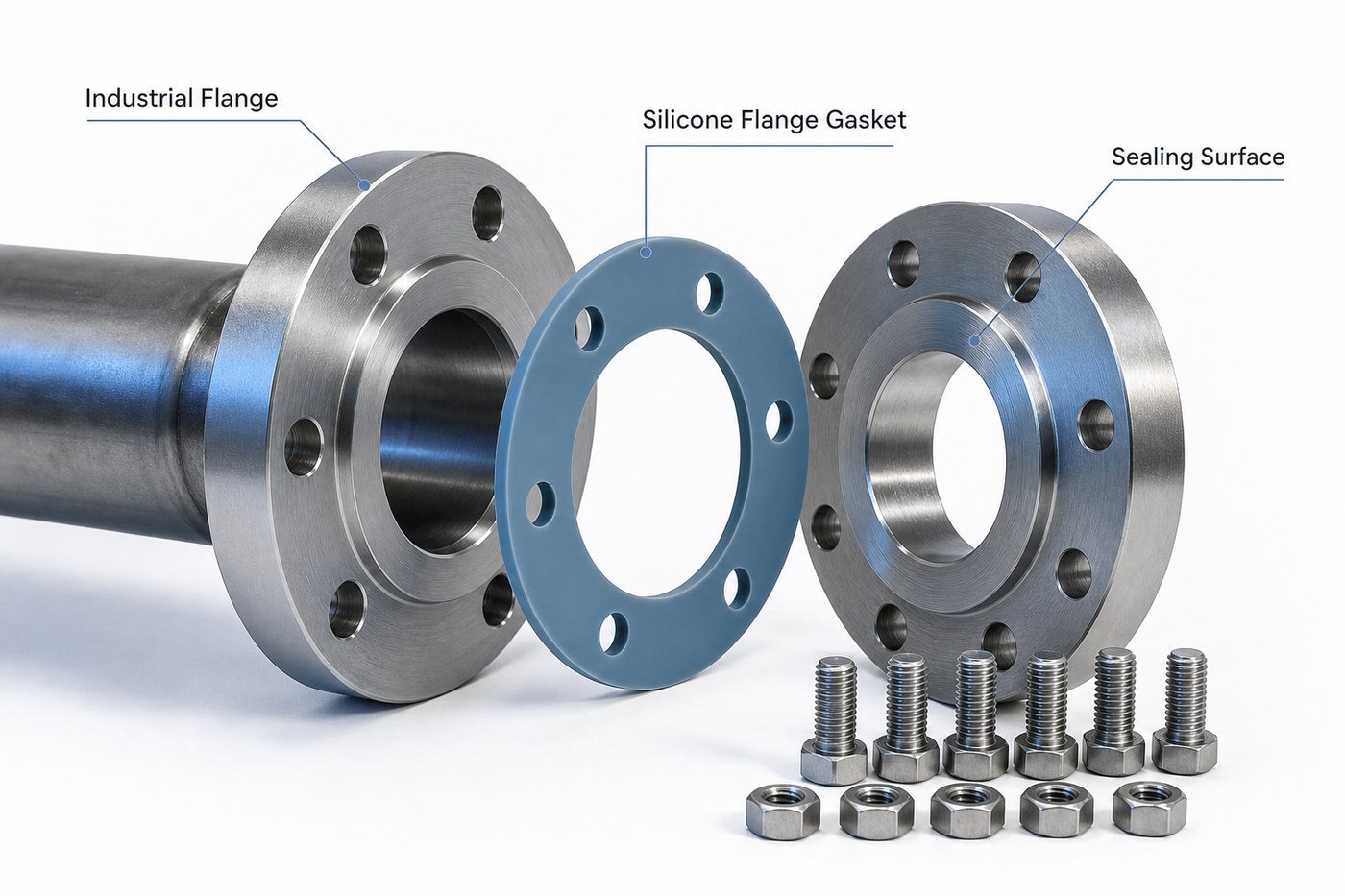
There is a particular kind of flange leak that repeats on a schedule. The joint weeps, the line is shut down, the gasket is replaced, the joint is dry for a few weeks, and then it starts again. Nobody finds a defect, because there is no defect. The flange is within its drawing tolerance. The gasket is the right size. The bolts are torqued to the specified pattern.
What is missing is a shared understanding of what "flat" means. A surface can be inside a flatness tolerance and still have a shape that a gasket cannot follow.
Silicone is often proposed for these joints because it is soft and conformable, and it is a reasonable candidate when the medium and the temperature suit it. But conformability is a budget, not a property. A section can absorb a certain amount of surface variation before it stops sealing, and that budget is spent differently depending on the shape of the variation, not just its size.
That distinction is the practical core of this article: a scratch and a dished face can have the same measured depth and completely different effects on a seal.
How an uneven flange surface defeats a gasket
Surface condition affects sealing through three separate mechanisms, and they are often confused with each other.
The first is amplitude: how far the surface deviates from a plane. The second is wavelength: over what distance that deviation happens. The third is direction: whether a defect runs across the sealing band or along it.
A shallow depression spread over 200 mm of a flange face will lift the gasket away from contact across a long arc, and no amount of bolt torque closes it, because the load is carried by the high points on either side. A scratch of the same depth but only 2 mm wide is bridged by the rubber and often has no effect at all. This is why a measured Ra value tells you very little about whether a joint will seal.
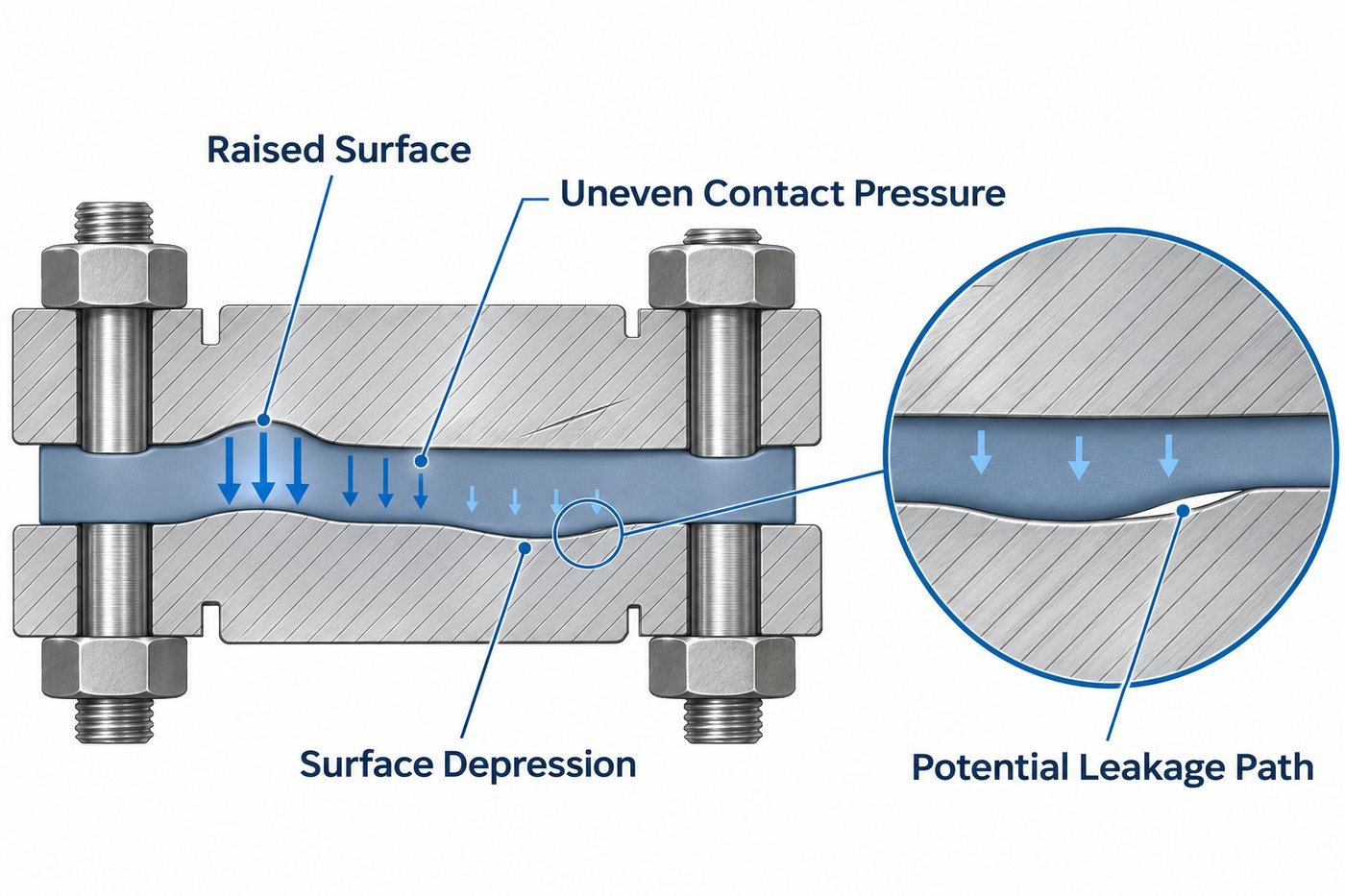
Local gaps prevent uniform contact
Where the flange falls away, the gasket is only partly loaded, and a partly loaded gasket is a path. The gap does not have to be open to leak; it only has to be wide enough that the rubber does not wet the surface. On a pressurised joint, that gap also becomes a place where the gasket can be pushed into, which is how a seal that held at low pressure starts extruding at high pressure.
High points take more compression than low points
Bolts apply load to the flange, and the flange distributes it to the high points first. The gasket under a high point is compressed hard, while the gasket over a depression is barely touched. The hard-compressed area takes a set, and the lightly compressed area never seals. Over a few thermal cycles, the hard area stops pushing back and the joint loosens.
Scratches and surface defects as leakage paths
A scratch that runs radially across the sealing band is a channel. A scratch that runs circumferentially inside the band may be harmless, because the gasket bridges it along its length. This is why the direction of a defect matters more than its depth, and why a visual inspection that only records "surface scratched" is not much use to whoever has to decide whether to re-machine the flange.
| Surface condition | Runs across or along the sealing band | Effect on the seal | What to do |
|---|---|---|---|
| Fine machining marks | Either | Bridged by the gasket, no measurable effect | Nothing |
| Scratch crossing the band | Across | Acts as a channel between the inside and outside | Polish or re-machine the local area |
| Score running around the band | Along | Usually bridged along its length | Record and monitor |
| Dished or warped face | Across the whole face | Gasket lifts over the depression; load carried by the high points | Re-machine or re-align; no gasket change fixes it |
Can a silicone gasket compensate for an uneven flange?
Within limits, yes. Outside those limits, no gasket will, and it is worth being direct about where the line sits.
How silicone deformation fills small gaps
Silicone is highly elastic and, at moderate hardness, it flows into small irregularities under load. That is genuinely useful on a machined face with fine tool marks or a light score. The limit is set by how much the section can deform without losing its ability to push back, and by how much space there is for the displaced material to go.
Why badly uneven surfaces cannot be solved by gasket selection alone
If the flange is dished, warped or stepped, the gasket would have to change thickness along its length to maintain contact. It cannot. A thicker gasket does not follow a dish; it bridges it and leaves the same gap underneath, with more rubber to extrude at the edges. In those cases the flange needs machining, alignment or a different joint design, and a gasket change is a delay rather than a fix.
When a softer gasket is worth considering
Softer compounds conform better and seal at lower bolt load, which helps on a thin or flexible flange where the available clamping force is limited. The trade-off is extrusion resistance and compression set: a soft gasket in a wide gap under pressure will migrate. Soft is a solution for low load, not for large gaps.
Choosing gasket thickness for a flange that is not perfect
Thickness is usually treated as a strength decision. On a flange joint it is a conformity decision, and getting it wrong moves the failure rather than removing it.
A thin gasket has a small conformity budget. It can close a well-machined joint with modest bolt load, and it is stable under pressure because there is very little material to extrude. Put it on a dished face and it simply follows the high points, leaving the depression open.
A thick gasket has more material to deform, which sounds like more tolerance, but the extra material also has more freedom to move sideways. Under uneven clamping it deforms unevenly, and at the edge of the flange it can creep out of the joint. Thick does not mean forgiving; it means the deformation is larger and harder to predict.
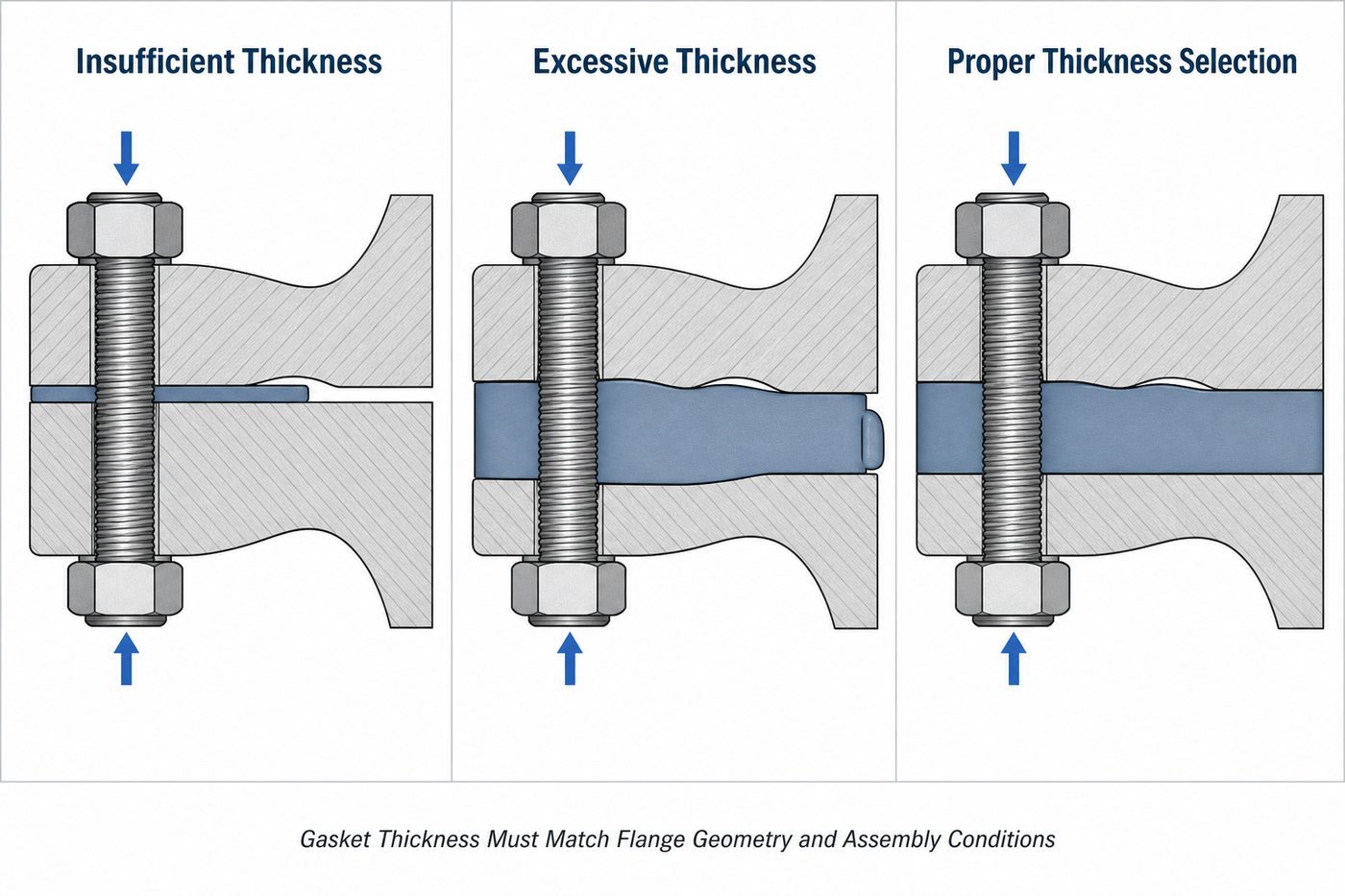
Thin gaskets and limited gap compensation
A thin section works when the flange is machined flat and the bolt load is high. On a large diameter with a long bolt circle, thin sections are also easier to keep in place during assembly, which matters more than it sounds on a vertical joint.
Thick gaskets and the risk of uneven deformation
Beyond a certain thickness, the gasket stops behaving like a compressed sheet and starts behaving like a body of rubber being squeezed between two plates. It bulges, it creeps, and it can be pushed into the bore on a pressurised joint. On a flange with a surface depression, a thick gasket will still compress preferentially over the high points, so the gap does not close; it just gets filled with deformed rubber that has lost its recovery.
Matching thickness to flange geometry and bolting
The variables are the measured gap, the bolt spacing, the bolt size and the stiffness of the flange. A wide bolt spacing on a thin flange produces a wavy compression pattern no matter what gasket is used. If the joint has to work, the thickness should be chosen after the bolt layout is checked, not before.
Material properties that matter on a flange
Hardness and conformity
Hardness sets both conformity and extrusion resistance, and the two pull in opposite directions. On a well-machined joint, a firmer compound gives a more stable seal and better creep resistance. On a marginal surface, a softer one conforms better. The decision needs the measured surface condition, not a general preference.
Compression set and long-term stability
A flange joint stays compressed for years. The property that decides whether it is still sealing at the end of that time is compression set, measured at the service temperature. A gasket that has taken a set has stopped following the flange, and on a joint that also sees thermal cycling the loss shows up as a loosening bolt torque rather than an obvious leak. Where the surface itself is the problem, this article on sealing irregular surfaces goes further into contact and gap behaviour.
Temperature and chemical compatibility
This is where silicone has to be chosen carefully rather than by default. Silicone handles heat well and handles many aqueous media, but it is not universally compatible with oils, fuels and some solvents, and it should not be assumed to suit steam service without checking. If the medium is a hydrocarbon, a nitrile or fluoroelastomer may be the correct material even when silicone would be easier to mould. Confirming the actual medium, concentration and temperature is part of the gasket design, not a purchasing detail.
Improving the seal when the surface is already uneven
Measure the surface properly
Record where the deviation is, how large it is, and over what distance it occurs. A flatness map or a set of feeler gauge readings across the face is more useful than a single roughness number, because it shows whether the problem is local or distributed.
Optimise contact width and section
A narrower contact band raises the unit pressure for the same bolt load, which helps on a hard-to-conform surface but reduces tolerance to lateral movement. A custom profile can put the sealing line where the flange is actually flat, which is sometimes a better answer than trying to seal across the whole face.
Review bolt layout and tightening
Torque sequence matters as much as torque value. A star pattern in stages distributes load more evenly than tightening each bolt fully in turn, and on a large flange the difference is visible in the contact pattern. If the bolt spacing is too wide for the flange stiffness, no gasket will produce uniform compression.
Verify with an assembly test
Test at the service temperature and pressure, not at ambient with a hand pump. A joint that holds cold water at low pressure can weep hot fluid at line pressure, and the difference is usually the flange moving as it heats.
What to send with a flange gasket enquiry
- Flange drawing with the bolt circle, bolt size and bolt count.
- Inner and outer diameter of the sealing face, and the width of the land.
- Measured flatness or a description of where the surface deviates.
- Gasket thickness currently used, and what happened to it in service.
- Operating temperature and pressure, including cycling.
- The medium, its concentration, and any cleaning chemicals.
- Bolt torque and tightening sequence if defined.
- Any test the joint has to pass, and the standard it is assessed against.
From drawing to production
On a non-standard flange, the useful development work happens before the mould: checking whether the sealing line can be moved to a flatter part of the face, whether a profiled section would conform better than a flat sheet, and whether the bolt layout allows even compression at all.
Sampling should include an assembly trial on the real joint. A gasket that measures correctly and leaks in service has usually not been tested against the flange it has to seal, only against a drawing of it.
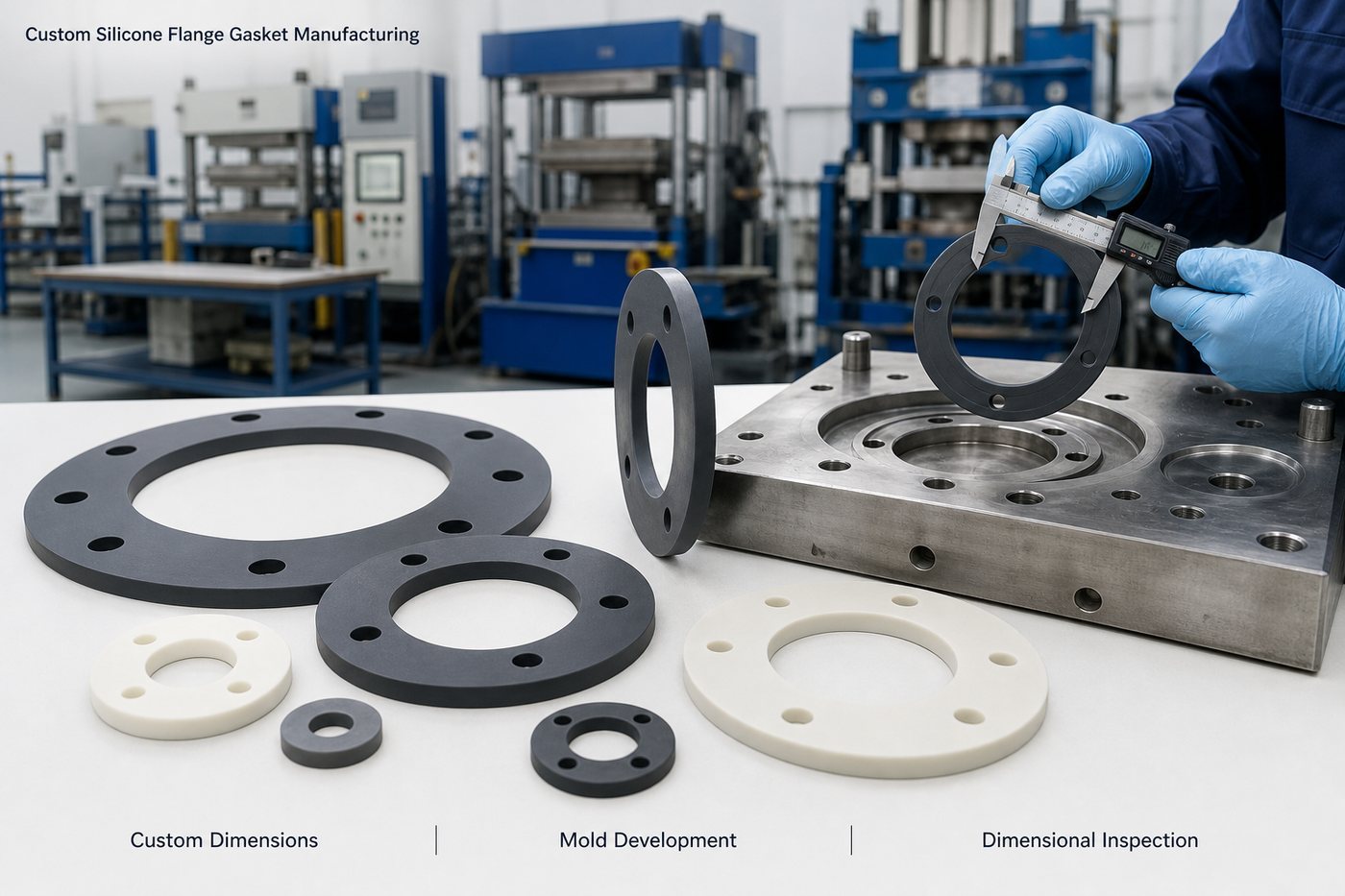
Reviewing the flange and the application
The review should cover the medium first, because that decides whether silicone is the right material at all. After that, the surface condition and the bolting decide the section.
Developing the shape and dimensions
Custom inner and outer diameters, bolt-hole patterns and profiled sealing lines are all tooling decisions. On a retrofit, matching an existing gasket dimension is not always right, because the existing gasket may be part of the problem.
Mould, sample and inspect
Inspection on a flange gasket should concentrate on thickness consistency around the circumference and on the flatness of the sealing faces. A gasket that is thicker on one side will compress unevenly before the bolts are even tightened.
Custom flange gaskets at FromRubber
FromRubber moulds custom silicone gaskets for industrial equipment from drawings and samples, including non-standard flange shapes, bolt patterns and profiled sealing sections. Tooling is built in-house in a CNC shop with 7 machines, and production runs on 32 compression moulding machines, 30 vacuum hydraulic presses and 2 flat-bed presses, across two plants, with dimensional inspection at the press and before packing. The in-house tooling shop has run since 2018, so a non-standard bolt pattern or an unusual bore is a tooling question rather than a reason to decline the job. Flange and industrial seals sit within the oil and fuel resistant gasket range where the medium allows it.
If a flange joint keeps returning to the maintenance list, the surface measurement and the failed gasket are more informative than a new compound trial. Send both, along with the medium and operating conditions, through the inquiry page, or discuss them on WhatsApp and WeChat at +86 18676210913.
Questions from industrial buyers
Will a thicker gasket seal a flange with a surface depression?
Usually not. A thicker gasket bridges the depression instead of filling it, and the extra material has more freedom to creep at the edges. The gap under the gasket stays, and the joint continues to weep.
Is silicone suitable for all industrial flange media?
No. Silicone is strong on heat and on many aqueous media, but it swells in contact with many hydrocarbons and is not a universal choice for oils, fuels or steam. The medium, concentration and temperature have to be checked before the material is chosen.
Can I use a softer silicone to conform to a rough flange?
It helps at low bolt load, but soft compounds extrude more readily and take set faster. If the roughness is a scratch, a softer gasket may be enough. If it is a dish, softness will not close it.
How much surface unevenness can a gasket absorb?
There is no single answer, because it depends on the wavelength of the deviation, the contact width, the bolt load and the hardness together. That is why a measured flatness map is more useful than a single tolerance value when specifying the joint.
Why does the joint leak again a few weeks after a gasket change?
Either the new gasket took a compression set under the same uneven load, or the flange moved as it reached operating temperature. A repeat failure on a short cycle usually means the surface condition was never addressed.
Uneven flange sealing is not a materials problem that a better compound solves. It is a geometry problem where the gasket has a fixed budget for conforming, and the flange spends that budget in a way that depends on the shape of the deviation, not just its size.
Measure the surface, look at the old gasket, and check the bolt layout. Those three pieces of evidence usually explain a repeat leak better than any specification sheet.