Silicone Keypad Brittle Failure at -30°C in Cold Chain Data Loggers: Low-Temperature Flexibility Formulation and Rebound Retention
- Share
- publisher
- FromRubber
- Issue Time
- Oct 5,2026
Summary
A keypad that feels crisp at 23°C can turn stiff at -30°C, and it can lose rebound long before it ever cracks. This article separates reversible low-temperature hardening from permanent damage, then works through formulation, membrane and return-leg geometry, housing compression, and a cold-condition test sequence that measures the finished keypad instead of a flat test sheet.
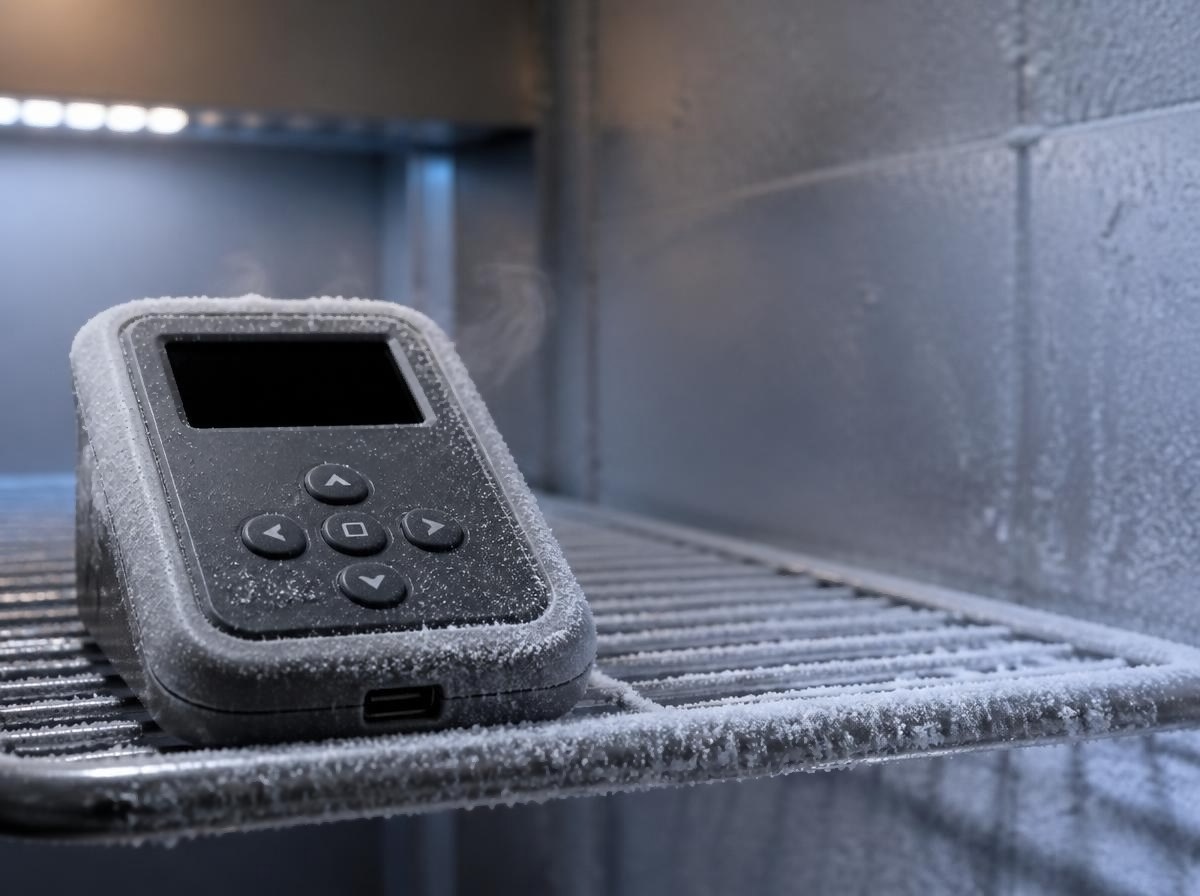
A cold-chain data logger can pass every bench check at 23 °C and still come back from its first winter shipment with a keypad that feels like a brick. The buttons still move. The contacts still close. But the operator pressing them through a glove, at −30 °C, has to lean into the panel to get a response — and after a few hundred presses one key stops coming back at all. That gap between “it works on the bench” and “it works in the truck” is where most low-temperature keypad problems live, and it is almost never a single material property that causes it.
Why a silicone keypad behaves so differently at −30 °C
A silicone keypad is a mechanical spring made of rubber. Everything an operator feels — the initial resistance, the snap, the return — comes from the shape of the force–displacement curve produced by a molded membrane, a key wall and a return leg, pushing against a fixed contact on the PCB. When the temperature drops, that spring changes its behaviour in three separate ways, and they do not fail at the same time.
What actually changes inside the material
1. Hardness at room temperature is not a low-temperature specification
Shore A hardness is measured under a fixed, short-duration indentation at a controlled temperature. It tells you how a compound resists a needle at that moment. It says nothing about how the same compound will store and release energy 40 hours later, at −30 °C, under a compression load. Two compounds that both read 50 Shore A on the same afternoon can behave completely differently in a freezer, because hardness and low-temperature elasticity are governed by different parts of the formulation.
As temperature falls, the silicone backbone loses mobility. Below a material-specific transition region, chain segments can no longer rearrange quickly enough to keep up with deformation, and the compound starts to behave stiffly. In some formulations the effect is amplified by crystallisation, and this is the trap: crystallisation-driven stiffening is largely reversible, while the damage it causes during repeated actuation is not. ISO 815-2:2019 describes exactly this difficulty in its scope note — at low temperatures, glass hardening and crystallisation dominate the compression-set result, and because those effects reverse on warming, the measurement has to be taken at the test temperature rather than after the sample returns to the lab.
2. Reduced flexibility shows up as lost key travel
Key travel is not a fixed number in a drawing. It is the distance the key can move before the membrane beneath it runs out of compliant material to give. When the compound stiffens, the same physical geometry now resists the same displacement with a much higher force, so the practical travel an operator can achieve with a thumb drops.
The symptom in the field is not usually “the button does not work”. It is “the operator has to press harder, and sometimes presses twice”. On a data logger used inside a freezer with gloves on, that is the difference between a two-second interaction and a ten-second one, and it is the reason low-temperature failures are so often reported as complaints about feel rather than as electrical faults.
3. Rebound retention is the slower, quieter problem
Immediate rebound and rebound retention are two different things, and only one of them is visible during a quick manual check. Immediate rebound is what you feel when you release a key and watch it pop back. Rebound retention is what remains of that behaviour after the keypad has been cycled repeatedly at low temperature, held under compression in a housing, and then cooled again.
A keypad can look perfectly intact — no cracks, no deformation, no discolouration — while its tactile performance has already drifted. If the return leg is sitting slightly compressed between the silicone and the housing, and the compound has taken a small permanent set at low temperature, the key loses its snap long before it loses its appearance. This is why incoming inspection on a warm bench misses the problem entirely.
Where the failure actually comes from
Formulation, not a single “best” compound
There is no universally correct low-temperature compound. What formulators do, in general practice, is shift the polymer system so that the transition region moves well below the intended service temperature, often by introducing bulky substituents along the siloxane chain and by controlling filler loading so the compound does not over-stiffen. That gives flexibility at low temperature but can cost something in tensile behaviour, compression set at high temperature, or cost per kilogram.
The practical point is that formulation has to be selected against the whole duty cycle — minimum operating temperature, how long the part stays there, how many actuations happen while it is cold, and how quickly it must recover — not against a single hardness target. A compound chosen only because it reads softer is not automatically better in a freezer.
Hardness versus low-temperature flexibility is a real trade-off
Dropping the nominal Shore A is the reflex answer, and it often makes things worse. A softer compound at room temperature can lose structural stability in thin sections, deform under assembly compression, and give a mushy key with poor tactile definition once it returns to normal conditions. The design question is not “how soft can we go” but “what force curve do we need at −30 °C, and what geometry produces it with a compound that also survives +70 °C storage”.
Thin walls and geometry amplify everything
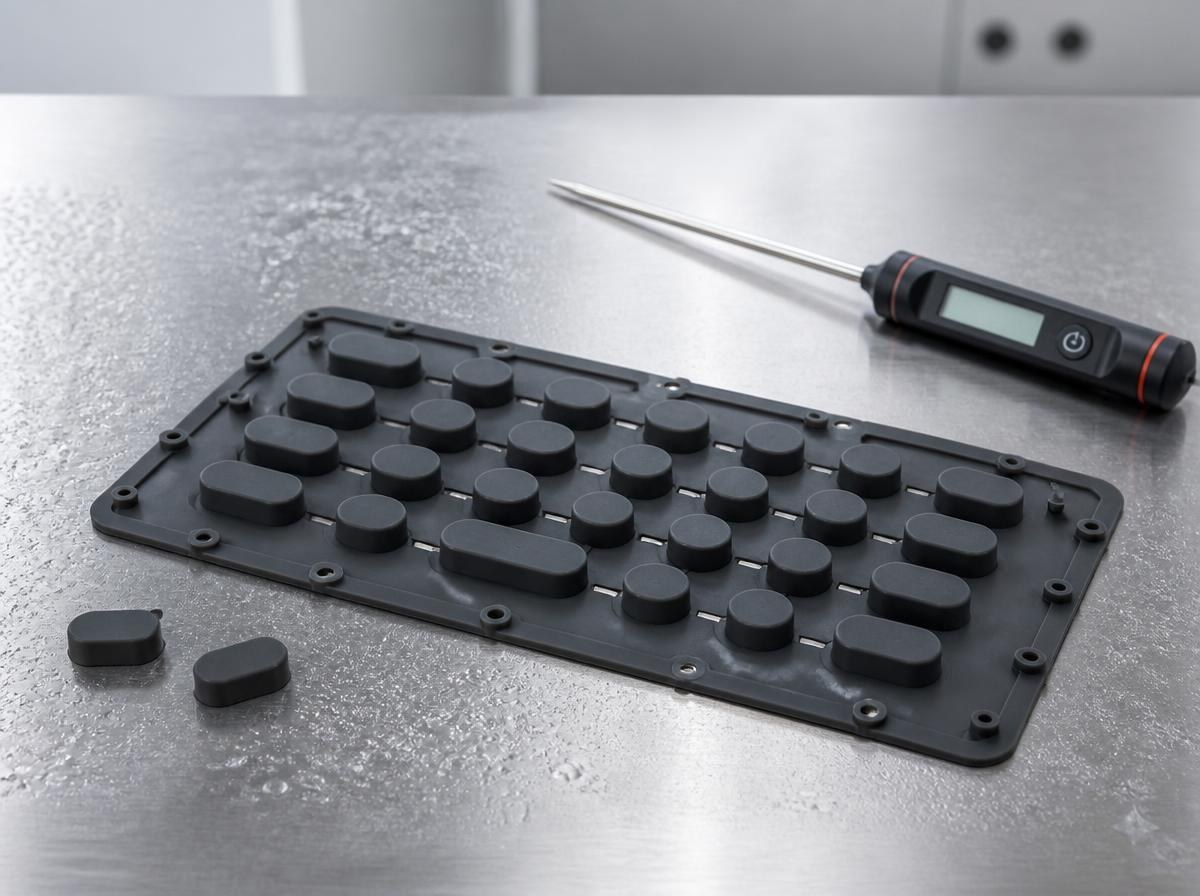
Geometry is where formulation problems get magnified. A membrane that is thin enough to give a light actuation force is also the first place where stiffening becomes mechanical rather than elastic. Sharp internal corners, abrupt wall-to-membrane transitions and uneven return legs create local stress concentrations; at low temperature those points become crack initiation sites. The same geometry that was acceptable at 23 °C is effectively a different part once the material is 40 % stiffer.
Why the housing interface decides half the outcome
Once a keypad is bolted into a housing, it is no longer a free-standing part. The mounting compression between the flange and the enclosure pre-loads the silicone. If the tolerance stack closes further than intended, the pre-load can be enough to hold a key partially depressed at room temperature. At low temperature, where the compound resists compression more strongly and relaxes more slowly, that pre-load turns into exactly the condition that produces permanent set.
Two units from the same production batch can therefore behave differently in the field purely because of housing tolerance. When a low-temperature complaint arrives, the housing drawing deserves the same scrutiny as the material certificate.
Designing a silicone keypad that holds up at −30 °C
Start by defining the temperature envelope properly
Write down four numbers before anything else: minimum operating temperature, minimum storage temperature, the longest continuous dwell at that temperature, and the number of actuations expected while cold. A keypad that is pressed twice a day in a cold store is a different engineering problem from one pressed two hundred times during a single unloading shift.
Balance tactile force and rebound together
Actuation force, travel and rebound should be specified as a set, because they trade against each other. Raising the key wall thickens the spring; lowering the force softens the snap. The usual approach is to fix a target actuation-force window measured at the lowest operating temperature, then tune geometry — membrane thickness, key height, return-leg length — until the room-temperature and cold-condition curves both sit inside the window. If only the room-temperature force is specified, the cold end will be whatever the material happens to do.
Treat the silicone-to-housing interface as a design feature
Give the flange a defined compression window rather than a nominal squeeze, and specify the mating surface flatness. Where a part must seal as well as actuate, keep the sealing lip geometrically separate from the actuating membrane so that compression for sealing does not pre-load the keys.
A low-temperature test sequence that answers the real question
Most low-temperature testing fails not because the chamber is wrong, but because the acceptance criteria are written afterwards. Fix the pass/fail numbers first, then run the sequence:
- Inspect the sampled keypads visually and record the reference photographs.
- Measure initial hardness on a flat area of each part, not on a key crown.
- Measure actuation force and record the full force–displacement curve for at least three keys per panel.
- Record key travel at the rated actuation force.
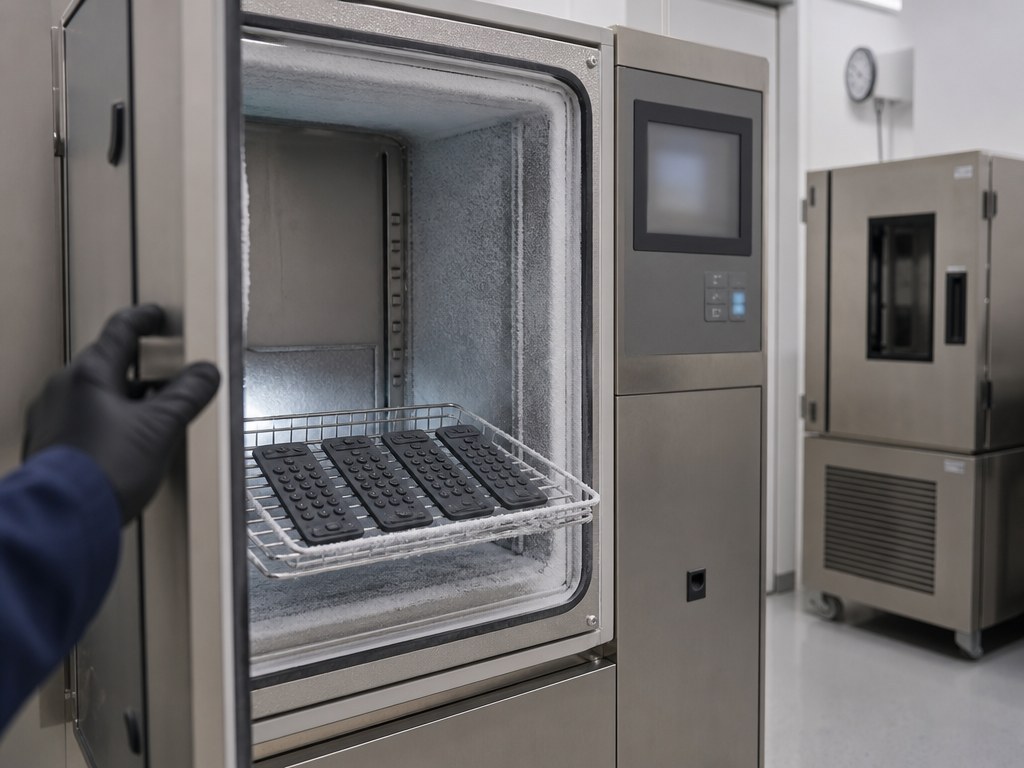
- Condition the samples at the minimum operating temperature long enough for the whole part to reach equilibrium, not just the surface.
- Cycle the keys the expected number of cold actuations, at the cold temperature.
- Re-measure force, travel and return speed while the samples are still cold.
- Inspect at magnification for cracks, tearing, local deformation and permanent set on the return legs.
- Warm the samples, let them stabilise, then measure again to separate reversible effects from permanent ones.
Where the end product has to demonstrate environmental performance, the cold-test methods described in IEC 60068-2-1:2025 give a recognised framework for conditioning and for testing equipment that must remain operational throughout the exposure, which is usually closer to a cold-chain duty cycle than a simple storage soak.
Temporary stiffening or permanent damage?
The single most useful distinction in a low-temperature investigation is whether the part recovered. The table below separates the two.
| Observation at −30 °C | Behaviour after returning to 23 °C | What it indicates |
|---|---|---|
| Hardness and actuation force increase | Returns to within the original window | Normal reversible stiffening. Acceptable if the cold-force value is still inside the operator’s window. |
| Slower return, reduced snap | Recovers over minutes to hours | Time-dependent elastic recovery. Check the duty cycle — repeated fast presses may still be a problem. |
| Visible cracking or tearing at a wall transition | Does not recover | Mechanical failure. Investigate stress concentration and compound selection. |
| Permanent deformation of the return leg | Partially or not at all | Compression set driven by pre-load plus cold dwell. Check the housing interface. |
| Surface gloss change, whitening or local marking | Usually permanent | Local damage or mould-surface transfer. Verify mould condition and demoulding. |
Questions to settle before a cold-chain keypad goes to tooling
- Minimum operating temperature and minimum storage temperature, stated separately?
- Continuous exposure or intermittent, and how long is the longest dwell?
- Required hardness range at 23 °C, and the acceptable force window at the cold limit?
- Actuation force at room temperature and at the cold limit?
- Expected total actuation cycles, and how many of those happen cold?
- Is backlighting required, and does the light path pass through the silicone?
- Conductive carbon contact, or a separate metal dome / tact switch under the key?
- Housing cavity dimensions, flange compression window and mating-surface flatness?
- Surface marking method and the abrasion requirement it has to survive?
How this looks in production
Low-temperature keypad programs tend to fail in the same place: the transition from a room-temperature sample approval to a cold-condition qualification. In our own work on cold-chain and outdoor instrument keypads at FromRubber, the useful shift was to move the force measurement into the cold chamber and to bring the housing drawing into the same review as the material sheet, so that pre-load and compound were decided together rather than sequentially.
FromRubber is a custom silicone rubber parts manufacturer — keypads, gaskets, seals and moulded technical parts — and we do not build the data loggers, controllers or enclosures our parts sit inside. What we can do is help define the material, membrane geometry and interface compression against a stated temperature and cycle requirement, and then measure the finished part rather than a flat test sheet.
What to take away
Low-temperature keypad reliability is decided by four things working together: the compound’s transition behaviour, the geometry of the membrane and return structures, the compression the housing applies to the flange, and a validation sequence with the acceptance numbers written down in advance. A single hardness figure — however carefully measured at 23 °C — predicts none of them on its own. If a keypad is going into a freezer, specify the cold-force window and the cold test method, and then measure the finished part while it is still cold.
References
- ISO 815-2:2019, Rubber, vulcanized or thermoplastic — Determination of compression set — Part 2: At low temperatures — https://www.iso.org/standard/74944.html
- IEC 60068-2-1:2025, Environmental testing — Part 2-1: Tests — Test A: Cold — https://webstore.iec.ch/en/publication/82354
- SINTEF, Elastic recovery after compression in HNBR at low and moderate temperatures: Experiment and modelling — https://www.sintef.no/publikasjoner/publikasjon/1470925/
Related reading on this site: selecting the right tactile force for control-panel silicone buttons, carbon contact wear after repeated button pressing, and the custom silicone rubber keypad range. If you have a cold-temperature requirement to work against, send the drawing and duty cycle to nani@fromrubber.com or karl@fromrubber.com, or reach us on WeChat / WhatsApp at +86 18676210913; our technical support page lists what to include. FromRubber — custom silicone rubber parts, Dongguan, China.