Silicone Keypad Printing: Why Legends Fail in Service
- Share
- publisher
- FromRubber
- Issue Time
- Nov 19,2026
Summary
Printed legends on industrial keypads fail at an interface, not in the middle of the ink. A practical look at ink systems, surface preparation, printing routes and cleaning agents, plus the checks that predict field wear better than a bench inspection.
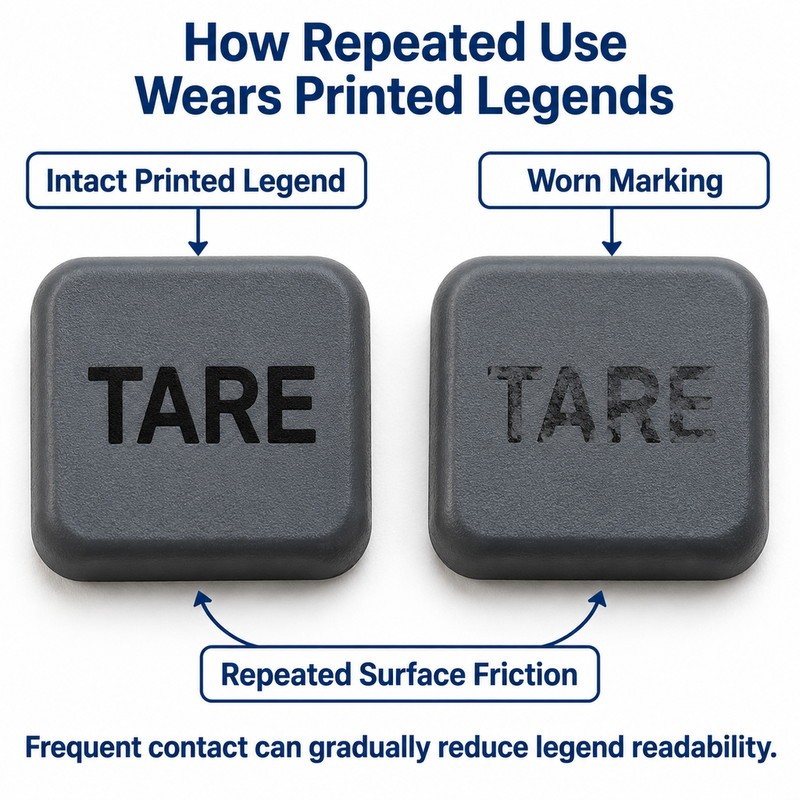
A scale keypad usually comes back from the field with the same complaint: the numbers are still there, but the “TARE” label is half gone and the operator has started counting button positions instead of reading them.
The instinct is to ask for harder ink. Harder ink is rarely the answer. Silicone keypad printing fails at an interface, not in the middle of a printed layer, and the interface that fails first is almost always the one at the edge of the legend — the place where ink stops and bare rubber begins.
This article follows that edge. It covers what actually removes ink from a keypad in service, which printing choices change the outcome, and what to measure before approving a printed sample.
Why Do Printed Legends Wear Off Industrial Silicone Keypads?
How Repeated Finger Contact Gradually Damages Printed Markings
A legend is a thin film of cured ink sitting on a low-energy surface. Every press delivers a small tangential load to that film, because a fingertip does not land perfectly vertically. Over a few hundred thousand cycles the film does not simply thin — it develops micro-cracks at the perimeter, where the ink layer ends and the stress concentration is highest.
Once a crack reaches the silicone, cleaning fluid and skin oils enter it. The ink then lifts from the edge rather than wearing from the top, and the legend loses whole strokes instead of fading gradually. That is the signature to look for on a returned part: if the ink is missing in flakes at the perimeter, the adhesion interface failed. If the ink is uniformly thin with the rubber texture showing through, the ink itself abraded.
The two failure modes have different fixes, and suppliers who treat both as “needs better ink” usually change the wrong variable.
Why Silicone Rubber Can Be Challenging for Printing Adhesion
Silicone is a poor substrate for anything that wants to stick to it. Its surface energy is low, it is flexible, and it is chemically inert by design — the same properties that make it a good keypad material make it a difficult printing surface. Ink does not soak in; it has to bond to the surface through chemistry rather than mechanical keying.
That is why the ink system matters more than the printing technique. A two-part addition-cure silicone ink crosslinks into the rubber and moves with it. A solvent-borne ink that dries by evaporation sits on top and relies on adhesion promoters; it can look perfect on the first article and delaminate after a few thousand presses, especially where the button flexes.
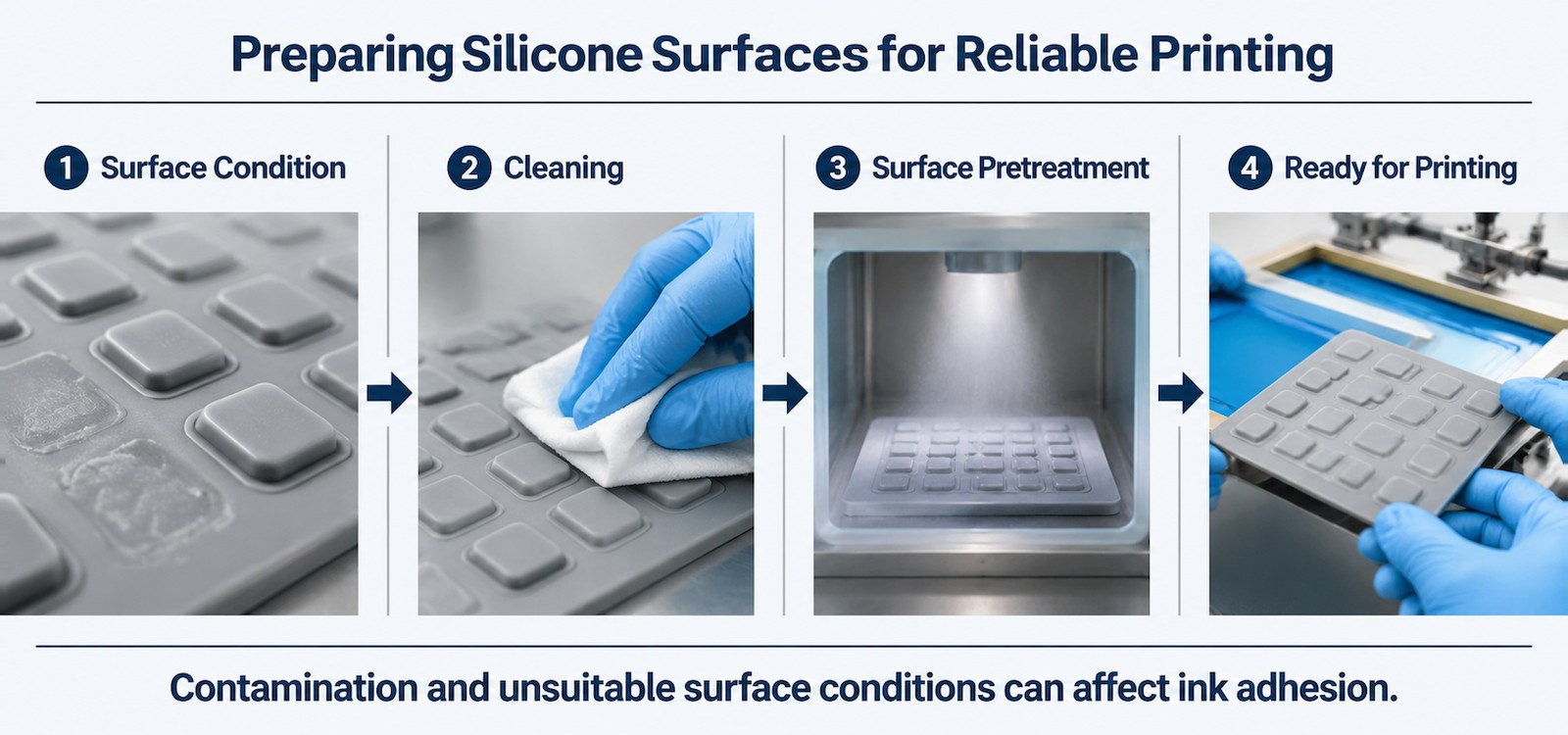
Surface contamination is the other half. Mould release agent, dust from trimming, skin oils from handling and plasticiser from packaging all sit between the rubber and the ink. A surface that has been handled without gloves before printing will produce legends that pass a visual check and fail in service.
How Cleaning Chemicals and Environmental Exposure Accelerate Legend Wear
Industrial equipment gets wiped. Alcohol, quaternary ammonium disinfectants, degreasers, and in food and medical settings, chlorine-based sanitisers. Each of these attacks a different part of the ink system: solvents swell the binder, surfactants migrate along the interface, and oxidisers attack the cured film itself.
Heat adds to it. A keypad on equipment near an oven, a steriliser or an engine bay spends its life at a temperature that softens the ink slightly and lets the wipe do more damage per pass. Temperature cycling then opens the micro-cracks further. If you know the cleaning agent and the surface temperature, you already know more about the legend’s life than any abrasion figure will tell you.
Which Printing Factors Affect Silicone Keypad Legend Durability?
Choosing Printing Inks That Bond Properly With Silicone Rubber
Ink selection starts with the substrate, then the cure schedule, then the environment. A silicone-specific ink that cures at elevated temperature needs a bake step that the schedule has to allow for; skipping or shortening the bake to hit a ship date is one of the quiet causes of legends that wear early. The ink may be dry to the touch and still under-cured at the interface.
Colour matters more than people expect. White and light colours need more pigment to reach opacity, and more pigment means less binder at the surface, which changes both adhesion and abrasion behaviour. A supplier who prints white legends with the same parameters as black ones is guessing.
How Surface Cleaning and Pretreatment Affect Printing Adhesion
Cleaning removes what should not be there. Pretreatment changes what is there. On silicone, that usually means a controlled surface modification or a primer that gives the ink a chemical bridge to the rubber. Both need to be matched to the specific compound: a pretreatment that works on a 40 Shore A general-purpose silicone is not automatically right for a flame-retardant or oil-resistant grade, because the additives at the surface are different.
The failure pattern when pretreatment is wrong is consistent: good initial adhesion, then peeling that starts in the areas of highest flex, usually the skirt of the most-used key. If a printed sample passes a tape test flat and fails after a week of use, the interface was never right.
Why Printing Thickness and Coverage Matter for Long-Term Performance
Thicker ink is not stronger ink. Beyond a point, a thicker film is more brittle, cures less evenly through its depth, and cracks sooner under flex. Thin, even coverage that fully cures usually outlasts a heavy deposit that is dry on top and soft underneath.
Coverage also affects how the legend reads. A symbol printed with uneven ink density will look patchy under low-angle light long before it fails, and on a backlit keypad the same variation becomes a brightness difference — which is why printing and light transmission have to be reviewed together rather than by two different people.
How Do Different Silicone Keypad Printing Methods Affect Wear Resistance?
Screen Printing for Clear and Consistent Keypad Legends
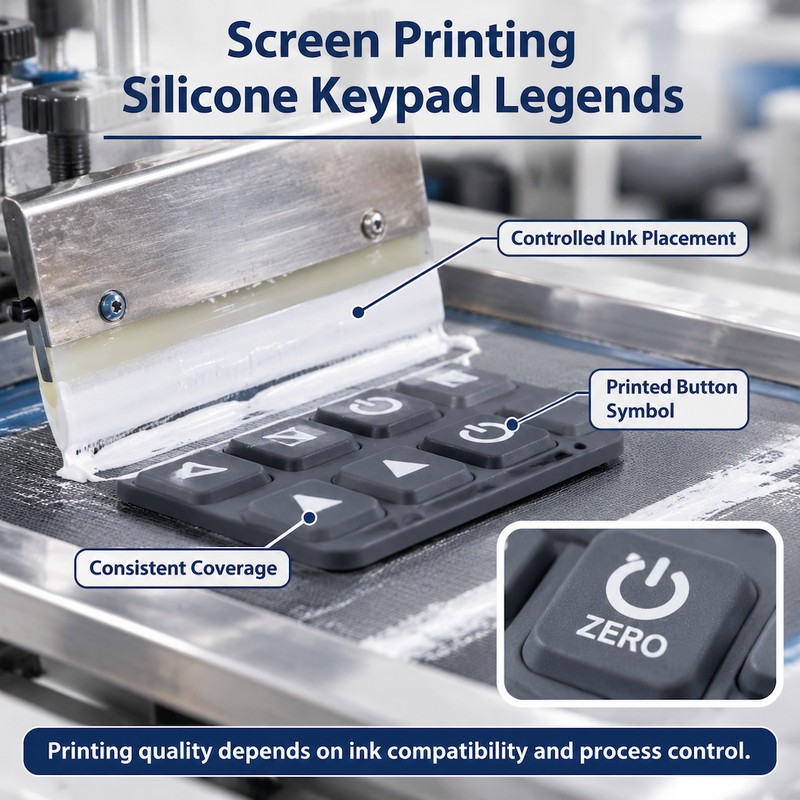
Screen printing remains the default for industrial keypads because it deposits a predictable film thickness in one pass and holds registration well across a large panel. Symbols, unit labels and multi-colour functional markings all suit it. Wear resistance depends on the ink, the cure and the surface preparation; the mesh choice mainly decides how much ink is available to cure.
Registration is where screen printing goes wrong on keypads. A legend that sits a few tenths of a millimetre off centre on a raised button looks acceptable on a flat proof and obviously wrong once the key is moulded, because the button top is domed. Printing after moulding, with the part located on the button geometry rather than the pad edge, avoids most of this.
Laser Etching for Backlit Silicone Keypad Markings
Laser etching removes material instead of adding it. On a translucent keypad with an opaque sprayed surface, the laser cuts through the coating to expose translucent silicone underneath, and the light comes through the exposed area. There is no ink film to delaminate, so the wear question changes from adhesion to geometry: the etched pocket collects dirt, and the edges of the pocket can fray if the laser parameters are too hot.
Etching is also used on solid-colour keys to create a recessed legend that sits below the finger contact plane. That recess protects the marking, at the cost of a small change in surface feel and a place for dust to gather. On equipment cleaned with a cloth rather than a brush, it is usually the more durable option. A chemical resistant equipment keypad often combines etched legends with a printed colour layer for exactly this reason.
Protective Coatings for Frequently Used Industrial Buttons
A clear coating over the printed legend adds a wear layer, and it changes what fails. Instead of the ink wearing, the coating wears — and if the coating is softer than the ink, the legend may look worse sooner. Coatings also change gloss and tactile feel, which matters on a keypad where operators work by touch.
The useful question is not whether to coat, but what the coating is expected to survive. A coating chosen for chemical resistance behaves differently from one chosen for abrasion. Specifying both without saying which matters more leaves the decision to whoever quotes the job.
| Route | Typical failure | Works well when | Watch out for |
|---|---|---|---|
| Screen printing, silicone ink | Edge peeling after flex cycles | Multi-colour legends, large panels, unit labels | Under-cure, registration on domed buttons |
| Pad printing, silicone ink | Thin coverage on tall keys | Small symbols on uneven surfaces | Ink transfer varies with pad wear |
| Laser etching through coating | Dirt in the etched pocket | Backlit keys, harsh cleaning | Laser parameters, coating thickness uniformity |
| Laser etching, recessed legend | Frayed pocket edge | High-contact keys, single colour | Depth consistency across the pad |
| Printed plus clear coat | Coating wear or hazing | Chemical exposure with moderate abrasion | Coating softer than the ink, feel change |
| Moulded-in legend (two-shot) | Colour bleed at the boundary | Legends that must never wear | Tool cost, minimum feature size |
How Can Silicone Keypad Design Help Prevent Printed Legend Wear?
Recessed and Protected Marking Areas for High-Contact Buttons
If a legend sits on the highest point of a button, it takes the full contact load. Moving it into a shallow recess, or onto the flat shoulder of a key rather than the dome, removes most of the direct rubbing without changing the operator’s experience. This is one of the few durability measures that costs nothing at production and is decided entirely in the drawing. Raised and recessed character keypad buttons are a normal request for this reason, not a special capability.
Positioning Legends Away From High-Wear Contact Zones
Watch where the thumb actually lands. On a handheld instrument, the pad of the thumb contacts the lower third of the key, not the centre. A legend placed centrally may be safe while one placed low is wiped every press. The same applies to function keys beside a screen, where users brace a finger against the panel edge.
This is easy to check with a marking compound or even a powder dusted on a used keypad from the field. Where the powder is polished away is where the legend should not be.
Matching Surface Finishes With Printing Requirements
Gloss, matte and textured surfaces print differently. A heavy matte texture gives ink mechanical anchoring but produces broken coverage on fine symbols. A polished surface gives crisp print but nothing to hold onto. Most industrial keypads settle on a light matte texture as the compromise, and the texture depth then has to be consistent across the tool — a cavity that is polished in one area and spark-eroded in another will show two different legend qualities on the same pad.
What Testing Should Be Completed Before Approving Printed Silicone Keypads?
Evaluating Abrasion Resistance Under Repeated Contact
Abrasion testing is a screening tool, not a prediction. An RCA-style abrasion test with a defined load and stroke count, or an eraser rub on a fixed jig, compares one ink and cure combination against another under the same conditions. It does not reproduce a thumb pressing at an angle with cleaning fluid on it.
Used properly, the test tells you whether a change in ink, primer or cure made things better or worse. Used badly, it becomes a number in a quotation. The pass criterion belongs on the drawing, and it should be set from the field life you need rather than from what a competitor claims.
Checking Ink Adhesion After Environmental Exposure
Print a set of samples, expose them to the actual cleaning agent at the actual concentration and temperature, then test adhesion. A cross-hatch or tape pull after exposure is crude, but it separates an ink that survives the chemistry from one that only survives the first wipe.
Include a thermal cycle if the equipment runs hot. Adhesion measured at 23 °C on a cool sample can be encouraging and irrelevant to a keypad that lives at 60 °C with sanitiser on it.
Comparing Printed Appearance Before and After Durability Testing
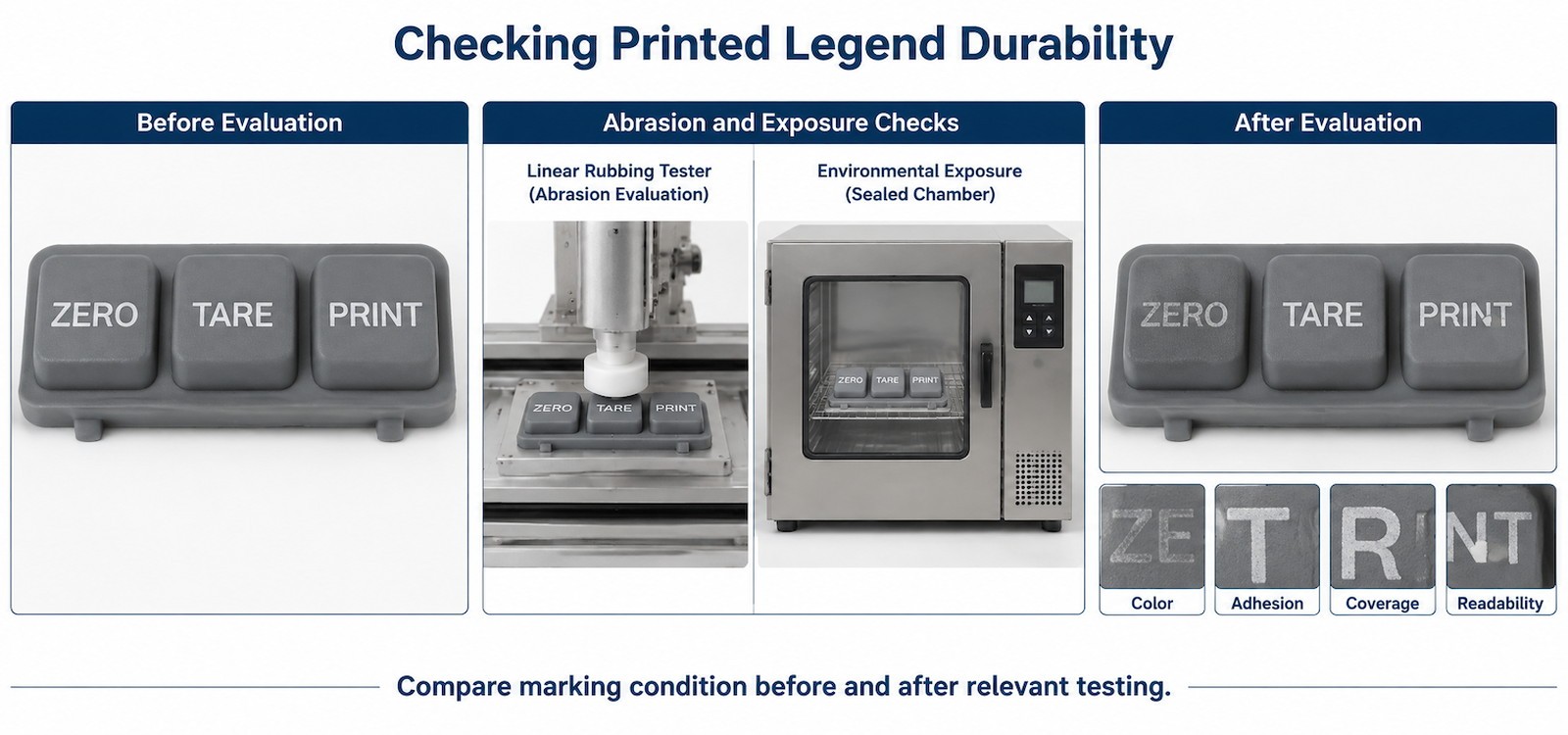
Photograph the sample before and after under identical lighting and angle, then judge four things: colour shift, adhesion at the stroke edge, coverage across the symbol, and whether the legend is still readable at arm’s length. The last one is the only measure that maps directly to the operator’s problem.
Keep the tested sample. A legend that has been through the exposure is the most useful reference you can give a supplier for the next order, because it shows what “acceptable” looks like after use rather than before it.
What Should Buyers Discuss With a Custom Silicone Keypad Manufacturer?
Sharing the Expected Operating Environment and Usage Frequency
Give the supplier three facts: what the operator’s hands are like (clean, gloved, oily, wet), what the keypad is cleaned with and how often, and how many presses per day a typical key sees. Those three answers move the specification more than any general statement about quality. A laboratory instrument wiped with alcohol twice a shift and a weighbridge controller cleaned with a hose are not the same printing job.
Confirming the Printing Method and Protective Treatment Before Tooling
Printing decisions interact with tooling. A recessed legend needs a tool feature. A two-shot legend needs a second cavity. A coating needs a fixture that does not mark the printed area. Settling these after the tool is cut turns a design choice into a rework cost.
Approving Printed Samples Under Realistic Operating Conditions
Visual approval on a clean bench proves almost nothing about wear. Before signing, wipe the sample with the actual cleaning agent, rub the most-used key with a thumb for a few hundred cycles, and look at the legend edge under a low-angle light. If the supplier can tell you which ink system and cure they used and why, that is a better signal than a sample that looks good on day one.
Final Thoughts on Improving Silicone Keypad Legend Durability
Legend durability is decided by four things in order: the ink chemistry matching the silicone, the surface being genuinely clean and correctly pretreated, the film being thin and fully cured, and the legend being placed where the finger does not rub it. Change any one of those and the result moves. Marketing language about “wear-resistant printing” without a named ink system and cure schedule is not information.
FromRubber, trading name of Dongguan Bohao Electronic Technology Co., Ltd., prints keypads in-house in Dongguan on the same site as the moulding, so a legend problem can be traced back to the press that made the part. Our inspection set includes abrasion and rubbing checks on printed characters, and the acceptance criteria are agreed with the customer before the first production lot rather than after the first complaint. If you have a legend that is failing in the field, send us a returned part and the cleaning agent; that pair usually explains more than a specification sheet. WhatsApp and WeChat: +86 18676210913, or use the contact page.
What this article does not claim. No printing method is wear-free, and no test result transfers automatically between applications. The comparative statements here describe mechanisms; the numbers for your part have to come from samples tested in your operating conditions. In practice that means a cross-hatch or tape-pull adhesion check after exposure to the actual cleaning agent, run along the lines of ISO 2409 or ASTM D3359, plus an abrasion run on a linear rubbing tester, with the pass criterion agreed in writing before the first lot.
Frequently asked questions
Why do only the most-used keys lose their legends?
Because wear is cumulative and localised. The key that is pressed thousands of times more than its neighbours reaches the failure point first, and its legend edge is also the one exposed to the most angled contact. If a whole panel fades evenly, suspect the ink or cure rather than the usage pattern.
Is laser etching always more durable than printing?
No. Etching removes material, so there is no film to peel, but the etched pocket can collect dirt and its edges can degrade if the laser parameters are wrong. On a key that is wiped with abrasive cloths, a shallow etched legend can become illegible through filling rather than through wear.
Can a protective coating fix a legend that is already failing?
Not reliably. If the ink is not bonded, a coating on top adds another interface that can fail. Coating is a wear layer for a sound print, not a repair for an unsound one.
What should be included in a printing specification?
The ink system family, the cure schedule, the surface preparation step, the legend colour and opacity requirement, the cleaning agents the part must resist, and the acceptance criteria with photographs. A drawing that says only “print as shown” leaves every one of those decisions open.
Does the button colour affect how long a legend lasts?
It affects contrast and how wear becomes visible, and it can affect ink choice. White legends on a dark key show edge failure quickly because the contrast is high; the same wear on a low-contrast combination may be invisible long after readability has dropped.