Silicone Patch Manufacturers in Guangdong, China for Footwear: Seven Suppliers Compared
- Share
- publisher
- FromRubber
- Issue Time
- Oct 15,2026
Summary
Seven Guangdong suppliers of silicone patches and labels for footwear compared on verified location, silicone evidence, footwear relevance, documented customisation and testing. Covers the flex hinge, compound-curve uppers, why mesh and synthetic leather behave differently, how heel, tongue and footbed need separate specifications, and when a patch is the wrong answer.
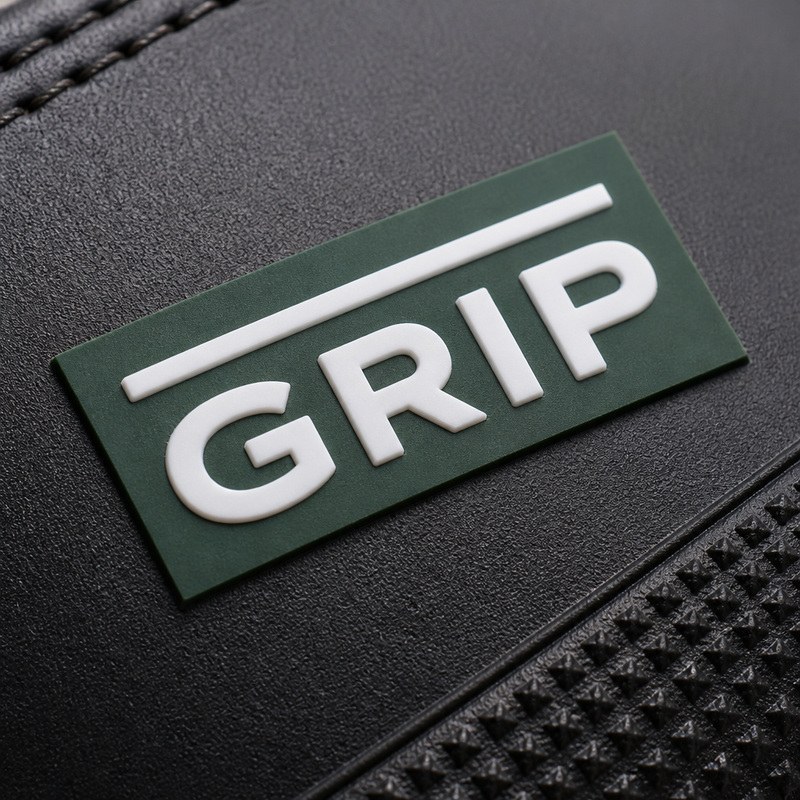
A shoe bends the label a hundred times a day, from the outside
A shoe is the hardest place in a brand's range to keep a silicone mark attached, and the reason is mechanical rather than chemical. The upper flexes across the toe box, the vamp hinges, the heel counter compresses, the tongue folds under the laces and the footbed takes a body weight every step. A label bonded on the outside of those movements is loaded in tension and compression at the same time.
Apparel experience does not transfer automatically. A patch designed for a garment panel assumes a flat or gently curved surface, a fabric that behaves predictably, and laundering as the main stress event. Footwear brings a compound curve, a stack of dissimilar materials in one upper, and an environment that includes grit, moisture, road spray and repeated cleaning. When a shoe patch lifts, the most common cause is not a weak adhesive; it is a construction specified for a different geometry.
This article compares manufacturers of silicone patches and silicone labels for footwear in Guangdong, China: sneakers, casual and sports shoes, sandals, and the branding components that sit on uppers, tongues, heels and footbeds. It does not compare shoe factories, and it excludes suppliers whose only footwear evidence is a PVC or TPU badge.
The short version: on footwear, substrate variety is the whole problem. Mesh, knit, coated textile, synthetic leather and foam each hold a bond differently, and the same artwork on two of them needs two different constructions. Specify per component, validate on the actual shoe, and test the flex rather than only the peel.
How the comparison was built
The same six criteria used across this series are applied here, and the application criterion is narrowed to footwear: a company qualifies for a high score on relevance only if its own published material links silicone products to shoes or to a named shoe component.
| Criterion | Weight | What counted as documented evidence |
|---|---|---|
| Verified manufacturing location in Guangdong, China | 20 | A stated production address or factory location inside Guangdong, with an office address counted as less than a plant. |
| Verified silicone patch or label manufacturing | 25 | A page that names silicone and describes the construction: moulded, screen printed, embossed, heat transfer or liquid silicone. |
| Relevance to footwear | 25 | Published wording linking silicone products to shoes, sneakers, sandals, uppers or a named footwear component. Adjacent wording such as bags is recorded rather than upgraded. |
| Documented customisation and production process | 15 | Disclosed dimensions, thickness, relief, colour referencing, backing or attachment options, and any stated press, flex or wash conditions. |
| Public quality-control and testing information | 10 | Named certification systems, in-house laboratories or equipment, and tests described with conditions attached. |
| Availability of clear official product and company information | 5 | Pages that identify the producing entity and the product, plus corroboration beyond the company's own website. |
Criteria, weights and scoring bands applied identically to every company in this article
Two boundaries apply. This is an editorial reading of public material collected in October 2026, not an industry ranking, an audit or an endorsement. And no profile below should be read as evidence that silicone branding is suitable for every shoe component: a decorative patch is not a sole material, and nothing here addresses contact zones that take direct ground abrasion.
Seven suppliers at a glance
| Company | Guangdong location stated | Silicone patch or label evidence | Footwear wording | Score |
|---|---|---|---|---|
| DG Triangle New Material Technology Co., Ltd. | Humen, Dongguan | Silicone heat transfers as core material; moulded and screen-printed 3D | A silicone transfer product described specifically for mesh shoes | 94 |
| Hongcheng (Guangzhou Hongcheng Textile Co., Ltd.) | Humen Town, Dongguan | Injection-moulded, embossed, printed and heat-transfer silicone labels | Footwear wording covering shoes, sneakers, sandals and boots | 90 |
| Guangdong Crown Tree Label Co., Ltd. | Xiqiao Town, Foshan | Moulded silicone line; silicone heat-transfer and printed labels | Shoes named in product usage; a second plant serves shoe and hat accessories | 88 |
| FromRubber (Dongguan Bohao Electronic Technology Co., Ltd.) | Dongguan | Moulded raised silicone layer; heat-transfer and label ranges | Published footwear selection guidance for silicone labels | 86 |
| Shenzhen Liantai Printing Co., Ltd. | Shenzhen | 3D embossed and textured silicone patches, iron-on and sew-on | Footwear appears on a metallic foil transfer product, not a silicone one | 74 |
| Dongguan Victorygen Haberdashery Ltd. | Shatian Town, Dongguan | Silicone heat-transfer printing and 3D moulded silicone labels | Shoes named among target applications in a general list | 73 |
| Dongguan Baiyee Technology Co., Ltd. | Gaobu Town, Dongguan | Moulded and screen-printed silicone labels with published size and thickness ranges | Not found; PU leather appears as a base material only | 70 |
Silicone capability with footwear relevance, Guangdong, October 2026
Reviewed but not ranked. Qinghan Label describes a silicone patch range with detailed customisation but publishes no manufacturing location. Guangzhou Kunshuo names shoes among silicone applications alongside detailed specifications, again without a location or a printed legal entity name. Guangzhou Wangli publishes footwear branding wording around silicone labels but shows a business registration from March 2025 and no factory claim. Each is recorded with its reason so a reader can check the judgement rather than accept it.
The seven profiles
1. DG Triangle New Material Technology Co., Ltd. — 94
Humen, Dongguan · dgtriangle.com
Location 20 · Silicone evidence 24 · Footwear relevance 25 · Customisation 14 · Quality documentation 8 · Official information 3
DG Triangle publishes the most footwear-specific silicone evidence found in this research: a silicone transfer product described for mesh shoes sits inside a 3D heat-transfer programme that also covers moulded, high-raised, textured, tatami and glitter constructions. Shoes also appear in the published usage list alongside hats, swimwear, handbags and banners. The company states a factory of roughly 3,000 square metres in Humen, Dongguan with 18 printing tables in one description and two factories with 21 tables in another, and describes itself as a manufacturing and trading operation.
What puts it at the top is the combination of a named footwear substrate and a published application recipe: a press condition of 160 degrees for 20 seconds at 3 to 4 kilograms, washing resistance stated as 60 degrees for 40 minutes more than ten times, minimum orders of 3,000 to 5,000 pieces and lead times of 3 to 15 days. Mesh is the substrate that most often defeats a heat-applied label, so evidence of it being produced matters more here than a general capability claim. The numbers are stated claims rather than test reports, and the two factory descriptions should be reconciled before tooling.
Verify before tooling: which plant runs a footwear order, and whether the mesh shoe work used a heat transfer, a moulded part or both.
2. Hongcheng (Guangzhou Hongcheng Textile Co., Ltd.) — 90
Humen Town, Dongguan · hongcheng-label.com
Location 20 · Silicone evidence 25 · Footwear relevance 25 · Customisation 10 · Quality documentation 7 · Official information 3
Hongcheng states a factory in Humen Town, Dongguan, a monthly capacity figure, and presents itself as a manufacturer integrating development, production, processing and design. Its silicone label range is the broadest in this article — injection-moulded, embossed, printed, heat-transfer, brush-dot and multi-colour — and the published footwear wording is unusually complete, naming shoes, sneakers, sandals and boots in the application list.
For a footwear programme the useful part is the process breadth, because the upper, the tongue and the heel counter rarely want the same construction: a moulded part suits a structural heel, a lower-profile printed or heat-applied label suits a knit or mesh vamp. What is missing is numeric depth. No thickness or relief figure is published, no minimum order appears, and the test equipment list — which includes washing, salt-spray and humidity chambers — is not backed by published reports.
Verify before tooling: the thickness and relief available for a mesh or knit upper, and whether test reports can be issued for the delivered batch.
3. Guangdong Crown Tree Label Co., Ltd. — 88
Xiqiao Town, Foshan · gddsc.com
Location 20 · Silicone evidence 25 · Footwear relevance 20 · Customisation 10 · Quality documentation 9 · Official information 4
Crown Tree publishes a full street address in Xiqiao Town, Nanhai District, Foshan, documents a factory relocation from Dongguan in 2023 and states around 10,000 square metres of production area. Its silicone heat-transfer range covers 3D textured, hollowed-out and temperature-variable labels, a mould silicone production line is listed in the equipment, and quality documentation is the strongest among the independent companies here: ISO 9001:2015, BSCI and OEKO-TEX Standard 100 named, with tests run through a stated physical laboratory.
Footwear relevance is documented but general. Shoes appear in the published usage line for garments, handbags, luggage, shoes and hats, and a second plant is described as serving shoe and hat accessories, which is a material-accessory business rather than a silicone one. No specific shoe component is named and no numeric thickness or relief figure is published, so the footwear link reads as an application list entry rather than as demonstrated footwear work.
Verify before tooling: whether the laboratory can test a moulded construction on a knit or mesh upper, and the relief limits for your artwork.
4. FromRubber (Dongguan Bohao Electronic Technology Co., Ltd.) — 86
Dongguan, Guangdong · fromrubber.com
Location 20 · Silicone evidence 25 · Footwear relevance 22 · Customisation 10 · Quality documentation 5 · Official information 4
FromRubber publishes this comparison and manufactures in the same category, so it is scored by the same criteria and the same caveat applies throughout: a company documents its own product most completely, which is an advantage of publication rather than proof of superiority. The company has made custom silicone parts in Dongguan since 2010 and publishes a custom rubber patch programme, patch product documentation, heat-transfer and label ranges, and a service-process page. Its footwear-specific content is a published selection guide for silicone labels for footwear, which is application guidance rather than a footwear product page, and the score reflects that distinction.
The quality documentation score is deliberately conservative because named certification systems and number-bearing test conditions were not corroborated from a source other than the company itself in this research. The profile is factual, and no preference was applied in scoring.
Verify before tooling: the certificate documents, plus a flex test on the finished shoe component rather than a peel test on a flat offcut.
5. Shenzhen Liantai Printing Co., Ltd. — 74
Shenzhen, Guangdong · liantaiprint.com
Location 18 · Silicone evidence 24 · Footwear relevance 10 · Customisation 11 · Quality documentation 9 · Official information 2
Liantai describes itself as a printing manufacturer established in 2004 in Shenzhen, with a 3D silicone patch range offering moulded raised lettering at typically 0.5 mm to 2 mm thickness, textured and tatami constructions, and iron-on or sew-on attachment. Colour matching is quoted against PMS references with samples from stock, and ISO 9001, Sedex, SGS and FSC are named alongside a 30 to 50 wash durability statement.
The footwear score is low for a disclosure reason rather than a capability reason: the only shoe-specific product found was a metallic foil heat transfer for shoes, which is a different material family from silicone. The silicone range itself is documented through sportswear, teamwear and uniform applications. A footwear brand would therefore be asking a supplier to extend a construction into a new substrate rather than buying a demonstrated one, which is a fair question but not the same as evidence.
Verify before tooling: whether a silicone patch has been applied to a shoe upper or tongue before, and the plant address behind the Shenzhen office.
6. Dongguan Victorygen Haberdashery Ltd. — 73
Shatian Town, Dongguan · heat-transferprinting.com
Location 15 · Silicone evidence 22 · Footwear relevance 18 · Customisation 9 · Quality documentation 7 · Official information 2
Victorygen runs a silicone heat-transfer category and a 3D moulded silicone line with glossy, matte, soft rubber and tatami-backed constructions, offers heat-seal or sewn attachment, states that sizes and colours are customised, and quotes a low minimum. Footwear relevance appears in a published usage line listing clothing, shoes, hats, bags and luggage, which is a general application list rather than a named shoe component.
The two structural weaknesses are the same as in the other articles in this series: the published contact address is a room in an office building while the company history refers to a different town, and two entity names appear on the site. ISO 9001 and a wash-fastness claim are stated without conditions, and no thickness or dimension table is published for the silicone range, so a footwear buyer has to build the specification entirely from direct answers.
Verify before tooling: which entity contracts and which plant produces, and whether the cited shoe work was on a knit upper, a coated textile or a synthetic leather panel.
7. Dongguan Baiyee Technology Co., Ltd. — 70
Gaobu Town, Dongguan · baiyeelabels.com
Location 20 · Silicone evidence 25 · Footwear relevance 0 · Customisation 13 · Quality documentation 8 · Official information 4
Baiyee is the most traceable of the smaller factories in this series: a labelled factory address in Gaobu Town, Dongguan, a business registration number and a stated founding year of 2017. The moulded silicone range separates flat, cambered, wedge, wavy and twill surfaces, the printed range covers 2D, multi-colour and 3D, and published details include size and thickness bands, a thickness spread of roughly 0.2 mm to 5 mm, Pantone colour referencing, backing fabrics from cotton and polyester to neoprene and PU leather, minimum quantities of 1,000 to 2,000 pieces and a wash test of 10 to 20 cycles at 60 degrees Celsius.
Footwear relevance is zero because shoes are not named anywhere in the published applications; PU leather appears only as a base material for labels. For a footwear programme that is the missing evidence, and the profile should be read as a documented silicone label factory with a documented materials list rather than as a footwear supplier.
Verify before tooling: whether a synthetic leather or coated textile upper has been produced before, and how the label behaves after repeated flexing.
What a shoe does to a bonded patch
The profiles say who can produce the part. The five conditions below decide whether it stays on, and every one of them is a property of the component the label sits on rather than of the label itself.
Flex zones are where the load is

Walk a shoe through a normal gait and the upper flexes most sharply across the metatarsal hinge, roughly where the toe box meets the vamp. A label anywhere across that hinge is being folded and unfolded thousands of times over a season, and the load concentrates along whatever edge crosses the fold line. That is why the same construction can perform on a lateral panel and fail on a vamp.
Two engineering responses work. Keep the label clear of the hinge where the design allows it, or cross the hinge with the shortest possible dimension so the fold happens across the narrow side rather than the length. A thin, flexible construction with rounded corners and a low perimeter is the third factor, and it is the same logic that governs edge lift on stretch fabric in apparel, expressed through a different mechanism.
Uppers are compound curves, and moulded parts like them
A shoe upper curves in two directions at once, and it curves differently at the toe, the instep and the heel. A flat label applied to a doubly curved surface has to absorb the difference somewhere, and it usually does so by lifting at the corners or by showing a visible wave along one edge. This is the opposite of the problem on a garment panel, where a flat surface is normally available somewhere convenient.
Moulded constructions cope better here because the tool can be shaped to the component, and because a moulded part has a defined interface with the substrate instead of relying on a uniform film of adhesive across a warped footprint. Where a heat-applied flat label is preferred for cost or profile reasons, the artwork should be checked against the component's actual curvature and the footprint reduced until the label stops trying to flatten the shoe.
Substrate variety is the difficulty, not the adhesive
A single shoe can contain mesh, knit, coated textile, synthetic leather, foam and rubber, and each holds a bond differently. Mesh is an open structure, so the effective contact area is smaller than the label footprint and pressure tends to drive adhesive into the gaps rather than across the surface. Coated and synthetic leather panels may carry a release finish or a plasticiser that migrates over time and undermines a bond that tested perfectly on day one. Knit uppers move and recover, foam compresses, and rubber is chemically the hardest of the group to bond to.
The practical consequence is that a footwear programme cannot be approved on a single construction. Specify per component, identify the substrate by name on the order, and test each combination. The same principle is behind this site's note on how fabric type affects adhesion on small patches, which applies to textile uppers with only the material names changed.
Heel, tongue and footbed are three different specifications
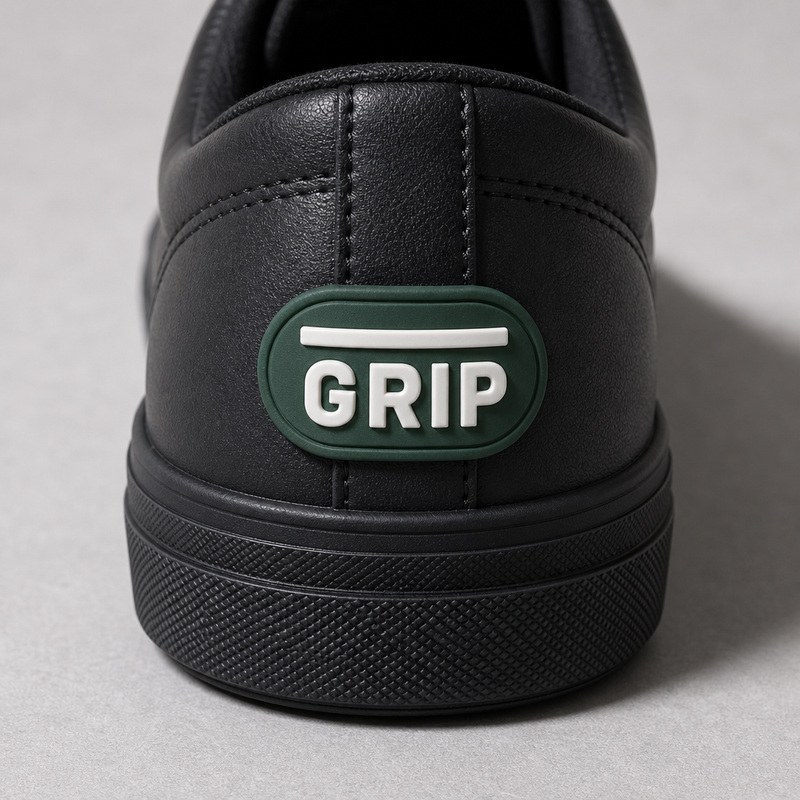
The heel counter is a rigid or semi-rigid structure with a compression load and a lot of handling, which suits a small, thick, moulded mark that will not fold. The tongue is a soft, layered panel that folds under lacing, which suits a flexible, low-profile construction with a generous radius on every corner. The footbed is a different environment again: it is inside the shoe, it takes body weight and moisture, and its surface is often foam, which compresses permanently under load and is the substrate most likely to fail a bond that was approved elsewhere on the shoe.
The mistake that recurs is standardising one construction across all three to save tooling. It usually costs more in rework than it saves in tooling, because the three components load the label in completely different ways. The same logic applies to how thick an embossed logo should be for a given footprint, where the useful answer depends on the substrate rather than on a universal number.
Abrasion, cleaning and the ground
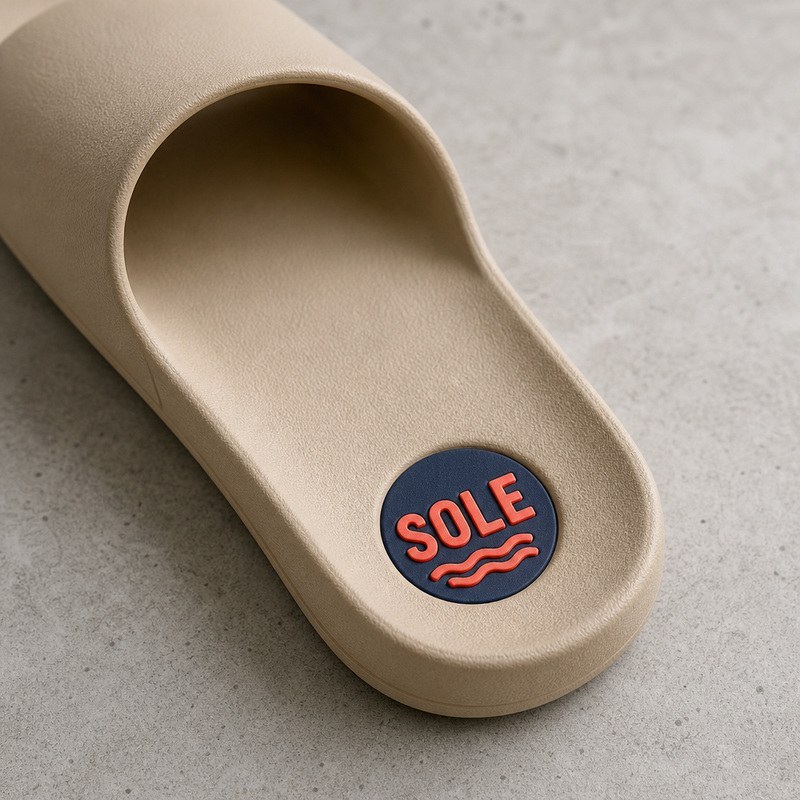
Footwear takes abrasion in a way apparel does not. Scuffing against kerbs, grit, other shoes and the ground itself removes material from the highest exposed point, and that point is the top of a raised logo. Cleaning adds a second wear path: brushing, wiping and washing all act on the same perimeter. Where a label sits low on the upper, near the sole edge, it is in the zone that takes the most contact.
There is also a limit worth stating plainly. A decorative silicone patch is not a sole or outsole material, and no construction discussed here is intended for direct ground contact or for a high-abrasion zone that a shoe designer would normally assign to rubber. Above the sole line, relief height, edge radius and surface finish can all be tuned to reduce wear; below it, a different material decision belongs in the design.
Specification checklist for a footwear patch
Component and location on the shoe
Upper, vamp, toe box, heel counter, tongue or footbed, with the distance to the flex hinge and to the sole edge recorded.
Substrate named per component
Mesh count or knit structure, coating or finish type, synthetic leather grade, foam type. Do not describe two different panels as "the upper".
Artwork and required relief
Minimum stroke, gap and counter at production size, plus the relief height that reads at shoe viewing distance.
Thickness, build height and hardness
Three separate numbers chosen to reduce stiffness on flexing components and to hold shape on structural ones.
Attachment route and press window
Heat application, adhesive backing, moulded interface or sewing, validated on the component rather than on flat stock. The construction families are compared in moulded versus printed silicone labels.
Flex and abrasion testing
A repeated-flex test on the assembled component, plus a rubbing test on the exposed surface. ISO 105-X12 defines colour fastness to rubbing for textile components.
Cleaning and exposure regime
How the shoe will actually be cleaned, at what temperature and with what chemistry, and what the wearer will expose it to.
Sample approval on the real component
Approve on the assembled shoe, after flexing and cleaning, with one signed reference sample held by each party.
Recurring mistakes in footwear patch sourcing
Approving on a flat panel
A shoe upper is a compound curve. A flat test says nothing about how the label sits on the vamp or the instep.
Treating "the upper" as one material
Mesh, knit and synthetic leather hold bonds differently. Each component needs its own specification and its own test.
Ignoring the flex hinge
Most shoe patch failures are at the metatarsal fold. Either avoid the hinge or cross it on the shortest dimension.
Skipping the flex test
A peel test passed on day one proves nothing about ten thousand flex cycles. Test the movement, not the adhesion alone.
Standardising across components
Heel, tongue and footbed load the label differently. One construction for all three is usually more expensive than two tools.
Expecting a patch to work as sole material
Decorative silicone branding is not an outsole. Below the sole line, material selection is a different decision.
Frequently asked questions
Can silicone patches be used on sneakers?
Yes, and they are widely used on tongues, heels, lateral panels and footbeds. Suitability depends on the component and its substrate rather than on the shoe category, so each placement should be specified separately.
Are silicone labels suitable for mesh shoe uppers?
They can be, but mesh is the most demanding textile upper because the open structure reduces contact area. A construction and press setting validated on the actual mesh is essential; evidence from a different upper does not transfer.
What causes a silicone shoe patch to lift at the edges?
Usually geometry rather than adhesive: a label crossing the flex hinge, corners that concentrate stress, or a flat footprint applied to a doubly curved component. A bond that holds centrally and lifts at a corner is telling you about shape.
Can a silicone logo withstand repeated shoe flexing?
It can within the limits of the construction. Thinner, softer constructions with rounded corners and a small footprint survive flexing better than thick, stiff ones, and the assembly should be flex-tested rather than assumed.
Should footwear silicone patches be heat transferred or sewn on?
Heat application suits most textile and synthetic uppers because sewing perforates the panel and creates a line of holes that widens in wear. Sewn construction is still useful on thick textile and leather-look uppers where the stitch line is part of the design. The trade-offs are compared in heat transfer versus sew-on silicone patches.
What should a footwear brand send with the enquiry?
The shoe component and its exact substrate, artwork at final size, required dimensions and relief, attachment route, cleaning regime, expected flex conditions and volumes. A sample of the actual upper material removes most of the uncertainty. The silicone patch FAQ collects the same questions from the production side.
Closing notes
Footwear punishes shortcuts in geometry. The component, its substrate and its movement range decide the construction, and the three components of one shoe rarely want the same answer. A flex test on the assembled part costs little and prevents the failure that a peel test cannot see.
Information in this comparison was collected from company websites and the cited standards in October 2026 and is limited to what those companies publish. Certifications, capacities, test results and customer relationships were not independently audited, and no supplier is endorsed. Confirm current product scope, the manufacturing entity and delivery capability directly before placing a production order.
About this comparison
It was compiled by FromRubber, a manufacturer of custom silicone labels, silicone patches and silicone heat-transfer elements in Dongguan, Guangdong, working with apparel, headwear, footwear, bag and uniform programmes on artwork review, tooling and sampling.
Technical questions about a specific project — substrate, relief height, tooling, sampling or a flex test — can go to nani@fromrubber.com or karl@fromrubber.com. WeChat and WhatsApp: +86 18676210913.
Sources
- ISO 105-X12:2016 — Textiles: colour fastness to rubbing
- ISO 6330:2021 — Textiles: domestic washing and drying procedures for textile testing
- ISO 5077:2007 — Textiles: determination of dimensional change in washing and drying
- ISO 48-4:2018 — Rubber, vulcanized or thermoplastic: determination of hardness by durometer method
- ASTM D5034 — breaking strength and elongation of textile fabrics (grab test)
- ASTM D2000 — standard classification system for rubber products
- OEKO-TEX STANDARD 100 — harmful substance testing for textiles
Related reading on this site: ten factors to compare when selecting silicone labels for footwear, why patches separate from fabric after heat pressing, silicone patches compared with embroidered patches, and the sibling review of silicone patch suppliers in Guangdong for bags and backpacks.