Silicone Patch for Seamless Sportswear: What Design Factors Matter?
- Share
- publisher
- FromRubber
- Issue Time
- Oct 12,2026
Summary
Seamless fabric moves as one continuous panel, and a patch that was designed for a stable garment changes how that panel behaves. This article works through stretch and recovery, patch flexibility, thickness, placement, edge geometry, fine detail, bonding compatibility, comfort and durability, with priorities by garment type.

Seamless sportswear punishes a patch that was designed for something else
Seamless garments are built around the assumption that nothing on the surface will restrict the fabric. The panel is engineered to stretch in specific directions, to sit close to the body, and to look smooth under tension. A silicone patch that is a millimetre too thick, a corner too sharp or a gram too stiff does not just look wrong — it changes how that panel behaves in movement.
The complaints that follow are consistent: a patch that lifts at one edge after a week of training, a raised outline that reads through a compression top, a logo that distorts when the wearer bends, or a patch that feels fine on a hanger and uncomfortable after twenty minutes of wear.
None of those problems are solved by choosing the softest silicone available. They are solved by matching the patch construction to the fabric's stretch behaviour and to the place on the body where it will sit. This article works through the design factors that actually drive that decision.
Understand the fabric before the artwork gets designed
Stretch and recovery set the requirement
Seamless fabric expands during movement and returns towards its original dimensions. A patch and the fabric underneath it do not deform identically, and the difference has to go somewhere: into edge stress, into wrinkling, or into visible distortion. Industry testing reflects how serious that difference is. ASTM D2594/D2594M distinguishes momentary stress from prolonged stress and measures both stretch and fabric growth, which is a useful reminder that a patch is judged across the whole day of wear, not only at the moment of maximum pull.
Surface and construction determine contact
Smooth, textured, fine-gauge and highly elastic seamless fabrics present very different surfaces to a bonding layer. Local construction matters too: a zone where the knit is denser, a bonded seam or a compression panel creates a different contact condition from the open fabric beside it. Which is why the patch should be evaluated on the actual production fabric rather than on a same-category substitute.
Heat sensitivity limits the process
Many seamless fabrics are built from synthetic fibre blends with dyes and finishes that respond to heat. Possible outcomes include surface marks, deformation, discolouration and a change in elasticity. Whether a heat transfer process suits a given seamless fabric is a question that has to be answered for that fabric and that patch construction — it cannot be assumed from the garment category. The care-label classes illustrate how tight the thermal windows already are: under the symbols defined for ISO 3758:2023, the lowest ironing class caps the sole plate at 120 °C, and tumble drying is classified at 60 °C and 80 °C.
Intended use changes the target
Leggings, sports bras, compression tops and cycling garments do not place the same demands on a patch. They differ in where the fabric extends, how much skin contact exists, how much perspiration the panel meets and how often the garment is washed. Treating them as one category is how a design that works on a training top ends up failing on a cycling short.
Outdoor and training marks carry the highest expectations
Patches with outdoor iconography sit on exactly the garments that get worn hard: repeated laundering, sun exposure, abrasion from packs, perspiration. The icon set also tends to include fine line art — a compass point, a flame, a mountain ridge — which is the detail most at risk when the construction is pushed too thin.
With this type of artwork, the practical trade is between line depth and patch thickness. Shallow relief fits a stretch fabric better; deeper relief survives abrasion but adds bulk. We normally build a physical sample in both directions before recommending one.
Nine design factors that decide how a silicone patch behaves on seamless fabric
1. Flexibility and hardness
Perceived flexibility comes from hardness, thickness, dimension and geometry together. The trade is between keeping the logo defined and letting the garment move. The only meaningful test is the patch applied to the target fabric under realistic stretch — a hardness figure alone does not predict how a finished patch will feel on a seamless panel.
2. Thickness and profile
Excess thickness creates a raised area, affects drape and becomes noticeable against the skin. The aim is a defined three-dimensional appearance without bulk, and the workable thickness depends on patch size, artwork, fabric and placement together. Published conversion-supplier ranges put silicone transfer label thickness at roughly 0.2–1.0 mm, with 0.5 mm a frequent middle choice (published industry thickness range).
3. Size and placement
A large patch restricts local stretch and makes any deformation more visible. Placement on an area of frequent extension — over a knee, across a shoulder, on the side seam of a legging — deserves more caution than a flat panel. Review the position on the garment pattern or a finished sample, because the flat area available on a table is not how the fabric behaves in wear.
4. Edge shape and geometry
Sharp corners, narrow projections and thin extensions all concentrate stress. Outlines that balance the logo shape with a rounded, simple perimeter survive repeated stretch and laundering better, and they are cheaper to produce than a design that has to be reworked after sampling.
5. Fine details and raised features
Small text, narrow lines, embossed detail and multi-level surfaces affect legibility, mould design, finished appearance and flexibility at once. Artwork should be reviewed against a physical sample before tooling, since minimum line widths and relief depths depend on the specific design and construction rather than on a general rule.
6. Attachment method and bonding compatibility
Heat transfer and other constructions suit different fabrics. Seamless fabric composition, texture, surface finish and heat sensitivity all influence the choice, and the silicone material on its own guarantees nothing. The bonding construction and its application parameters should be confirmed for the exact substrate.
7. Colour, finish and visibility
Matte, gloss, raised and contrasting-colour treatments each read differently against a seamless surface. The finish should suit the fabric texture and the intended brand appearance, and colour stability and detail retention after laundering belong in the specification rather than in a follow-up question after bulk production.
8. Comfort and skin contact
Stiffness, edge profile, thickness and placement drive comfort, especially on leggings and sports bras. These are assessed on a representative worn garment. A loose patch on a bench cannot demonstrate how an edge feels against the body under tension.
9. Durability under stretch, sweat and washing
Adhesion and appearance need to be evaluated under conditions that resemble use: repeated extension and recovery, perspiration exposure, laundering and drying. Laboratory validation demonstrates performance under defined conditions; it is not the same thing as a claim about service life. AATCC TM61 states that one 45-minute accelerated laundering test roughly approximates the effect of five typical hand or home launderings, which is a useful equivalence to have in writing when a wash protocol is turned into a cycle count.

Mixed geometry sets need per-shape validation
When one garment carries a round brand mark, a hexagonal technology badge and a capsule sizing mark, the shapes are not interchangeable. Each outline distributes stretch stress differently, so a pass on the circle says very little about the hexagon beside it.
Our usual approach for a set like this is to validate the most demanding outline first — normally the smallest one with the most complex perimeter — and then confirm the rest against it.
Design priorities by seamless sportswear type
The table is a starting point for a specification discussion. Products within one category do not share a single fabric or construction, so a genuine fabric sample still decides the final answer.
| Garment type | Main fabric or use consideration | Patch design priority | Recommended validation |
|---|---|---|---|
| Seamless leggings | Multi-directional stretch, frequent movement, high skin contact | Compact outline, low relief, rounded edges, placement away from the knee line | Repeated stretch and recovery, washing, edge condition after wear |
| Seamless sports bras | High elongation, close fit, perspiration exposure | Minimal thickness, soft edge profile, small footprint | Comfort on a worn sample, adhesion under stretch, wash durability |
| Compression tops | Continuous tension across the panel | Outline that does not interrupt the compression line, restrained thickness | Adhesion and appearance under sustained extension, laundering |
| Seamless cycling garments | Long wear duration, abrasion, washing after every use | Durable surface finish, geometry that avoids narrow projections | Abrasion and laundering evaluation alongside adhesion testing |
| Yoga and training wear | Wide range of movement, mixed fibre blends | Flexible construction, legible relief at low thickness | Stretch, recovery and comfort assessment on the production fabric |
Thin raised line patterns are a flexibility question, not a look
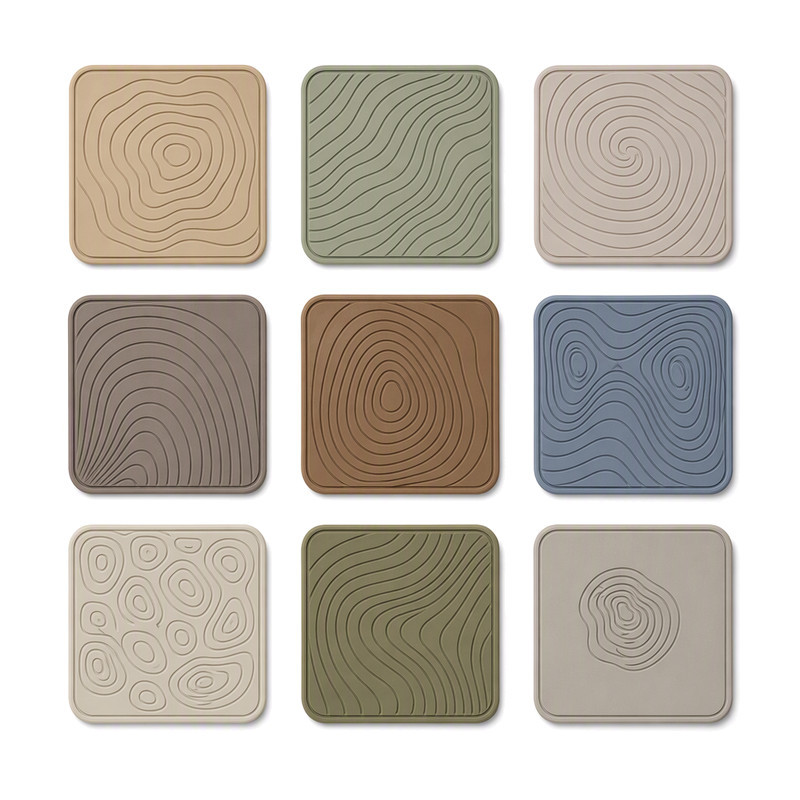
Fine contour or topographic line work is popular on seamless styles because it reads as technical without needing colour. The lines are shallow, closely spaced and cover most of the patch surface, which means the material has very little uninterrupted area to carry the fabric's stretch.
On stretch fabrics we normally reduce relief depth and keep a flat border around the pattern. It costs nothing in appearance and it makes the perimeter considerably easier to bond.
How to develop a custom silicone patch for seamless sportswear
- Send the right project information. Fabric composition and a physical sample, stretch and recovery behaviour, garment type and placement, artwork with dimensions, colour, finish and relief expectation, attachment method and available equipment, plus washing, perspiration, stretch, comfort and appearance requirements.
- Review the artwork for manufacturing feasibility. Fine detail, narrow edges, complex outlines and multiple relief levels influence mould design and the finished result. Confirm feasibility before tooling rather than after.
- Select the construction as a set of properties. Flexibility, thickness, geometry, bonding compatibility and intended use are decided together; no single material property is sufficient on its own.
- Test a prototype on the actual fabric. Fit, appearance, edge contact, stretch behaviour, recovery and comfort — and specifically whether the patch distorts or creates a local stiff area during movement.
- Validate before bulk. Appropriate adhesion, washing, stretch and durability evaluations, with acceptance criteria defined before testing and the approved sample plus its specification retained for production consistency.

Line-art icons are the feasibility test for any artwork
Thin continuous lines with open interiors are the hardest artwork to reproduce well and the easiest to lose when the relief has to stay shallow. They are a good early check on whether the design intent fits the constraints of the fabric.
When a design like this is heading for a stretch panel, we usually produce a test sample at the intended low relief first. If the line detail holds at that depth, tooling can proceed; if it does not, the artwork is adjusted before the mould is cut.
Five design mistakes that show up on seamless styles
Copying a patch from a non-stretch garment
Stable fabric performance does not predict seamless fabric performance. The artwork may transfer; the construction usually cannot.
Choosing a patch that is too thick or rigid
Extra bulk reduces flexibility, affects comfort and concentrates stress around the outline of the patch.
Ignoring edge geometry
Complex outlines and narrow projections create both bonding and durability problems on a fabric that never stops moving.
Finalising artwork before a feasibility review
Fine details, relief depth and dimensions interact with the mould, and changing them after tooling is expensive.
Skipping application and durability validation
Appearance on a flat sample does not establish how the patch behaves in wear, in perspiration or in the wash.
Frequently asked questions
Are silicone patches suitable for seamless sportswear?
They can be, when fabric properties, patch construction, attachment method, garment use and testing all align. Suitability is a combination of factors rather than a property of the material.
How thick should a silicone patch for seamless sportswear be?
Thickness follows from patch dimensions, the relief you need, the flexibility required, comfort and how the fabric behaves. There is no single figure that suits different designs.
Can a silicone patch stretch with seamless fabric?
The finished patch and the fabric may deform at different rates, so the combination has to be evaluated under representative stretch conditions rather than assumed to behave as one material.
Why does a silicone sportswear patch lift at the edges?
Fabric compatibility, edge design, uneven contact during application, process conditions and repeated stretch are all possible contributors. Identifying which one is driving it begins with the failure face and the application record.
What should I send a custom silicone patch manufacturer?
A fabric sample, artwork, dimensions, garment type, placement, intended attachment method and durability requirements. Each item that is real rather than estimated improves the recommendation.
Sources and further reading
- ASTM D2594/D2594M-21 — Standard Test Method for Stretch Properties of Knitted Fabrics Having Low Power, covering fabric stretch and fabric growth under momentary and prolonged stress: store.astm.org — ASTM D2594/D2594M-21
- ISO 13934-1:2013 — Textiles — Tensile properties of fabrics — Part 1: strip method, applicable to fabrics with stretch characteristics imparted by elastomeric fibre or treatment: iso.org/standard/60676.html
- GINETEX — care symbols and treatment classes under ISO 3758:2023: ginetex.net — care symbols
- ISO 2411 — Rubber- or plastics-coated fabrics — Determination of coating adhesion: filkfreiberg.de — DIN EN ISO 2411
- ISO 6330:2021 — Textiles — Domestic washing and drying procedures for textile testing: iso.org/standard/75934.html
- AATCC TM61 — Test Method for Colorfastness to Laundering: Accelerated (one 45-minute test approximates five hand or home launderings): members.aatcc.org — TM061 test method
- Silicone transfer label thickness range published by industry converters: cusmytrims.com — silicone heat transfer labels
Design the patch around the fabric and the way it is worn
Flexibility, thickness, geometry, detail depth, attachment compatibility, comfort and durability are one design problem. On seamless fabric, where the surface is expected to move as a single continuous panel, a patch that ignores any one of them becomes the weakest point in the garment.
FromRubber (Dongguan Bohao Electronic Technology Co., Ltd.) produces custom silicone patches and silicone labels for apparel and reviews artwork and fabric samples for manufacturing feasibility before tooling. If you are developing a seamless style, send the fabric sample, the artwork and the placement, and we can assess the design and support prototype evaluation before bulk production: nani@fromrubber.com or karl@fromrubber.com, WeChat and WhatsApp +86 18676210913. Constructions are listed under custom rubber patch products and custom silicone labels, and the related failure mode on elastic fabric is covered in why silicone heat transfer labels fail on stretch fabric.
Related reading in this series
Why Does a Silicone Heat Transfer Label Peel After Washing? · How Does Pressing Temperature Affect a Silicone Heat Transfer Label? · How to Choose a Silicone Label for Knitted Garments? · How to Check Silicone Heat Transfer Patch Adhesion After Pressing?
About the figures and the review behind this article
Figures quoted here are published industry references rather than measurements from our own production: care and treatment classes follow the ISO 3758:2023 symbol system, the laundering equivalence comes from AATCC TM61, the peel geometry from ISO 2411, and the application and thickness ranges from published conversion-supplier documentation.
Editorial review by FromRubber engineering. FromRubber (Dongguan Bohao Electronic Technology Co., Ltd.) has moulded silicone components in Dongguan since 2010, runs 32 compression moulding machines across two plants, works to ISO 9001:2015, ISO 14001:2015 and IATF 16949:2016 certified systems, and has operated a dedicated silicone fabric-label and heat transfer label division since 2023.