Silicone Pet Product Manufacturers with Multi-Color Molding: What to Verify Before Tooling
- Share
- publisher
- FromRubber
- Issue Time
- Oct 21,2026
Summary
A verification guide to multi-color silicone moulding for pet products. It separates integrated moulded colour from colour ranges and surface printing, explains colour boundary tolerances, second-cure colour shift and scrap cost, and shows what supplier pages actually document.
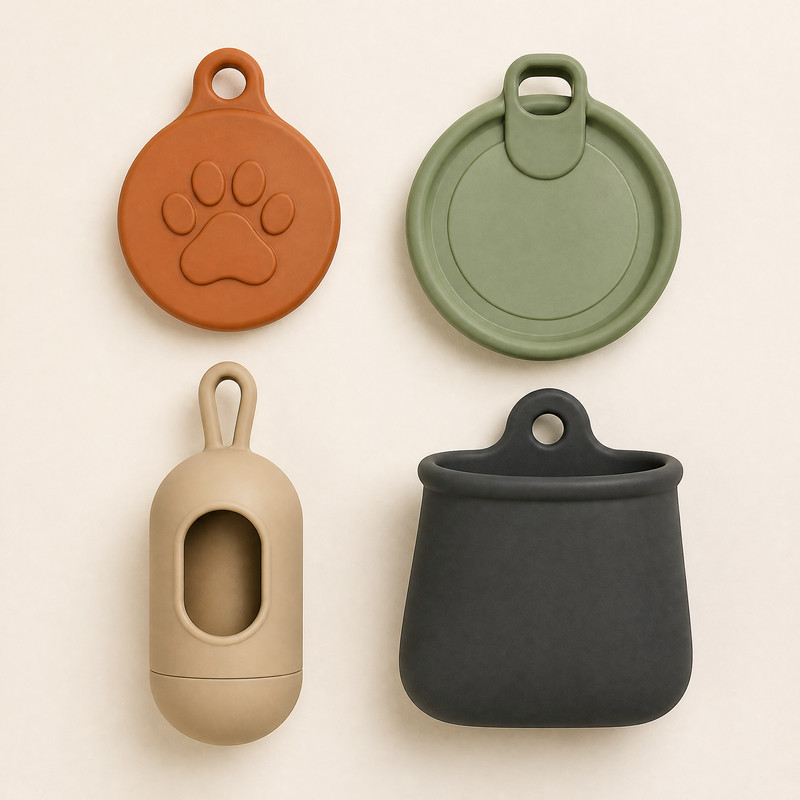
The approved sample had two colours. The production order had two colours. They were not in the same place.
That is the normal failure in multi-colour silicone work. The colours exist; the boundary moved. On a pet product the boundary is usually a paw print, a rim stripe or a two-tone boot sole, and a millimetre of drift reads as a defect because the mark is small and the eye is good at symmetry.
This article is a verification guide rather than a ranking, for one reason: very few Chinese silicone factories publish evidence of integrated multi-colour moulding. Most publish colour options, which is a different capability. The companies below are grouped by what their pages actually show, and the rest of the article covers the checks that decide whether a two-colour project will hold its boundary at volume.
When Multi-Color Molding Makes Sense for Silicone Pet Products
Integrated colour earns its cost in three situations. The first is brand recognition at a distance, where a specific two-colour combination identifies the product before the label is read. The second is functional coding, where colour marks a size, a hardness or a use zone, so the user reads the product without instructions. The third is wear, where the colour has to survive chewing, dishwashing and abrasion that would remove a print.
It stops making sense when the design only needs colour on a flat area. A printed or sprayed logo on a single-colour part is cheaper, faster and often more detailed than a moulded insert. Buyers who specify multi-colour for a flat graphic pay tooling money for a decoration problem.
The distinction that decides everything: is the second colour formed by the tool, or added after the part leaves the tool? Moulded colour is part of the geometry. Printed colour sits on top of it. Both can look identical in a photograph and behave completely differently after a hundred washes.
How to Verify a Multi-Color Claim
Verification runs as a sequence of gates rather than a score, because a supplier that fails the first gate cannot be rescued by strength elsewhere.
| Gate | Question | Evidence that passes | Weight |
|---|---|---|---|
| 1. Process identity | Is the colour integrated in the mould or applied afterwards? | Process description, mould sequence, photographs of raw parts before decoration | 35 |
| 2. Product relevance | Are there pet parts, or parts with comparable geometry? | Published examples with more than one colour zone | 20 |
| 3. Tooling capability | Can the factory cut and run the tool the design needs? | In-house tooling, insert or shuttle tooling, press list | 15 |
| 4. Colour control | How is the boundary and the shade held between runs? | Reference samples, light source, boundary inspection criteria | 15 |
| 5. Engineering support | Will the factory challenge the design before steel is cut? | DFM feedback, colour separation drawings, sample revisions | 10 |
| 6. Material documentation | Does the compound suit the process and the market? | Compound sheets for each colour, cure data, contact documentation | 5 |
A high general OEM score does not compensate for failing gate one. Editorial assessment from public pages reviewed on 21 October 2026.
What the Public Pages Actually Show
The table separates three things that are often reported as one: integrated multi-colour moulding, colour programmes where the same part is offered in several shades, and surface decoration applied after moulding.
| Company | What is published | Category |
|---|---|---|
| FromRubber | Dedicated multi-colour silicone page describing mixed-colour production, silicone dispensing equipment and multi-colour patch and label work | Integrated multi-colour described |
| Dongguan Wellfine Silicone | Compression, LSR injection, silicone over-moulding and printing in one plant | Over-moulding and decoration, colour integration not stated |
| Guangdong Yumingsheng (YMS) | HTV and LSR lines, multi-material bonding with PP, ABS, TPE and steel, six colourways on an ODM bowl line | Multi-material and colour programme |
| SM (Dongguan Sanmao) | Printing and laser engraving listed as secondary operations | Surface decoration |
| Dongguan Yuankang | Pantone matching, logo engraving or printing | Colour programme and decoration |
| JOYI Silicone | Colour and logo listed among customisable options for bowls and mats | Colour programme |
Only the first row describes a process where two colours are formed in the tool. The others may well be able to do it; the point is that nothing on their public pages proves it, and a buyer should treat an unproven claim as a question rather than a capability.
Why the list is short
Integrated multi-colour work needs either insert moulding, where a pre-formed colour is placed in the cavity for the second shot, or a dispensing system that fills defined zones before cure. Both need more tooling, more handling and more scrap than single-colour production, so many factories offer colour ranges instead and describe them as custom colour.
That is not dishonesty so much as a category error that buyers inherit. The correction is to ask for a part where the second colour is inside the geometry, then look at the boundary under a loupe.

What Buyers Should Check in a Multi-Color Silicone Project
Can the colour boundaries stay clean?
A boundary is a tolerance. Ask what the acceptable offset is at the worst point, not on average, and ask how it will be measured. On a paw print 12 mm across, a 0.3 mm shift is visible; on a 60 mm rim stripe it is not. The inspection criterion should be written per feature, because a single global tolerance will either reject good parts or accept bad ones.
Bleed is the second issue. Silicone pigments can migrate at the interface during cure, especially where a light colour meets a dark one and the second shot runs hot. The fix is usually a mechanical boundary, a small step or groove that interrupts migration, rather than a tighter pigment specification.
Does the design need one mould or several moulding steps?
Geometry decides. A colour zone that wraps around a corner needs a different tool from one contained on a flat face. Where the two colours have different hardness, the part also becomes a bonding problem, and the interface becomes the place where tearing starts.
Ask the factory to draw the colour separation before quoting. If the drawing looks like the artwork, the process has not been thought through. If it shows a step, a groove or a shut-off at the boundary, someone has already considered how the second colour will stop.
How will colour consistency be controlled?
Two references are needed: a physical standard for each colour, and a defined light source for comparison. Pigment lots vary, and a second cure cycle can shift a shade, particularly in pale colours. A factory that keeps a signed sample per colour and records the pigment lot on the batch card can repeat the work. One that matches to a Pantone number alone cannot, because Pantone describes a printed ink rather than a cured silicone.
Will the design affect tooling cost and yield?
Every additional colour adds a handling step and a chance of misalignment. Insert moulding usually means loading the insert by hand, which sets the cycle time and introduces the largest single source of scrap. Ask what the expected scrap rate is on a comparable part, and whether the quoted price assumes it. A price quoted at single-colour yield will be renegotiated after the first run.
Multi-Color Molding Versus Printed Silicone Products
| Consideration | Integrated multi-colour moulding | Printing, spraying or pad printing |
|---|---|---|
| Appearance | Colour is flush with the surface, with a visible edge | Colour sits on the surface, with a defined ink film |
| Tactile result | Colour zones can have different textures or hardness | Texture comes from the mould, not the print |
| Wear | Colour cannot be removed without removing material | Durability depends on ink, surface treatment and abrasion |
| Detail | Limited by cavity filling and boundary tolerance | Can hold finer lines and gradients |
| Tooling | Higher, with insert or shuttle tooling and more handling | Lower, with screen or pad tooling added separately |
| Best use | Brand colour zones, functional coding, thick relief marks | Fine graphics, small text, multi-colour artwork |
Neither is universally better. A printed mark can outlast a moulded one where the ink and the surface treatment are matched to the wear; a moulded zone cannot flake because there is no film to flake.
Questions to Ask Before Approving a Multi-Color Mold
- Show a part, not a page. Ask for a physical sample where the second colour is inside the geometry.
- Where is the colour formed? In the cavity, in a second shot, or applied after demoulding.
- What is the boundary tolerance? Per feature, in millimetres, with a stated inspection method.
- What is the scrap rate? On a comparable two-colour part, and whether the quote assumes it.
- Which light source is used for approval? And whether the sample will be kept as the reference.
- What happens to the second colour in the dishwasher? Cure history and compound matter more than the pigment.
How FromRubber Evaluates Custom Multi-Color Silicone Projects
FromRubber, the trading name of Dongguan Bohao Electronic Technology Co., Ltd. in Qiaotou Town, Dongguan, publishes a dedicated multi-colour silicone page that describes mixed-colour production, the dispensing equipment used and multi-colour patch and label work, with prototype moulds quoted at three to five days and production moulds at seven to twenty-five days. The company works from two plants with an in-house mould shop, and its IATF 16949, ISO 9001 and ISO 14001 certificates are listed on the certification page.
The review for a two-colour pet part starts with the colour separation rather than the artwork: which zones are formed by which shot, where the boundary sits relative to the wall, and whether the second colour needs a different hardness. Where the answer is a mechanical step at the boundary, that is proposed before steel is cut, because it is the cheapest point in the project to change a decision.
Colour separation drawings, a reference sample or a sketch can be sent to nani@fromrubber.com or karl@fromrubber.com, or by WeChat and WhatsApp on +86 18676210913.
Frequently Asked Questions
What is multi-color silicone molding?
A process where two or more silicone colours are formed as part of the part itself, either by placing a pre-formed insert in the cavity for a second shot or by dispensing colours into defined zones before cure. The colour is geometry, not a coating.
Is two-shot molding the same as multi-color molding?
Two-shot is one way to achieve multi-colour, and it is the common route where the colours sit side by side on the same face. Multi-colour can also be produced by insert moulding with separate presses, or by dispensing. The right route depends on geometry, hardness and volume rather than on the name.
Can a silicone pet bowl have different colors in different sections?
Yes, where the boundary can be formed by the tool. A rim in one colour and a body in another is a common insert job. A thin diagonal stripe across a curved wall is much harder, because the boundary has to follow a surface that the insert cannot easily match.
What affects the cost of a multi-color silicone mold?
The number of colour zones, whether inserts must be loaded by hand, the boundary tolerance, the hardness difference between colours, and the expected scrap rate. A two-colour tool with one flat boundary is a different project from a three-colour tool with boundaries on two faces.
How can buyers verify a supplier's multi-color experience?
Ask for a physical part, then look at the boundary with a loupe and ask how it was formed. A supplier with real experience will describe the shot sequence without prompting. A supplier without it will describe the colour range.
Sources and Notes
- Company pages cited inline, reviewed 21 October 2026. Where a page lists colour options without describing a moulding sequence, it is recorded as a colour programme rather than as multi-colour moulding.
- 21 CFR 177.2600 for repeated-use rubber food-contact articles where the part also contacts food; Regulation (EC) No 1935/2004 and the LFGB for European documentation.
- ASTM D2240-15(21) for durometer hardness, relevant where two colours use different compounds.
- Related reading on this site: mould making, cavity count and tooling cost and pet supplies manufacturing.
No company in this article is ranked. The categories reflect published evidence only, and a company placed in the colour-programme group may still hold unpublicised multi-colour capability.
Ask where the colour is formed. Everything else, from tooling cost to the dishwasher test, follows from that one answer.
Colour separation drawings can be sent to nani@fromrubber.com or karl@fromrubber.com. WeChat and WhatsApp: +86 18676210913.