Small Button, Big Safety: How Flame-Retardant Silicone Protects Smart Home Electrical Security
- Share
- publisher
- FromRubber
- Issue Time
- Sep 3,2026
Summary
Flame-retardant silicone for smart home and appliance keypads: how UL 94 V-0 compounds work, why thickness changes the rating, and the specification checklist that survives certification.
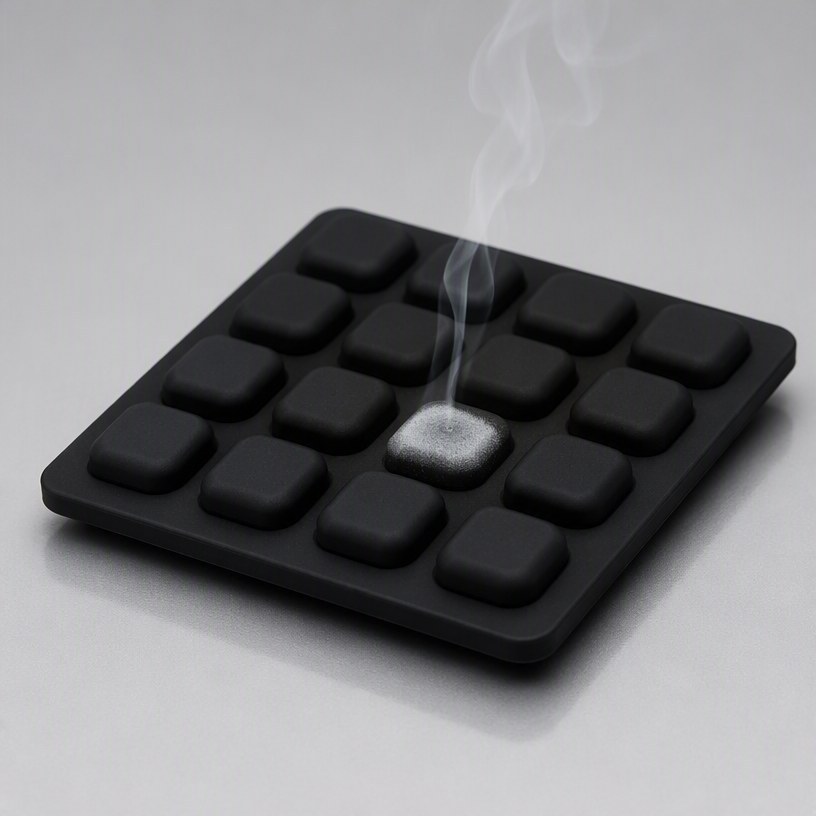
An appliance engineer once told us the keypad "can't be a safety issue — it's silicone, silicone doesn't burn." That sentence is wrong in a way that costs real money. Silicone resists flame far better than most plastics, but it can burn, it chars, and in a thin keypad geometry the question is never "does it ignite easily" but "what does it do inside a UL 94 or glow-wire scenario, at the actual thickness you mould." Flame-retardant silicone exists precisely because ordinary silicone is not automatically flame-retardant enough for every electrical application. This article explains how flame-retardant silicone keypads actually work, what the ratings mean, and where smart home and appliance safety certification can go wrong.
First, retire the "silicone can't burn" assumption
Silicone is an organic-inorganic polymer, and the organic methyl groups on its backbone are combustible. What silicone does unusually well is resist sustained burning: it tends to self-extinguish, it does not melt and drip like thermoplastics, and it forms a silica char that acts as a barrier. That behaviour is a real advantage, and it is the reason silicone parts appear in electrical devices everywhere. But "resists" is not "cannot," and the difference shows up in standardised tests. The combustion behaviour depends on formulation, fillers, and thickness, which is why flame-retardant grades of silicone exist as a distinct product family.
If you specify silicone for an electrical enclosure or a keypad mounted near power electronics, the honest question to ask the supplier is not "is silicone flame retardant?" but "what UL 94 class does this exact compound hold, at what thickness, and with what test report?" The distinction between silicone families and their flammability behaviour is part of the material selection process we walk through in our silicone versus rubber versus elastomer material guide — and it is worth reading before the certification deadline, not after.
How flame-retardant silicone is made to behave
Flame retardancy in silicone comes from the formulation, and there are two mainstream routes. The first is platinum-catalysed addition-cure systems, which produce a cleaner, more stable polymer network; the second is loading the compound with flame-retardant fillers such as aluminium hydroxide or magnesium hydroxide, which release water vapour when heated and dilute the flame, while promoting the ceramic-like char layer that blocks oxygen. The filler route is how most UL 94 V-0 rated silicone parts achieve their class without halogens — increasingly important because halogenated flame retardants face regulatory and reputational pressure in consumer electronics.
A recent review of fire-retardant silicone rubber composites in the scientific literature describes exactly this trade: with the right filler loading, silicone composites reach a UL-94 V-0 rating while total heat release and smoke production drop significantly. What that means for a keypad buyer is that V-0 silicone is not exotic or expensive by default — but the compound choice does change processing behaviour, hardness, and sometimes surface finish, which is why the flame-retardant decision has to be made together with the tactile and durability decisions, not after them.
Reading UL 94 and its siblings correctly
The UL 94 standard classifies how plastics behave when a flame is applied, and V-0 is the class people quote most: the material self-extinguishes within ten seconds of a flame application, with no burning drips that ignite a cotton indicator. V-1 and V-2 are progressively less strict, and HB is the basic horizontal burn class. Two details matter enormously for keypads:
- Thickness is part of the rating. A compound certified V-0 at 3.0 mm is not automatically V-0 at 0.8 mm. Keypad walls are usually thin, so the rating must be confirmed at the thickness you actually mould, and the test report should say so.
- The rating belongs to the part, not the material name. "Silicone" on a data sheet means nothing by itself; the certificate should name the compound grade, the moulded test specimen configuration, and the laboratory. This matters because flame retardancy can be altered by additives used for colour, by the curing system, and by heavy pigment loads.
Beyond UL 94, appliance and smart home devices headed to certain markets also face glow-wire testing (IEC 60695 family), which asks whether a part withstands contact with a hot element, and some OEMs specify flame-retardant silicone for compliance with internal fire-safety policies even when the end standard only demands it for the enclosure. If the part sits inside the enclosure cavity, some certifiers treat the UI subassembly as part of the flammability assessment — which is why curing system choices, which influence the polymer network and additive compatibility, are relevant to more than smell and taste.
What the keypad actually contributes to electrical safety
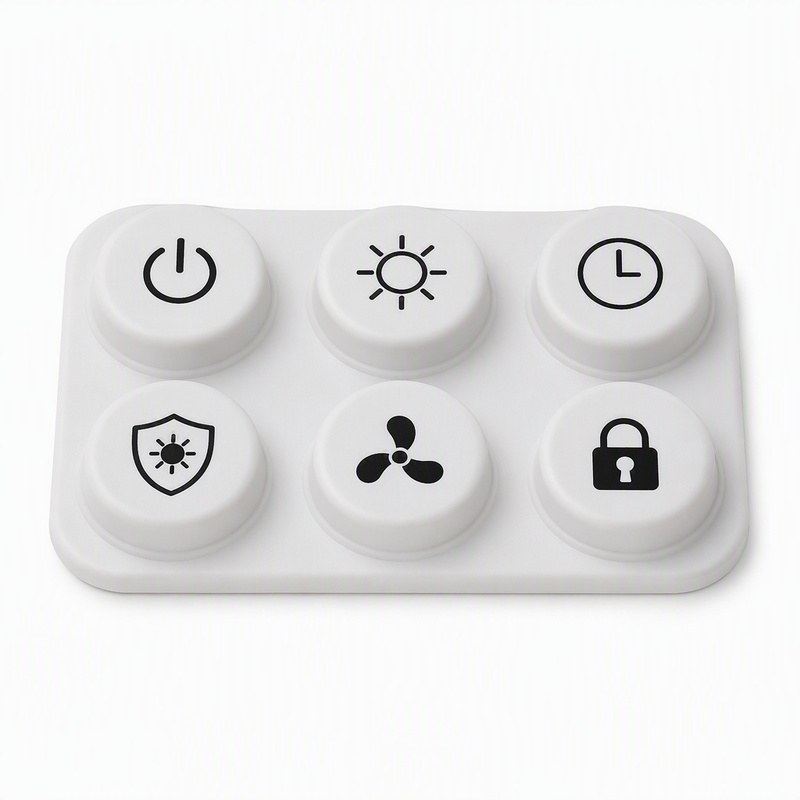
Let us be precise about responsibility. FromRubber does not design printed circuit boards, and a keypad is not an ignition source. The keypad's safety job is narrower and still essential: it must not become a fuel path inside the device. If a fault occurs on the electronics — and board-level faults are the customer's domain — the silicone parts mounted in the cavity should self-extinguish rather than sustain or spread a flame, and they should not emit burning drips onto other components. In humid appliance environments, that duty is doubled: surface moisture can track along a part, and a part that degrades in humidity is a part whose fire behaviour drifts from its certificate. Full-process manufacturers control the compound, the cure, and the post-processing together for exactly this reason — the same argument we make about why full-chain manufacturing prevents premature keypad failure.
A checklist for specifying flame-retardant keypads
When a smart home or appliance project requires a flame-retardant silicone keypad, this is the specification discipline that prevents surprises at certification:
- Name the standard and class explicitly — e.g., "UL 94 V-0 at 1.0 mm, vertical test, no flaming drip" — not just "flame retardant".
- Ask for the thickness-matched report. The certificate must cover the wall thickness of your actual part; request a moulded plaque from the production compound rather than a generic datasheet claim.
- Confirm halogen-free if required for your market or your brand's environmental policy.
- Lock colour and additive limits. Deep blacks and heavy pigment loads can affect the compound's fire response; qualify the final colour, not the natural compound.
- Re-verify after any compound change. A cheaper "equivalent" compound is not equivalent if it has not been retested at your thickness — treat the certificate as part-specific, because it is.
- Check the adjacent parts. Legend inks, adhesives, and backlight films inside the key stack also burn; if the assembly must be V-0, every material in the stack needs a view, not just the silicone.
Food-contact and safety certifications for kitchen appliances follow a similar discipline — certification is tied to the exact material state, which is why we treat FDA and LFGB compliance for kitchen appliance keypads as a formulation matter, not a paperwork matter.
A case in point: V-0 at the real thickness
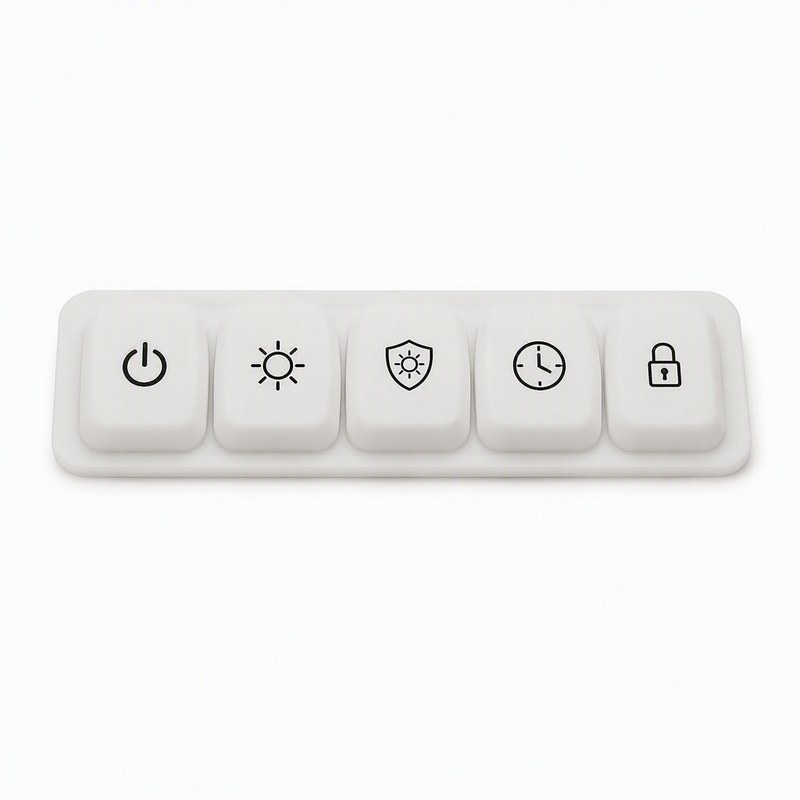
An appliance OEM came to us with a UL 94 V-0 requirement for the control keypad of a countertop air-treatment device. The original supplier had quoted a V-0 compound, but the certificate covered a 3 mm plaque while the production part moulded at 1.2 mm walls with a deep black colour. We reformulated with a filler-loaded, halogen-free, platinum-cured compound, validated V-0 at the production thickness and colour, and shipped the first articles with the thickness-matched report attached. Nothing about the keypad's feel changed; everything about its certification story did. That is the difference between buying "flame-retardant silicone" and buying a flame-retardant silicone keypad that can prove it.
Sources and further reading:
- PMC — Recent advances in fire-retardant silicone rubber composites (filler systems, UL-94 V-0 behaviour, heat and smoke release)
- Protolabs — UL 94 classifications and flame-retardant materials (what V-0, V-1, V-2 and HB mean in testing)
- Elastostar — The significance of UL 94 V-0/HB certification for flame-retardant silicone (silicone gaskets and seals in electrical/electronic components)
About FromRubber. FromRubber is a full-process silicone keypad and silicone parts manufacturer. We formulate flame-retardant, halogen-free compounds, mould the parts, and maintain the thickness-matched UL documentation our customers need for certification. We do not design PCBs — we make sure the silicone parts around them behave. If your appliance or smart home keypad needs a defensible flame-retardant story, send us your drawing and target class, and we will qualify the compound at your real thickness before you commit to tooling.