Stop Wasting Foundation: How a Silicone Powder Foundation Scraper Can Save You Money Every Day
- Share
- publisher
- Suey
- Issue Time
- Mar 11,2026
Summary
Discover how a silicone powder foundation scraper from FromRubber prevents makeup waste, saves money daily, and offers custom manufacturing for beauty brands.

Yield note
Pressed powder and cream foundation are lost in two places: the ring the brush cannot reach and the pan that is discarded while still holding product. A silicone powder foundation scraper addresses both, because a flexible silicone edge conforms to the pan radius and lifts the last layer instead of gouging the compact.
- The loss is geometric: a brush cannot reach the outer ring, and the pan is thrown away holding it.
- A soft silicone edge conforms to the pan radius; a rigid spatula leaves a hard line of product behind.
- Edge radius and hardness decide whether the tool scrapes cleanly or scratches the compact.
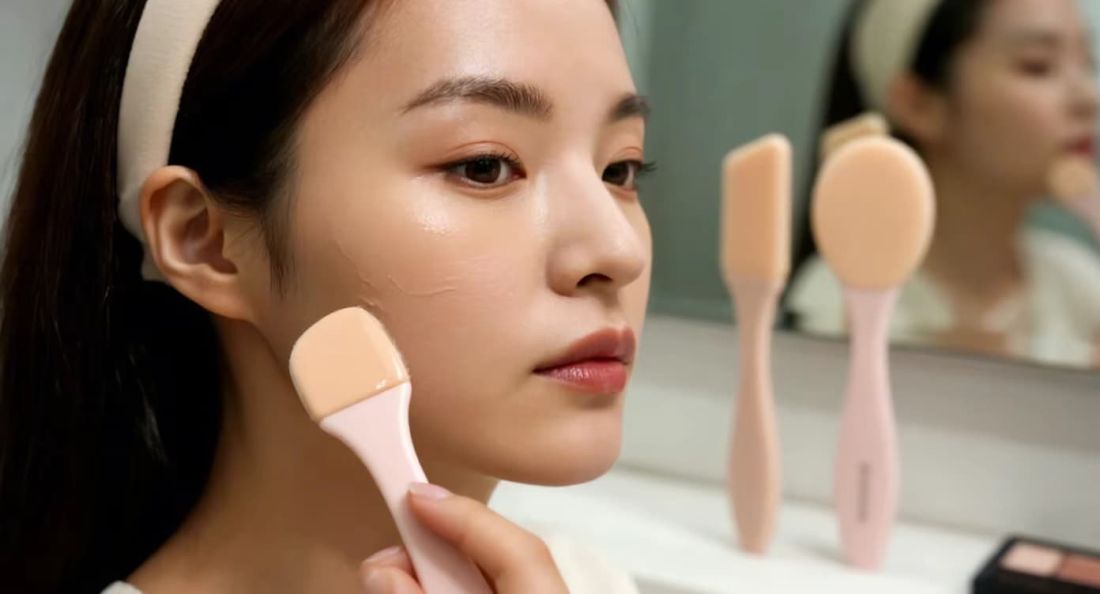
Why a silicone powder foundation scraper recovers more product
In a pressed compact, the brush footprint is smaller than the pan, so the outer ring is never touched; the deeper the dome, the larger that ring. In a cream pan, product migrates to the wall as the user works from the centre, and the last few millimetres are unreachable without a tool. Neither loss is a formula problem, which is why reformulation does not fix it.
The second loss is behavioural. A user who cannot reach the last layer declares the product finished and opens a new one, so the effective yield per unit is below the fill weight. Recovering that layer moves the perceived value of the product without changing anything in the formula, and it is one of the few improvements a brand can make in packaging rather than in chemistry.
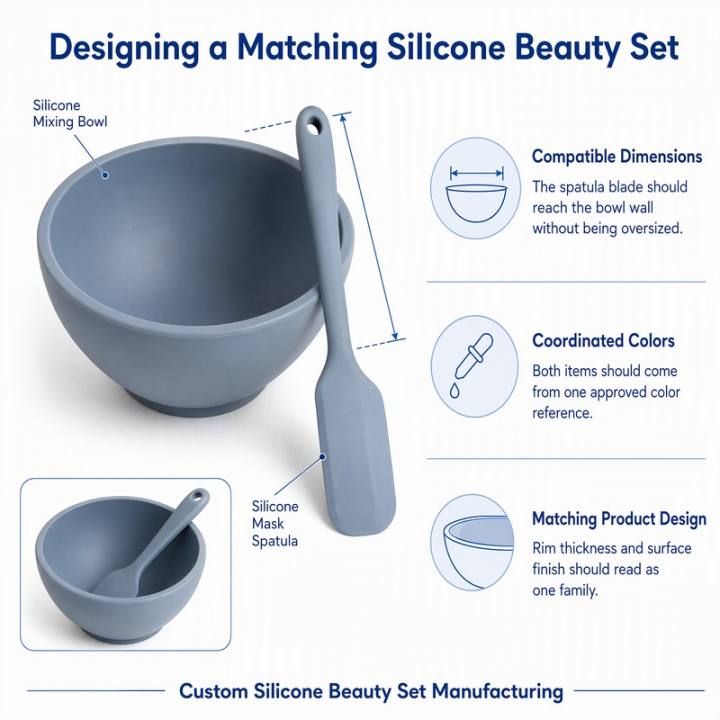
Edge geometry: what makes the scraper work
The working edge should be thin enough to slide under product and round enough not to score the compact. An edge radius in the region of 0.3 to 0.8 millimetres with a slight taper behind it gives that combination: the contact is narrow, but there is no sharp corner to cut into the pan or the skin.
Hardness decides how the edge behaves against a curved wall. At 50 to 70 Shore A the blade flexes enough to follow the pan radius while staying stiff enough to push product rather than fold over. Softer compounds feel pleasant but smear; harder ones behave like a plastic card and leave a line of product where the blade stops conforming.
- Edge radius — 0.3 to 0.8 mm with a tapered back.
- Hardness — 50 to 70 Shore A for a blade that flexes without folding.
- Thickness — thin at the edge, thicker at the spine for control.
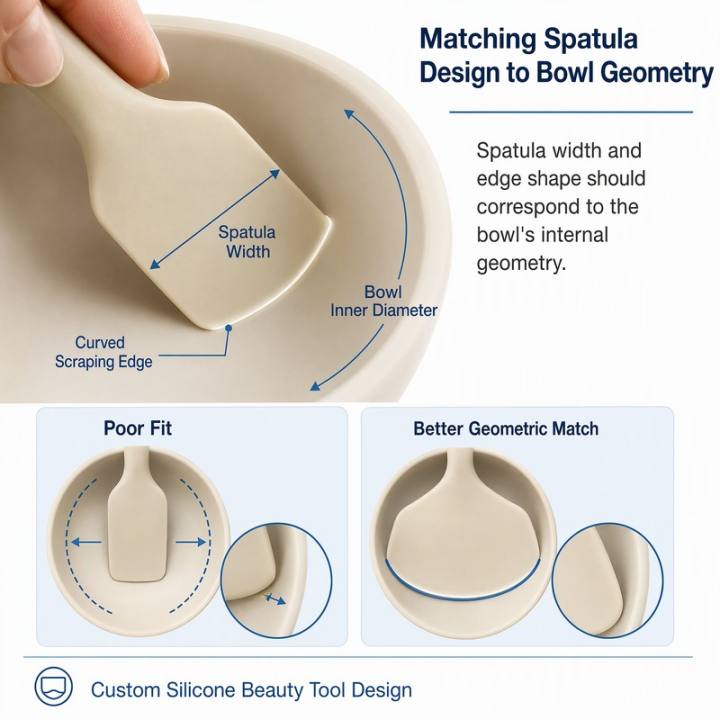
Scraper designs and what each recovers
| Design | Reaches | Limitation |
|---|---|---|
| Flat flexible blade | Pan floor and shallow radius | Struggles at a deep wall |
| Curved blade matching pan radius | Wall and corner in one pass | Only fits the pan it was designed for |
| Narrow tip | Corners and hinge areas | Slow for bulk recovery |
| Wide blade | Bulk product | Misses the last corner |
| Blade with a scoop back | Product transfer to a jar | Needs a deeper mould and more material |
Hygiene, cleaning and the claims that hold up
A scraper touches product and skin, so it is a cosmetic accessory rather than a gadget, and the same expectations apply: a non-porous surface that wipes clean, no crevice where product collects, and a cure level that does not leave residue. A one-piece moulding with no joint answers all three, which is why most commercial scrapers are single-material rather than assembled.
Claims should follow the test. “Recovers up to X uses” is only defensible if somebody measured the residue in a pan of the specified size; “hygienic” is a property of cleaning, not of the material. A brand that states the cleaning routine and the pan format it was designed for is more credible than one that promises a saving without arithmetic.
Count the uses, not the promises. A compact rated at a fixed number of applications assumes the user reaches the last layer; in practice the outer ring is abandoned and the pan is replaced early. Moving that ring back into the routine adds uses without changing the fill weight, and the gain is measurable on a panel of ten users before a brand makes any claim.
The arithmetic is worth doing once. If a pan holds product worth a fixed amount and the unreachable ring is a visible fraction of the surface, the recovered value per unit is small in absolute terms and large as a percentage of margin on a low-cost accessory. That is the argument a private-label buyer can take to a finance team, and it is why the tool ships with the compact rather than as an afterthought.
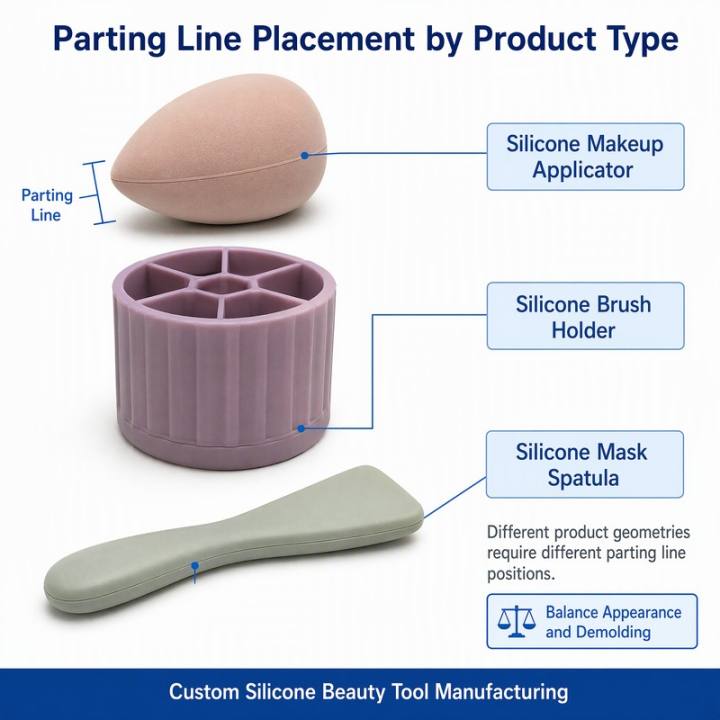
How a custom beauty accessory is quoted and run
Accessories are usually tooled to fit a specific packaging format, so the packaging drawing comes first.
Inputs
Pan or compact dimensions, product type, brand colour and the retail packaging it must fit.
Design
Blade radius, hardness, spine thickness and whether a scoop or a hanging hole is needed.
Sampling
Parts for a usability panel with the actual product, plus a cleaning and staining check.
Volume and packing
Cavity count, colour, logo method and whether it ships loose or in a blister.
Questions from brands and buyers
Does it scratch the compact?
Not when the edge radius is rounded and the hardness is moderate. A sharp edge or a hard material will score the pan, which is why both are specified together.
Will it work on cream and powder?
Yes, but with different blade profiles. A cream product needs a wider, flatter blade; a pressed powder needs a narrower edge to lift the layer.
Is silicone or TPE better?
Silicone holds up better to repeated cleaning and does not go tacky as quickly. TPE is cheaper and adequate for a short-life promotional item.
Can it be branded?
Yes: a moulded logo on the spine, or a colour match to the compact. A moulded mark survives cleaning better than a printed one.
Send the compact drawing and the product type
FromRubber moulds silicone beauty accessories in Dongguan, including blades profiled to a specific pan radius. Send the compact drawing, the product type and the packaging format; we will propose a blade geometry and a hardness, then mould samples for a usability panel.
Request an accessory reviewRelated reading: silicone brush pads and palettes and custom silicone beauty tools.