The Instrument Silicone Keypad Passed 1M Cycle Tests – So Why Does It Fail First During System Aging?
- Share
- publisher
- FromRubber
- Issue Time
- Sep 9,2026
Summary
A million-cycle pass and a field failure are not a contradiction: cycle tests measure mechanical fatigue in free air, system aging adds heat, preload and chemistry. Compression set, stress relaxation and cure system decide which keypad survives the product.
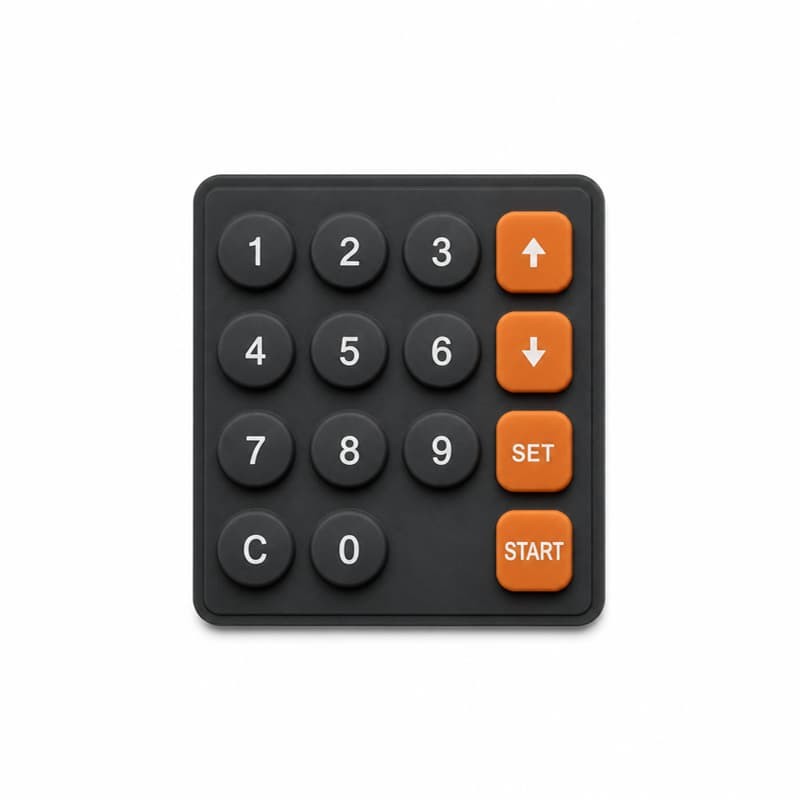
Your industrial instrument silicone keypad passed one million cycle tests on paper, then became the first thing to fail in system aging. The lab record said the keypad outlasts the instrument. The field data says otherwise. The gap is not a fluke — it is the difference between a mechanical fatigue test and the slow chemical and mechanical creep a keypad experiences when it is clamped inside a real product.
What a million-cycle test actually proves
A cycle test presses a key against a rigid anvil, usually in free air, at a fixed speed and a fixed temperature, and counts how many presses the key survives before it stops actuating or tears. It answers one question: how many times can this rubber bounce back under these exact conditions. That is mechanical fatigue, and for a well-built silicone keypad the number is usually high — a million presses is an achievable target for industrial and medical-grade compounds. But the test removes the two things that kill keypads in service: sustained compression and elevated temperature. A keypad in an instrument sits squeezed between the housing and the switch board for years, and the instrument sits in an environment that is rarely 23°C.
The relevant material behavior is covered by two standard test families. Compression set, per ASTM D395, measures how much elastic recovery a rubber compound loses after prolonged compressive stress — in plain terms, whether a key that is held compressed for months still springs back. Air-oven aging, per ASTM D573, measures how much the physical properties degrade under prolonged elevated temperature, which is the chemical side: oxidation of the silicone network. A one-million-cycle test exercises neither. That is why it can pass while the system fails.
The failure mode that cycle tests miss: stress relaxation
When a keypad is assembled, the housing compresses the keypad's actuator and gasket areas against the board to guarantee contact. That squeeze is the exact loading that compression set tests are built to expose. Over months of heat and constant deflection, the rubber slowly loses its ability to push back. The actuation force drifts, the key feels spongy, and eventually the key does not return or the contact resistance rises until the switch no longer triggers reliably. None of that shows up in a free-air cycle test, because in the test the key is pressed and released; in the product the key is pressed, released, and permanently preloaded.
Heat turns mechanical wear into chemical aging
The second hidden variable is temperature. Industrial instruments run warm — control cabinets, fryers, welding machines, forklift dashboards — and silicone's properties shift with it. Industry practice for conductive silicone keypads in vehicle and industrial environments commonly targets a working range of about -40°C to +150°C, and the chemical side matters at the top end: oxidation of the methyl side chains accelerates, and the network can harden or crack over time. The curing system plays a large role here. Peroxide-cured compounds leave small-molecule byproducts in the network; under long-term heat those residuals volatilize and the crosslinked network gradually loosens, which is why some parts harden and crack after a few thousand hot hours. Platinum-catalyzed addition-cure systems produce a cleaner network with fewer mobile residuals, and are preferred when long hot life is required.
This is where a "lab pass" and a "field pass" diverge. The cycle test runs at a benign temperature, so the compound's high-temperature degradation never gets a chance to start. The system aging test runs the whole instrument at elevated temperature while the keypad is under load — which is exactly the combination the cycle test was designed to avoid.
What to ask your supplier when the keypad must survive system aging: (1) compression set of the compound at your operating temperature, not at 23°C; (2) force decay after accelerated oven aging per ASTM D573 at your rated temperature, on molded keys rather than flat slabs; (3) whether the compound is peroxide- or platinum-cured, and what residuals it leaves; (4) the same force-travel data after 100,000 presses at the high end of your temperature range.
Why the keypad fails "first" in the system
Part of the answer is mechanical, part is optical. Electrically, the keypad is the most loaded soft component in the instrument: it takes the operator's press, the housing's preload, and the heat, all at once. Plastics and electronics also age, but a keypad failure is immediately felt by the user, while a slowly degrading capacitor is invisible until the instrument dies as a whole. So the keypad is not necessarily aging faster than everything else — it is simply the component whose aging the user notices first and blames first. That distinction matters, because it changes the fix: sometimes the right answer is a more heat-stable compound, and sometimes it is a small design change that takes the preload off the rubber.
What the acceptance test should look like
If your product spec includes system aging, add a keypad-specific leg to it instead of relying on the component cycle test alone. Practical additions: measure actuation force and contact resistance at 0, 500, and 1000 hours of oven aging with the keypad held at its assembly deflection; cycle a mounted keypad — not a loose one — through your temperature profile; and check compression set on the actual actuator geometry, because thick ribs and thin skirts creep differently than a test slab. These three numbers will tell you in weeks what the field would take months to reveal.
One case: the forklift keypad that went spongy at 2000 hours
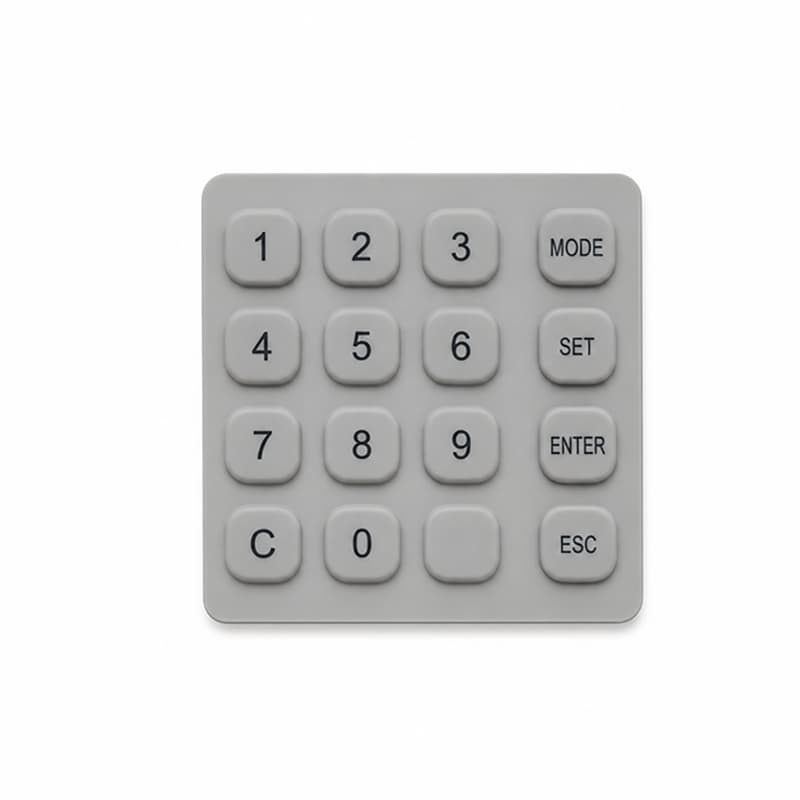
We molded a keypad for a forklift instrument that passed its one-million-cycle component test without issue. In the field, operators reported keys that felt spongy after roughly 2000 hours, and one customer wrote that the pad "got soft." The drawing and the cycle data were both clean. We reproduced the failure by aging mounted samples at the cabin's top temperature with the keypad held at assembly deflection. The culprit was compression set in the actuator geometry plus a peroxide-cured compound that lost network integrity at sustained heat. The fix was a compound change to a platinum-cured, low-compression-set material and a small rib adjustment that reduced the standing preload on the return zone. The redesigned pad held its actuation force through the full accelerated profile. The cycle test had not lied — it had simply tested the wrong stress.
Batch consistency is part of the aging story
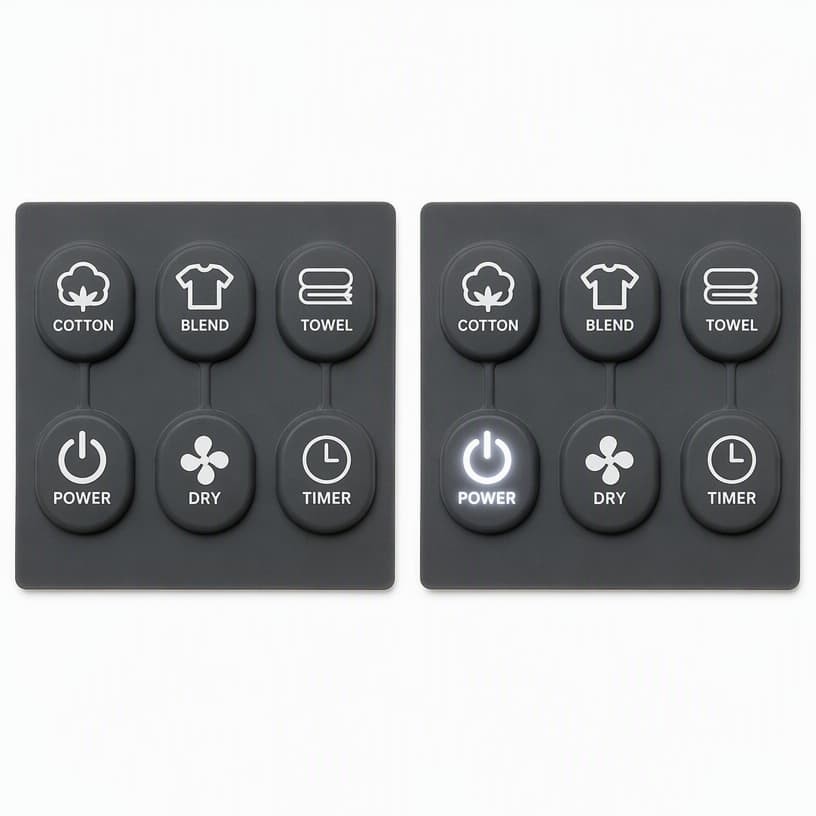
The lab sample that passed a million cycles is one point in time. Production batches bring their own variation: cure state, preform weight, compound lot. A slightly under-cured batch starts field life with more mobile material and a weaker network, so it ages faster even though it samples identically on the bench. Asking for batch-level compression-set data — not just the first-article report — is how you make the million-cycle pass mean something for the parts that actually ship.
Related reading
In short
A million-cycle result is a statement about mechanical fatigue in free air. System aging is a statement about a preloaded, heated, chemically aging rubber. Test the keypad the way the product uses it: mounted, compressed, hot. That single change — aging under assembly deflection instead of cycling in free air — is what closes the gap between the lab pass and the field failure.
This article was written by the molding engineering team at FromRubber, a custom silicone keypad manufacturer in Dongguan, China, working with industrial instrument, appliance and vehicle keypads. We validate compounds and geometries the way products actually load them.
Sources
- ASTM D395-16, Standard Test Methods for Rubber Property — Compression Set, ASTM International. https://www.astm.org/d0395-16.html
- ASTM D573-04(2019), Standard Test Method for Rubber — Deterioration in an Air Oven, ASTM International. https://www.astm.org/d0573-04r19.html
- Conductive silicone keypad working temperature range (-40°C to +150°C) and compression set guidance. https://c.m.163.com/news/a/L49GF31Q0556LF6I.html
- Compression set target (≤15%) and batch drift discussion for conductive silicone keypads. https://m.elecfans.com/article/8275843.html
- Peroxide versus platinum curing systems and long-term high-temperature network stability. http://m.toutiao.com/group/7677514734475985435/
- Silicone keypad accelerated aging testing practice (GB/T 3512). https://shenzhen0238438.11467.com/m/news/12809697.asp