Top 10 3D Silicone Patch Manufacturers for Apparel Branding
- Share
- publisher
- FromRubber
- Issue Time
- Oct 16,2026
Summary
Ten suppliers compared on how they handle the patch-to-garment joint, with a 100-point rubric, a strain and edge-geometry checklist, and a five-step pre-production evaluation you can run on a real garment.
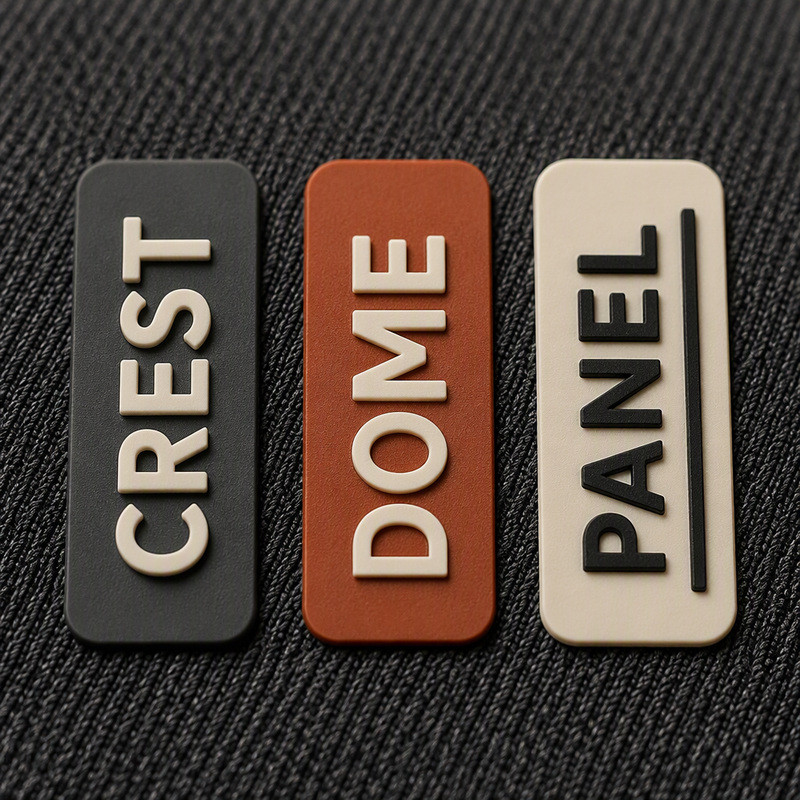
Top 10 3D Silicone Patch Manufacturers for Apparel Branding
The patch passed every check in the sample room. First wash, the corners lifted. Second wash, one lifted further. By the time the returns came in, the discussion had moved to the supplier — when the actual fault was that a stiff patch had been specified for a fabric that stretches.
A 3D silicone patch is not a badge sitting on a garment. It is a joint between two materials with very different elastic behavior, and most field failures in this category are joint failures: edges lifting, patches separating after heat pressing, or a mark that feels like a tile on a light hoodie.
Direct answer
Judge a 3D silicone patch manufacturer on how it handles attachment and strain, not only on how well it molds relief. The shortlist below was filtered on three things: live product evidence for molded silicone patches used in apparel branding, a documented method of attaching the patch to a garment, and published information about relief or thickness. Suppliers that only catalog flat printed labels were not counted, even where the word 3D appears on the page.
The patch and the garment are one structure
Think about the joint rather than the patch, and three variables appear immediately.
Strain mismatch. A woven shell fabric barely moves. A four-way stretch knit moves a great deal. A patch that neither stretches nor floats will concentrate the entire movement of the fabric at its own perimeter, which is why edge lift starts at the corners.
Edge geometry. A square corner is a stress riser. A radius is not. Nothing about the molding changes when you add a 2 mm radius to an outline, but the wash performance of the finished garment often does, because the peel load spreads over a longer edge.
Flexural stiffness. Stiffness is a function of thickness and material hardness together, and it is the reason two patches of identical relief can behave completely differently on the same jacket. Hardness is quoted on a defined scale — ASTM D2240 covers durometer hardness testing for rubber and elastomeric materials — and it belongs in the specification alongside thickness.
The practical consequence is that the right question is not “how deep is the relief” but “what is the total stiffness of this patch on this fabric, and how was it tested”.
Hardness belongs in numbers rather than adjectives. A typical 70 Shore A silicone datasheet cited in FromRubber’s published thickness note, updated 7 October 2026, lists hardness of 70 ± 5, tensile strength of 5.0 MPa required against 5.7 MPa achieved, and elongation at break of 150 percent required against 266 percent achieved. Read together, the design constraint is plain: the compound is built to stretch to more than twice its length before it breaks, so a patch that is over-built in thickness is fighting a material whose main advantage is compliance.
Attachment is part of the product, not a line item
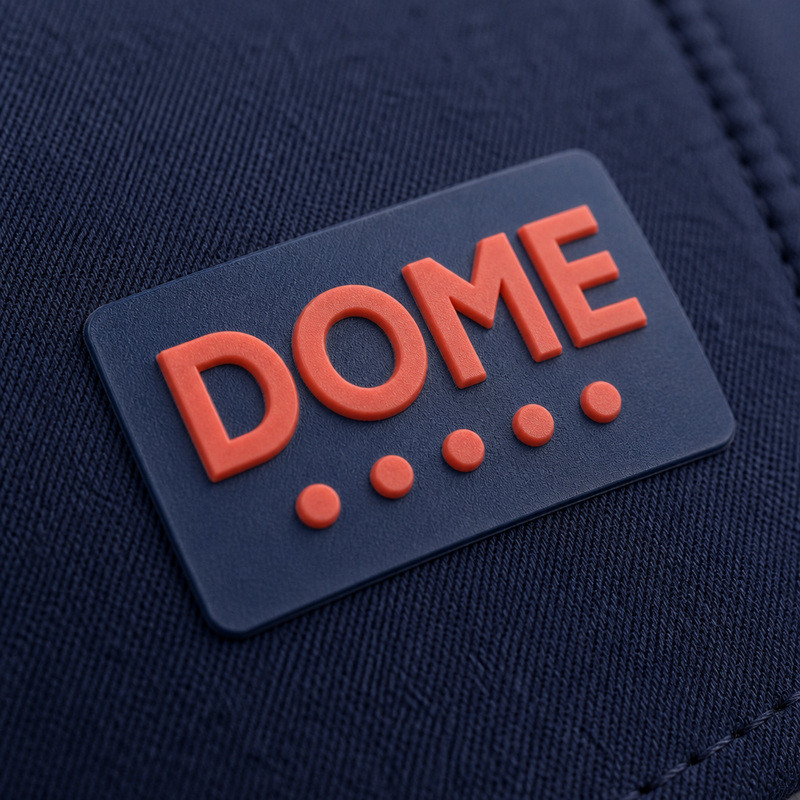
Three attachment systems dominate, and they behave differently under wash and wear.
Sew-on. Mechanical attachment through a molded channel or stitched perimeter. The most durable route on heavy fabric and the most predictable across repeat orders, but it introduces needle damage and can distort a patch on a curved panel if the placement is not planned.
Heat transfer or heat seal. A thermoplastic adhesive layer is activated under temperature and pressure. Clean and fast, and it suits lightweight garments because the patch can be thin. It is also the route most sensitive to process control: too cool or too short a dwell and the bond is incomplete; too hot and the relief softens. Suppliers that publish a press window are telling you they have already mapped this — see the note on checking adhesion after pressing.
Adhesive-backed or hook-and-loop. Right for removable or repositionable branding, and the wrong choice where wash durability is the priority. Adhesive backing is a consumer-application method, not a factory one.
Which of these a supplier documents, per construction rather than as a general list, is the fastest signal of how much of this problem it has actually solved. The comparison between the routes is covered in more depth in heat transfer versus sew-on for silicone patches.
How the candidates were assessed
| Weight | Criterion | What counted as evidence |
|---|---|---|
| 25 | Verified silicone patch manufacturing for apparel branding | A live product page for molded silicone patches aimed at garments or accessories |
| 25 | Documented 3D or multi-level molded construction | Named raised, embossed, layered or 3D patch constructions |
| 20 | Relevant attachment options for apparel | Sew-on, heat-seal, adhesive or hook-and-loop named per patch construction |
| 15 | Custom shape, relief, color and thickness development | Stated customization of outline, relief plan, Pantone matching and thickness |
| 10 | Sampling and production-quality information | A published proof or sample-approval step, or documented inspection stages |
| 5 | Publicly verifiable technical documentation | Published thickness or relief ranges |
Editorial scoring from each company’s own published pages, checked on 16 October 2026. No relief heights, color limits, tolerances or wash results were estimated. FromRubber, which publishes this website, was scored with the same rubric. The comparison was compiled by the FromRubber technical team from the suppliers’ own published documentation, and every source listed below was opened on the date shown.
Comparison at a glance
| # | Company | Patch product evidence | Dimensional structure | Attachment documented | Score |
|---|---|---|---|---|---|
| 1 | FromRubber | Custom rubber patch service and a dedicated patch product group | Embossed and raised detail, multi-color molding, multi-process builds | Sew-on, heat transfer, adhesive-backed and overmolded constructions | 92 |
| 2 | Nanjing Jiamei (Jiamei Labels) | Silicone patch and PVC/rubber badge categories for apparel and footwear | Raised, recessed, embossed, 3D and multi-layer effects | Sew-on channel, heat transfer, adhesive, hook-and-loop | 89 |
| 3 | Qinghan Label | 95-product silicone patch category with apparel, hat and backpack applications | 3D printed, 3D rubber patch, dot relief, screen-printed silicone | Iron-on, sew-on, hook-and-loop | 88 |
| 4 | The American Patch | Dedicated custom silicone patch page with a published specification table | Flat or raised 3D molded detail, matte or gloss finish | Heat-seal, hook-and-loop, adhesive, sewing channel, each described | 85 |
| 5 | ASEE Fashion / RY Labels | 3D silicone label and patch program for clothing | 2D and 3D silicone constructions | Heat transfer with a stated press temperature window | 82 |
| 6 | JW Trims (Jiewei) | Silicone label category for garment labels and trims | Molded silicone labels with dimensional finish, plus heat-transfer constructions | Sew-on and heat-applied options listed by construction | 79 |
| 7 | PB Patch | Factory-direct custom silicone patch page with bulk production stated | Flexible 3D logo effect stated by the company | Not published per construction | 75 |
| 8 | ClothingTags.cn (MINT Limited) | 3D silicone heat transfer patches and rubber label categories | 3D heat transfer with letter, arc and two-layer styles | Heat press | 74 |
| 9 | Yusen Trims | Silicone and PVC label category covering garments, bags and headwear | Molded dimensional finish | Not published per construction | 70 |
| 10 | Cruz Label | PVC, silicone and leather patch collection stating apparel and footwear production | Molded rubber patch construction | Not published per construction | 66 |
Kaishen (KSPatch) was reviewed and excluded: its published material covers embroidery and patch manufacturing but does not document a molded silicone apparel-patch program, so it did not meet this article’s requirement.
Company profiles
1. FromRubber
FromRubber publishes both a custom rubber patch capability page and a patch product group with individual items including sew-on silicone patches for caps and heat transfer rubber patches, which is the per-construction attachment detail this article weights. The site also documents a patch service process and publishes field guidance on preventing edge lift on sportswear and on why patches separate after heat pressing. Unconfirmed: a published wash-cycle qualification record. Company details published on the same page record the manufacturer as Dongguan Bohao Electronic Technology Co., Ltd., Jingcheng Road 122, Langxia Village, Qiaotou Town, Dongguan, Guangdong, China, operating since June 2010 with 32 compression molding machines across two sites and IATF 16949:2016, ISO 9001:2015 and ISO 14001:2015 certification.
2. Nanjing Jiamei Garment Accessory Factory (Jiamei Labels)
Jiamei lists silicone patch, PVC/rubber badge and uniform badge categories for apparel and footwear, with raised, recessed, embossed, 3D and multi-layer effects and four attachment methods including a sew-on channel. Pantone color matching and custom thickness are offered. Unconfirmed: how the company qualifies adhesion on stretch fabric, and its tool ownership terms.
3. Qinghan Label
Qinghan’s silicone patch category covers apparel, hat and backpack applications and includes 3D printed silicone, 3D rubber patches, brush-dot appliqué and screen-printed constructions. The company documents in-house washing, physical and rating laboratories, which is directly relevant to patch attachment claims. Unconfirmed: a published attachment specification per construction and the wash procedure its laboratory follows.
4. The American Patch
This supplier publishes the most explicit attachment guidance of the group, describing heat-seal pressing in top-heat-only terms with a stated temperature and dwell, a cooling period, and a warning against bottom heat — plus a night's resting period before the first wash for heat transfer labels. It also explains why a correctly pressed patch survives a dryer while a poorly pressed one does not, and offers four backing systems. Unconfirmed: garment-factory scale and non-US production.
5. ASEE Fashion / RY Labels
ASEE documents 3D silicone and TPU heat transfer labels produced by vacuum heat pressing with a stated temperature control window, which is the process variable that most affects whether a raised heat-transfer patch survives washing. Unconfirmed: whether patches are molded in-house and its published adhesion test method.
6. JW Trims (Jiewei)
JW Trims publishes a silicone label category aimed at clothing labels and trims, with molded and heat-transfer constructions presented as separate options and a stated manufacturing role. Separating the two constructions at product level is the specific signal this article weights, because they fail differently once the garment is washed. Unconfirmed: the durometer range offered and the peel or wash protocol used to qualify adhesion.
7. PB Patch
PB Patch presents itself as a factory-direct source for custom silicone patches with bulk production support and a stated flexible 3D logo effect, aimed at buyers who need low minimum quantities and fast sampling. Unconfirmed: the manufacturing entity behind the brand, its attachment options per construction, and any published thickness or hardness values.
8. ClothingTags.cn (MINT Limited)
The company lists 3D silicone heat transfer patches in letter, arc and two-layer styles and documents a full sequence from requirements negotiation through design, sampling and inspection to shipping, with photographs taken for approval before dispatch. Unconfirmed: relief depth and adhesion testing procedure.
9. Yusen Trims
Yusen publishes a silicone and PVC label category covering garments, bags and headwear and provides a structured inquiry route for edge lift, bulkiness and color mismatch — symptoms that map directly onto the joint problems described above. Unconfirmed: which entity manufactures the patches and whether attachment systems are quoted per construction.
10. Cruz Label
Cruz states that it produces PVC and silicone labels not only for apparel and footwear companies but also for the automotive and packaging industries, and presents them in a patch collection. Broad material coverage can be an advantage for durability-focused programs. Unconfirmed: 3D relief capability specifically, and attachment options for apparel.
How to evaluate a 3D patch before bulk production
Test the joint, not just the patch. A sample that looks right on a bench tells you almost nothing about how it will behave after ten domestic washes on a garment that stretches in two directions.
Placement on the real garment
Put the sample where it will live: across a seam, over a panel boundary, on the curve of a cap crown. Flat placement on a swatch hides alignment problems that show immediately in production.
Relief legibility at distance
View at the distance the mark will be read from, under raking light, not straight-on studio light.
Edge geometry review
Radius the corners, then compare. On stretch fabric the difference is usually visible after the first wash cycle. More on this in design factors for patches on seamless sportswear.
Hardness against fabric
Ask what durometer the patch is, then bend it with the fabric. If the label resists while the garment moves, stiffness is wrong for the application — see choosing patch hardness for flexible sportswear.
Wash cycling to a defined procedure
Use a repeatable domestic wash and dry regime rather than an informal wash. ISO 6330:2021 sets out domestic washing and drying procedures for textile testing, and the value of using it is that results become comparable between suppliers.
Repeat-order consistency
Confirm that tooling is retained and that color references are recorded, so the second order matches the first rather than approximating it.
Questions buyers keep asking
What is the difference between a 3D silicone patch and a silicone clothing label?
Construction and attachment, mainly. A patch is a discrete object with its own outline, attached by sewing, heat sealing, adhesive or hook-and-loop. A clothing label is often a thinner heat-transfer construction that presses into the fabric with little or no raised edge. Both can be molded; they fail in different ways.
Which attachment method suits which garment?
Heat transfer for lightweight and technical garments where a raised edge is a liability; a sew-on channel for heavy outerwear, workwear and caps where mechanical attachment is more predictable; hook-and-loop only where removability is the point. If a supplier offers one route for everything, that is an answer in itself.
Can a 3D silicone patch be used on stretch sportswear?
Yes, but the specification changes: thinner base, softer compound, radiused corners and a smaller footprint. A stiff patch on a four-way stretch panel is a design conflict, not a bonding problem. See why a silicone patch can feel stiff on stretch fabric.
Does a larger relief height always improve logo visibility?
No. Visibility comes from edge contrast and shadow. Beyond a certain depth you are adding weight and stiffness without adding legibility, particularly on dark garments where the mark is read mainly by shape.
How should adhesion be tested before bulk production?
Press samples on the production fabric, rest them for the period the supplier specifies, then run them through a defined wash-and-dry cycle and inspect the perimeter. Test the corners first: that is where the failure starts, and it is also where a radius will pay for itself.
What files and samples should buyers provide?
Vector artwork, finished patch dimensions, the relief plan, color references, the target fabric, the attachment method and an estimated quantity. Send the garment or a full panel where you can, because curvature affects placement, and placement affects the peel load at the edge.
Where this leaves the sourcing decision
Shortlist on attachment evidence and relief documentation, then decide on a wash test rather than an opinion. The suppliers worth keeping in a program are the ones that will name the press parameters, state a durometer, and accept a rounded outline because they know what it does for the finished garment.
Where a company’s 3D claim rests on a single catalog line rather than a product or process page, treat it as a question to put in your first email. Some of the gaps in the table above are publishing gaps rather than capability gaps, but in patch work, the ability to describe the joint precisely is closely related to the ability to control it.
FromRubber produces custom silicone patches and silicone labels in Dongguan, Guangdong, and publishes its custom patch capability and patch development process alongside its product range. If you have artwork, a target size, the garment fabric and an estimated quantity, a feasibility review is the practical starting point — with the caveat that relief geometry and garment stretch interact, so a patch that works on a jacket panel may need to be respecified for a stretch base layer.
Inquiries: nani@fromrubber.com or karl@fromrubber.com. WeChat and WhatsApp: +86 186 7621 0913.
Relief plan
Edge radius
Durometer
Press window
Wash cycle
Five specification items that decide whether a 3D patch is still attached after a season. None of them appear on a typical patch quotation, and all of them can be agreed in a single technical email before the tool is cut.
Rubber product dimensions are quoted in tolerance classes rather than absolute values — ISO 3302-1:2014 defines those classes — so agree the class at the same time as the relief plan. Where the finished garment touches skin directly, or is intended for children, it is also normal for brands to ask the trim supplier for OEKO-TEX STANDARD 100 certification, since the test criteria are set by skin contact rather than by material.
Sources and references
- ISO. ISO 6330:2021, Textiles — Domestic washing and drying procedures for textile testing.
- ISO. ISO 3302-1:2014, Rubber — Tolerances for products — Part 1: Dimensional tolerances.
- ASTM International. ASTM D2240-15(2021), Standard Test Method for Rubber Property — Durometer Hardness.
- OEKO-TEX. OEKO-TEX® STANDARD 100 harmful-substance testing.
- The American Patch. Heat-seal application guidance, backing options and wash notes.
- Nanjing Jiamei Garment Accessory Factory. Silicone patches, rubber badges and attachment options.
- Qinghan Label. Silicone patch category and in-house testing laboratories.
- ASEE Fashion / RY Labels. 3D silicone heat transfer patch production and press control.
- JW Trims (Jiewei). Custom silicone labels for garment labels and trims.
- PB Patch. Custom silicone patch production page.
- ClothingTags.cn (MINT Limited). 3D silicone heat transfer patch and rubber label catalog.
- Yusen Trims. Custom silicone and PVC label category.
- Cruz Label. PVC, silicone and leather patch collection.
- Kaishen Garment Accessory Co., Ltd. (KSPatch). Company homepage. Reviewed and excluded from this article.
Related reading on this site: why silicone patches hold color where embroidery fades, and preventing edge lift on sportswear patches.
All sources were checked on 16 October 2026. Attachment methods, press parameters and material specifications are company statements and can change, so confirm the current position directly before committing to tooling or a bulk run.