Top 10 Silicone Pet Feeding Product Manufacturers for Custom Brand Projects
- Share
- publisher
- FromRubber
- Issue Time
- Oct 21,2026
Summary
A buyer's guide to ten silicone pet feeding manufacturers, scored on published evidence rather than catalogue size. It covers usable volume and rim geometry, colour and hardness consistency across a range, existing versus new tooling, food-contact documentation, and the questions that separate a product developer from a stock supplier.
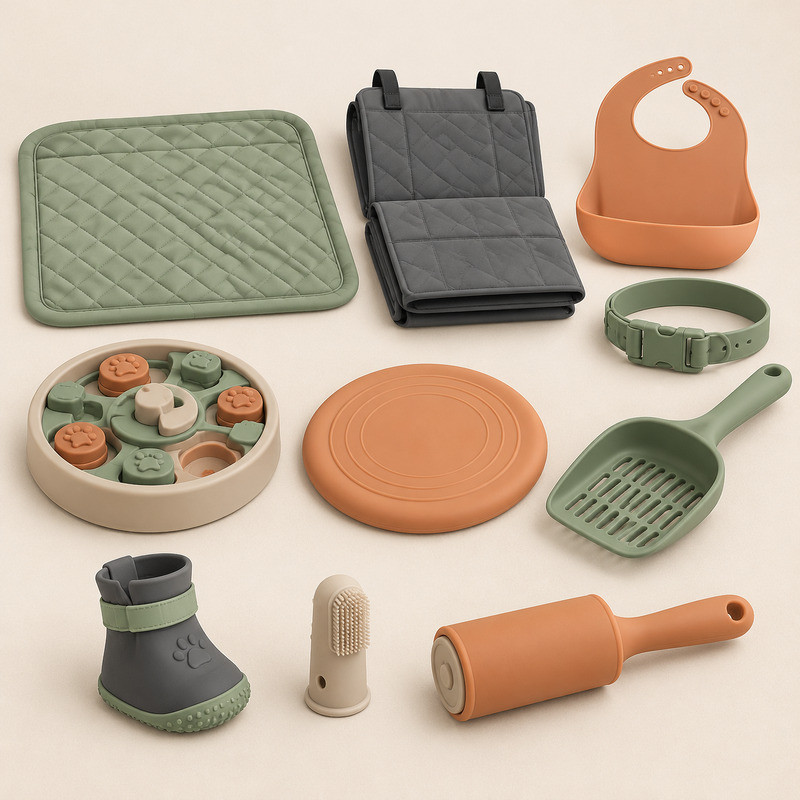
A feeding range rarely fails at the mould. It fails where the bowl, the mat and the lick pad come from three suppliers and stop looking like one brand.
The bowl is a shade of sage the mat is not. The mat is 40 Shore A and the bowl is 60, so one feels soft and the other feels like a tyre. The carton was designed around the bowl and crushes the mat on the pallet. Nobody made a single bad decision; the range was simply bought one SKU at a time.
This guide covers ten manufacturers that publish silicone pet feeding products or custom feeding development, and the checks that separate a company able to run a brand's feeding range from one that can only ship a stock bowl with a logo on it. Scores are editorial, drawn from public pages reviewed on 21 October 2026, and each entry states what the page shows and what it still leaves open.
What Customization Really Means for Silicone Pet Feeding Products
Suppliers use “custom” for two very different jobs: changing the surface of an existing item, and changing the object itself. The distinction decides tooling cost, lead time and how much of the design is actually yours.
Capacity is a volume question, not a diameter question
A 400 ml bowl measured to the brim may hold 300 ml before food spills over the rim during eating. Once a maze or a set of ridges is added, usable volume drops again, and the freeboard above the fill line becomes the number that matters. Two suppliers can quote the same diameter and deliver different usable capacity, because one measured the cavity and the other measured the drawing.
Rim geometry follows the same logic. The rim is the stiffest part of a bowl, so a thick rim with a thin wall creates a stress line where the two meet. A uniform thin wall folds under a full load. Neither problem appears in a product photo.
Colour and hardness travel together
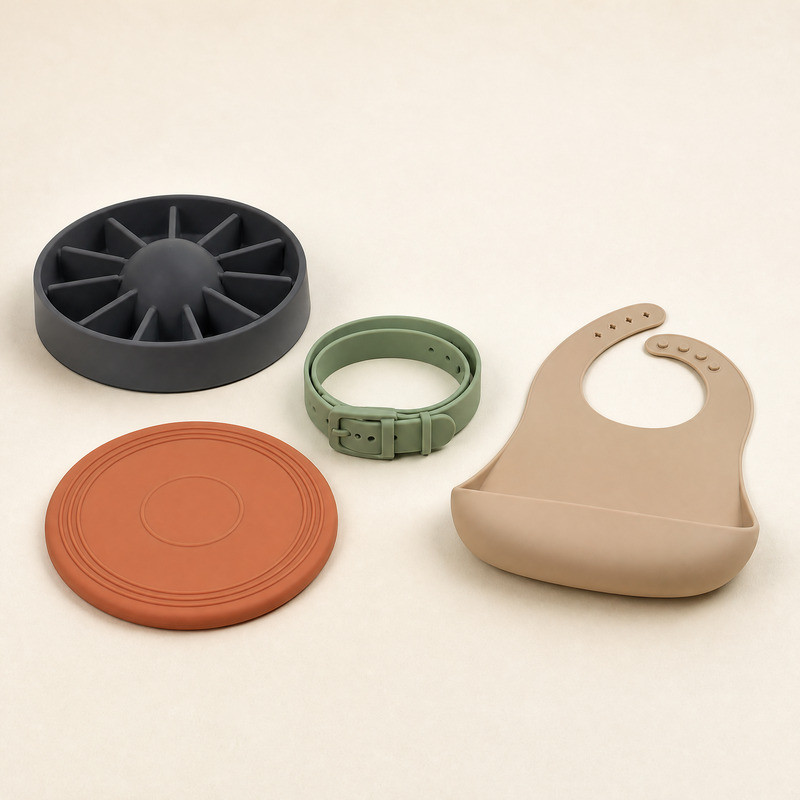
A brand colour is not a Pantone number alone. It is a pigment system matched to a specific compound, cured at a specific temperature. Change the compound from 50 to 70 Shore A for a stiffer bowl and the same pigment may read differently, because the base polymer and the cure package changed too. Ranges that hold together are usually built from one pigment lot and one compound family, with hardness adjusted inside that family rather than across suppliers.
The practical test is simple: ask each supplier for the compound data sheet and the colour reference they would use, then compare the two documents side by side. If the compounds come from different families, the colours will drift even when the chips match.
A logo is a depth decision
Embossed and debossed marks behave differently on a feeding product. A debossed logo below the food line collects residue; an embossed logo on the inner surface interferes with licking. The safe zone is the outer wall or the base underside, and the depth should be a fraction of the wall thickness rather than a number copied from another project. Artwork that looks clean at 60 mm can close up at 25 mm when the same depth is applied to a thinner wall.
Existing mould, new mould, or family mould
There are three routes and they are not interchangeable. An existing mould fixes the shape and lets you change colour, logo and packaging. A new mould buys geometry, and with it a shrinkage calculation, a parting line and a first-article inspection. A family mould places several related parts on one plate so a bowl, a lid and a scoop share a production cycle. The third option is often the reason a small brand can afford a four-SKU launch, and it is rarely offered unless the buyer asks.
Stock supplier or product developer
Four questions sort the two quickly. Can they read a section drawing rather than a photo? Do they quote a prototype mould separately from a production mould? Will they tell you which feature in your design is the one that will not mould? And do they own the tool, or does a third party? A supplier that answers all four in specifics is developing products. A supplier that answers in adjectives is reselling them.
The range problem in one line: a feeding programme is a tooling programme plus a colour programme plus a packaging programme, and the three are decided in that order. Buyers who decide packaging last usually pay for it twice.
How We Evaluated These Manufacturers
The weighting below is built for brand projects, where the risk sits in tooling and consistency rather than in unit price. Each criterion is scored out of its weight, and no points are awarded for a capability that only appears in a slogan.
| Evaluation criterion | Weight | What earns the points |
|---|---|---|
| Directly documented silicone feeding products | 25 | Bowls, slow feeders, feeding mats or lick mats published as products, not implied by a category page |
| Evidence of OEM/ODM and product customization | 25 | Stated customization of shape, size, colour, logo, packaging, with a described process |
| Mould development and engineering support | 20 | In-house or clearly coordinated tooling, prototyping, drawing review, sample approval steps |
| Material documentation and quality control | 15 | Compound information, hardness range, test references, inspection stages |
| Branding, packaging and export support | 15 | Private label, retail packaging, labelling, export documentation |
These scores are an editorial assessment of published information. They are not an audited ranking, and a low score means the page said little, not that the factory can do little. Research date: 21 October 2026.
10 Silicone Pet Feeding Product Manufacturers to Evaluate
The order follows the scores below. Where a company publishes a feeding product but not the tooling behind it, the entry says so, because that gap is what a buyer has to close in the first call.
| Company | Documented feeding range | Customization and tooling evidence | Score |
|---|---|---|---|
| JOYI Silicone | Slow feeder bowls, lick bowls, lick mats | OEM programme, mould making, 3D drawing to sampling sequence | 86 |
| Guangdong Yumingsheng (YMS) | Feeding bowls, foldable travel bowls, slow feeder mats | In-house design and tooling, 32 HTV and 32 LSR lines, multi-cavity mat tooling | 85 |
| Dongguan Wellfine Silicone | Pet bowls and feeders, pet mats, can covers | Compression, LSR and over-moulding in one plant, MOQ from 200 pcs | 82 |
| Pawseed Pet Products | Suction bowl, lick-and-feed bowl, slow feeder | OEM/ODM with mould opening and packaging customization | 78 |
| SM (Dongguan Sanmao) | Feeding and activity mats, collapsible bowls | Product definition before tooling, sample-based approval route | 76 |
| Dongguan Yuankang | Slow feeder, feeding mat, collapsible bowl, travel bottle | Mould development, prototyping, Pantone matching, private label | 74 |
| FromRubber | Pet feeding items within a broader custom silicone range | In-house mould shop, multi-colour moulding, printing, laser etching | 70 |
| Naike Silicone | Lick mat programme, dog and cat bowls, slow feeder | Specification-led mat development with defined footprint and radii | 69 |
| Xiamen Guzhan | Custom silicone pet bowl, 200 to 1200 ml | Shape and logo customization, Pantone matching, industry and trade role | 66 |
| NEWTOP Custom Silicone | Lick bowl, foldable bowl, feeding bowls | Prototyping and moulded customization stated, factory address not published | 62 |
1. JOYI Silicone
Publishes a slow feeder and lick bowl range alongside a lick mat OEM programme, and describes customization of shape, texture, size, colour and logo. The documented route runs from requirement discussion through 3D drawing, mould making, sampling and production, which is the sequence a brand project needs to see written down.
Confirm before quoting: whether bowl tools are cut in-house, the MOQ for a new outline, and how cleaning geometry is validated on maze bowls.
2. Guangdong Yumingsheng (YMS)
Runs a dedicated pet site from a Dongguan base with 32 HTV and 32 LSR lines, a stated tolerance of ±0.1 mm and a hardness window of 30 to 80 Shore A. Its published case work includes a foldable travel bowl line developed as full ODM with six colourways, and slow feeder mats built on a multi-cavity tool covering three surface patterns. That is a useful reference for buyers planning several patterns from one tool.
Confirm before quoting: which of the two moulding routes your part would run on, and whether the tolerance figure applies to the finished part or the tool.
3. Dongguan Wellfine Silicone
Established in 2011 in Shatian, Dongguan, with over 300 staff and a stated factory area above 30,000 m². Compression moulding, LSR injection, printing and silicone over-moulding sit in the same plant, and the site states a minimum order from 200 pieces plus FBA labelling and assembly support. For a brand testing a first run, that combination matters more than a catalogue count.
Confirm before quoting: which feeder formats are existing tools, and whether the 200-piece minimum applies to a new mould or only to stock shapes.
4. Pawseed Pet Products
Lists several bowl formats, including a C-shape bowl with a strong suction base, a round lick-and-feed slow feeder and a two-mode lick bowl. The site states OEM/ODM with prototype development, mould opening and packaging customization from a Dongguan address, so the product thinking is visible even where the process detail is thin.
Confirm before quoting: suction performance on the surfaces your market actually uses, and who owns each bowl tool.
5. SM (Dongguan Sanmao)
Approaches pet products as component projects and asks buyers to define target animal, geometry, cavity or texture layout and cleaning method before tooling. Its collapsible bowl page asks for open size, collapsed profile, wall geometry and rim, which is the correct order of decisions for a folding product.
Confirm before quoting: how many sample rounds are included, and which secondary processes stay in-house.
6. Dongguan Yuankang
States more than 17 years in silicone manufacturing and lists collapsible bowls, feeding mats, slow feeders, food scoops and travel bottles as current pet models. Customization includes mould development, prototyping, logo engraving or printing, Pantone matching and private-label packaging, with ISO 9001, BSCI and Sedex referenced on the site.
Confirm before quoting: the scope of each certificate for the specific compound, and which pet moulds already exist.
7. FromRubber
A Dongguan custom silicone and plastic manufacturer with an in-house mould shop, CNC capacity, and 32 presses across two plants, including smaller machines for compact or low-volume parts and larger presses for big or high-volume work. Its public pet page describes the market and the process rather than a bowl catalogue, so feeding evidence here is partial and scored accordingly. Documented capability covers multi-colour moulding, printing, spray coating and laser etching.
Confirm before quoting: current bowl and mat tooling experience, and the dimensional report format issued with a first article.
8. Naike Silicone
Publishes a structured lick mat programme and related feeding products, including dog and cat bowls and a slow feeder. Its specification language is unusually precise, using footprint, corner radius, perimeter height and usable spread area, which suits buyers who want an approval chain rather than a photo.
Confirm before quoting: bowl-specific tooling and the production scale behind the mat programme.
9. Xiamen Guzhan
Publishes a custom silicone pet bowl page with 200 to 1200 ml capacity options, Pantone colour matching and print, deboss or emboss logo options. The company describes itself as industry and trade, so the manufacturing role needs confirming before a tool is placed.
Confirm before quoting: whether moulding is in-house or placed with a partner factory, and the mould ownership terms.
10. NEWTOP Custom Silicone
Lists a lick bowl, a foldable bowl and feeding bowls among a broad pet range, with OEM/ODM and prototyping stated. The site does not publish a factory address, so the manufacturing location is unconfirmed and the entry rests on product relevance alone.
Confirm before quoting: factory location, which bowl moulds exist, and how a custom outline would be quoted.
What Brand Buyers Should Check Before Approving a Manufacturer
Can the manufacturer develop a new feeding design?
Ask for the last three projects where the buyer supplied a drawing and the supplier proposed a change. A real developer will have examples of adjusting wall section, adding a draft angle or splitting a part to make it mouldable. A reseller will send a catalogue.
How are material and food-contact requirements verified?
A general certificate claim does not prove that a specific bowl in a specific colour complies. In the United States, repeated-use rubber articles fall under 21 CFR 177.2600, which sets extractives limits per square inch of food-contact surface: no more than 20 mg/in² in distilled water over the first seven hours, and no more than 175 mg/in² in n-hexane for fatty contact. Because the limit scales with area, a large feeding mat presents far more surface than a bowl from the same compound. A test report that covers the bowl does not automatically cover the mat.
In the EU, Regulation (EC) No 1935/2004 sets the framework for food-contact materials, and national rules apply on top. For Germany, the LFGB is the reference most buyers are asked for. Ask for the report that names the compound, the colour and the part, not the one that names the factory.
Will the product hold its shape and function?
Bowl stability, mat deformation, odour after repeated washing and dimensional consistency between batches are the four failure points. A large mat is the hardest of the four, because a wide flat part shows every difference in cure and every variation in thickness as a wave across the surface.
Hardness is measured under ASTM D2240, and a stated hardness without a stated test method is only an adjective. Ask which scale was used, where on the part it was measured, and whether it was measured on a finished moulded part or a lab plaque.
Can the supplier support packaging and repeat orders?
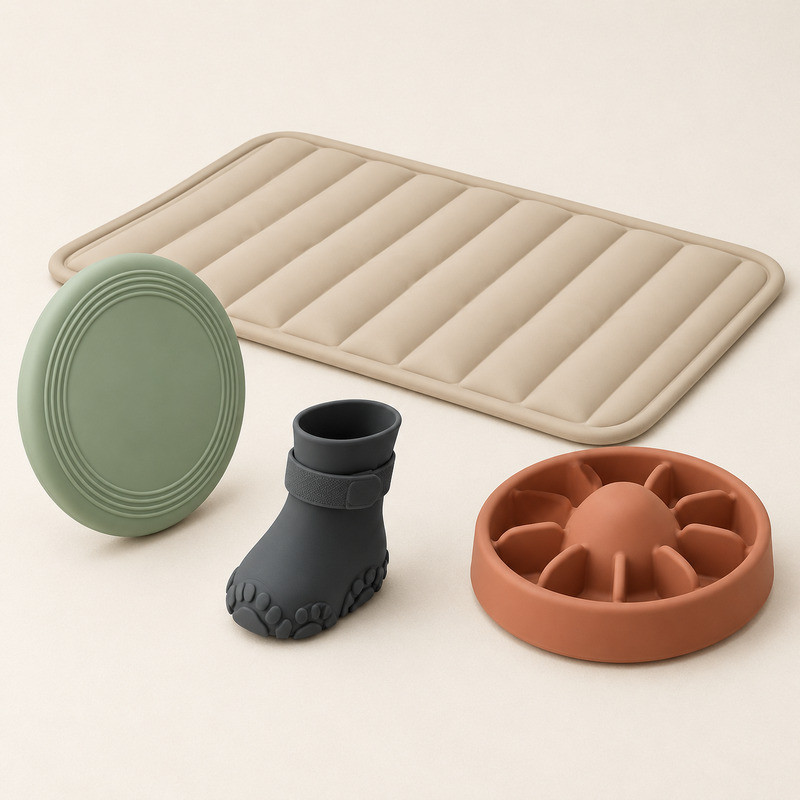
Colour consistency across repeat runs depends on retained pigment lots and a signed reference sample. Packaging consistency depends on a carton specification written from measured parts. Both are administrative controls, and both are the first thing to disappear when a factory changes its planner.
Questions to Ask Before Requesting a Custom Quote
- Existing or new mould? Which features are fixed by the current tool, and which need steel cut?
- What is included in the tooling price? Prototype tool, production tool, revisions, and who pays for a change after approval.
- Which documents come with the sample? Compound sheet, hardness reading, dimensional report and colour reference.
- How is colour reproduced on a reorder? Pigment lot retention, acceptable delta, and the light source used for approval.
- What is the inspection plan? AQL level, critical dimensions, and the appearance criteria for flash and flow marks.
- What is the real calendar? Sample date, approval date, tool date and ship date as four separate dates.
How FromRubber Approaches Custom Silicone Feeding Projects
FromRubber is the trading name of Dongguan Bohao Electronic Technology Co., Ltd., a silicone and plastic manufacturer at Jingsheng Road 122, Langxia Village, Qiaotou Town, Dongguan, working from two plants with an in-house mould shop. Its IATF 16949, ISO 9001 and ISO 14001 certificates are published on the certification download page. The useful part for a feeding project is the press mix: smaller machines for compact parts or low volumes, larger presses for big mats and high-volume runs, which means a first order of around a thousand pieces and a later bulk order can both be quoted on equipment that suits them rather than being forced onto one machine.
A project review starts with the drawing, the target animal and size, the intended market, the colour reference and the first order quantity. From that, the question is usually whether the part needs a new tool, a family tool or an existing tool with a colour change. Public pages list a quote within three hours, samples within five days and production moulds in seven to ten days, and the multi-colour silicone page sets out the dispensing and moulding setup used for colour work.
Requests can be sent to nani@fromrubber.com or karl@fromrubber.com, or by WeChat and WhatsApp on +86 18676210913. Drawings, a reference sample or a dimensioned sketch are enough to start a feasibility check. Not every design survives that check, and saying so early is cheaper than discovering it after the tool is cut.
Frequently Asked Questions
How do I choose a custom silicone pet feeding product manufacturer?
Match the supplier's published evidence to the hardest part of your design. If the difficulty is the maze, look for cleaning geometry and multi-cavity mat work. If it is the fold, look for collapsible tooling. If it is the colour, look for integrated moulding rather than printing.
Can a manufacturer develop a proprietary feeding mat or bowl?
Yes, within moulding limits. Draw ratio, wall thickness, corner radius and demoulding direction decide what is feasible. A shape that is too deep for its opening needs a different parting line or a softer compound, and that conversation belongs before the tool drawing is signed.
What information is needed for a silicone feeding product quote?
Drawing or reference sample, dimensions and usable volume, wall and base requirements, colour reference, logo artwork and position, material and market requirements, packaging format, first order quantity and target date. Without the first four, any figure is an estimate.
How should food-contact documentation be checked?
Read the report for the compound name, the colour, the part description and the test method. Then check that the report covers the market you sell into and the surface area of the actual product. A factory-level certificate is a starting point, not a product clearance.
Is a new mould necessary for every custom design?
No. Colour, logo, packaging and small dimensional changes can often run on an existing tool. A new outline, a different wall section or a new feeding pattern usually needs one. Ask which category your change falls into before comparing prices.
Sources and Notes
- Manufacturer product and process pages cited inline, reviewed 21 October 2026. Where a page states a capacity, tolerance or minimum order, the figure is reported as published by that company and has not been independently audited.
- 21 CFR 177.2600, Rubber articles intended for repeated use, electronic Code of Federal Regulations, current as of 19 October 2026.
- Regulation (EC) No 1935/2004 on materials and articles intended to come into contact with food, EUR-Lex.
- Lebensmittel- und Futtermittelgesetzbuch (LFGB), German Federal Ministry of Justice portal.
- ASTM D2240-15(2021), Standard Test Method for Rubber Property, Durometer Hardness.
- Related reading on this site: silicone pet bowl manufacturers and bowl structure, why own-brand bowls become unstable, and pet supplies manufacturing.
Scores reflect published evidence only. Buyers should confirm current tooling, capacity and certification scope directly with each company before placing an order.
A range is easier to build than to fix. Decide the shared colour, the shared hardness and the carton before the first tool is cut, then choose suppliers who can work inside those limits.
Project notes and drawings can be sent to nani@fromrubber.com or karl@fromrubber.com. WeChat and WhatsApp: +86 18676210913.