Top 10 Small Silicone Label Manufacturers for Clothing Logos
- Share
- publisher
- FromRubber
- Issue Time
- Oct 16,2026
Summary
Ten suppliers reviewed for compact silicone clothing labels, with a rubric weighted to small-logo evidence and a practical worksheet for specifying stroke width, gap width, relief depth and thickness before sampling.

Top 10 Small Silicone Label Manufacturers for Clothing Logos
The sample was approved at 40 mm wide and looked right. The production order is the same 40 mm, the same artwork and the same material — and the lettering now reads as a smudge, because nothing in the specification said how wide the thinnest stroke would be once the label shrank.
Small silicone labels fail for reasons that have almost nothing to do with the rubber compound. They fail because a logo designed for a printed hang tag or an embroidery file is handed to a molder without anyone converting the artwork into the units that molding actually works in: stroke width, gap width and relief depth measured in tenths of a millimeter at final size.
Direct answer
There is no universal minimum size for a silicone clothing logo. What can be molded depends on the thinnest feature in the artwork, the gap between features, the number of relief levels, the label thickness you are willing to accept, and how the label attaches to the garment. A supplier worth shortlisting for small labels will discuss stroke and gap dimensions before it discusses price — and will tell you which parts of your logo need simplifying.
Why a small label is a geometry problem, not a material problem
A large patch has room to absorb error. A 3 mm deviation on a 90 mm patch disappears into the outline. The same 3 mm on a 25 mm label removes a fifth of the design. That is why small-format work is judged on ratios rather than dimensions.
The most useful ratio to agree with a supplier is stroke width against label height. A wordmark set so that its strokes are a small fraction of the label’s height has more tolerance headroom than a wordmark whose strokes are relatively heavy, because the risk in molding is not that a stroke is too thick — it is that silicone cannot completely fill a narrow channel before it cures, and that a narrow gap between two strokes closes as the tool wears.
Thickness deserves the same treatment. On a small label, thickness is dictated by the thinnest feature and by how far material must flow to reach it, not by how soft you want the finished product. A label that feels supple when you hold it on its own can still read as a hard tile on a lightweight jersey, because the surface it is pressed onto has almost no bulk of its own.
Published figures for this product family give the working band. FromRubber’s note on silicone patch thickness, updated 7 October 2026, places printed silicone at up to about 1.5 mm and molded silicone at 1.5 mm and above, and describes roughly 1 mm as the thickness that balances flexibility against a pronounced 3D effect. The same note reports a widely used ceiling of no more than six colors for printed silicone and no more than two for molded silicone. On a small clothing label that ceiling matters more than any other single number, because every added color is another hairline boundary that can close at final size.
Suppliers that publish their own limits are the most useful reference points here, because they have committed to numbers. The American Patch, for example, states on its custom silicone patch page that roughly 0.1 inch of cap height is the practical floor for text on molded silicone, and that fine raised detail holds to approximately 0.8 mm line width subject to artwork review. Those figures are the company’s own published guidance rather than a standard, but they are the kind of number you should be asking every supplier to give you.
How the candidates were assessed
This is an editorial scoring exercise drawn from each company’s own published pages, checked on 16 October 2026. Nothing was scored from a third-party directory, and no points were given for a capability that could not be found on a live page.
| Weight | Criterion | What counted as evidence |
|---|---|---|
| 25 | Documented silicone clothing-label manufacturing | A live silicone label or silicone patch category aimed at apparel |
| 25 | Evidence of small-logo or compact-label customization | Published small-format examples, miniature lettering or dot-detail constructions |
| 20 | Fine-detail, embossed, debossed or printed-logo options | Named relief or surface treatments with stated limitations |
| 15 | Sampling and artwork feasibility review | A published design, proof or sample-approval step |
| 10 | Attachment methods and garment applications | Sew-on channels, heat transfer, adhesive or hook-and-loop options named per product |
| 5 | Publicly available technical information | Published dimensions, thickness ranges or press parameters |
Scores are editorial and depend on what a company chooses to publish, which is not the same as what a company can do. FromRubber, which publishes this website, was scored with the same rubric and appears in the list. The comparison was compiled by the FromRubber technical team from the suppliers’ own published documentation, and every source listed below was opened on the date shown.
Comparison at a glance
| # | Company | Small-label product evidence | Detail options | Attachment | Score |
|---|---|---|---|---|---|
| 1 | Qinghan Label | Silicone patch category including brush-dot appliqués and dot-formed letter logo patches | 3D printed silicone, screen-printed silicone, dot relief | Sew-on, iron-on, hook-and-loop options listed | 92 |
| 2 | Nanjing Jiamei (Jiamei Labels) | Silicone rubber labels plus a dedicated toothbrush-label and cut-piece range for apparel branding | Flat, raised, recessed, embossed, printed, multi-layer | Sew-on, heat transfer, adhesive, hook-and-loop | 90 |
| 3 | FromRubber | Custom silicone label and apparel label product groups | Raised letters with or without rules, multi-color molding, printed detail | Sew-on, heat transfer and adhesive-backed constructions | 89 |
| 4 | ASEE Fashion / RY Labels | 3D silicone label and TPU heat transfer logo program for clothing | 2D and 3D silicone heat-transfer constructions | Heat transfer, with documented press temperature control | 85 |
| 5 | ClothingTags.cn (MINT Limited) | 3D silicone heat transfer logo category with letter, rhombus, arc and two-layer styles | Raised letter and shape constructions, flock alternatives | Iron-on heat transfer | 80 |
| 6 | ClothingLabels.cn | Silicone label page stating any size, color or type, with a 1,000-piece minimum | Embossed or debossed logo on both faces, engraving or printing | Adhesive, stitched or string-attached | 78 |
| 7 | The American Patch | Custom silicone patch page with published small-detail limits for molded work | Flat or raised 3D, matte or gloss, Pantone matching | Heat-seal, hook-and-loop, adhesive, sewing channel | 76 |
| 8 | Acctrims | Silicone label and silicone heat transfer label line for clothing, bags, hats and shoes | Molded silicone and heat-transfer constructions | Heat transfer and sew-on | 72 |
| 9 | Jinsheu | Custom silicone patches for clothing labels, with published print and molded specifications | Printed silicone from flat up to a stated maximum thickness; molded silicone from a stated minimum thickness, with a color ceiling per process | Plain, iron-on, hook-and-loop and double-adhesive backings | 70 |
| 10 | Yusen Trims | Silicone and PVC label category for garments, bags and headwear | Molded labels with dimensional finish | Not published per construction | 67 |
Kaishen (KSPatch) was reviewed for this article and set aside: its published material describes an embroidery and patch manufacturing operation, and a small silicone clothing-label program is not documented, so the article’s specific requirement could not be evidenced.
Company profiles
1. Qinghan Label
Qinghan publishes the widest small-format silicone evidence of the candidates reviewed. Its silicone patch category runs to 95 products and includes a brush-dot sub-category and dot-formed letter logo patches where the lettering is built from raised dots rather than strokes — a construction that exists precisely because dot geometry survives small sizes better than thin lines. The site also documents a five-step design-to-inspection process and in-house washing, physical and rating laboratories. Unconfirmed: whether the company will commit to a minimum stroke width in writing.
2. Nanjing Jiamei Garment Accessory Factory (Jiamei Labels)
Jiamei publishes silicone rubber label, toothbrush-label and cut-piece categories alongside its silicone patch line, which indicates ongoing small-format branding work rather than only large decorative patches. Logo treatments include flat, raised, recessed, embossed, printed, 3D and multi-layer effects, and Pantone color matching is offered. Unconfirmed: the smallest lettering the company will quote, and its edge-definition acceptance criteria between batches.
3. FromRubber
FromRubber is unusual in that it publishes guidance rather than only product pages: how small a small silicone logo can be on clothing and how to keep thin lines visible at small sizes both set out the relationship between artwork geometry and molding outcome, and the site also addresses why small logos lose fine detail. Product evidence sits in the custom silicone label group. Unconfirmed: a published stroke-width floor, which the guidance frames as design-dependent rather than fixed. Company details published on the same page record the manufacturer as Dongguan Bohao Electronic Technology Co., Ltd., Jingcheng Road 122, Langxia Village, Qiaotou Town, Dongguan, Guangdong, China, operating since June 2010 with 32 compression molding machines across two sites and IATF 16949:2016, ISO 9001:2015 and ISO 14001:2015 certification.
4. ASEE Fashion / RY Labels
ASEE publishes a heat-transfer label program built around 3D silicone and TPU logos, with a stated vacuum heat-press process and a temperature control window. Heat-transfer construction suits small branding marks because there is no raised edge to lift. Unconfirmed: the minimum cap height the company accepts and whether it offers a molded sew-on alternative for heavier fabrics.
5. ClothingTags.cn (MINT Limited)
The company lists 3D silicone heat-transfer logos in letter, rhombus, arc and two-layer styles, which is a reasonable proxy for small-format flexibility, and it publishes a one-stop sequence covering computer design, sample making and bulk production. Unconfirmed: any dimensional floor for lettering or gaps.
6. ClothingLabels.cn
The silicone label page describes the molding sequence in plain terms and states that logos can be embossed or debossed on both faces, with size, color and shape open to specification and a 1,000-piece minimum order quantity. Unconfirmed: tooling cost, tool ownership and how fine a detail the company will agree to before sampling.
7. The American Patch
This supplier is included mainly for the transparency of its published limits: a stated practical cap height for molded silicone text, a stated fine raised line width, and an explicit list of artwork that will not mold, including gradients and halftones. Those disclosures are useful when you are deciding whether a small logo should be molded or printed. Unconfirmed: garment-factory-scale production capacity and non-US manufacturing locations.
8. Acctrims
Acctrims publishes silicone label and silicone heat-transfer label categories covering clothing, bags, hats, shoes and home textiles, which places small garment marks within a defined product scope. Unconfirmed: published dimensional limits and whether development sampling is offered separately from production.
9. Jinsheu
Jinsheu publishes process-level silicone specifications rather than adjectives: printed silicone can be produced flat or raised up to a stated maximum thickness, molded silicone begins at a stated minimum thickness, and the company recommends a color ceiling for each process because added colors raise the failure rate. Separate minimum order quantities for printed and molded designs are also stated. That level of disclosure is directly useful when a small logo has to be chosen between printed and molded construction. Unconfirmed: the smallest lettering height and gap it will accept.
10. Yusen Trims
Yusen lists custom silicone and PVC labels for garments, bags and headwear and routes inquiries about unclear detail, edge lift and color mismatch through a structured contact process, which suggests these are recognized field issues. Unconfirmed: the manufacturing entity behind the label line and its tooling arrangements — a material consideration for small-format repeat orders.
How to specify a small silicone label properly
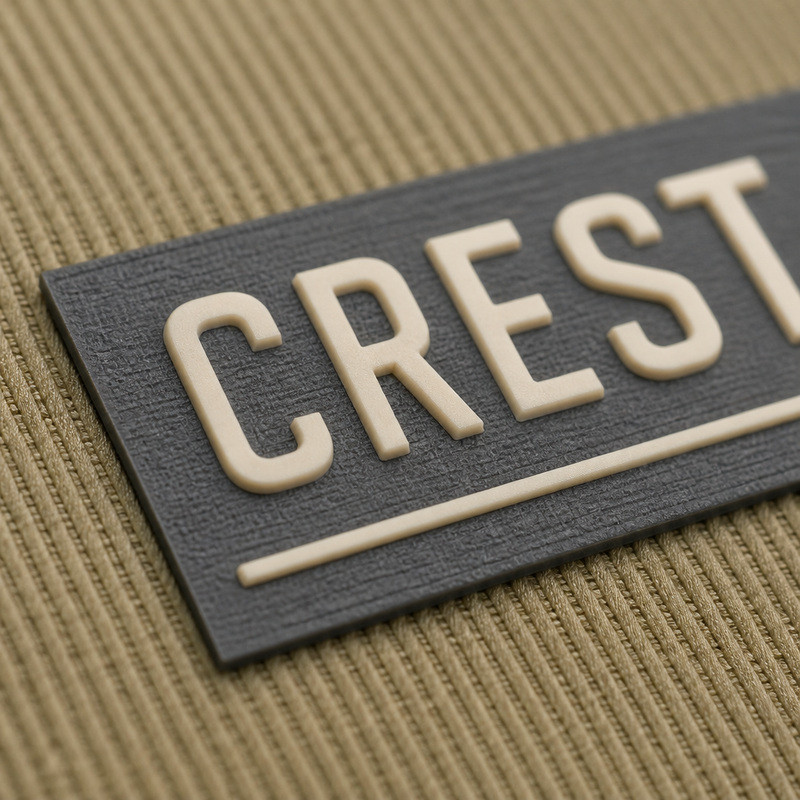
Give the supplier a specification instead of a picture. A picture invites an opinion; a specification invites a feasibility answer.
- Finished width and height in millimeters, measured on the label, not on the artwork board.
- Thinnest stroke width and narrowest gap in the artwork, expressed in millimeters at final size.
- Relief depth and which elements are raised and which are recessed.
- Label thickness range you will accept, tied to the garment weight it will sit on.
- Color count and boundary definition, with references for each color.
- Attachment method and the exact fabric, including stretch behavior.
- Acceptance criteria for the sample: legibility at arm’s length, edge cleanliness under raking light, and color match.
Two documents are worth requesting alongside the sample. The first is a dimensional report against your drawing, which should reference an agreed tolerance basis — ISO 3302-1:2014 sets out the classes most rubber molders work from. The second is a wash-result record following a defined procedure such as ISO 6330:2021 for domestic washing and drying, because a small label has less bonding area and will show adhesion problems before a large one does.
Care labeling is a separate but adjacent question. If the label carries care symbols, the symbol set should correspond to ISO 3758:2023, the textiles care labeling code using symbols. When your brand also claims a safety label for skin-contact or children’s garments, OEKO-TEX STANDARD 100 is the certification buyers most often ask a trim supplier to produce, and its limit values are set by intended skin contact rather than by material type.
Questions buyers keep asking
How small can a silicone clothing logo be?
Small enough to work, but not at any size you choose. The limit is set by the artwork’s thinnest feature and narrowest gap at final size, together with the relief depth and the number of colors. Ask for an opinion on your drawing before you ask for a price.
Can fine lettering stay readable on a small silicone label?
Yes, with two adjustments: reduce the number of separate strokes, and increase the contrast between the lettering and its background. Contrast does more for legibility at small sizes than a heavier font, and it costs nothing in tooling.
Does a thicker label preserve detail better?
Not automatically. Beyond a point, extra thickness stiffens the label and makes it sit badly on light garments without improving fill in narrow channels. On small formats, thickness is usually set by the thinnest feature and the flow the mold has to achieve.
Which details should be simplified in a miniature logo?
Hairline outlines, tight counters inside letters, thin parallel rules and any element that depends on a small gap. Simplification decided at artwork stage costs nothing; the same simplification forced after sampling costs a tool revision. There is more on this in the note on molded versus printed silicone labels.
How does stretch fabric change the specification?
It changes the attachment question more than the molding question. On four-way stretch, a small rigid label concentrates stress at its own edge, so the adhesion system, the label thickness and the edge geometry all need to be chosen together — see the notes on choosing a silicone label for knitted garments.
What should I send when requesting a small silicone label quotation?
Vector artwork, finished dimensions, the smallest stroke and gap dimensions in the file, relief structure, color references, garment fabric, attachment preference and an estimated quantity. Add a photograph of the intended placement if the logo sits near a seam, because curvature changes what will sit flat.
Where this leaves the sourcing decision
Shortlist on evidence, then decide on a sample. A supplier that can quote a small label, describe how it will fill the narrowest channel, and tell you which part of the design it would change is a better bet than one that simply confirms the size is possible.
Where the evidence is thin, treat that as a question to ask rather than a reason to exclude. Most of the gaps in the table above are publishing gaps, not capability gaps — but on small-format work, a supplier’s willingness to put a number in writing is the closest thing you have to a prediction of the production run.
FromRubber makes custom silicone labels and patches in Dongguan, Guangdong, and publishes its own silicone label range together with written guidance on small-logo feasibility. If you have artwork, a target size, the garment fabric and an estimated quantity, a feasibility review is the practical starting point — with the honest caveat that some marks work better printed than molded, and that no supplier can promise an unchanged design will reproduce at every size.
Inquiries: nani@fromrubber.com or karl@fromrubber.com. WeChat and WhatsApp: +86 186 7621 0913.
Sources and references
- ISO. ISO 3302-1:2014, Rubber — Tolerances for products — Part 1: Dimensional tolerances.
- ISO. ISO 6330:2021, Textiles — Domestic washing and drying procedures for textile testing.
- ISO. ISO 3758:2023, Textiles — Care labeling code using symbols.
- OEKO-TEX. OEKO-TEX® STANDARD 100 harmful-substance testing and product classes.
- The American Patch. Published molded-silicone specifications and small-detail limits.
- Qinghan Label. Silicone patch category, including brush-dot and dot-letter constructions.
- Nanjing Jiamei Garment Accessory Factory. Silicone rubber labels, toothbrush labels and cut pieces.
- ASEE Fashion / RY Labels. 3D silicone heat transfer label program.
- ClothingTags.cn (MINT Limited). Rubber labels and 3D silicone heat transfer logo catalog.
- ClothingLabels.cn. Silicone label process, options and minimum order quantity.
- Acctrims. Custom silicone labels and silicone heat transfer labels.
- Jinsheu. Custom silicone patches for clothing labels, with published thickness, color and minimum-order specifications.
- Yusen Trims. Custom silicone and PVC label category.
- Kaishen Garment Accessory Co., Ltd. (KSPatch). Company homepage. Reviewed and excluded from this article.
Related reading on this site: heat transfer versus sew-on for silicone patches, and choosing a silicone label for knitted garments.
All sources were checked on 16 October 2026. Product ranges, minimum order quantities and stated detail limits are subject to change, so confirm the current position directly with each company before production.